
Beranda » Produk » Field Devices instruments » Lens Antenna Technology in Radar Level Sensors
Lens Antenna Technology in Radar Level Sensors
Pendahuluan
Lens Antenna technology is one of the most important microwave focusing technologies used in modern high-frequency radar level sensors.
As industrial radar systems evolved from traditional low-frequency radar architectures toward modern 80GHz and 120GHz microwave systems, antenna technology became increasingly critical for improving signal focusing capability, obstacle suppression performance, and measurement precision.
The true value of Lens Antenna technology lies in how microwave focusing technology improves:
- Beam concentration
- Signal directionality
- Weak echo detection
- Obstacle avoidance
- False echo suppression
- Compact antenna design
Modern radar level sensors are no longer limited by microwave generation capability alone. Instead, antenna engineering has become one of the key technologies determining overall radar performance.
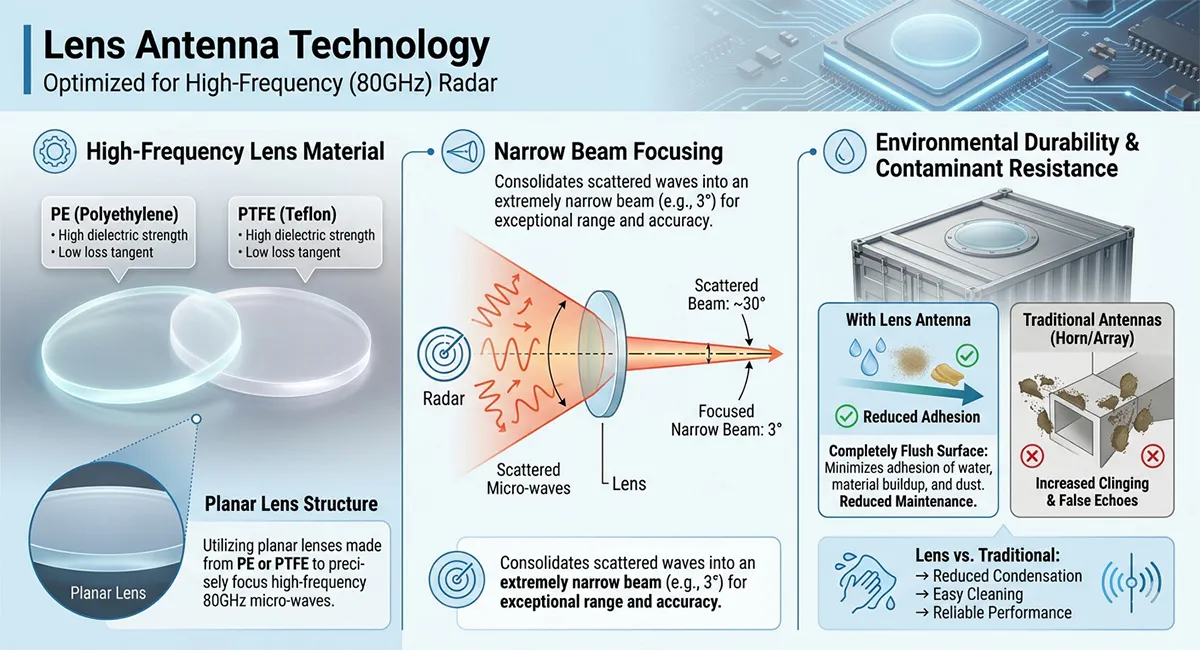
In modern high-frequency radar systems such as 80GHz radar level sensors, flat lens antennas made from PE (Polyethylene) or PTFE (Polytetrafluoroethylene) are now widely adopted because they provide extremely narrow beam angles while improving resistance to condensation, buildup, and dust accumulation.
1. History and Development of Lens Antenna Technology
Early radar level sensors mainly used:
- Horn antennas
- Rod antennas
- Parabolic microwave structures
These traditional antenna systems were effective for low-frequency radar technologies such as 6GHz and 26GHz radar systems, but they also had several engineering limitations:
- Large antenna size
- Wide beam angles
- Limited obstacle rejection
- Larger blind zones
- Installation limitations
As microwave semiconductor technology advanced, radar systems gradually evolved toward higher frequencies such as:
- 80GHz radar
- 120GHz radar
- Millimeter-wave radar
Higher-frequency microwaves enabled engineers to miniaturize antenna structures while simultaneously improving beam focusing capability.
This evolution created the need for compact microwave lens technologies capable of precisely controlling electromagnetic wave propagation.
Industrial automation companies such as VEGA, Endress+Hauser, Siemens, dan Emerson played important roles in commercializing lens antenna technologies for industrial radar level sensing.
Today, lens antennas have become one of the defining technologies behind modern compact 80GHz radar level sensors.
2. Core Technical Principle of Lens Antenna Technology
Lens Antenna technology works by controlling microwave propagation using dielectric focusing materials.
In high-frequency radar systems such as 80GHz radar, flat lens antennas made from PE (Polyethylene) or PTFE (Polytetrafluoroethylene) are commonly used.
The lens structure acts similarly to an optical lens by focusing scattered microwave energy into a highly concentrated microwave beam.
This allows the radar system to generate extremely narrow beam angles such as:
- 3°
- 4°
- 5°
depending on antenna size and radar frequency.
The microwave focusing principle can be conceptually represented as:
θ∝λ/D
Dimana:
- θ = beam angle
- λ = microwave wavelength
- D = antenna aperture size
As microwave frequency increases, wavelength becomes shorter, allowing the antenna to generate much narrower microwave beams.
This is one of the major reasons why modern 80GHz radar systems can achieve extremely focused microwave transmission.
3. Why Lens Antenna Technology Became Important in 80GHz Radar
The transition toward 80GHz radar technology dramatically increased the importance of antenna focusing capability.
Higher-frequency radar systems generate shorter microwave wavelengths, which enables:
- Stronger beam focusing
- Smaller antenna structures
- Higher signal resolution
- Better obstacle rejection
However, these advantages can only be fully utilized when combined with advanced antenna technologies such as lens antennas.
Without effective microwave focusing, high-frequency radar systems would suffer from:
- Signal dispersion
- Weak echo instability
- Increased false reflections
- Reduced measurement accuracy
Lens antenna technology enables high-frequency microwave energy to remain concentrated and stable during transmission and reception.
4. Advantages of Lens Antenna Technology
Extremely Narrow Beam Angles
One of the biggest advantages of lens antennas is the ability to generate extremely narrow microwave beams.
Modern lens antennas can achieve beam angles as small as:
- 3°
- 4°
This allows radar signals to avoid:
- Tank walls
- Internal pipes
- Agitators
- Structural supports
- Ladders
As a result, obstacle interference is greatly reduced.
Improved Measurement Stability
Because the microwave beam is highly concentrated, the radar system can focus more directly on the target surface.
This improves:
- Echo clarity
- Weak signal detection
- False echo suppression
- Stabilitas pengukuran
especially in narrow or complex industrial vessels.
Compact Antenna Design
Traditional horn antennas often required relatively large physical structures.
Lens antennas allow modern radar sensors to become:
- Smaller
- Lighter
- Easier to install
- More adaptable to compact tanks
This is especially important for hygienic and sanitary industrial applications.
Flat Flush Antenna Surface
In high-frequency radar systems such as 80GHz radar level sensors, flat lens antennas made from PE (Polyethylene) or PTFE (Polytetrafluoroethylene) are widely used.
The antenna surface remains completely flush and flat, which significantly reduces:
- Condensation buildup
- Material adhesion
- Dust accumulation
- Surface contamination
Compared with deep horn structures, flat lens antennas are much less likely to trap process residue or condensed moisture.
This greatly improves long-term operational stability.
5. PE and PTFE Lens Materials
Material selection is extremely important in lens antenna engineering because the material directly affects microwave transmission performance.
PE (Polyethylene)
PE materials are widely used because they provide:
- Good microwave transparency
- Low dielectric loss
- Stable microwave propagation
- Good mechanical performance
PE lens antennas are commonly used in standard industrial radar applications.
PTFE (Polytetrafluoroethylene)
PTFE materials provide additional advantages such as:
- Excellent chemical resistance
- Extremely low surface adhesion
- Strong temperature resistance
- Better anti-stick performance
PTFE lens antennas are especially suitable for:
- Corrosive environments
- Sticky process media
- Hygienic applications
- High-condensation conditions
6. Technical Challenges of Lens Antenna Technology
Although lens antenna technology provides major performance advantages, it also introduces engineering challenges.
Sensitivity to Surface Moisture
High-frequency microwaves are highly sensitive to:
- Water films
- Condensation droplets
- Crystallization
- Surface contamination
Even thin moisture layers on the lens surface can partially absorb or scatter microwave signals.
This may reduce:
- Echo strength
- Stabilitas sinyal
- Measurement reliability
Precision Manufacturing Requirements
Lens antenna performance strongly depends on:
- Surface geometry
- Material consistency
- Microwave transparency
- Manufacturing precision
Small production deviations may affect microwave focusing capability and beam stability.
As radar frequencies continue increasing toward 120GHz systems, manufacturing precision becomes even more critical.
7. Fresnel-Based Lens Antenna Innovation
As radar level sensing technologies continue evolving toward higher-frequency millimeter-wave systems, internal microwave reflections inside dielectric lens structures have become an increasingly important engineering challenge.
Traditional ellipsoidal dielectric lens antennas provide excellent beam focusing capability, but unwanted internal reflections can negatively affect:
- Near-distance measurement stability
- Weak echo detection
- Blind zone performance
- Signal clarity
This issue becomes more critical in compact high-frequency radar systems operating at:
- 80GHz
- 120GHz
- Millimeter-wave frequencies
To address these limitations, researchers have begun developing advanced Fresnel-based dielectric lens antenna technologies.
According to the paper:
Detailed analysis of Fresnel-based lens antennas with reduced antenna reflections for millimeter wave radars
Published in 2026 by Cambridge University Press in association with The European Microwave Association.
the researchers proposed:
“a Fresnel-based design of a far-field dielectric lens antenna.”
The paper states:
“The proposed approach effectively reduces internal reflections, preserves the excellent antenna characteristics of conventional ellipsoidal lens antennas, and increases the usable near-distance measurement range for TLPR applications.”
This represents an important technological evolution in radar antenna engineering because internal microwave reflections are one of the major factors limiting short-range radar measurement accuracy.
The study further demonstrated that:
“Measurements validate the design and demonstrate the reduction of internal reflections by more than 13 dB, leading to an increased measurement range in a Tank Level Probing Radar scenario and a size and weight reduction of 41% and 34%, respectively.”
From an industrial radar perspective, these improvements are highly significant.
Why Reducing Internal Reflections Matters
Internal microwave reflections inside the antenna structure can create:
- False echoes
- Near-range interference
- Blind zone enlargement
- Signal distortion
This is especially problematic in:
- Small tanks
- Compact vessels
- Short measuring distances
- High-precision applications
By reducing internal reflections, Fresnel-based lens antennas can significantly improve:
- Near-distance measurement capability
- Echo clarity
- Small tank measurement accuracy
- Weak signal stability
Advantages of Fresnel-Based Lens Antennas
Compared with traditional ellipsoidal dielectric lens antennas, Fresnel-based designs may provide:
- Lower internal microwave reflections
- Smaller antenna size
- Reduced antenna weight
- Improved near-field measurement performance
- Better compact radar integration
The reduction of antenna size and weight is particularly important for:
- Compact radar sensors
- Hygienic process installations
- Small process connections
- Lightweight industrial equipment
Future Importance in 120GHz Radar Systems
As industrial radar technologies continue evolving toward:
- 120GHz radar
- Millimeter-wave sensing
- Ultra-narrow beam architectures
antenna reflection control will become increasingly important.
Future high-frequency radar systems may increasingly utilize:
- Fresnel dielectric lens structures
- Meta-material microwave surfaces
- AI-assisted antenna optimization
- Adaptive beam shaping technologies
to further improve radar performance under complex industrial conditions.
8. How Lens Antenna Technology Enhances Instrument Functions
Lens antenna technology directly determines many important capabilities of modern radar level sensors.
Narrow Beam Focusing Enables Obstacle Avoidance
The focused microwave beam allows radar sensors to operate reliably in tanks containing:
- Pipes
- Agitators
- Internal structures
- Heating coils
This significantly improves installation flexibility.
Flat Antenna Design Improves Operational Reliability
The flush lens surface reduces buildup and contamination, improving:
- Long-term stability
- Maintenance intervals
- Measurement consistency
This is especially valuable in dusty or condensing environments.
Compact Design Enables Smaller Radar Sensors
Lens antennas allow modern radar sensors to become increasingly compact while maintaining high microwave performance.
This supports:
- Small process connections
- Hygienic tank installations
- Compact industrial equipment
9. Industry 4.0 Evolution of Lens Antenna Technology
In the Industry 4.0 era, lens antenna technology is evolving together with intelligent radar sensing systems.
Modern radar sensors increasingly combine lens antennas with:
- AI-assisted echo analysis
- Intelligent DSP processing
- Adaptive signal filtering
- Remote diagnostics
- Pemeliharaan prediktif
- Cloud monitoring
The antenna is no longer simply a passive microwave component. It is becoming part of an integrated intelligent sensing architecture.
AI-Assisted Signal Optimization
Future radar systems may automatically compensate for:
- Surface condensation
- Signal attenuation
- Microwave scattering
- Antenna contamination
using AI-assisted signal processing algorithms.
10. Future Development Trends of Lens Antenna Technology
Future lens antenna technologies are expected to evolve toward:
- Higher-frequency microwave systems
- Smaller antenna structures
- Meta-material microwave lenses
- Adaptive beam steering
- Self-cleaning antenna surfaces
- AI-optimized microwave focusing
Future radar systems may dynamically adjust beam characteristics according to:
- Tank geometry
- Process conditions
- Surface behavior
- Environmental interference
This could significantly improve autonomous industrial sensing capability.
Kesimpulan
Lens Antenna technology has become one of the core technologies behind modern high-frequency radar level sensors.
The true value of lens antennas lies in how microwave focusing technology improves:
- Beam concentration
- Obstacle rejection
- Stabilitas sinyal
- Compact radar design
- Weak echo detection
- Environmental adaptability
The widespread adoption of PE and PTFE flat lens antennas in 80GHz radar systems has enabled extremely narrow beam angles while significantly reducing problems related to condensation, material buildup, and dust accumulation.
Meanwhile, emerging Fresnel-based dielectric lens technologies are further improving:
- Internal reflection suppression
- Near-distance measurement capability
- Compact radar integration
- Millimeter-wave sensing performance
As Industry 4.0 technologies continue advancing, lens antenna technology is expected to become increasingly intelligent, adaptive, and integrated with AI-assisted microwave sensing architectures.
Rekomendasi Produk Terkait
What is a lens antenna in radar level sensors?
A lens antenna is a microwave focusing structure that concentrates radar signals into a narrow beam for improved measurement accuracy and obstacle rejection.
Why are lens antennas used in 80GHz radar systems?
80GHz radar systems require highly focused microwave beams. Lens antennas allow narrow beam angles, compact antenna size, and improved signal stability.
What materials are commonly used in lens antennas?
Modern radar lens antennas commonly use:
- PE (Polyethylene)
- PTFE (Polytetrafluoroethylene)
because of their excellent microwave transparency and chemical resistance.
What are Fresnel-based lens antennas?
Fresnel-based lens antennas are advanced dielectric lens structures designed to reduce internal microwave reflections while improving compactness and near-distance radar performance.
What are the advantages of flat lens antennas?
Flat lens antennas reduce:
- Condensation buildup
- Dust accumulation
- Material adhesion
- Surface contamination
while improving long-term operational stability.
How will lens antenna technology evolve in the future?
Future lens antenna technologies are expected to integrate:
- Fresnel dielectric structures
- AI-assisted signal optimization
- Adaptive beam control
- Self-cleaning surfaces
- Meta-material microwave lenses
to improve industrial sensing performance and automation capability.
Mengapa Memilih Instrava
Dibangun di atas Konsistensi, Bukan Klaim
Berfokus pada Aplikasi Industri
Kami mengkhususkan diri dalam analisis dan deteksi industri, dengan pemahaman yang jelas tentang lingkungan dan persyaratan operasi dunia nyata.
Kriteria Pemilihan Produk yang Ketat
Setiap instrumen dievaluasi berdasarkan performa, stabilitas, dan kesesuaian aplikasi-bukan hanya spesifikasi atau harga.
Konsistensi Pasokan & Kualitas yang Dapat Diandalkan
Kami bekerja sama dengan produsen tepercaya untuk memastikan pasokan yang stabil, kualitas yang konsisten, dan pengiriman yang dapat diandalkan.
Dukungan Praktis dan Berbasis Pengalaman
Rekomendasi kami didasarkan pada pemahaman aplikasi, membantu pelanggan menghindari masalah umum dan mencapai hasil yang dapat diandalkan.
Instrava dibuat untuk mengurangi ketidakpastian-sehingga setiap keputusan yang Anda buat menjadi lebih jelas, aman, dan dapat diandalkan.