
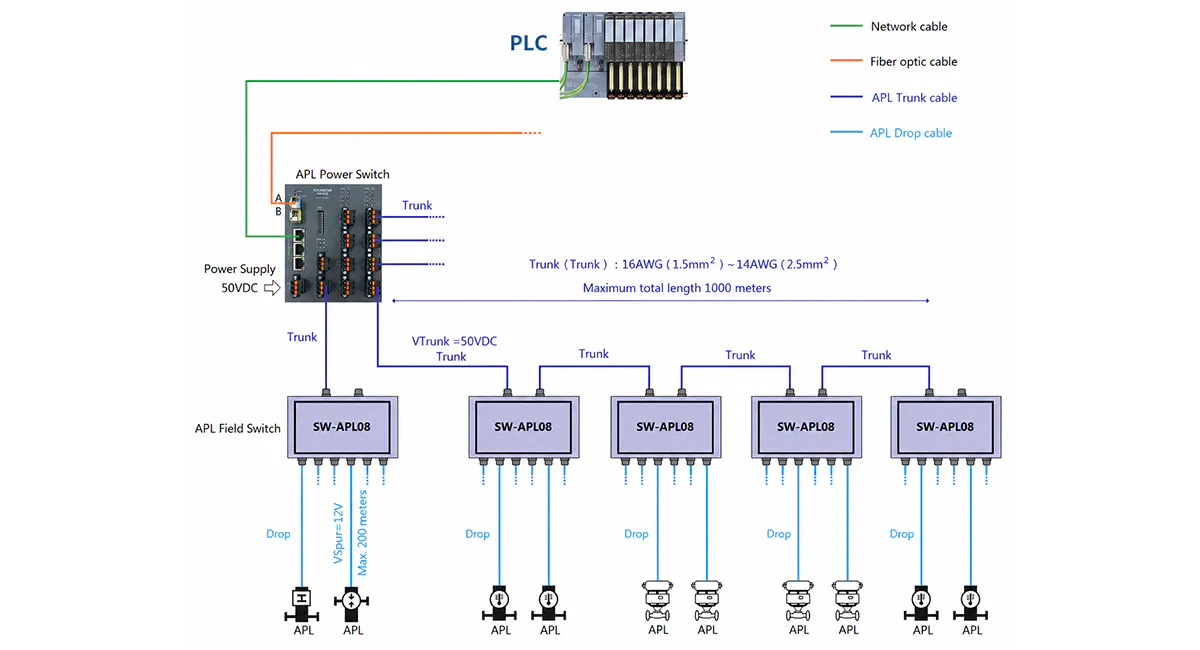
Teknologi Ethernet-APL dalam Industri 4.0
Pendahuluan
Ethernet-APL (Advanced Physical Layer) adalah salah satu teknologi komunikasi terpenting yang mendorong transformasi digital sistem otomasi proses.
Teknologi fieldbus industri tradisional seperti:
- HART
- PROFIBUS PA
- Yayasan Fieldbus
pada awalnya dirancang untuk lingkungan komunikasi industri dengan bandwidth rendah. Meskipun teknologi ini menyediakan komunikasi proses yang andal selama bertahun-tahun, teknologi ini semakin sulit untuk memenuhi persyaratan data arsitektur Industri 4.0 modern.
Nilai sebenarnya dari teknologi Ethernet-APL terletak pada kemampuan komunikasi Ethernet industri berkecepatan tinggi:
- Akses data industri secara real-time
- Komunikasi lapangan dengan bandwidth tinggi
- Integrasi perangkat cerdas
- Diagnostik tingkat lanjut
- Komputasi tepi
- Konektivitas awan
- Komunikasi sensor-ke-pengontrol yang aman
Instrumentasi industri modern tidak lagi terbatas pada transmisi variabel proses sederhana. Ethernet-APL mengubah perangkat lapangan menjadi simpul data industri cerdas yang mampu mendukung sistem otomasi digital tingkat lanjut.
Ethernet-APL adalah salah satu bagian dari teka-teki untuk jaringan yang terkonvergensi, yang mendukung berbagai protokol waktu nyata seperti PROFINET, EtherNet/IP, HART-IP, serta protokol middleware OPC UA.
1. Sejarah dan Perkembangan Teknologi Ethernet-APL
Pengembangan teknologi Ethernet-APL didorong oleh meningkatnya kebutuhan untuk membawa Ethernet industri secara langsung ke dalam lingkungan otomasi proses yang berbahaya.
Teknologi Ethernet tradisional menghadapi beberapa keterbatasan dalam industri proses karena infrastruktur Ethernet standar tidak dirancang untuk itu:
- Jarak kabel yang jauh
- Lingkungan yang aman secara intrinsik
- Instrumentasi lapangan dua kabel
- Kondisi industri yang keras
Seiring perkembangan arsitektur Industri 4.0, sistem otomasi industri membutuhkan lebih banyak data dari perangkat lapangan daripada yang dapat disediakan oleh sistem fieldbus tradisional.
Untuk mengatasi keterbatasan ini, “Proyek APL” didirikan pada tahun 2018.
Perjanjian untuk mengembangkan teknologi Ethernet-APL di bawah “Proyek APL” didirikan pada tahun 2018 dan didukung oleh organisasi pengembangan standar industri (SDO) terkemuka:
- Grup FieldComm
- ODVA
- Yayasan OPC
- PROFIBUS & PROFINET International
Proyek ini juga didukung oleh perusahaan-perusahaan otomasi industri besar termasuk:
- ABB
- Emerson
- Endress + Hauser
- Krohne
- Pepperl + Fuchs
- Kontak Phoenix
- R. Stahl
- Otomasi Rockwell
- Samson
- Siemens
- VEGA
- Yokogawa
Ethernet-APL secara khusus dirancang untuk menghadirkan kemampuan Ethernet ke dalam instrumentasi bidang proses sambil mempertahankannya:
- Keamanan intrinsik
- Komunikasi jarak jauh
- Operasi dua kabel
- Integrasi daya dan komunikasi
Saat ini, Ethernet-APL menjadi salah satu teknologi pendukung utama di balik otomatisasi proses digital.
2. Prinsip Teknis Inti dari Ethernet-APL
Ethernet-APL didasarkan pada teknologi Single Pair Ethernet (SPE) yang dioptimalkan untuk lingkungan otomasi proses.
Teknologi ini memungkinkan:
- Pengiriman daya
- Komunikasi Ethernet
- Transmisi jarak jauh
melalui satu kabel dua kawat.
Tidak seperti arsitektur Ethernet tradisional yang membutuhkan banyak pasangan kabel dan jarak kabel yang relatif pendek, Ethernet-APL dioptimalkan untuk:
- Kabel industri yang panjang
- Area berbahaya
- Instalasi yang aman secara intrinsik
- Instrumentasi tingkat lapangan
Kecepatan komunikasi Ethernet-APL adalah:
10 Mbit/s10\ \mathrm{Mbit/s}10 Mbit/s
Kecepatan data ini merupakan lompatan teknologi besar dibandingkan dengan teknologi fieldbus proses tradisional.
3. Mengapa Ethernet-APL Merupakan Peningkatan Teknologi Utama
Sistem fieldbus proses tradisional terutama dirancang untuk mentransmisikan variabel proses dasar seperti:
- Tekanan
- Suhu
- Tingkat
- Aliran
Namun, sistem Industri 4.0 modern semakin membutuhkan:
- Diagnostik resolusi tinggi
- Pemantauan kesehatan perangkat
- Data pemeliharaan prediktif
- Analisis tingkat lanjut
- Konfigurasi jarak jauh
- Pemantauan aset secara real-time
Teknologi fieldbus berkecepatan rendah tradisional berjuang untuk mendukung persyaratan canggih ini.
4. Ethernet-APL vs PROFIBUS PA dan HART
Menurut Toni Mertala dalam:
APLIKASI ETHERNET -TEKNIIKAN KECEPATAN 800XA-JÄRJESTELMÄSSÄ JA PA-LAITTEIDEN INTEGROIMINEN-THESEUS
Ethernet APL: kecepatan tertinggi 10 mbit/s pada kecepatan 300 kbps pada Profibus PA: kecepatan tertinggi dan HART: kecepatan tertinggi.
Dari perspektif otomatisasi proses, ini adalah terobosan teknologi yang besar.
Sistem HART dan PROFIBUS PA tradisional tidak pernah dirancang untuk mentransmisikan data diagnostik dan operasional dalam jumlah besar secara terus menerus.
Bandwidth Ethernet-APL yang jauh lebih tinggi memungkinkan perangkat lapangan untuk melakukan transmisi:
- Diagnostik tingkat lanjut
- Informasi status perangkat
- Analisis proses
- Data bentuk gelombang
- Informasi pemeliharaan prediktif
- Pembaruan pengukuran frekuensi tinggi
secara real time.
Tesis tersebut lebih lanjut menyatakan:
“Ethernet APL:n tidak memiliki ikatan yang kuat dengan perangkat lain, sehingga tidak ada yang dapat digunakan, tidak ada yang dapat digunakan.”
Hal ini mencerminkan salah satu keunggulan inti teknologi Ethernet-APL:
Instrumentasi lapangan tidak lagi terbatas pada transmisi pengukuran sederhana. Perangkat menjadi sumber informasi industri yang cerdas.
Artikel tersebut juga menyatakan:
“Prosessiteollisuudessa tällä hetkellä käytettävät Profibus PA -kenttälaitteet eivät mahdollista tämän lisätiedon hyödyntämistä.”
Hal ini menyoroti keterbatasan utama sistem fieldbus tradisional di lingkungan Industri 4.0.
Akhirnya, tesis ini menyimpulkan:
“Teknologi Ethernet APL yang telah menjadi bagian dari Profibus PA -teknologi yang telah terbukti dan terbukti sebagai teknologi yang paling efektif dan efisien.”
Dari perspektif evolusi teknologi, Ethernet-APL mewakili transisi dari:
- Komunikasi lapangan tradisional
- Instrumentasi bandwidth rendah
- Jaringan proses yang terisolasi
ke arah:
- Arsitektur Ethernet Terpadu
- Pabrik digital yang cerdas
- Ekosistem data industri waktu nyata
5. Dukungan Protokol Industri Waktu Nyata
Salah satu kekuatan terpenting dari Ethernet-APL adalah kemampuan konvergensi protokol.
Ethernet-APL mendukung beberapa protokol komunikasi industri secara bersamaan, termasuk:
- PROFINET
- EtherNet/IP
- HART-IP
- OPC UA
Hal ini memungkinkan pabrik proses untuk membangun infrastruktur Ethernet industri terpadu yang mampu berintegrasi:
- Instrumentasi lapangan
- Pengontrol
- Sistem SCADA
- Platform cloud
- Perangkat tepi
- Sistem manajemen aset
Dukungan OPC UA sangat penting, karena memungkinkan:
- Interoperabilitas industri standar
- Pertukaran data yang aman
- Integrasi IIoT yang dapat diskalakan
- Komunikasi lintas platform
6. Tantangan Keamanan Siber di Jaringan Ethernet-APL
Karena Ethernet-APL secara langsung menghubungkan perangkat lapangan ke jaringan pabrik berbasis Ethernet, keamanan siber menjadi semakin penting.
Menurut:
Niemann, Karl-Heinz, dan Simon Merklin. 2022.
“Persyaratan keamanan OT untuk perangkat lapangan EthernetAPL: Perubahan teknologi dapat menghasilkan perlindungan yang lebih baik.”
atp Magazin 63 (5).
makalah ini menunjukkan bahwa perangkat lapangan Ethernet-APL dapat mengalami serangan potensial.
Koran tersebut menyatakan:
“Struktur jaringan datar menawarkan penyerang akses yang relatif mudah ke perangkat, karena terhubung langsung ke jaringan pabrik.”
Tidak seperti sistem fieldbus tradisional yang terisolasi, perangkat Ethernet-APL beroperasi di dalam infrastruktur Ethernet industri yang sangat terhubung.
Hal ini sangat meningkatkan pentingnya:
- Segmentasi jaringan
- Otentikasi
- Enkripsi
- Perlindungan integritas perangkat
- Protokol komunikasi yang aman
Persyaratan Komunikasi yang Aman
Makalah ini menjelaskan lebih lanjut:
“Oleh karena itu, komunikasi yang aman akan dibutuhkan untuk perangkat Ethernet-APL.”
dan:
“Persyaratan keamanan untuk komponen otomasi, seperti yang dijelaskan dalam IEC 62443-4-2 juga berlaku untuk perangkat APL.”
Ini berarti perangkat lapangan Ethernet-APL harus diperlakukan dengan cara yang sama:
- Pengontrol
- Sistem I/O jarak jauh
- Infrastruktur jaringan industri
daripada instrumen lapangan pasif yang sederhana.
Integritas Data Sensor-ke-Pengontrol
Salah satu keunggulan teknologi yang paling penting dari Ethernet-APL adalah kemampuan komunikasi end-to-end yang aman.
Koran tersebut menyatakan:
“Dengan menggunakan protokol komunikasi yang aman, untuk pertama kalinya dimungkinkan untuk melindungi integritas dan keaslian nilai sensor dari sensor ke pengontrol, yang saat ini tidak mungkin dilakukan dengan HART atau PROFIBUS PA.”
Hal ini merupakan kemajuan besar dalam Industri 4.0 karena nilai pengukuran proses sekarang dapat diverifikasi dengan aman di seluruh arsitektur otomatisasi.
Hal ini semakin penting untuk:
- Proses yang sangat penting bagi keselamatan
- Manufaktur farmasi
- Produksi bahan kimia
- Sistem energi
- Lingkungan kembar digital
Arsitektur Pertahanan yang Mendalam
Makalah ini juga merekomendasikan:
“konsep pertahanan yang mendalam harus digunakan untuk melindungi area pabrik dari serangan dari luar.”
Arsitektur Ethernet-APL modern semakin dibutuhkan:
- Firewall
- Gerbang yang aman
- Segmentasi VLAN
- Deteksi intrusi
- Komunikasi terenkripsi
- Autentikasi perangkat yang aman
untuk melindungi infrastruktur otomasi industri.
Integrasi Keamanan Perangkat Keras
Makalah ini selanjutnya merekomendasikan bahwa produsen harus:
“mencadangkan sumber daya yang cukup di perangkat mereka (memori, daya komputasi, mungkin elemen aman seperti Modul Platform Tepercaya atau yang serupa).”
Hal ini mencerminkan evolusi teknologi utama dalam instrumentasi industri.
Perangkat lapangan di masa depan diharapkan semakin terintegrasi:
- Modul keamanan perangkat keras
- Modul Platform Tepercaya (TPM)
- Arsitektur boot yang aman
- Prosesor kriptografi tertanam
langsung di dalam instrumen industri.
7. Bagaimana Ethernet-APL Meningkatkan Fungsi Instrumen
Ethernet-APL teknologi secara fundamental mengubah kemampuan perangkat bidang industri.
Komunikasi Berkecepatan Tinggi Memungkinkan Diagnostik Tingkat Lanjut
Peningkatan bandwidth memungkinkan perangkat lapangan untuk menyediakan:
- Diagnostik waktu nyata
- Pemantauan kesehatan perangkat
- Analisis bentuk gelombang lanjutan
- Data pemeliharaan prediktif
- Analisis operasional terperinci
Hal ini secara signifikan meningkatkan visibilitas pabrik dan kecerdasan operasional.
Arsitektur Ethernet Terpadu Menyederhanakan Integrasi
Ethernet-APL memungkinkan perangkat lapangan untuk berintegrasi secara langsung ke dalam sistem industri berbasis Ethernet.
Ini menyederhanakan:
- Arsitektur jaringan pabrik
- Integrasi data
- Akses jarak jauh
- Konektivitas awan
- Komunikasi SCADA
Data Waktu Nyata Meningkatkan Kemampuan Otomasi
Komunikasi lapangan berkecepatan tinggi meningkat:
- Daya tanggap proses
- Presisi otomatisasi
- Pengoptimalan waktu nyata
- Kontrol proses tingkat lanjut
Hal ini memungkinkan sistem otomasi industri yang lebih cerdas.
8. Evolusi Industri 4.0 dari Ethernet-APL
Ethernet-APL adalah salah satu teknologi dasar yang memungkinkan arsitektur otomatisasi proses Industri 4.0.
Sistem Ethernet-APL modern semakin mendukung:
- Konektivitas awan
- Komputasi tepi
- Analisis berbasis AI
- Pemeliharaan prediktif
- Kembar digital
- Pemantauan pabrik jarak jauh
- Manajemen aset yang cerdas
Instrumentasi lapangan berevolusi dari perangkat pengukuran yang terisolasi menjadi simpul jaringan industri yang cerdas.
Integrasi Edge dan Cloud
Ethernet-APL memungkinkan integrasi langsung antara:
- Perangkat lapangan
- Platform komputasi tepi
- Sistem analisis cloud
- Aplikasi AI industri
Hal ini secara signifikan meningkatkan aksesibilitas data industri.
Integrasi Kembar Digital
Sistem kembar digital modern semakin dibutuhkan:
- Data perangkat waktu nyata
- Diagnostik berkelanjutan
- Pembaruan proses frekuensi tinggi
Ethernet-APL menyediakan bandwidth dan interoperabilitas yang diperlukan untuk mendukung arsitektur canggih ini.
9. Tren Pengembangan Ethernet-APL di Masa Depan
Teknologi Ethernet-APL di masa depan diperkirakan akan berevolusi ke arah:
- Integrasi keamanan siber yang lebih tinggi
- Diagnostik jaringan dengan bantuan AI
- Manajemen perangkat otonom
- Komunikasi industri yang canggih
- Pabrik Ethernet yang sepenuhnya terkonvergensi
- Jaringan industri yang ditentukan oleh perangkat lunak
Perangkat bidang industri di masa depan dapat semakin terintegrasi:
- Prosesor AI tertanam
- Elemen perangkat keras yang aman
- Arsitektur diagnostik mandiri
- Algoritme pengoptimalan otonom
Ethernet-APL diharapkan menjadi salah satu infrastruktur komunikasi yang dominan untuk sistem otomasi proses generasi berikutnya.
Kesimpulan
Teknologi Ethernet-APL merupakan salah satu kemajuan komunikasi yang paling penting dalam otomatisasi proses modern.
Nilai sebenarnya dari Ethernet-APL terletak pada bagaimana komunikasi Ethernet industri berkecepatan tinggi mengubah instrumentasi lapangan menjadi perangkat otomasi digital cerdas yang mampu mendukung:
- Komunikasi industri waktu nyata
- Diagnostik tingkat lanjut
- Transfer data sensor-ke-pengontrol yang aman
- Integrasi industri 4.0
- Konektivitas awan
- Analisis berbasis AI
Dibandingkan dengan sistem fieldbus tradisional seperti HART dan PROFIBUS PA, Ethernet-APL menyediakan bandwidth komunikasi yang jauh lebih tinggi sekaligus memungkinkan arsitektur Ethernet industri yang aman, dapat diskalakan, dan terpadu.
Seiring dengan perkembangan teknologi Industri 4.0, Ethernet-APL diharapkan menjadi salah satu teknologi komunikasi inti di balik sistem otomasi proses cerdas.
Apa yang dimaksud dengan Ethernet-APL?
Ethernet-APL (Advanced Physical Layer) adalah teknologi komunikasi Ethernet industri yang dirancang untuk otomasi proses dan lingkungan industri yang berbahaya.
Mengapa Ethernet-APL penting untuk Industri 4.0?
Ethernet-APL memungkinkan komunikasi real-time berkecepatan tinggi, diagnostik tingkat lanjut, integrasi cloud, dan jaringan industri cerdas untuk sistem otomasi modern.
Seberapa cepat komunikasi Ethernet-APL?
Ethernet-APL mendukung kecepatan komunikasi sebesar:
10 Mbit/s
yang lebih dari 300 kali lebih cepat daripada sistem komunikasi PROFIBUS PA dan HART tradisional.
Protokol apa saja yang didukung oleh Ethernet-APL?
Dukungan Ethernet-APL:
PROFINET
EtherNet/IP
HART-IP
OPC UA
memungkinkan integrasi Ethernet industri terpadu.
Mengapa keamanan siber penting untuk Ethernet-APL?
Karena perangkat Ethernet-APL terhubung langsung ke jaringan pabrik Ethernet, perangkat ini memerlukan perlindungan keamanan siber tingkat lanjut seperti enkripsi, autentikasi, dan protokol komunikasi yang aman.
Akankah Ethernet-APL menggantikan PROFIBUS PA dan HART?
Banyak pakar industri mengharapkan Ethernet-APL secara bertahap menggantikan teknologi fieldbus yang lebih tua karena menyediakan bandwidth yang jauh lebih tinggi, interoperabilitas yang lebih baik, dan kemampuan integrasi Industri 4.0 yang lebih kuat.
Mengapa Mempercayai Instrava?
Kami memilih produsen dari sudut pandang yang netral dan tidak memihak, dengan selalu mengutamakan kepentingan terbaik Anda.
Keberadaan kami bergantung pada upaya kami dalam membantu Anda menemukan produk yang paling sesuai dengan kebutuhan Anda.
Berbasis di Tiongkok, kami dapat melakukan inspeksi langsung di lokasi terhadap lingkungan produksi dan kualitas produk.
Kami membantu Anda menghindari perantara yang menyamar sebagai pabrik.
Kami memudahkan layanan purna jual yang lebih lancar, sehingga menghilangkan kendala perbedaan zona waktu dan keterlambatan yang sering terjadi saat berurusan langsung dengan pabrik.
Tim multibahasa kami memastikan komunikasi yang efektif.
Bagi sebuah perusahaan rintisan di bidang perdagangan, setiap interaksi dengan klien merupakan kesempatan yang berharga—sebagai tanda bahwa Anda bersedia mempercayai kami dan memberi kami kesempatan untuk membuktikan diri.
Di era digital, meskipun informasi mudah diakses, kesalahpahaman sering kali mengaburkan rasa saling percaya di antara sesama manusia.
Instrava sepenuhnya bertumpu pada kepercayaan; hal ini merupakan filosofi inti kami dan landasan keberadaan kami di masyarakat. Inilah landasan utama bagi pertumbuhan jangka panjang kami serta komitmen kami untuk melayani masyarakat.
Mohon percayalah kepada kami.