
การจำลองข้อมูลอุตสาหกรรม: การเปลี่ยนสัญญาณดิบให้กลายเป็นข้อมูลเชิงโครงสร้างสำหรับ IIoT
Introduction: Data Without Structure Has No Value
Industrial systems generate massive amounts of data every second. However, in most brownfield environments, this data exists as:
- Raw analog signals (4–20mA)
- Register values (Modbus)
- Device-specific parameters (HART)
While the data exists, it is often unstructured, inconsistent, and difficult to use.
👉 This is where Industrial Data Modeling กลายเป็นสิ่งสำคัญ.
It transforms raw signals into structured, contextual, and cloud-ready data, enabling true เครื่องมือสู่ระบบคลาวด์ connectivity.
What Is Industrial Data Modeling?
Industrial Data Modeling is the process of:
- Structuring raw industrial data
- Assigning meaning and context
- Standardizing formats for interoperability
- Preparing data for cloud and analytics systems
วัตถุประสงค์หลัก
👉 Convert raw signals into usable digital information
Why Data Modeling Is Essential in Brownfield Digitalization
In legacy industrial environments:
- Data formats vary across devices
- Naming conventions are inconsistent
- No unified data structure exists
- Cloud systems cannot interpret raw values
Example Problem
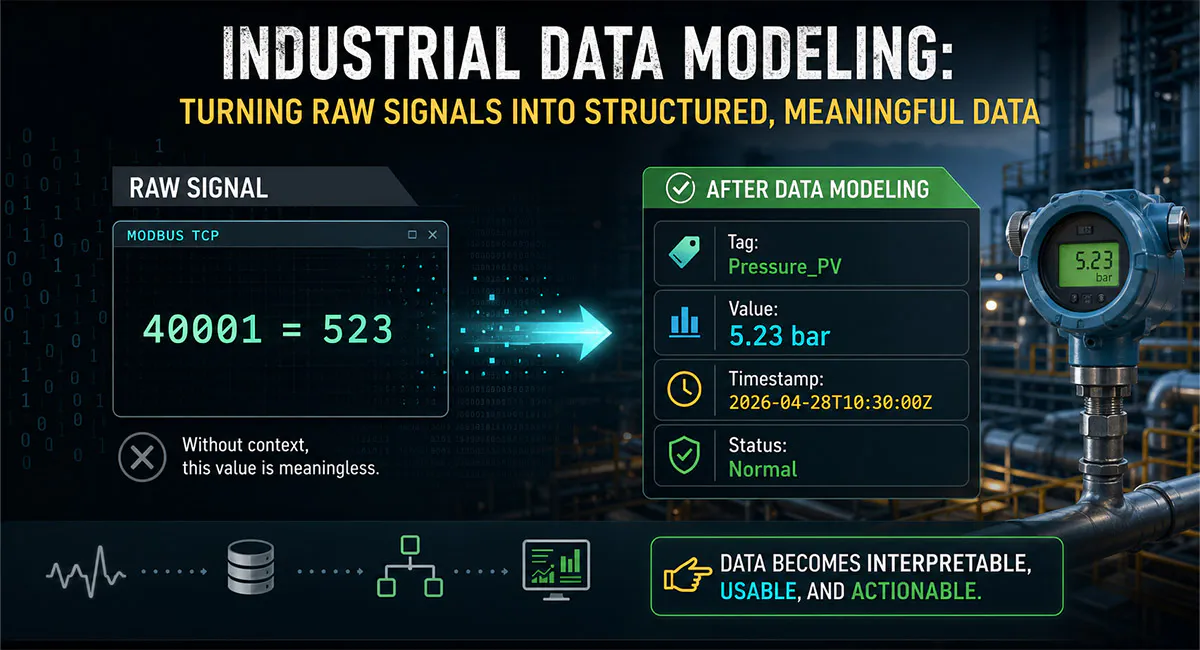
A Modbus register value like:
40001 = 523
Without context, this value is meaningless.
After Data Modeling
Tag: Pressure_PV
Value: 5.23 bar
Timestamp: 2026-04-28T10:30:00Z
Status: Normal
Value: 5.23 bar
Timestamp: 2026-04-28T10:30:00Z
Status: Normal
👉 Data becomes interpretable, usable, and actionable.
Where Data Modeling Happens: The Role of Edge Integration
Industrial data modeling is typically performed at the ชั้นขอบ, not in the cloud.
Why at the Edge?
- Closer to data source
- Lower latency
- Reduced cloud processing complexity
- Standardization before transmission
Edge Data Modeling Functions
- Tag mapping
- Unit conversion
- Scaling and calibration
- Data structuring (JSON / OPC UA models)
👉 Edge integration ensures data arrives in the cloud already clean and structured.
Key Components of Industrial Data Modeling
1. Tag Standardization
Assign consistent naming conventions:
- Temperature_T1
- Pressure_PV
- Flow_Rate
👉 Eliminates ambiguity across systems
2. Unit and Scaling Conversion
Convert raw values into engineering units:
- 4–20mA → 0–100°C
- Register value → pressure (bar, psi)
3. Asset Contextualization
Link data to physical assets:
- Plant → Line → Equipment → Sensor
👉 Enables hierarchical analysis
4. Time-Series Structuring
Attach timestamps and data frequency:
- Real-time streaming
- Historical logging
5. Data Formatting
Convert into cloud-ready formats:
- JSON
- OPC UA information models
- Time-series database structures
Industrial Data Flow: From Signal to Insight
| เวที | คำอธิบาย |
|---|---|
| Raw Signal | Analog or register data |
| การประมวลผลแบบขอบ | Scaling and filtering |
| การสร้างแบบจำลองข้อมูล | Tagging and structuring |
| Cloud Ingestion | MQTT / API |
| การวิเคราะห์ | Dashboards, AI insights |
👉 Each step increases the value and usability of the data.
Benefits of Industrial Data Modeling
ประโยชน์ในการดำเนินงาน
- Improved data visibility
- Faster troubleshooting
- การตรวจสอบแบบเรียลไทม์
ประโยชน์ทางเทคนิค
- Interoperability across systems
- Standardized data architecture
- Reduced integration complexity
ประโยชน์ทางธุรกิจ
- Better decision-making
- Predictive maintenance capability
- Higher ROI on IIoT investments
Data Modeling in Instrument to Cloud Architecture
Industrial Data Modeling is a core layer in เครื่องมือสู่ระบบคลาวด์ systems.
Without Data Modeling
- Cloud receives raw, unusable data
- Complex parsing required
- High engineering effort
With Data Modeling
- Clean, structured data flows into cloud
- การPLOYMENTที่รวดเร็วขึ้น
- Scalable analytics
👉 Data modeling turns connectivity into true digital value.
Industrial Data Modeling vs Raw Data Collection
| แง่มุม | Raw Data | Modeled Data |
|---|---|---|
| Structure | ไม่มี | Standardized |
| Meaning | Undefined | Contextualized |
| Usability | ต่ำ | สูง |
| Cloud readiness | ไม่ | ใช่ |
Use Cases for Industrial Data Modeling
น้ำมันและก๊าซ
- Pressure and flow normalization
- Asset-level monitoring
Chemical Industry
- Process parameter structuring
- Safety data standardization
การบำบัดน้ำ
- Distributed sensor data unification
การผลิต
- Machine performance metrics
- Energy data analysis
Instrava Industrial Data Modeling Approach
Instrava integrates data modeling directly into the edge layer, ensuring seamless Instrument to Cloud connectivity.
ความสามารถหลัก
- Multi-protocol data normalization
- Standardized tag structures
- Asset-based data hierarchy
- Cloud-ready data formats
ผลลัพธ์
👉 Raw industrial signals become structured, meaningful, and actionable data
Conclusion: Data Modeling as the Core of Industrial Intelligence
Industrial Data Modeling is not optional—it is essential.
Without it, data remains fragmented and underutilized.
With it, industrial systems gain:
- การมองเห็น
- Intelligence
- ความสามารถในการขยายขนาด
👉 In the era of IIoT, data structure defines data value.
ทำไมต้องเลือก Instrava
สร้างบนความสม่ำเสมอ ไม่ใช่คำกล่าวอ้าง
มุ่งเน้นการใช้งานในอุตสาหกรรม
เราเชี่ยวชาญด้านการวิเคราะห์และตรวจจับในอุตสาหกรรม โดยมีความเข้าใจอย่างชัดเจนเกี่ยวกับสภาพแวดล้อมการทำงานจริงและความต้องการต่างๆ.
เกณฑ์การคัดเลือกผลิตภัณฑ์อย่างเข้มงวด
ทุกเครื่องมือได้รับการประเมินตามประสิทธิภาพ, ความเสถียร, และความเหมาะสมในการนำไปใช้—ไม่ใช่เพียงแค่ข้อมูลจำเพาะหรือราคา.
การจัดหาที่เชื่อถือได้และความสม่ำเสมอของคุณภาพ
เราทำงานร่วมกับผู้ผลิตที่เชื่อถือได้เพื่อให้แน่ใจว่ามีปริมาณการจัดหาที่เสถียร คุณภาพที่สม่ำเสมอ และการจัดส่งที่น่าเชื่อถือ.
การสนับสนุนที่ปฏิบัติได้จริงและอิงจากประสบการณ์
คำแนะนำของเราได้รับการสนับสนุนจากความเข้าใจในการใช้งานจริง ช่วยให้ลูกค้าหลีกเลี่ยงปัญหาทั่วไปและบรรลุผลลัพธ์ที่เชื่อถือได้.
Instrava ถูกสร้างขึ้นเพื่อลดความไม่แน่นอน—เพื่อให้ทุกการตัดสินใจของคุณชัดเจน ปลอดภัย และน่าเชื่อถือมากขึ้น.