
Industrial Data Modeling: Turning Raw Signals into Structured Intelligence for IIoT
Introduction: Data Without Structure Has No Value
Industrial systems generate massive amounts of data every second. However, in most brownfield environments, this data exists as:
- Raw analog signals (4–20mA)
- Register values (Modbus)
- Device-specific parameters (HART)
While the data exists, it is often unstructured, inconsistent, and difficult to use.
👉 This is where Industrial Data Modeling becomes critical.
It transforms raw signals into structured, contextual, and cloud-ready data, enabling true Instrument to Cloud connectivity.
What Is Industrial Data Modeling?
Industrial Data Modeling is the process of:
- Structuring raw industrial data
- Assigning meaning and context
- Standardizing formats for interoperability
- Preparing data for cloud and analytics systems
Core Objective
👉 Convert raw signals into usable digital information
Why Data Modeling Is Essential in Brownfield Digitalization
In legacy industrial environments:
- Data formats vary across devices
- Naming conventions are inconsistent
- No unified data structure exists
- Cloud systems cannot interpret raw values
Example Problem
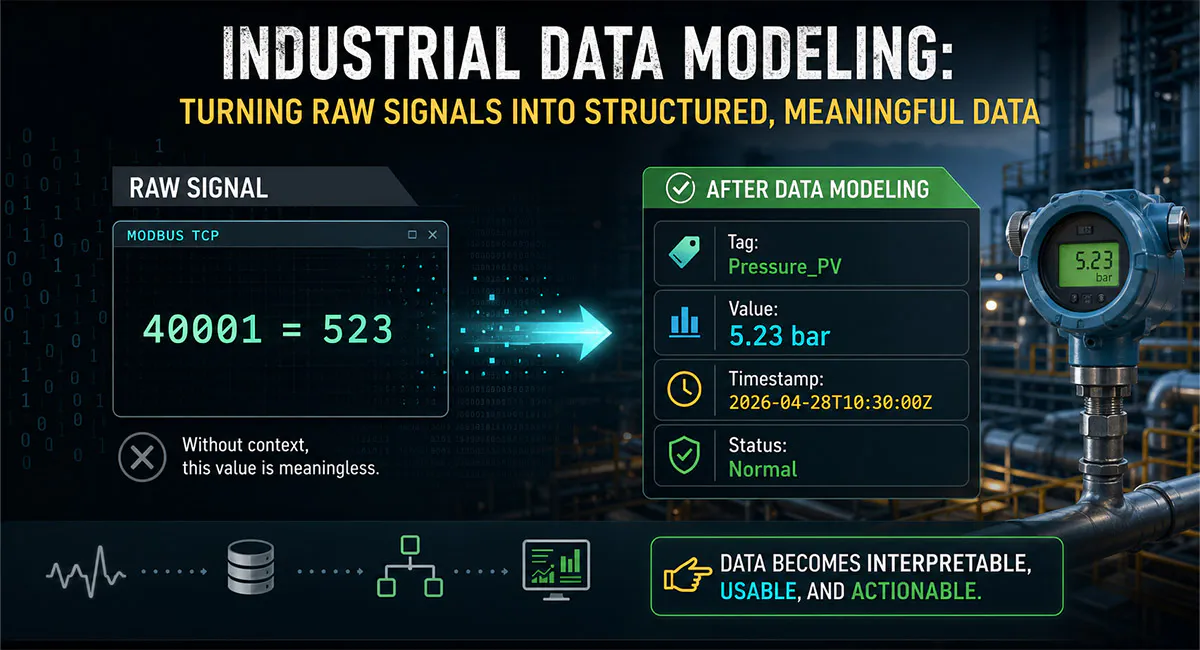
A Modbus register value like:
40001 = 523
Without context, this value is meaningless.
After Data Modeling
Tag: Pressure_PV
Value: 5.23 bar
Timestamp: 2026-04-28T10:30:00Z
Status: Normal
Value: 5.23 bar
Timestamp: 2026-04-28T10:30:00Z
Status: Normal
👉 Data becomes interpretable, usable, and actionable.
Where Data Modeling Happens: The Role of Edge Integration
Industrial data modeling is typically performed at the edge layer, not in the cloud.
Why at the Edge?
- Closer to data source
- Lower latency
- Reduced cloud processing complexity
- Standardization before transmission
Edge Data Modeling Functions
- Tag mapping
- Unit conversion
- Scaling and calibration
- Data structuring (JSON / OPC UA models)
👉 Edge integration ensures data arrives in the cloud already clean and structured.
Key Components of Industrial Data Modeling
1. Tag Standardization
Assign consistent naming conventions:
- Temperature_T1
- Pressure_PV
- Flow_Rate
👉 Eliminates ambiguity across systems
2. Unit and Scaling Conversion
Convert raw values into engineering units:
- 4–20mA → 0–100°C
- Register value → pressure (bar, psi)
3. Asset Contextualization
Link data to physical assets:
- Plant → Line → Equipment → Sensor
👉 Enables hierarchical analysis
4. Time-Series Structuring
Attach timestamps and data frequency:
- Real-time streaming
- Historical logging
5. Data Formatting
Convert into cloud-ready formats:
- JSON
- OPC UA information models
- Time-series database structures
Industrial Data Flow: From Signal to Insight
| Stage | Description |
|---|---|
| Raw Signal | Analog or register data |
| Edge Processing | Scaling and filtering |
| Data Modeling | Tagging and structuring |
| Cloud Ingestion | MQTT / API |
| Analytics | Dashboards, AI insights |
👉 Each step increases the value and usability of the data.
Benefits of Industrial Data Modeling
Operational Benefits
- Improved data visibility
- Faster troubleshooting
- Real-time monitoring
Technical Benefits
- Interoperability across systems
- Standardized data architecture
- Reduced integration complexity
Business Benefits
- Better decision-making
- Predictive maintenance capability
- Higher ROI on IIoT investments
Data Modeling in Instrument to Cloud Architecture
Industrial Data Modeling is a core layer in Instrument to Cloud systems.
Without Data Modeling
- Cloud receives raw, unusable data
- Complex parsing required
- High engineering effort
With Data Modeling
- Clean, structured data flows into cloud
- Faster deployment
- Scalable analytics
👉 Data modeling turns connectivity into true digital value.
Industrial Data Modeling vs Raw Data Collection
| Aspect | Raw Data | Modeled Data |
|---|---|---|
| Structure | None | Standardized |
| Meaning | Undefined | Contextualized |
| Usability | Low | High |
| Cloud readiness | No | Yes |
Use Cases for Industrial Data Modeling
Oil & Gas
- Pressure and flow normalization
- Asset-level monitoring
Chemical Industry
- Process parameter structuring
- Safety data standardization
Water Treatment
- Distributed sensor data unification
Manufacturing
- Machine performance metrics
- Energy data analysis
Instrava Industrial Data Modeling Approach
Instrava integrates data modeling directly into the edge layer, ensuring seamless Instrument to Cloud connectivity.
Key Capabilities
- Multi-protocol data normalization
- Standardized tag structures
- Asset-based data hierarchy
- Cloud-ready data formats
Outcome
👉 Raw industrial signals become structured, meaningful, and actionable data
Conclusion: Data Modeling as the Core of Industrial Intelligence
Industrial Data Modeling is not optional—it is essential.
Without it, data remains fragmented and underutilized.
With it, industrial systems gain:
- Visibility
- Intelligence
- Scalability
👉 In the era of IIoT, data structure defines data value.
Why Choose Instrava
Built on Consistency, Not Claims
Focused on Industrial Applications
We specialize in industrial analysis and detection, with a clear understanding of real-world operating environments and requirements.
Strict Product Selection Criteria
Every instrument is evaluated based on performance, stability, and application suitability—not just specifications or pricing.
Reliable Supply & Quality Consistency
We work with trusted manufacturers to ensure stable supply, consistent quality, and dependable delivery.
Practical, Experience-Based Support
Our recommendations are grounded in application understanding, helping customers avoid common issues and achieve reliable results.
Instrava is built to reduce uncertainty—so every decision you make is clearer, safer, and more reliable.