







HART-to-Cloud / Brownfield Digitalization: Unlocking Value from Existing Industrial Assets
Introduction: Why Brownfield Digitalization Is Crucial Today
Nowadays, most industrial facilities are not built from scratch. They are constructed upon a foundation of various instruments, control systems, and field devices installed over decades—many of which continue to operate reliably today, relying on 4–20mA and HART communication technologies.
However, on Wednesday, April 22, 2026—the third day of the 2026 Hannover Messe—live demonstrations proved that APL instruments from different manufacturers (such as E+H, VEGA, and KROHNE) can achieve configuration-free, high-speed communication within the same network segment. This marks the formal entry of the process industry into the “All-Ethernet” era, signaling a turning point where the traditional market for 4–20mA analog signals faces rapid displacement by advanced, intelligent digital protocols.
Consequently, with the advent of the AI era, mere reliability is no longer sufficient. Modern operational management demands data visualization, predictive maintenance, energy optimization, and cloud-based analytics capabilities. This shift is driving a major trend within the process industry: Brownfield Digitalization.
On one hand, enterprises could opt for a comprehensive “digital-first” approach for new projects (utilizing APL/Ethernet).
However, APL currently presents several challenges:
- Device costs are higher than those of traditional instruments;
Network architecture is more complex (involving switches, power supplies, and topologies);
Engineering personnel require integrated IT + OT expertise.
On the other hand, rather than undertaking a wholesale replacement of entire systems, enterprises are increasingly focusing on a more pragmatic and cost-effective strategy—the “HART-to-Cloud” transition—aimed at extracting and unlocking the latent value within their existing assets.
What Is “HART-to-Cloud”?
“HART-to-Cloud” refers to the comprehensive process of extracting data from HART-enabled field instruments and transmitting it to a cloud platform for monitoring, analysis, and optimization.
In traditional systems:
- 4–20mA signals typically provide only a single primary measurement value;
HART data often remains dormant or is simply ignored.
Under the “HART-to-Cloud” architecture:
- HART digital data is collected via gateways or edge devices;
The data is converted into standardized formats (e.g., OPC UA, MQTT, REST API);
This information is then transmitted to a cloud platform for advanced data analytics.
This architecture enables legacy instrumentation to integrate seamlessly into modern digital ecosystems without the need for physical replacement.
What is Brownfield Digitalization?
Brownfield Digitalization refers to the process of modernizing and upgrading existing industrial facilities without completely replacing their current systems.
Unlike “Greenfield Projects” (i.e., newly constructed facilities), brownfield environments typically exhibit the following characteristics:
- A mix of instrumentation devices spanning various generations (old and new);
Multiple coexisting communication protocols (e.g., HART, Modbus, Profibus);
And traditional PLC/DCS control systems.
The core objective is not to “rip and replace”—to tear everything down and start over—but rather to:
- Extract actionable data from existing systems;
Integrate legacy assets into digital platforms;
Evolve incrementally to ultimately achieve intelligent operations.
Why is Brownfield Digitalization Crucial?
1. A Massive Installed Base
Globally, billions of HART-enabled devices are currently deployed and operational within the industrial sector. Attempting to replace this entire installed base would be impractical from both an economic and an operational standpoint.
Brownfield Digitalization enables enterprises to:
- Extend asset lifecycles
Avoid unnecessary capital expenditures
Maximize the return on existing investments
2. Hidden Data Value
Most industrial devices already contain valuable data that extends far beyond traditional 4–20mA signals, including:
- Device diagnostic information
Secondary process variables
Calibration and drift data
Without “HART-to-Cloud” connectivity capabilities, this data remains untapped and unutilized.
3. Operational Visibility
Traditional systems often operate in isolation, creating “data silos.” Data is fragmented and scattered across:
- Field instrumentation
PLCs (Programmable Logic Controllers)
SCADA (Supervisory Control and Data Acquisition) systems
Brownfield Digitalization enables unified, plant-wide visibility, thereby enhancing decision-making capabilities and operational insights.
4. The Foundation of Predictive Maintenance
Once HART data is connected to the cloud, it can be utilized for:
- Early fault detection
Performance degradation analysis
Maintenance strategy optimization
This transforms maintenance strategies from a passive, reactive approach into a proactive, predictive one.
Architecture of the “HART-to-Cloud” System
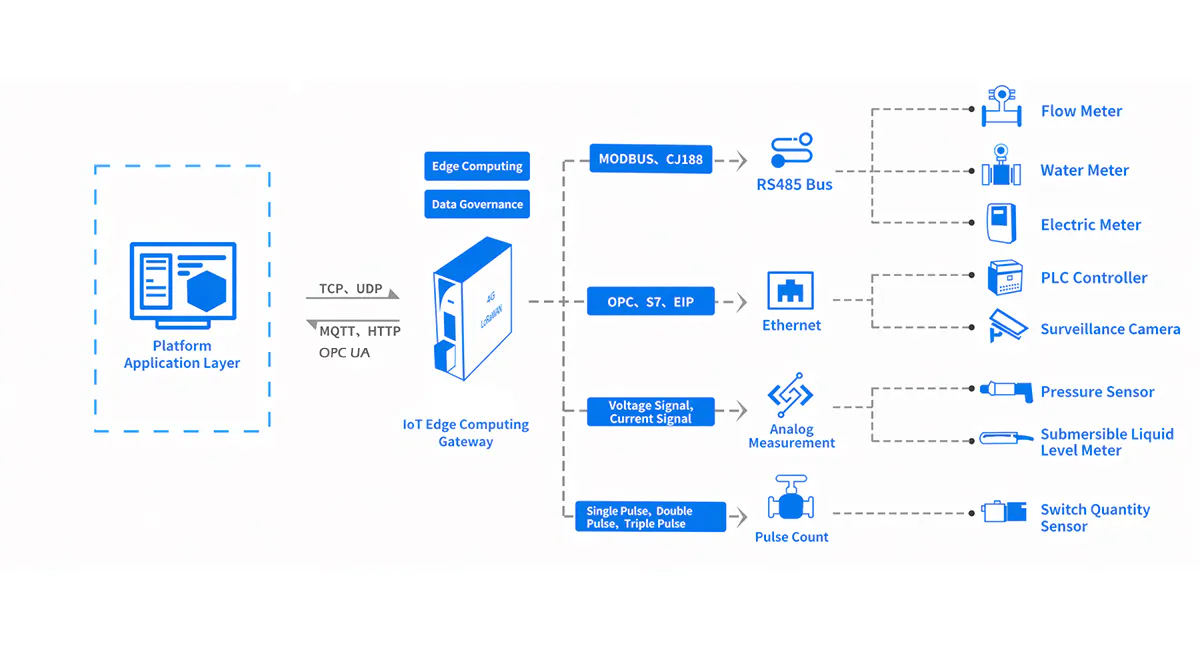
A typical digitalization architecture for existing facilities comprises three distinct layers:
1. Field Layer
- Existing 4–20mA + HART instrumentation
No physical device replacement required
2. Edge Layer
- HART multiplexers or edge gateways
Protocol conversion (HART → OPC UA / MQTT)
Local data processing and filtering
3. Cloud Layer
- Industrial Internet of Things (IIoT) platform
Data storage and visualization
AI-based data analysis and optimization
This layered architectural design ensures that disruption to existing operations is minimized while maximizing data utilization.
Key Technologies Driving the Transformation
HART Communication
In the process industry, it remains the communication protocol with the largest installed base among smart instrumentation. It serves as a critical bridge between analog signals and digital data.
Edge Computing
Edge devices act as both “translators” and “processors,” transforming raw field data into structured information that is compatible with the cloud environment.
OPC UA and MQTT
These protocols enable standardized, secure, and scalable data transmission between OT (Operational Technology) systems and IT (Information Technology) systems.
Cloud-Based Data Analytics
The cloud platform enables:
- Cross-site comparative data analysis
AI-driven anomaly detection
Energy and efficiency optimization
Brownfield vs Greenfield: A Strategic Perspective
| أسبكت | Brownfield Digitalization | Greenfield (APL-based systems) |
|---|---|---|
| Investment | Low to medium | عالية |
| Implementation Speed | سريع | Slower |
| Risk | منخفضة | متوسط |
| Ideal For | Existing plants | New facilities |
| Approach | Retrofit & integration | Full digital design |
While Ethernet-APL represents the future of new installations, Brownfield Digitalization is the most practical path for existing industrial infrastructure today.
Common Challenges in HART to Cloud Projects
Despite its advantages, implementation is not without challenges:
- Lack of standardized data models
- Integration complexity with legacy DCS systems
- Cybersecurity concerns in OT networks
- Limited digital skills in maintenance teams
Successful projects require not just technology, but also a clear digital roadmap and system-level design thinking.
Strategic Value for Industrial Operators
Organizations that implement Brownfield Digitalization typically achieve:
- Improved asset utilization
- Reduced unplanned downtime
- Lower maintenance costs
- Enhanced energy efficiency
- Better regulatory compliance
More importantly, they establish a foundation for long-term digital transformation without disrupting existing operations.
Conclusion: A Practical Path to Industrial Intelligence
HART to Cloud and Brownfield Digitalization are not about replacing what already works. They are about activating the intelligence already embedded in industrial assets.
Instead of waiting for full system replacement or new plant construction, operators can begin extracting value today—by connecting legacy instrumentation to modern data ecosystems.
Within this transition, Instrava focuses on enabling practical, step-by-step digital evolution—helping industrial operators move from isolated signals to intelligent systems without disrupting existing operations.
The future of industrial automation is not purely new infrastructure. It is intelligent integration of the old and the new.