
الصفحة الرئيسية » التكنولوجيا » Industrial Digital pH / ORP Sensors for Continuous Process Control
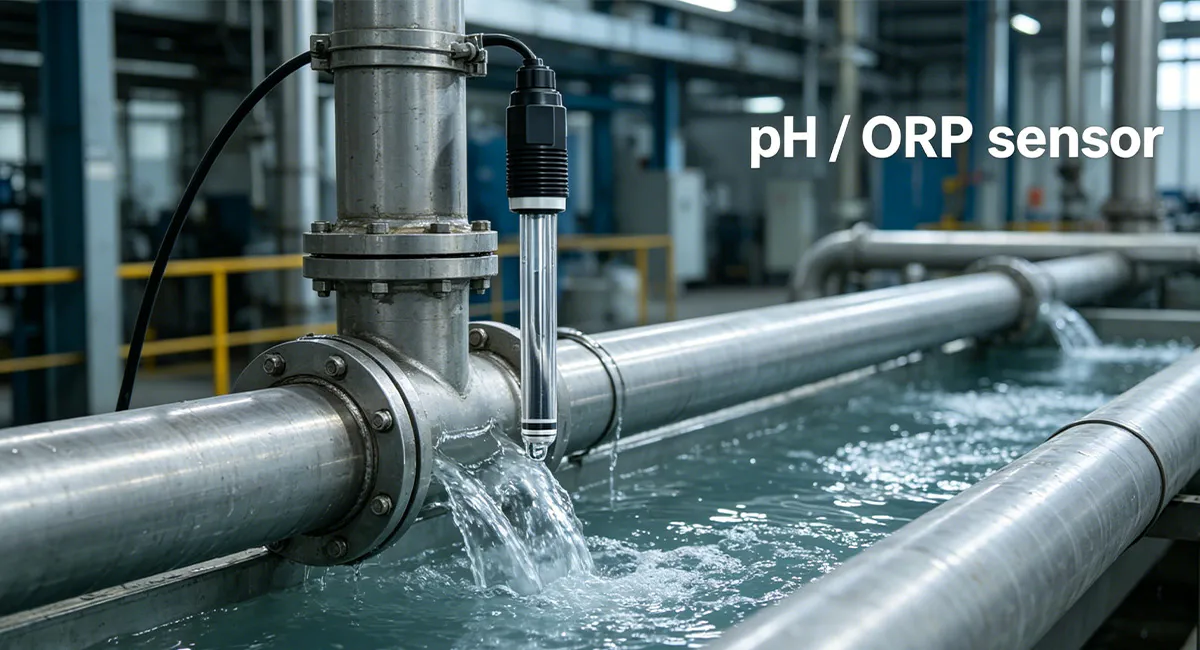
Industrial Digital pH / ORP Sensors for Continuous Process Control
1. What is a pH / ORP Sensor?
An Industrial pH / ORP (Oxidation-Reduction Potential) sensor is an advanced electrochemical instrument engineered for real-time, online monitoring of hydrogen ion activity (acidity/alkalinity) and electron transfer capabilities (oxidizing/reducing strength) in liquid solutions.
In the era of Industry 4.0, these sensors serve as the critical analytical “eyes” of automated process loops. By converting complex chemical variables into actionable data, they empower Programmable Logic Controllers (PLCs) and Distributed Control Systems (DCS) to manage chemical dosing accurately, maintain strict environmental compliance, and safeguard heavy industrial assets from corrosion or catastrophic process failure.
2. Traditional Technology Challenges in Harsh Conditions
In demanding industrial environments—such as electroplating wastewater treatment, aggressive chemical synthesis, and high-salinity cooling towers—traditional analog pH/ORP sensors frequently suffer from premature failure.
When deployed in harsh chemical process water and high-solid industrial effluent installations, traditional technology faces three major bottlenecks:
Signal Drift and Electromagnetic Interference (EMI): Traditional sensors rely on high-impedance analog millivolt (mV) signals. When transmitted over long distances or routed near heavy machinery, Variable Frequency Drives (VFDs), or high-voltage pumps, the signal degrades severely, leading to erratic readings and constant recalibration.
Rapid Electrode Fouling and Junction Clogging: Suspended solids, oily emulsions, and crystalline scales in harsh streams quickly coat the sensitive glass membrane and reference junction. This contamination isolates the electrode from the process fluid, resulting in sluggish response times and massive measurement errors.
High Maintenance Overhead and Short Lifespan: Because traditional electrodes lack mechanical and chemical resilience under extreme conditions, plant operators must perform labor-intensive weekly manual cleanings and frequent buffer calibrations, skyrocketing total cost of ownership (TCO).
How Modern Digital Sensors Perfect Counter These Challenges:
Modern digital pH/ORP sensors eliminate these vulnerabilities by embedding an intelligent micro-transmitter directly within the sensor head. This core converts weak voltage signals into a robust Digital RS485 Modbus RTU output, completely mitigating signal drift and ensuring crystal-clear transmission up to 1,200 meters without EMI distortion. Utilizing industrial-grade wetted materials like chemically-resistant ABS and hardened glass, paired with optional automatic jet-cleaning compatibility, these sensors actively repel contaminants, reduce manual intervention to a minimum, and maximize online uptime.
3. International Parameters and Certification Requirements
For cross-border EPC contractors and international supply chain directors, component compliance and technical interoperability are paramount. Industrial instrumentation must satisfy rigorous global standards to guarantee safety, operational continuity, and seamless integration into large-scale engineering topologies.
The following comprehensive matrix details the foundational parameters and the specialized requirements dictated by distinct industrial sectors:
Foundational Technical Parameters
Measurement Range: 0 ~ 14 pH (pH Sensor) / -1999 mV ~ +1999 mV (ORP Sensor)
Measurement Accuracy: ±0.05 pH (with integrated temperature compensation) / ±1 mV (ORP)
Operating Temperature: 0 ~ 80 ℃ (pH) / -10 ~ 100 ℃ (ORP)
Operating Pressure: ≤ 0.6 MPa (pH) / ≤ 0.8 MPa (ORP)
Temperature Sensor: مركز التجارة الوطنية 2.252 ألف
Wetted Materials: Industrial ABS, Hardened Electrode Glass
Protection Class: IP65 Ingress Protection
Process Connection Threads: 3/4″ NPT, PG13.5
Industry-Specific Parameters & Compliance Matrix
| Target Industry | Specific Technical Adjustments | Essential International Certifications |
| معالجة المياه الصناعية ومياه الصرف الصحي | High-capacity reference junctions to prevent fouling; customizable signal cable lengths (5m to 20m) for deep basin immersion. | CE, RoHS, ISO 9001 Ensures environmental compliance and standardized performance. |
| معالجة الكيماويات والبتروكيماويات | High-pressure seals (up to 0.8 MPa); heavy-duty glass formulation resistant to aggressive chemical solvents and strong acids. | ATEX / IECEx (Ex-proof) Mandatory for hazardous areas and explosive atmospheres. |
| Power Plant Boiler Water Systems | Low-conductivity glass formulation to prevent reference junction polarization in ultra-pure water loops. | Traceable Calibration Certificates Required for strict water chemistry audit trails. |
| Food & Beverage Process Water | Sanitary process connections; high-temperature resistance to withstand CIP (Clean-in-Place) thermal cycles up to 100°C. | FDA-Compliant Materials / EHEDG Guarantees non-toxic wetted boundaries. |
4. Instrava Product Spotlight: Industry Application Scenarios and Customized Compliance
As a premier curated supplier of elite B2B industrial instrumentation, إنسترافا يسلم أدوات إنسترافا المنسقة و حلول إنسترافا المحسّنة. Rather than operating as a rigid manufacturer, Instrava meticulously selects proven instruments from trusted global manufacturers. By deeply evaluating engineering topologies against real working conditions, we solve practical grid and process challenges with flexible, tailored configurations.
إن Instrava Industrial Digital pH / ORP Sensor for Continuous Process Control embodies this application-driven philosophy, serving as a highly reliable asset for global supply chains.
Real-World Case 1: Industrial Wastewater Plant Commissioning (EPC Project)
The Challenge: A cross-border EPC contractor was integrating an online water quality monitoring framework for a heavy metal precipitation plant. The heavy presence of industrial agitators and high-volume drainage pumps generated extreme electromagnetic noise, causing standard analog sensors to drift continuously and corrupting the automated chemical dosing loops.
The Instrava Solution: Instrava optimized the project deployment by providing the Industrial Digital pH / ORP Sensor configured with heavy-shielded, customized 20-meter digital RS485 cables.
The Result: Because signal conversion occurred instantly inside the digital sensor head, the central DCS received noise-immune Modbus RTU data. This eliminated the need for standalone intermediate transmitters, accelerated project commissioning timelines by 30%, and guaranteed 100% regulatory compliance for environmental discharge.
Real-World Case 2: Chemical Cooling Tower Biocide Optimization
The Challenge: A chemical manufacturing site required continuous ORP monitoring to regulate oxidative biocide additions in its cooling infrastructure. High system pressures (0.5 MPa) and sudden thermal shifts caused standard market glass bulbs to crack within weeks, threatening supply chain efficiency.
The Instrava Solution: Instrava curated a heavy-duty sensor variant featuring a robust ABS housing, 3/4″ NPT process connections, and an integrated NTC 2.252K temperature sensor for dynamic real-time compensation.
The Result: The optimized sensor easily withstood process pressures up to 0.8 MPa, expanding the equipment replacement cycle from 2 months to over 14 months, drastically lowering maintenance overhead for the client’s procurement division.
5. Instrava Sensor: Installation Conditions and Operating Environments
To guarantee unwavering measurement accuracy, the Instrava digital sensor must be deployed according to strict professional protocols:
Mounting Versatility: Equipped with dual 3/4″ NPT and PG13.5 threads, the sensor supports multiple mounting configurations: immersion (via a submergence pipe or bracket in open basins), online pipe insertion (utilizing a standard pipe T-piece), or bypass flow-cell installation for precise sample control.
Angular Orientation: The sensor must always be installed at an angle between 15° and 90° relative to the horizontal plane. Horizontal or upside-down installation is strictly prohibited, as the internal reference electrolyte must physically rest against the glass bulb to maintain electrical continuity.
Environmental Boundaries: Process pressures must remain within ≤ 0.6 MPa (for pH) or ≤ 0.8 MPa (for ORP). While the casing boasts an IP65 protection class, the sensor bulb must remain fully submerged in liquid during active operations to prevent dehydration of the gel layer.
6. Instrava Sensor: Product Maintenance Protocol
With proper operational care, the typical service life of an Instrava curated electrode spans 12 to 18 months. Adhering to this structured maintenance routine ensures maximum field longevity:
Chemical Cleaning Routine: Periodically inspect the sensor bulb for physical fouling. For organic oil films, gently wipe the glass bulb with a soft cloth moistened with a mild detergent or isopropyl alcohol. For mineral scaling or calcium build-ups, submerge the electrode tip in a 3% to 5% dilute Hydrochloric Acid (HCl) solution for 5 minutes, followed by a thorough rinse with distilled water.
Calibration Schedules: In stable industrial water setups, monthly calibration is sufficient. In volatile or aggressive process streams, perform a standard calibration every 1 to 2 weeks. Utilize standard buffer solutions (pH 4.01, 6.86, and 9.18) to execute a precise two-point or three-point calibration directly through your control system interface.
Hydration Protection: Never store the sensor dry or in pure distilled water. When removing the instrument from the pipeline for extended periods, always fill the protective rubber cap with a 3M KCl (Potassium Chloride) solution and secure it tightly over the electrode tip to maintain sensor hydration.
Why is the pH / ORP reading fluctuating erratically or drifting on our DCS?
This is typically caused by a ground loop potential or severe localized EMI along the pipeline. Verify that the RS485 shield wire is properly grounded at the control cabinet side. Additionally, check for air bubbles trapped around the glass bulb or a coating of oil; cleaning the bulb or installing the sensor at a steeper angle resolves this.
How often should the Instrava pH / ORP sensor be calibrated?
For stable industrial water applications, calibration is recommended once per month. In harsh, highly active, or fluctuating process conditions, calibration every 1–2 weeks helps maintain optimal measurement accuracy.
What is the typical service life of the electrode in online applications?
Under normal industrial water conditions, the typical service life of an Instrava curated electrode is 12–18 months. The actual lifespan depends heavily on liquid temperature, chemical composition, and maintenance consistency.
What site factors most commonly reduce the lifespan of an electrode?
Lifespan is shortened by prolonged exposure to extreme temperatures (>80°C), strong hydrofluoric acid (which chemically dissolves glass), heavy oil coatings that suffocate the reference junction, and highly abrasive slurry solids that scratch the glass membrane.
Can the Instrava digital sensor be used directly in wastewater with suspended solids?
Yes. The sensor is optimized for wastewater applications. However, to prevent severe fouling on the glass membrane which impacts response times, integrating a regular manual cleaning schedule or an automated air/water jet cleaning system is highly recommended.
Does this digital sensor require an expensive standalone transmitter unit?
No. The Instrava digital sensor features an embedded microprocessor that outputs native RS485 Modbus RTU protocol directly. It connects directly to your PLC, DCS, or Edge Gateway without intermediate transmitter hardware, saving valuable cabinet space and lowering procurement costs for supply chain directors.
لماذا تثق في Instrava؟
نختار الشركات المصنعة من منطلق محايد ونزيه، مع مراعاة مصلحتك دائمًا.
يعتمد وجودنا ذاته على مساعدتكم في العثور على المنتجات التي تناسب احتياجاتكم تمامًا.
ونظرًا لوجود مقرنا في الصين، فإننا قادرون على إجراء عمليات تفتيش ميدانية لبيئات الإنتاج وجودة المنتجات بشكل مباشر.
نحن نساعدك على تجنب الوسطاء الذين يتظاهرون بأنهم مصانع.
نحن نسهل تقديم دعم ما بعد البيع بشكل أكثر سلاسة، مما يزيل مشاكل الفارق الزمني والتأخيرات التي غالبًا ما ترتبط بالتعامل المباشر مع المصانع.
يضمن فريقنا متعدد اللغات التواصل الفعال.
بالنسبة لشركة ناشئة في مجال التداول، يمثل كل تفاعل مع العميل فرصة ثمينة — فهو دليل على استعدادك لوضع ثقتك فينا ومنحنا الفرصة لإثبات جدارتنا.
في العصر الرقمي، ورغم سهولة الوصول إلى المعلومات، غالبًا ما تؤدي المفاهيم الخاطئة إلى إضعاف الثقة بين الناس.
تعتمد «إنسترافا» كليًّا على الثقة؛ فهي فلسفتنا الأساسية وأساس وجودنا في المجتمع. وهي الركيزة الأساسية لنمونا على المدى الطويل والتزامنا بخدمة المجتمع.
نرجو أن تضعوا ثقتكم فينا.