
Accueil » Technologie » TSN (Time-Sensitive Networking): The Future of Deterministic Industrial Ethernet
TSN (Time-Sensitive Networking): The Future of Deterministic Industrial Ethernet
Introduction: Why Traditional Ethernet Is No Longer Enough
Modern industrial automation systems demand far more than simple data connectivity. Industrial robots, PLCs, servo drives, machine vision systems, and autonomous vehicles all rely on ultra-fast and deterministic communication to operate safely and accurately.
However, traditional Ethernet was never designed for real-time industrial control.
Conventional Ethernet operates on a “best-effort” basis, meaning data packets are delivered whenever bandwidth becomes available. In office environments, a few milliseconds of delay may not matter. But in industrial automation, even tiny communication jitter or latency can cause synchronization errors, production interruptions, or safety risks.
For decades, industrial vendors solved this problem by developing proprietary Industrial Ethernet protocols such as:
- PROFINET IRT
- EtherCAT
- EtherNet/IP
- CC-Link IE
- POWERLINK
While these technologies enabled real-time control, they also created isolated industrial communication ecosystems that lacked interoperability.
This is exactly where TSN (Time-Sensitive Networking) enters the picture.
What Is TSN?
IEEE 802.1 Working Group defines TSN (Time-Sensitive Networking) as a family of IEEE Ethernet standards designed to add deterministic and real-time capabilities to standard Ethernet networks.
Rather than replacing Ethernet, TSN enhances it with precise timing and traffic management mechanisms.
Its primary mission is simple:
Deliver critical data with guaranteed latency, minimal jitter, and extremely high reliability over standard Ethernet infrastructure.
In practical terms, TSN transforms Ethernet from a traditional “best-effort” network into a deterministic communication platform suitable for mission-critical applications.
TSN enables:
- Communication déterministe
- Ultra-low latency
- Precise time synchronization
- Traffic prioritization
- Network convergence
- Seamless interoperability
This makes TSN one of the foundational technologies behind Industry 4.0, Industrial IoT (IIoT), autonomous driving, and smart manufacturing.
The Evolution of TSN: From AVB to Industrial Ethernet
The AVB Era (2005–2012)
TSN originated from AVB (Audio Video Bridging), a technology initially developed for professional audio and video synchronization.
During the mid-2000s, industries such as:
- Broadcast studios
- Live concerts
- Professional media production
faced serious synchronization challenges.
Audio and video streams transmitted over traditional Ethernet often suffered from:
- Delay
- Packet loss
- Timing mismatch
To solve these issues, IEEE established the AVB Working Group in 2005.
Several foundational standards were introduced, including:
- IEEE 802.1AS for time synchronization
- IEEE 802.1Qav for traffic shaping
- IEEE 802.1BA for AVB systems
The original objective was straightforward:
Enable synchronized low-latency media streaming over standard Ethernet.
The Transition to TSN (2012–Present)
As AVB matured, industrial automation and automotive companies realized something important:
The same synchronization technology used for audio and video could also solve industrial real-time communication problems.
In November 2012, the AVB Working Group officially evolved into the TSN Working Group.
This marked a major turning point.
TSN expanded beyond multimedia networking into:
- Industrial automation
- Ethernet automobile
- Aerospace systems
- Smart grids
- Mission-critical control networks
TSN was no longer about synchronized audio streams — it became a platform for deterministic industrial networking.
Who Is Driving TSN Adoption?
Avnu Alliance and Ecosystem Certification
Avnu Alliance plays a central role in promoting TSN interoperability and certification.
Founded by companies such as:
the organization focuses on ensuring multi-vendor compatibility across TSN devices and chipsets.
Its role is comparable to what the Wi-Fi Alliance did for wireless networking.
Industrial Automation Leaders
Major industrial automation companies are actively integrating TSN into their future architectures, including:
One of the most important industry initiatives is OPC UA over TSN.
Fondation OPC promotes OPC UA over TSN as a unified architecture for Industry 4.0.
In this model:
- OPC UA provides semantic interoperability
- TSN provides deterministic transport
Together, they create a unified communication framework from edge devices to cloud platforms.
Automotive Ethernet and Autonomous Driving
The automotive industry is also rapidly adopting TSN.
Modern vehicles now generate massive volumes of data from:
- Cameras
- LiDAR
- Radar
- ADAS systems
- Centralized vehicle computing
Traditional CAN bus architectures are no longer sufficient.
TSN-based Automotive Ethernet enables:
- High-bandwidth communication
- Real-time control
- Safety-critical synchronization
- Scalable in-vehicle networking
BMW was among the earliest automotive manufacturers to actively explore TSN-based in-vehicle networks.
The Four Core Technologies Behind TSN
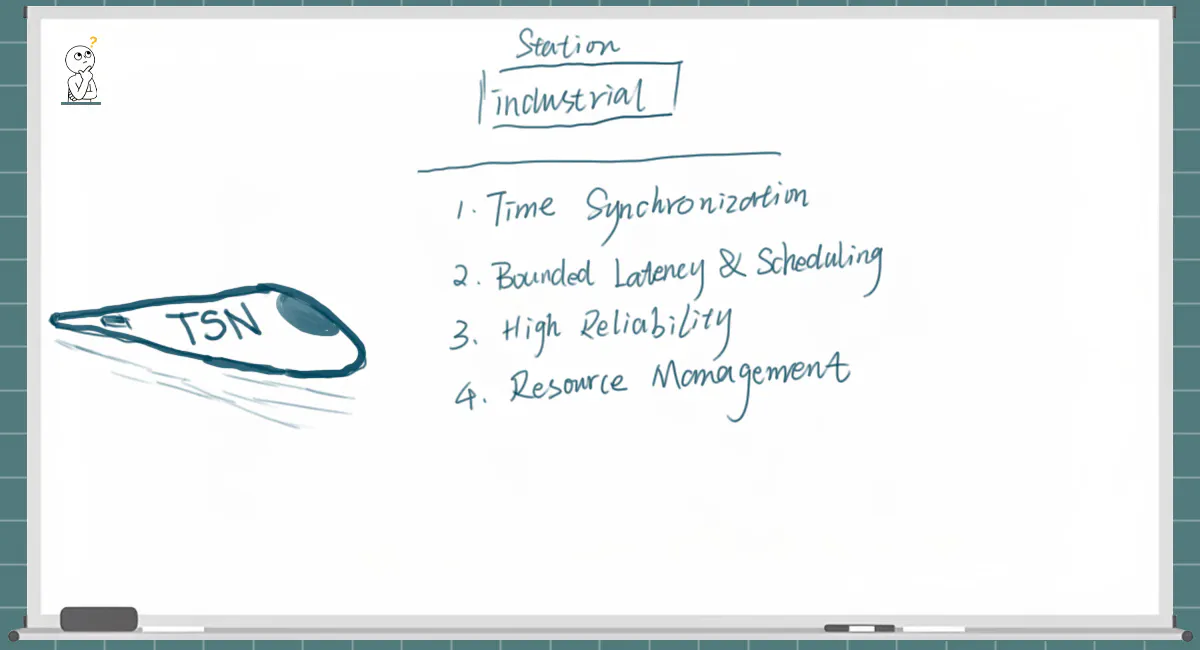
TSN includes many IEEE standards, but its core architecture can be summarized into four key technical pillars.
1. Time Synchronization
Representative standard:
- IEEE 802.1AS
All TSN devices share a highly synchronized network clock.
Il s'agit notamment de
- Contrôleurs
- Switches
- Capteurs
- Industrial robots
Synchronization accuracy can reach:
- Sub-microsecond precision
- Even tens of nanoseconds
Without synchronized time, deterministic scheduling would not be possible.
TSN synchronization works similarly to a distributed industrial “master clock” across the entire network.
2. Traffic Scheduling and Time-Aware Shaping
Representative standard:
- IEEE 802.1Qbv
This is one of the most critical TSN technologies.
Traditional Ethernet transmits packets whenever the link is available. TSN introduces time-based traffic scheduling.
Tcycle=Tcontrol+TIT+TguardT_{cycle}=T_{control}+T_{IT}+T_{guard}Tcycle=Tcontrol+TIT+Tguard
Network transmission cycles are divided into deterministic time slots for different traffic classes:
- Motion control traffic
- Safety traffic
- Video streams
- Standard IT data
During critical control windows:
- Non-critical traffic is blocked
- High-priority traffic receives guaranteed bandwidth
This mechanism is called Time-Aware Shaper (TAS).
It effectively creates dedicated “express lanes” for industrial control traffic.
3. Reliability and Redundancy
Representative standard:
- IEEE 802.1CB
Industrial systems cannot tolerate communication failures.
TSN improves reliability through frame replication and elimination.
The same packet can be:
- Replicated multiple times
- Sent across different physical paths
- Automatically deduplicated at the receiver
This provides:
- Zero-time recovery
- Fault tolerance
- Seamless redundancy
Compared to traditional Ethernet redundancy protocols, TSN significantly reduces failover time.
4. Resource Management and Configuration
Representative standard:
- IEEE 802.1Qcc
TSN networks require centralized resource orchestration.
Il s'agit notamment de
- Bandwidth reservation
- Stream configuration
- Traffic scheduling
- End-to-end path management
Centralized Network Configuration (CNC) enables intelligent network-wide management for deterministic communication.
Why TSN Matters for Industrial Automation
Breaking Industrial Communication Silos
Traditional industrial networks are fragmented.
Factories often deploy separate infrastructures for:
- Motion control
- Safety systems
- SCADA
- Video monitoring
- Systèmes MES
TSN enables network convergence.
Instead of multiple isolated networks, factories can operate:
One converged Ethernet infrastructure for both IT and OT traffic.
This is one of TSN’s biggest advantages.
TSN and IT/OT Convergence
One of the key goals of Industry 4.0 is integrating:
- Technologie opérationnelle (OT)
- Technologie de l'information (IT)
TSN supports this by allowing:
- Real-time control traffic
- Cloud communication
- AI workloads
- Video streams
- MES data
to coexist on the same physical network without interference.
This dramatically simplifies factory architecture and reduces infrastructure complexity.
TSN vs Traditional Industrial Ethernet
TSN is often misunderstood as a direct replacement for protocols like EtherCAT or PROFINET.
In reality, TSN functions more as a new deterministic Ethernet layer rather than a complete replacement.
In 2017, PROFIBUS et PROFINET International (PI) stated that TSN should be viewed as an additional real-time transport option for PROFINET rather than a disruptive replacement.
Future industrial architectures will likely resemble:
| Layer | Technologie |
|---|---|
| Application Layer | OPC UA / DDS / PROFINET |
| Deterministic Transport | TSN |
| Physical Layer | Standard Ethernet |
Challenges Facing TSN Adoption
1. Complex Time Synchronization
Large industrial networks require extremely accurate synchronization across hundreds or thousands of devices.
Maintaining nanosecond-level timing precision is technically demanding.
2. Traffic Scheduling Complexity
TSN scheduling is highly complex because every stream must be coordinated across the entire network.
Cela augmente :
- Configuration difficulty
- Engineering workload
- Management complexity
3. Brownfield Deployment Limitations
Existing factories already operate stable industrial Ethernet systems.
Replacing them with TSN infrastructure involves:
- High costs
- Downtime risks
- Integration challenges
As many industry professionals point out:
TSN adoption will likely accelerate first in greenfield factories rather than legacy plants.
4. Wireless TSN Remains Immature
Current TSN implementations are primarily wired.
However, future smart factories increasingly rely on:
- AGVs
- AMRs
- Wireless robots
- Mobile industrial devices
Integrating TSN with:
- Wi-Fi
- 5G
- Wireless deterministic networking
remains an active research area.
The Future of TSN: Beyond Industrial Networking
TSN is evolving far beyond factory automation.
Emerging research areas include:
- Jumeaux numériques
- Plates-formes industrielles de métavers
- AI-driven manufacturing
- DDS over TSN
- Intelligent QoS orchestration
Recent studies explore combining:
- DDS (Data Distribution Service)
- TSN
- Reinforcement learning
- Semantic QoS mapping
to create intelligent deterministic communication systems for next-generation industrial infrastructures.
This suggests that TSN may become one of the core foundations of future cyber-physical systems.
Conclusion
TSN represents one of the most important transformations in Ethernet history.
Its true value is not simply faster communication.
Instead, TSN brings deterministic behavior to standard Ethernet for the first time.
En permettant :
- Communication en temps réel
- Ultra-low latency
- Network convergence
- Vendor interoperability
- IT/OT integration
TSN is paving the way for the next generation of industrial automation, autonomous systems, and intelligent infrastructure.
From its origins in AVB multimedia synchronization to its role in Industry 4.0 and Automotive Ethernet, TSN reflects a much larger shift:
Ethernet is evolving from a data network into a time-aware deterministic network.
What is TSN in industrial Ethernet?
TSN (Time-Sensitive Networking) is a collection of IEEE Ethernet standards designed to provide deterministic, real-time communication over standard Ethernet networks. It enables ultra-low latency, precise synchronization, traffic scheduling, and high reliability for industrial automation, automotive Ethernet, and mission-critical applications.
How is TSN different from traditional Ethernet?
Traditional Ethernet operates on a “best-effort” basis, meaning packet delivery times are unpredictable during network congestion. TSN adds deterministic communication capabilities through technologies such as time synchronization, traffic shaping, and scheduled transmission, ensuring critical data arrives on time with minimal jitter and packet loss.
Will TSN replace industrial protocols like PROFINET or EtherCAT?
Not immediately. TSN is better understood as a deterministic Ethernet transport layer rather than a direct replacement for industrial protocols. Technologies such as PROFINET, OPC UA, EtherCAT, and DDS can operate on top of TSN to achieve real-time communication and network convergence.
What are the key benefits of TSN for Industry 4.0?
TSN supports several core Industry 4.0 requirements, including:
Deterministic real-time communication
IT/OT network convergence
Interopérabilité multi-fournisseurs
Reduced network infrastructure complexity
High reliability and redundancy
Support for smart manufacturing and Industrial IoT
These capabilities make TSN a strong foundation for next-generation industrial automation systems.
What industries are adopting TSN technology?
TSN is being adopted across multiple industries, including:
Industrial automation
Automotive Ethernet and autonomous driving
Smart grids and energy systems
Aerospace and defense
Professional audio/video broadcasting
Industrial robotics and machine control
It is especially valuable in applications requiring synchronized, low-latency, and highly reliable communication.
What are the biggest challenges facing TSN deployment?
Although TSN offers significant advantages, several challenges remain:
Maintaining precise network-wide synchronization
Complex traffic scheduling and configuration
Integration with legacy industrial systems
Limited maturity of wireless TSN solutions
Higher engineering and deployment complexity
For this reason, TSN adoption is currently more common in greenfield industrial projects and next-generation smart factories.
Pourquoi choisir Instrava ?
Construit sur la cohérence, pas sur les revendications
Axé sur les applications industrielles
Nous sommes spécialisés dans l'analyse et la détection industrielles, avec une compréhension claire des environnements d'exploitation et des exigences du monde réel.
Critères stricts de sélection des produits
Chaque instrument est évalué en fonction de ses performances, de sa stabilité et de son adéquation à l'application, et non pas seulement en fonction de ses spécifications ou de son prix.
Approvisionnement fiable et constance de la qualité
Nous travaillons avec des fabricants de confiance pour garantir un approvisionnement stable, une qualité constante et une livraison fiable.
Un soutien pratique et basé sur l'expérience
Nos recommandations sont fondées sur la compréhension des applications, ce qui permet aux clients d'éviter les problèmes courants et d'obtenir des résultats fiables.
Instrava est conçu pour réduire l'incertitude, afin que chaque décision que vous prenez soit plus claire, plus sûre et plus fiable.