
Portable Gas Detectors: B2B Technical Architecture & Global Compliance Insights
1. Introduction: What is a Portable Gas Detector?
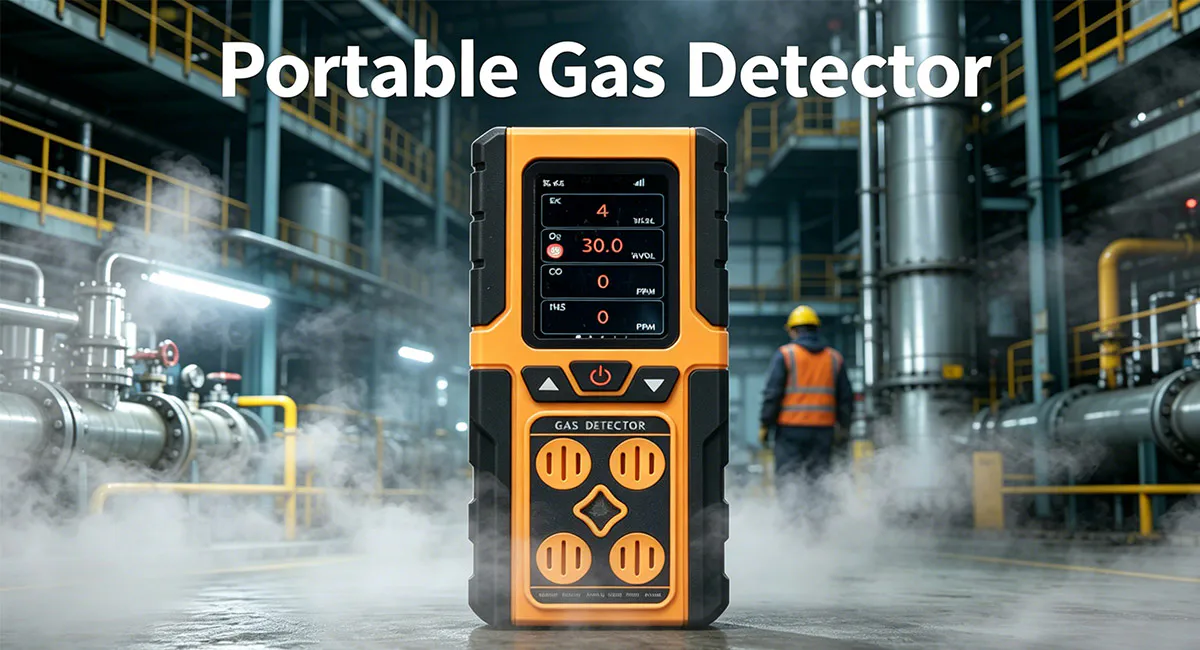
A detektor gas portabel is a critical piece of personal protective equipment (PPE) designed to monitor the atmosphere in real-time for hazardous gas concentrations. Unlike fixed gas detection networks that protect broad facility zones, portable gas detectors are wearable, compact devices that accompany personnel directly into potentially compromised spaces. They serve as an immediate defense system against three primary atmospheric threats: toxic gases (such as hydrogen sulfide [$H_2S$] and carbon monoxide [CO]), combustible gases prone to explosive ignition (measured in Lower Explosive Limit [%LEL]), and oxygen depletion or enrichment zones.
Modern portable gas detectors integrate advanced electrochemical, catalytic bead, photoionization (PID), and non-dispersive infrared (NDIR) sensor arrays. By outputting continuous ppm (parts per million) or volume percentage readings to high-visibility displays and syncing with integrated audible, visual, and vibrating alarms, these instruments provide workers with the critical margin of safety required to execute evacuations before exposure limits are breached.
2. Overcoming Harsh Industrial Environments: 3 Traditional Challenges & Modern Solutions
Industrial processing environments—such as petrochemical plants, underground mining shafts, and municipal wastewater treatment facilities—present extreme conditions that severely challenge traditional gas detection technologies. Below are the three most prevalent operational pain points encountered by legacy equipment, alongside the precise engineering mechanisms modern portable gas detectors utilize to neutralize them.
Challenge 1: Sensor Poisoning and Drift in High-Chemical Zones
The Problem: Traditional catalytic bead sensors used for combustible gas detection are highly susceptible to “poisoning” from trace silicones, sulfides, phosphates, and lead compounds. Exposure to these elements causes irreversible degradation of the catalyst material, leading to severe sensor drift, inaccurate zero-baselines, and catastrophic “false safe” readings where the device fails to detect explosive methane or hydrocarbons.
The Solution: Modern portable gas detectors combat this by incorporating advanced Non-Dispersive Infrared (NDIR) sensor technology alongside heavily filtered electrochemical cells. NDIR sensors utilize optical absorption pathways that do not interact chemically with the target environment, rendering them entirely immune to silicone or sulfide poisoning. Furthermore, internal microprocessor algorithms automatically compensate for ambient environmental baselines, performing continuous digital zero-point calibration to eliminate drift entirely.
Challenge 2: Micro-Condensation and Dust Occlusion in Confined Spaces
The Problem: Confined spaces like wastewater wet wells, storage tanks, and steam tunnels frequently exhibit 100% condensing humidity and heavy particulate loads. Traditional sensor faces easily become blocked by microscopic water films or fine dust barriers, preventing ambient gas from diffusing into the internal sensor chamber and resulting in severely delayed or non-existent response times ($T_{90}$).
The Solution: To maintain perfect atmospheric access, premium portable units feature specialized multi-layered hydrophobic and oleophobic membrane barriers integrated directly into the outer shell. These specialized filters reject water droplets and fine sub-micron dust particles while allowing gas molecules to pass through unhindered. Combined with specialized high-flow internal micro-pumps, the device actively clears surface moisture and draws clean samples without risking internal liquid ingress.
Challenge 3: Mechanical Shock and Thermal Shock in Heavy Industries
The Problem: Heavy industrial fields subject safety equipment to severe physical abuse, including high-altitude drops onto concrete, and radical temperature fluctuations (e.g., transitioning from arctic outdoor processing units to high-heat boiler rooms). Legacy equipment prone to cracking experiences rapid structural degradation, internal PCB alignment failure, and sudden thermal drift in sensor electronics.
The Solution: Modern engineering provides a dual-layer defense. Portable gas detectors are encased in an external shock-absorbing thermoplastic elastomer (TPE) or rubberized overmold over a reinforced polycarbonate core, easily securing IP67 or IP68 ratings for absolute water and dust tightness. On the circuit level, embedded temperature thermistors track ambient thermal shifts at millisecond intervals, feeding real-time correction data to the sensor bridges to normalize output and eliminate thermal shock fluctuations.
3. International Parameters, Certifications, and Industry-Specific Requirements
To safely deploy portable gas detectors across global supply chains, devices must fulfill rigid standardized performance baselines and maintain localized hazardous area certifications. Below is the comprehensive technical matrix detailing fundamental equipment specifications and targeted industry applications.
Part A: Core Standard Parameters (Base Specifications)
| Parameter Type | Standard Baseline Range | Teknologi Pengukuran |
| Combustible Gases (LEL) | 0 – 100% LEL (Resolution: 1% LEL) | Catalytic Bead / NDIR (Poison-Resistant) |
| Oxygen Concentration ($O_2$) | 0 – 30.0% Vol (Resolution: 0.1% Vol) | Lead-Free Long-Life Electrochemical |
| Toxic Gas: $H_2S$ / CO | $H_2S$: 0–100 ppm; CO: 0–500 ppm | High-Selectivity Micro-Electrochemical |
| Response Time ($T_{90}$) | < 15 seconds (for $O_2$ / LEL) | Diffusive / Pumped Micro-Sampling Channel |
| Perlindungan Masuknya Air | IP67 / IP68 Minimum | Dual-Injection Molded Hydrophobic Housing |
| Operational Battery Life | $\ge$ 18 Hours Continuous Run-Time | Intelligent Lithium-Polymer Energy Core |
Part B: Segmented Industry Applications & Specific Certifications
| Target Industry Vertical | Critical Gas Focus & Specific Parameters | Mandatory International Certifications |
Oil & Gas / Petrochemical
(Upstream/Downstream) | • High $H_2S$ (up to 500ppm)
• Benzene / VOCs (via high-sensitivity PID)
• Methane (%LEL/%Vol auto-range switching) | • ATEX Zone 0 (Ex ia IIC T4 Ga)
• IECEx Certified Safety standards
• SIL 2 (Safety Integrity Level) Functional Cap |
Wastewater & Municipal
(Sewers, Treatment Plants) | • Carbon Dioxide ($CO_2$ via NDIR)
• Ammonia ($NH_3$ 0-100ppm)
• Methane & Hydrogen Sulfide accumulation | • IP68 (Water Immersion Submergibility)
• Class I, Div 1, Groups C, D (UL913/CSA) |
Underground Mining & Tunnels
(Coal, Hard Rock Mining) | • Methane ($CH_4$ accumulation tracking)
• Carbon Monoxide (CO safety ceiling)
• Oxygen depletion zones | • ATEX Group I M1 (Ex ia I Ma)
• MSHA (Mine Safety & Health Administration)
• MA / KA Chinese Coal Mining Safety Approval |
4. Instrava: Navigating Global Distribution and Regional Challenges as a Chinese Supplier
As a premium Chinese supplier of industrial portable gas detectors, Instrava bridges the gap between high-tier manufacturing efficiency and strict international reliability. However, exporting safety-critical instrumentation across diverse geopolitical boundaries introduces specific regional hurdles. Understanding these localized complexities ensures seamless operational readiness and uncompromised compliance.
Regional Market Barriers & Regulatory Frameworks
European Union (EU Market): Access requires absolute alignment with ATEX Directive 2014/34/EU and CE conformity. Instrava maintains rigorous Quality Assurance Notifications (QAN) auditing for its manufacturing facilities, allowing units to pass through EU customs clearance smoothly.
North American Market (US & Canada): The transition from European zoning frameworks to North American Division systems (Class I, Division 1, Groups A, B, C, D) demands testing by Nationally Recognized Testing Laboratories (NRTLs) such as UL, CSA, or Intertek (ETL). Suppliers must prepare distinct product sub-variants built with specific intrinsic safety barriers calibrated to NEC/CEC guidelines.
Developing Markets (Southeast Asia, Latin America, Middle East): While many regions accept baseline ATEX or IECEx certifications natively, localized regulatory schemes—such as Brazil’s INMETRO, India’s PESO, or China’s own NEPSI—frequently mandate independent test reporting and localized registration dossiers before legal industrial entry is authorized.
Operational Readiness Checklist for Global Deployment
To successfully bypass logistical bottlenecks and ensure long-term equipment up-time overseas, procurement teams and suppliers must satisfy the following three fundamental readiness vectors:
Localized Calibration Infrastructure & Traceability: Gas sensors require routine calibration using specialized, traceable calibration gas cylinders. Instrava proactively aligns its international distribution channels with local gas blending hubs to ensure end-users have access to regional NIST-traceable gas mixtures matching target sensor profiles.
Climatic Adaptation Mapping: Devices shipped to high-altitude mining networks in Chile or desert oil fields in Iraq must undergo custom environmental testing. This includes deploying specialized low-temperature or high-humidity battery chemistry variants and configuring internal algorithmic software with localized cross-sensitivity filters.
Multilingual Documentation & Interactive Software: Safety guidelines must be universally understood by field technicians. Ensuring that device firmware, localized configuration apps, and physical safety manuals are fully translated into major operating languages (English, Spanish, Arabic, French, German) prevents user errors and keeps sites fully compliant with regional occupational health safety frameworks.
How do extreme temperatures impact portable gas detector runtime and accuracy?
Sub-zero environments reduce lithium battery discharge efficiency, lowering available runtime, while high heat can degrade electrochemical electrolytes, triggering baseline signal drift. Industrial-grade units resolve this by utilizing extended-temperature lithium-polymer cells coupled with internal MCU digital temperature compensation curves to dynamically stabilize readings across a wide range of -40°C to +55°C.
What is the practical significance of the "T90" parameter in gas safety monitoring?
The $T_{90}$ response time measures the exact duration it takes for a gas detector to register 90% of the actual ambient gas concentration. In hazardous personal safety applications, an ultra-fast $T_{90}$ time (e.g., <15 seconds) is vital because it guarantees that the device triggers its evacuation alarms instantly upon encountering a dangerous pocket of gas, saving lives before toxic accumulation occurs.
What causes gas sensor "poisoning" and how do modern devices circumvent this issue?
Sensor poisoning occurs when volatile compounds containing silicones, heavy metals, or sulfur react with and coat the active chemical catalysts inside standard combustion sensors. This blocks regular gas contact. Modern detectors prevent this by introducing optical Non-Dispersive Infrared (NDIR) technology, which utilizes light wavelengths instead of chemical catalytic reactions, providing absolute immunity to chemical poisoning agents.
Can a single portable gas detector identify both combustible and toxic gases concurrently?
Yes. Modern multi-gas detectors are engineered with multi-slot sensor chambers (typically 4-gas or 5-gas architectures). They simultaneously operate independent sensor nodes—such as a poison-resistant catalytic bead or NDIR sensor for explosive risks alongside separate high-selectivity electrochemical cells for toxic targets like $H_2S$, CO, and $O_2$.
What is the recommended frequency for bump testing vs. full calibration of a portable gas detector?
A bump test should be performed before every single daily use. It involves a brief exposure to a known concentration of target gas to verify sensor responsiveness and alarm activation. A full calibration must be conducted every 3 to 6 months (or if a bump test fails), adjusting the device’s internal accuracy baseline against certified reference gas standards to correct for long-term physical sensor drift.
How do ATEX and IECEx certifications differ for portable instrumentation?
ATEX is a mandatory European legal framework bound to EU directives, requiring specific CE marking and factory auditing within Europe. IECEx is a voluntary, globally harmonized international standard system based directly on IEC standards. Because IECEx aims for universal acceptance, having independent IECEx test reports heavily accelerates obtaining localized country-specific hazardous area certifications worldwide.
Mengapa Mempercayai Instrava?
Kami memilih produsen dari sudut pandang yang netral dan tidak memihak, dengan selalu mengutamakan kepentingan terbaik Anda.
Keberadaan kami bergantung pada upaya kami dalam membantu Anda menemukan produk yang paling sesuai dengan kebutuhan Anda.
Berbasis di Tiongkok, kami dapat melakukan inspeksi langsung di lokasi terhadap lingkungan produksi dan kualitas produk.
Kami membantu Anda menghindari perantara yang menyamar sebagai pabrik.
Kami memudahkan layanan purna jual yang lebih lancar, sehingga menghilangkan kendala perbedaan zona waktu dan keterlambatan yang sering terjadi saat berurusan langsung dengan pabrik.
Tim multibahasa kami memastikan komunikasi yang efektif.
Bagi sebuah perusahaan rintisan di bidang perdagangan, setiap interaksi dengan klien merupakan kesempatan yang berharga—sebagai tanda bahwa Anda bersedia mempercayai kami dan memberi kami kesempatan untuk membuktikan diri.
Di era digital, meskipun informasi mudah diakses, kesalahpahaman sering kali mengaburkan rasa saling percaya di antara sesama manusia.
Instrava sepenuhnya bertumpu pada kepercayaan; hal ini merupakan filosofi inti kami dan landasan keberadaan kami di masyarakat. Inilah landasan utama bagi pertumbuhan jangka panjang kami serta komitmen kami untuk melayani masyarakat.
Mohon percayalah kepada kami.