Уровнемер
Главная » Приборы для измерения уровня
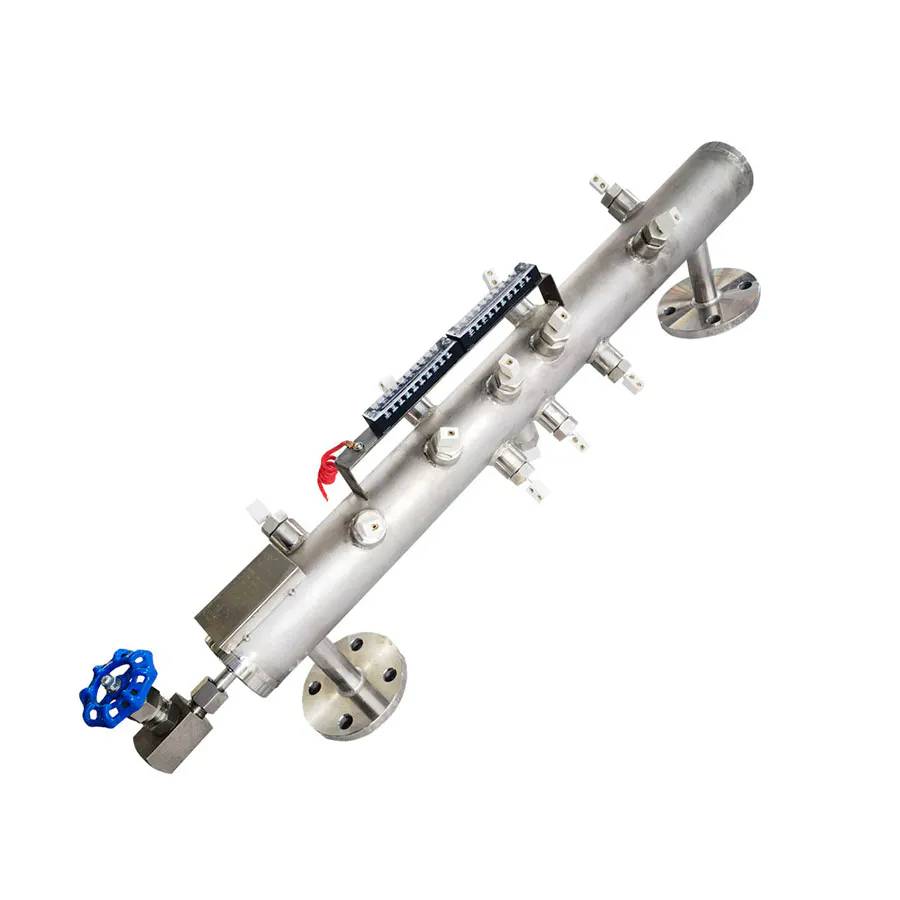
Диапазон измерений: 440-2200 мм
Рабочее давление: 22MPa
Download liquid level gauge product information EN document
The level gauge can be used for level measurement of various industrial media such as water, oil, chemical liquids, corrosive media, high-viscosity liquids and slurries.
Level gauges are critical components in modern industrial automation systems designed to monitor and control the height of liquids, solids, or interfaces within tanks, silos, vessels, and pipelines. These instruments provide real‑time level data that help prevent overflow, dry‑run conditions, and process interruptions — ensuring safety, efficiency, and compliance across various applications.
Компания Instrava предлагает широкий ассортимент высокопроизводительных приборов для измерения уровня, обеспечивающих точность, долговечность и беспрепятственную интеграцию в промышленные системы управления.
What Is Level Gauge?
A измеритель уровня (English: Level Gauge / Level Transmitter; Русский: Уровнемер; Español: Medidor de nivel; Français: Jauge de niveau) is an industrial instrument used to measure, monitor, and display the real-time height or volume of liquids, slurries, or granular solids inside a tank, vessel, or silo.
Acting as the “eyes” of industrial automation, it plays a critical role in process control, inventory management, and safety prevention across industries such as chemical processing, oil and gas, water treatment, and power generation.
Depending on the application, level gauges operate on various physical principles—ranging from simple visual indicators (like magnetic flaps) to advanced, non-contact electronic technologies like Радар, Ультразвуковой, и Guided Wave Radar (GWR)—ensuring precise data transmission even under extreme conditions of high pressure, high temperature, or corrosive environments.
Common Types of Level Gauge
Industrial processes vary widely in media, conditions, and accuracy requirements. Below are the most widely used level gauges type:
1. Capacitive Level Gauge
Operates on the principle that the capacitance formed between the measuring probe and the vessel wall (or an auxiliary electrode) changes with the material level. Variations in the medium’s height alter the dielectric constant or the electrode coverage area, which is then converted into standard electrical signals.
✔ Zero Mechanical Wear: Compact structure with no moving parts, ensuring extremely low maintenance costs.
✔ High Pressure Resistance: Capable of operating stably under ultra-high pressure, high vacuum, or high-temperature environments.
✔ Versatile Applications: Highly suitable for measuring conductive/non-conductive liquids, highly corrosive media, and powders or granules.
2. Displacer Level Gauge
Based on Archimedes’ buoyancy principle. A displacer (internal cylinder) suspended from a spring or torque tube is immersed in the liquid. As the liquid level rises, the buoyant force on the displacer increases, reducing its apparent weight. The mechanical structure converts this weight change into a level signal.
✔ High-Precision Measurement: Exceptionally well-suited for measuring the interface between two liquids of different densities.
✔ Extreme Process Conditions: Exhibits excellent stability in large vessels under high temperatures, high pressures, and high vacuums.
✔ Turbulence Resistance: Compared to standard floats, the displacer provides superior suppression against turbulent surfaces or wave action.
3. Electrode Level Gauge (Conductivity Level Switch)
Utilizes the electrical conductivity of liquids to detect levels. When the liquid comes into contact with metal electrode rods of varying lengths, the electrical circuit closes, triggering a switch signal or controlling pump start/stop operations.
✔ Highly Cost-Effective: Simple configuration, making it one of the most economical solutions for level control.
✔ Rapid Response Time: Contact-type switching provides immediate, direct signal triggering.
✔ Ideal Applications: Exclusively designed for multi-point limit alarm and control of conductive liquids such as water, wastewater, acids, and alkalis.
4. Float Level Gauge
Operates on basic buoyancy, where a hollow float containing a magnet or connected to a mechanical link rides directly on the liquid surface. The vertical displacement of the float is converted into a mechanical indication or electrical output via connecting rods, wire ropes, or internal magnetic reed switches.
✔ Simple Structure: Proven, intuitive technology that is easy to install and maintain.
✔ High Cost-Performance: Ideal for continuous measurement in standard storage tanks, sumps, and open basins.
✔ Independent of Medium Properties: Measurement results are unaffected by changes in liquid density, electrical conductivity, or dielectric constants.
5. Glass Level Gauge
Based on the principle of communicating vessels. A robust transparent glass tube or flat plate assembly is connected directly to the side of the vessel. Due to pressure equalization, the liquid rises to an identical height within the glass chamber, allowing direct visual inspection by operators.
✔ Direct & Reliable: Provides 100% authentic local visual verification with zero power required.
✔ Severe Service Duty: Utilizes specialized explosion-proof and high-pressure reinforced glass, making it suitable for high-temperature, high-pressure boilers.
✔ Zero Electronic Failures: Completely immune to electromagnetic interference, signal loss, or electronic component aging.
6. Magnetic Level Gauge
Connected to the primary vessel via a bypass chamber containing an internal float with a built-in magnet. As the liquid level shifts, the float drives the external indicator—composed of red/white (or black/yellow) magnetic rollers—to flip 180°, delivering a high-contrast boundary display.
✔ High Local Visibility: Provides clear, long-distance visual indication of the level without needing an external power supply.
✔ Secure Isolation: Complete magnetic isolation between the measuring chamber and the indicator array ensures “zero leakage” of hazardous process media.
✔ Excellent Extensibility: Can be easily equipped with magnetostrictive sensors or magnetic switches to output synchronous 4-20mA remote transmission signals.
7. Magnetostrictive Level Gauge
The electronic housing emits a current pulse that travels down a waveguide wire, generating a circular magnetic field. When this field meets the magnetic field of the float riding on the liquid, a mechanical strain wave is generated and reflected back to the sensor head. The level is determined with extreme precision by calculating the Time-of-Flight (ToF).
✔ Ultra-High Precision: Accuracy typically reaches millimeter ($mm$) or micrometer ($\mu m$) levels, making it the preferred choice for custody transfer and commercial billing.
✔ Dual Interface Measurement: By utilizing floats with distinct densities, it can simultaneously and precisely measure the total level and the oil-water interface.
✔ Outstanding Stability: Entirely unaffected by variations in temperature, pressure, vapor, mist, or the dielectric constant of the medium.
8. Radar Level Gauge
A non-contact measurement technology. The antenna emits high-frequency microwave pulses (typically 26GHz or 80GHz) toward the material surface. The microwaves reflect off the medium, and the antenna receives the return echo, determining the distance by calculating the wave’s travel time or frequency differential.
✔ Robust Performance: Completely immune to vacuum, high pressure, extreme high temperatures (up to thousands of degrees), and heavy vapors.
✔ Zero-Maintenance Design: The non-contact probe eliminates issues related to corrosion, wear, coating, or scaling.
✔ High Focusing Capability: Modern high-frequency (e.g., 80GHz) radar features an extremely narrow beam angle, easily avoiding internal tank obstructions like agitators or ladders.
9. Ultrasonic Level Gauge
A non-contact measurement technology. The transducer (probe) mounted at the top emits high-frequency acoustic pulses. The sound waves strike the surface of the liquid or solid and reflect back. The probe receives the echo and calculates the level based on the round-trip travel time.
✔ Economic Non-Contact Solution: Offers the most competitive cost-performance ratio among non-contact measurement alternatives.
✔ Effortless Installation: Top-mounted, integrated design allows for plug-and-play deployment and highly intuitive commissioning.
✔ Ideal Applications: Extensively used in open-channel flow monitoring, municipal wastewater management, acid/alkali storage tanks, and atmospheric water applications.
How Level Gauge Work
The Universal Principle: The “Zero-Point” Distance Formula
While different level gauges use completely different physical mechanisms—ranging from mechanical floats to acoustic waves—almost all continuous electronic level gauges (like Radar, Ultrasonic, and Magnetostrictive) calculate the liquid level using a fundamental distance subtraction formula:
Tank Height ($H$): A fixed reference value configured into the gauge during installation (the distance from the sensor face to the bottom of the tank).
Measured Distance ($D$): The real-time distance from the sensor down to the liquid surface, which changes constantly.
How Each Type Works (The Physics Broken Down)
To understand how a specific level gauge works, we look at the exact physics it uses to find either that Distance ($D$) or the direct physical position of the fluid surface.
1. Non-Contact Radar & Ultrasonic (Time-of-Flight Principle)
Both technologies act like industrial “echolocators.”
The Action: A sensor mounted at the top of the tank fires a signal downward. Radar fires high-frequency microwave pulses (at the speed of light), while Ultrasonic fires acoustic sound waves (at the speed of sound).
The Reflection: The wave hits the liquid surface and bounces back up to the sensor.
The Calculation: The gauge’s internal microprocessor records the precise round-trip transit time ($t$). Since the speed of the wave ($v$) is known, it calculates the distance using:
2. Guided Wave Radar – GWR (Contact Microwave Guidance)
GWR functions similarly to standard radar, but with a physical guide.
The Action: Instead of broadcasting microwaves through the open air, GWR launches the pulse down a rigid metal rod or flexible cable probe immersed in the liquid.
The Reflection: When the pulse hits the boundary between the upper air/gas layer and the lower liquid, it encounters a sudden drop in the dielectric constant ($\varepsilon_r$). This electrical mismatch forces the microwave pulse to reflect straight back up the probe to the transmitter head, which measures the Time-of-Flight.
3. Magnetostrictive (Wiegand Effect & Magnetic Interaction)
This is one of the most precise methods for commercial and custody transfer applications.
The Action: The sensor head sends a high-speed electrical current pulse down a specialized ferromagnetic waveguide wire inside the probe tube. This current creates a temporary circular magnetic field around the wire.
The Intersection: A permanent magnetic float rides up and down the tube on top of the liquid. Where the circular magnetic field meets the float’s magnetic field, a physical distortional strain (a torsional wave) is instantly triggered in the wire (known as the Wiegand effect).
The Calculation: This mechanical wave travels back up the wire to the sensor head at a known speed of sound. The sensor calculates exactly where the float is located based on how long it took for the wave to arrive.
4. Magnetic Level Gauge (Bypass Magnetic Coupling)
A purely mechanical, highly visible method that requires zero electrical power.
The Action: A bypass chamber is mounted to the side of the tank. Because of the law of communicating vessels, the liquid inside the chamber always mirrors the level inside the main tank.
The Coupling: Inside the chamber, a sealed float containing strong permanent magnets rides the liquid surface. Outside the chamber, an airtight scale of interlocking, dual-colored magnetic rollers (usually red and white) is attached.
The Visual: As the float moves, its internal magnetic field reaches through the stainless steel chamber wall and physically flips the rollers 180°. The color boundary shifts instantly, creating a clear visual line.
5. Hydrostatic / Differential Pressure (Weight of the Liquid Column)
This method relies entirely on fluid mechanics.
The Action: A pressure sensor is placed at the very bottom of the tank. It detects the force exerted by the weight of the liquid directly above it.
The Calculation: The sensor calculates the height ($h$) using the standard hydrostatic equation:
(Where $P$ is pressure, $\rho$ is the known density of the fluid, and $g$ is gravity).
Примечание: For closed, pressurized tanks, a Differential Pressure (DP) transmitter is used. It measures both the bottom pressure and the top gas pressure, subtracting the top pressure so it only calculates the true weight of the liquid column.
6. Capacitive (The Liquid as an Electrical Component)
The Action: An insulated metal rod probe is inserted into the tank, acting as one plate of a giant electrical capacitor. The metal walls of the tank act as the second plate.
The Shift: Air has a dielectric constant ($\varepsilon_r$) of roughly 1, while process liquids have much higher values (e.g., water is $\approx 80$). As the liquid rises and displaces the air between the probe and the wall, the overall electrical capacitance increases proportionally. The transmitter detects this change in capacitance and scales it to a 0–100% level reading.
Industrial Applications of Level Gauge
Level gauges are indispensable across nearly every process industry. By providing precise data to distributed control systems (DCS), they prevent catastrophic overflows, protect expensive equipment, and ensure accurate inventory tracking.
The primary industrial sectors where level gauges are heavily deployed include:
1. Oil & Gas (Petrochemicals)
The oil and gas industry requires high-precision instruments capable of handling explosive vapors, toxic gases, and extreme pressures.
Приложения: Oil-water interface measurement in separators, custody transfer tracking in large crude storage tanks, and monitoring liquefied natural gas (LNG) at cryogenic temperatures.
Preferred Gauges: Magnetostrictive Level Gauges (for high-accuracy dual interface tracking), Радарные уровнемеры (80GHz non-contact for large tanks), and Displacer Level Gauges (for heavy-duty high-pressure separators).
2. Химическая обработка
Chemical plants handle aggressive, highly corrosive, and flammable fluids that can rapidly degrade standard mechanical instrumentation.
Приложения: Bulk storage of highly concentrated acids (like sulfuric or hydrochloric acid), alkali mixing tanks, and high-temperature chemical reactors.
Preferred Gauges: Non-Contact Radar (with PTFE-coated horn antennas to resist corrosion) and Magnetic Level Gauges (utilizing specialized plastic or exotic metal linings like Hastelloy for zero-leakage local display).
3. Power Generation & Energy
Power plants rely heavily on steam cycles, requiring level measurement under severe high-temperature and high-pressure (HP) conditions.
Приложения: Boiler steam drum level control, feedwater heater tracking, condenser hotwells, and oil level monitoring in massive power transformers.
Preferred Gauges: Glass Level Gauges (high-pressure reflex or transparent plates for direct steam boiler verification), Guided Wave Radar (GWR) (with dynamic vapor compensation to adjust for dense steam), and Differential Pressure (DP) Transmitters.
4. Water & Wastewater Treatment
Water treatment facilities require rugged, cost-effective, and low-maintenance solutions capable of handling open-air environments and dirty, debris-filled fluids.
Приложения: Sewage wet wells, clarifier tanks, chemical dosing skids (alum, chlorine), and open-channel flow monitoring (weirs/flumes).
Preferred Gauges: Ultrasonic Level Gauges (the primary economic choice for open-air basins), Float Level Gauges/Switches (for pump control and overflow prevention), and Electrode Level Gauges (for simple multi-point limit alarms in clean water tanks).
5. Food, Beverage & Pharmaceuticals
Sanitation is paramount in these sectors. Instruments must comply with strict hygienic standards (like 3A or EHEDG) to prevent bacterial growth and survive Clean-In-Place (CIP) or Sterilize-In-Place (SIP) washdown cycles.
Приложения: Dairy storage silos, fermentation vessels, beer brewing tanks, and pure water purification loops.
Preferred Gauges: Capacitive Level Gauges (hygienic flush-mount designs), Non-Contact Radar (with stainless steel housings and sanitary tri-clamp fittings), and Hydrostatic Pressure Sensors (hygienic diaphragm type).
How to Choose the Right Level gauge
Selecting the right level gauge is about matching your specific process conditions with the physical limits of the measurement technology. There is no single “perfect” level gauge—only the right gauge for your specific application.
To make the right choice, engineers follow a systematic 4-step selection process.
The 4-Step Selection Process
Step 1: Characterize the Medium
The physical and chemical properties of what you are measuring eliminate half of your options immediately.
State: Is it a clean liquid, slurry, paste, or bulk solid (powders/granules)? Ultrasonic struggles with heavy dust solids; Radar or Capacitive handles them better.
Corrosivity: Will it eat through stainless steel? Aggressive chemicals require non-contact radar or magnetic gauges with PTFE/PP linings.
Electrical Properties: For Radar and GWR, check the Dielectric Constant ($\varepsilon_r$). Low $\varepsilon_r$ fluids (like oils or solvents) reflect weak radar signals. For Electrode gauges, the liquid must be conductive.
Step 2: Define Process Conditions
Exceeding a gauge’s operating limits leads to immediate instrument failure or unsafe leakage.
Температура и давление: High-pressure boilers or cryogenic tanks require heavy-duty mechanical options (Glass/Magnetic gauges) or high-frequency Non-Contact Radar.
Vapor & Foam: Heavy steam or surface foam dampens acoustic waves (Ultrasonic) and open-air microwaves (Radar). Guided Wave Radar (GWR) or Hydrostatic DP transmitters are much more stable here.
Step 3: Assess Tank Geometry & Installation
Where and how the gauge mounts dictates the mechanical form factor.
Internal Obstructions: Does the tank have agitator blades, heating coils, or structural baffles? Standard radar beams might bounce off them. Use a narrow 80GHz radar or a GWR probe inside a bypass chamber.
Mounting Connections: Check the top or side nozzle size and rating (e.g., Flanged or Threaded Tri-clamp). Side connections require Magnetic or Glass gauges; top connections favor Radar, Ultrasonic, or Floats.
Step 4: Determine Function & Budget
Indication vs. Control: Do you just need a local operator to see the level (Magnetic/Glass), or do you need a continuous signal (4-20mA, HART, Modbus) sent to a DCS/PLC?
Требования к точности: Is this for rough inventory monitoring ($\pm 10\text{ mm}$ is fine) or high-value custody transfer commercial billing where millimeter ($\pm 1\text{ mm}$) accuracy is mandatory? For custody transfer, choose Magnetostrictive or high-precision Radar.
Technology Selection Matrix
Use this quick-reference table to cross-match your dominant process challenge with the ideal technology:
| If your process has… | Best Technology Choice | Why it works | What to Avoid |
| Heavy Surface Foam | Guided Wave Radar (GWR) / Hydrostatic | Traverses through foam to find the true liquid layer | Non-Contact Radar / Ultrasonic (signals get absorbed) |
| Aggressive Acids ($HCl, H_2SO_4$) | Non-Contact Radar (PTFE) / Magnetic (Plastic Lined) | No metal contact with the corrosive fluid | Standard metallic floats or bare probes |
| Internal Agitators / Obstacles | 80GHz Radar / Magnetic Bypass | Narrow beam avoids obstacles; bypass isolates the measurement | Wide-beam Radar or loose float switches |
| Vapor / Heavy Steam Layers | Hydrostatic DP / GWR with Vapor Comp | Pressure and guided probes are unaffected by ambient gas | Ultrasonic (speed of sound changes with gas density) |
| High Accuracy Custody Transfer | Magnetostrictive / 80GHz Radar | Provides millimeter-level repeatability | Hydrostatic DP (affected by temperature/density shifts) |
| Zero Power / Remote Fields | Magnetic Level Gauge / Glass Gauge | Relies entirely on mechanical buoyancy and optics | All electronic transmitters |
Совет профессионала: When dealing with sticky, coating-prone fluids (like wastewater sludge or resins), always lean toward non-contact technologies (Ultrasonic or Radar). Contact probes will inevitably suffer from product buildup, causing the sensor to output false high-level readings.
Level Gauge Knowledge Hub
На этой странице представлен структурированный, ориентированный на инженеров обзор промышленных измерений уровня. Она предназначена для поддержки решений по выбору, применению и проектированию систем, а не для основных определений. Содержание отражает реальные условия процесса и долгосрочные эксплуатационные соображения.
1. Роль измерения уровня в промышленных системах
Измерение уровня является основным компонентом безопасности, контроля и управления запасами. В промышленных условиях информация об уровне редко используется изолированно. Она служит опорой для блокировок, аварийных сигналов, контроля партий и баланса материалов. Ценность устройства для измерения уровня заключается не только в точности, но и в его стабильности, доступности и совместимости с общей системой.
Основные задачи систем измерения уровня включают:
Предотвращение переполнения или работы вхолостую
Поддержание непрерывности и сбалансированности процесса
Поддержка функций, связанных с безопасностью
Предоставление надежных данных для автоматизации и оптимизации
2. Уровнемер, датчик уровня и преобразователь уровня - роли системы
Различные устройства для измерения уровня выполняют разные функции в системе:
Уровнемеры обеспечивают локальную визуальную индикацию для операторов и обслуживающего персонала.
Датчики уровня преобразуют изменения уровня в электрические сигналы для управления или сигнализации.
Преобразователи уровня обеспечивают стандартизированные выходы для интеграции в системы ПЛК, DCS или SCADA.
Во многих приложениях эти устройства используются вместе, чтобы обеспечить резервирование, перекрестную проверку и гибкость в работе. Выбор правильной комбинации зачастую важнее, чем выбор одного типа устройства.
3. Ключевые факторы выбора приборов для измерения уровня
Эффективный выбор начинается с условий процесса, а не с типа продукта. К важнейшим факторам относятся:
Свойства технологической среды, такие как плотность, вязкость, коррозионная активность, пенообразование или содержание твердых частиц
Диапазоны рабочего давления и температуры
Геометрия судна и ограничения на установку
Необходимое время отклика и стабильность сигнала
Доступ к техническому обслуживанию и стоимость жизненного цикла
Датчик уровня, хорошо работающий в лабораторных условиях, может вести себя совершенно иначе в реальной промышленной среде. При выборе следует отдавать предпочтение надежности в реальных условиях эксплуатации.
4. Проблемы измерений, ориентированных на приложения
4.1 Сосуды высокого давления и высокой температуры
В системах, работающих под давлением или при высоких температурах, механическая целостность и надежность уплотнения становятся критически важными. Уровнемеры и датчики уровня должны сохранять свои рабочие характеристики без ухудшения качества материала или дрейфа сигнала с течением времени.
4.2 Среда с пеной, покрытием или твердыми частицами
Пенящиеся жидкости, липкие среды или взвешенные твердые частицы могут помешать измерению уровня. Некоторые принципы измерения переносят эти условия лучше, чем другие. Правильный подбор технологии и смачиваемых материалов снижает количество ложных показаний и частоту технического обслуживания.
4.3 Динамические условия процесса
Быстрое наполнение, опорожнение или перемешивание вносит турбулентность, которая может исказить показания уровня. Место установки и демпфирующие характеристики датчика уровня играют ключевую роль в достижении стабильности измерений.
5. Установка и интеграция системы
Качество установки напрямую влияет на производительность измерения уровня. К важным аспектам относятся:
Расположение форсунок относительно входов, выходов и мешалок
Вертикальное выравнивание и жесткость крепления
Электрическое заземление и экранирование сигналов
Интеграция с системами управления и логикой сигнализации
Хорошо продуманная установка часто повышает надежность измерений больше, чем постепенное повышение точности датчиков.
6. Надежность, резервирование и стратегия безопасности
В системах, связанных с безопасностью, измерение уровня редко зависит от одного устройства. Общие стратегии включают:
Комбинирование местных уровнемеров с независимыми датчиками уровня
Использование отдельных устройств для управления и сигнализации высокого уровня
Реализация обнаружения неисправностей и проверки сигналов в системе управления
Эти подходы снижают риск необнаружения отказа и поддерживают безопасную работу в нештатных условиях.
7. Техническое обслуживание, калибровка и стоимость жизненного цикла
На стоимость жизненного цикла влияет не только цена покупки. Ключевыми факторами являются:
Частота и доступность калибровки
Требования к очистке или проверке
Наличие запасных частей
Время простоя во время технического обслуживания
Выбор приборов для измерения уровня с низкими требованиями к обслуживанию может значительно снизить общую стоимость владения в течение всего жизненного цикла системы.
8. Отраслевая практика измерения уровня
Практика измерения уровня зависит от отрасли:
В перерабатывающей промышленности приоритет отдается надежности и долгосрочной стабильности
В системах водоснабжения и очистки сточных вод особое внимание уделяется коррозионной стойкости и простоте обслуживания
Применение в нефтяной и газовой промышленности часто требует соблюдения стандартов для опасных зон
Понимание отраслевых ожиданий помогает согласовать стратегию измерений с операционной реальностью.
9. Общие ошибки системного уровня при измерении уровня
Часто встречающиеся проблемы в проектах по измерению уровня включают:
Выбор устройств только на основе характеристик точности
Игнорирование ограничений на установку при проектировании
Недооценка влияния вариативности процесса
Использование одной точки измерения для критически важных функций
Чтобы избежать этих ошибок, необходимо ориентироваться на системный уровень, а не на продукт.
10. Построение надежной стратегии измерения уровня
Надежная стратегия измерения уровня рассматривает выбор, установку, интеграцию и обслуживание устройств как единую систему. Сосредоточившись на долгосрочной производительности и эксплуатационном контексте, уровнемеры и датчики уровня могут обеспечить постоянную ценность на протяжении всего срока службы установки.
Эта структура знаний предназначена для поддержки принятия обоснованных решений и непрерывного совершенствования систем измерения промышленного уровня.
Уровнемер-FAQ
Как выбрать уровнемер для длительной промышленной эксплуатации?
Выбор уровнемера должен основываться на условиях эксплуатации, таких как давление, температура, свойства среды и ограничения по установке. Для непрерывной работы стабильность и устойчивость к колебаниям процесса часто важнее лабораторной точности. Во многих промышленных системах уровнемер также выполняет функцию датчика уровня для управления или сигнализации, поэтому надежность сигнала с течением времени является критически важным фактором.
Какие факторы чаще всего влияют на точность измерения уровня в реальных приложениях?
В реальных технологических условиях на точность измерений влияют изменения плотности среды, колебания температуры, механические вибрации и отложения на смачиваемых деталях. В отличие от идеальных условий испытаний, промышленные уровнемеры должны выдерживать эти факторы, сохраняя при этом повторяемость результатов. Выбор датчика уровня, разработанного для реальных условий процесса, значительно снижает долгосрочные отклонения.
Как положение установки влияет на работу уровнемера?
Расположение установки напрямую влияет на надежность измерений. Ориентация сопла, геометрия емкости, близость к впускным отверстиям или мешалкам могут вызвать турбулентность или ложные показания. Правильное расположение гарантирует, что уровнемер или датчик уровня отражает истинный уровень жидкости, а не локальные возмущения в емкости.
В каких случаях местный уровнемер следует комбинировать с датчиком уровня или преобразователем уровня?
Местные уровнемеры обеспечивают визуальное подтверждение и часто используются для плановой проверки, в то время как датчики уровня или передатчики позволяют осуществлять дистанционный мониторинг и управление. Во многих случаях сочетание обеих систем повышает безопасность эксплуатации, обеспечивая избыточность и перекрестную проверку визуальной индикации и электронных сигналов.
Как свойства рабочей среды влияют на выбор уровнемера и датчика уровня?
При выборе важную роль играют такие свойства среды, как вязкость, коррозионная активность, склонность к пенообразованию и наличие твердых частиц. Некоторые уровнемеры хорошо работают с чистыми жидкостями, но могут испытывать трудности с липкими или абразивными средами. Соответствие конструкции датчика уровня и смачиваемых материалов измеряемой среде помогает предотвратить дрейф измерений и механические поломки.
Какие проблемы возникают при использовании уровнемеров в сосудах под высоким давлением или при высоких температурах?
Условия высокого давления и высокой температуры создают дополнительную нагрузку на уплотнения, материалы и измерительные компоненты. В таких условиях уровнемер должен сохранять механическую целостность, а датчик уровня оставаться стабильным и отзывчивым. Выбор конструкций, рассчитанных на полный рабочий диапазон, необходим для безопасного и надежного измерения.
Как оценивается надежность уровнемеров, используемых в системах безопасности?
Надежность оценивается по долговременной стабильности, устойчивости к нарушениям технологического процесса и постоянству выходных данных в изменяющихся условиях. В системах безопасности уровнемеры часто используются вместе с независимыми датчиками уровня для обеспечения многоуровневой защиты и снижения риска необнаруженного отклонения уровня.
Какие аспекты технического обслуживания влияют на стоимость жизненного цикла уровнемера?
Частота технического обслуживания, доступность и требования к повторной калибровке напрямую влияют на стоимость жизненного цикла. Датчик уровня, требующий частой очистки или регулировки, может показаться экономически эффективным на начальном этапе, но при этом увеличивается время простоя и трудоемкость обслуживания. Выбор датчика уровня с низкими требованиями к обслуживанию повышает общую эффективность системы.
Может ли одна конструкция уровнемера охватывать несколько конфигураций резервуаров или емкостей?
Хотя некоторые уровнемеры предлагают гибкие варианты монтажа, оптимальные характеристики обычно достигаются, когда конструкция соответствует типу емкости. Вертикальные резервуары, горизонтальные емкости и контейнеры под давлением ставят перед собой различные задачи измерения, поэтому при выборе важно учитывать специфику применения.
Как уровнемеры и датчики уровня помогают контролировать и оптимизировать процесс?
Помимо индикации, уровнемеры и датчики уровня обеспечивают критически важные данные для управления запасами, контроля процессов и систем сигнализации. Стабильные и точные данные об уровне помогают операторам поддерживать баланс процесса, предотвращать переполнение или сухое протекание и повышать общую эффективность работы.
Почему стоит доверять Instrava?
Мы выбираем производителей, руководствуясь нейтральной и беспристрастной позицией, всегда ставя во главу угла ваши интересы.
Наше существование зависит от того, чтобы помочь вам найти товары, которые идеально соответствуют вашим потребностям.
Благодаря тому, что наша компания базируется в Китае, мы имеем возможность лично проводить проверки производственных объектов и качества продукции на месте.
Мы помогаем вам избежать контактов с посредниками, выдающими себя за заводы.
Мы обеспечиваем более бесперебойное послепродажное обслуживание, устраняя проблемы, связанные с разницей во времени, и задержки, которые часто возникают при непосредственном взаимодействии с заводами.
Наша многоязычная команда обеспечивает эффективное общение.
Для стартапа в сфере трейдинга каждое взаимодействие с клиентом — это ценная возможность, свидетельствующая о том, что вы готовы довериться нам и дать нам шанс проявить себя.
В эпоху цифровых технологий, несмотря на широкую доступность информации, заблуждения зачастую подрывают доверие между людьми.
«Инстрава» полностью опирается на доверие; это наша основная философия и основа нашего существования в обществе. Это фундаментальная основа нашего долгосрочного роста и нашей приверженности служению обществу.
Пожалуйста, доверьтесь нам.