เกจวัดระดับ
หน้าแรก » เครื่องมือวัดระดับ
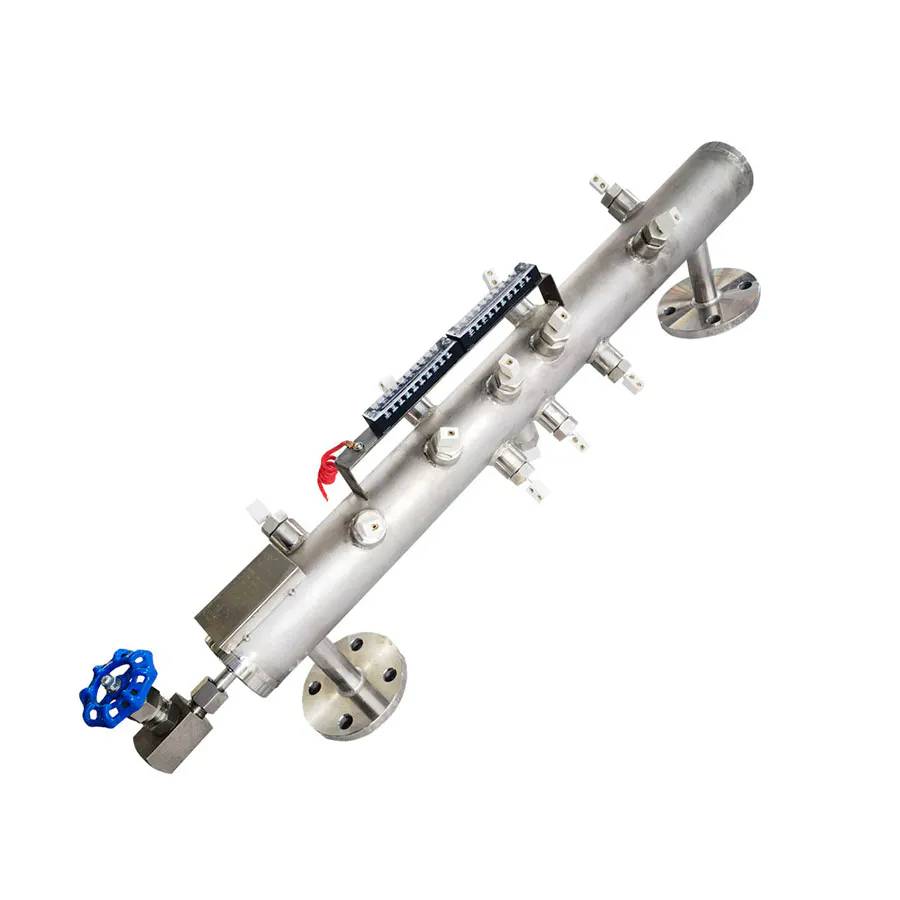
ช่วงการวัด: 440-2200 มม.
Working pressure: 22MPa
Download liquid level gauge product information EN document
The level gauge can be used for level measurement of various industrial media such as water, oil, chemical liquids, corrosive media, high-viscosity liquids and slurries.
Level gauges are critical components in modern industrial automation systems designed to monitor and control the height of liquids, solids, or interfaces within tanks, silos, vessels, and pipelines. These instruments provide real‑time level data that help prevent overflow, dry‑run conditions, and process interruptions — ensuring safety, efficiency, and compliance across various applications.
ที่ Instrava, เราให้บริการพอร์ตโฟลิโอกว้างขวางของเครื่องมือวัดระดับประสิทธิภาพสูงที่ออกแบบมาเพื่อความแม่นยำ, ความคงทน, และการผสานรวมอย่างราบรื่นเข้ากับระบบควบคุมอุตสาหกรรม.
What Is Level Gauge?
A เกจวัดระดับ (English: Level Gauge / Level Transmitter; Русский: Уровнемер; Español: Medidor de nivel; Français: Jauge de niveau) is an industrial instrument used to measure, monitor, and display the real-time height or volume of liquids, slurries, or granular solids inside a tank, vessel, or silo.
Acting as the “eyes” of industrial automation, it plays a critical role in process control, inventory management, and safety prevention across industries such as chemical processing, oil and gas, water treatment, and power generation.
Depending on the application, level gauges operate on various physical principles—ranging from simple visual indicators (like magnetic flaps) to advanced, non-contact electronic technologies like เรดาร์, อัลตราโซนิก, และ Guided Wave Radar (GWR)—ensuring precise data transmission even under extreme conditions of high pressure, high temperature, or corrosive environments.
Common Types of Level Gauge
Industrial processes vary widely in media, conditions, and accuracy requirements. Below are the most widely used level gauges type:
1. Capacitive Level Gauge
Operates on the principle that the capacitance formed between the measuring probe and the vessel wall (or an auxiliary electrode) changes with the material level. Variations in the medium’s height alter the dielectric constant or the electrode coverage area, which is then converted into standard electrical signals.
✔ Zero Mechanical Wear: Compact structure with no moving parts, ensuring extremely low maintenance costs.
✔ High Pressure Resistance: Capable of operating stably under ultra-high pressure, high vacuum, or high-temperature environments.
✔ Versatile Applications: Highly suitable for measuring conductive/non-conductive liquids, highly corrosive media, and powders or granules.
2. Displacer Level Gauge
Based on Archimedes’ buoyancy principle. A displacer (internal cylinder) suspended from a spring or torque tube is immersed in the liquid. As the liquid level rises, the buoyant force on the displacer increases, reducing its apparent weight. The mechanical structure converts this weight change into a level signal.
✔ High-Precision Measurement: Exceptionally well-suited for measuring the interface between two liquids of different densities.
✔ Extreme Process Conditions: Exhibits excellent stability in large vessels under high temperatures, high pressures, and high vacuums.
✔ Turbulence Resistance: Compared to standard floats, the displacer provides superior suppression against turbulent surfaces or wave action.
3. Electrode Level Gauge (Conductivity Level Switch)
Utilizes the electrical conductivity of liquids to detect levels. When the liquid comes into contact with metal electrode rods of varying lengths, the electrical circuit closes, triggering a switch signal or controlling pump start/stop operations.
✔ Highly Cost-Effective: Simple configuration, making it one of the most economical solutions for level control.
✔ Rapid Response Time: Contact-type switching provides immediate, direct signal triggering.
✔ Ideal Applications: Exclusively designed for multi-point limit alarm and control of conductive liquids such as water, wastewater, acids, and alkalis.
4. Float Level Gauge
Operates on basic buoyancy, where a hollow float containing a magnet or connected to a mechanical link rides directly on the liquid surface. The vertical displacement of the float is converted into a mechanical indication or electrical output via connecting rods, wire ropes, or internal magnetic reed switches.
✔ Simple Structure: Proven, intuitive technology that is easy to install and maintain.
✔ High Cost-Performance: Ideal for continuous measurement in standard storage tanks, sumps, and open basins.
✔ Independent of Medium Properties: Measurement results are unaffected by changes in liquid density, electrical conductivity, or dielectric constants.
5. Glass Level Gauge
Based on the principle of communicating vessels. A robust transparent glass tube or flat plate assembly is connected directly to the side of the vessel. Due to pressure equalization, the liquid rises to an identical height within the glass chamber, allowing direct visual inspection by operators.
✔ Direct & Reliable: Provides 100% authentic local visual verification with zero power required.
✔ Severe Service Duty: Utilizes specialized explosion-proof and high-pressure reinforced glass, making it suitable for high-temperature, high-pressure boilers.
✔ Zero Electronic Failures: Completely immune to electromagnetic interference, signal loss, or electronic component aging.
6. Magnetic Level Gauge
Connected to the primary vessel via a bypass chamber containing an internal float with a built-in magnet. As the liquid level shifts, the float drives the external indicator—composed of red/white (or black/yellow) magnetic rollers—to flip 180°, delivering a high-contrast boundary display.
✔ High Local Visibility: Provides clear, long-distance visual indication of the level without needing an external power supply.
✔ Secure Isolation: Complete magnetic isolation between the measuring chamber and the indicator array ensures “zero leakage” of hazardous process media.
✔ Excellent Extensibility: Can be easily equipped with magnetostrictive sensors or magnetic switches to output synchronous 4-20mA remote transmission signals.
7. Magnetostrictive Level Gauge
The electronic housing emits a current pulse that travels down a waveguide wire, generating a circular magnetic field. When this field meets the magnetic field of the float riding on the liquid, a mechanical strain wave is generated and reflected back to the sensor head. The level is determined with extreme precision by calculating the Time-of-Flight (ToF).
✔ Ultra-High Precision: Accuracy typically reaches millimeter ($mm$) or micrometer ($\mu m$) levels, making it the preferred choice for custody transfer and commercial billing.
✔ Dual Interface Measurement: By utilizing floats with distinct densities, it can simultaneously and precisely measure the total level and the oil-water interface.
✔ Outstanding Stability: Entirely unaffected by variations in temperature, pressure, vapor, mist, or the dielectric constant of the medium.
8. Radar Level Gauge
A non-contact measurement technology. The antenna emits high-frequency microwave pulses (typically 26GHz or 80GHz) toward the material surface. The microwaves reflect off the medium, and the antenna receives the return echo, determining the distance by calculating the wave’s travel time or frequency differential.
✔ Robust Performance: Completely immune to vacuum, high pressure, extreme high temperatures (up to thousands of degrees), and heavy vapors.
✔ Zero-Maintenance Design: The non-contact probe eliminates issues related to corrosion, wear, coating, or scaling.
✔ High Focusing Capability: Modern high-frequency (e.g., 80GHz) radar features an extremely narrow beam angle, easily avoiding internal tank obstructions like agitators or ladders.
9. Ultrasonic Level Gauge
A non-contact measurement technology. The transducer (probe) mounted at the top emits high-frequency acoustic pulses. The sound waves strike the surface of the liquid or solid and reflect back. The probe receives the echo and calculates the level based on the round-trip travel time.
✔ Economic Non-Contact Solution: Offers the most competitive cost-performance ratio among non-contact measurement alternatives.
✔ Effortless Installation: Top-mounted, integrated design allows for plug-and-play deployment and highly intuitive commissioning.
✔ Ideal Applications: Extensively used in open-channel flow monitoring, municipal wastewater management, acid/alkali storage tanks, and atmospheric water applications.
How Level Gauge Work
The Universal Principle: The “Zero-Point” Distance Formula
While different level gauges use completely different physical mechanisms—ranging from mechanical floats to acoustic waves—almost all continuous electronic level gauges (like Radar, Ultrasonic, and Magnetostrictive) calculate the liquid level using a fundamental distance subtraction formula:
Tank Height ($H$): A fixed reference value configured into the gauge during installation (the distance from the sensor face to the bottom of the tank).
Measured Distance ($D$): The real-time distance from the sensor down to the liquid surface, which changes constantly.
How Each Type Works (The Physics Broken Down)
To understand how a specific level gauge works, we look at the exact physics it uses to find either that Distance ($D$) or the direct physical position of the fluid surface.
1. Non-Contact Radar & Ultrasonic (Time-of-Flight Principle)
Both technologies act like industrial “echolocators.”
The Action: A sensor mounted at the top of the tank fires a signal downward. Radar fires high-frequency microwave pulses (at the speed of light), while Ultrasonic fires acoustic sound waves (at the speed of sound).
The Reflection: The wave hits the liquid surface and bounces back up to the sensor.
The Calculation: The gauge’s internal microprocessor records the precise round-trip transit time ($t$). Since the speed of the wave ($v$) is known, it calculates the distance using:
2. Guided Wave Radar – GWR (Contact Microwave Guidance)
GWR functions similarly to standard radar, but with a physical guide.
The Action: Instead of broadcasting microwaves through the open air, GWR launches the pulse down a rigid metal rod or flexible cable probe immersed in the liquid.
The Reflection: When the pulse hits the boundary between the upper air/gas layer and the lower liquid, it encounters a sudden drop in the dielectric constant ($\varepsilon_r$). This electrical mismatch forces the microwave pulse to reflect straight back up the probe to the transmitter head, which measures the Time-of-Flight.
3. Magnetostrictive (Wiegand Effect & Magnetic Interaction)
This is one of the most precise methods for commercial and custody transfer applications.
The Action: The sensor head sends a high-speed electrical current pulse down a specialized ferromagnetic waveguide wire inside the probe tube. This current creates a temporary circular magnetic field around the wire.
The Intersection: A permanent magnetic float rides up and down the tube on top of the liquid. Where the circular magnetic field meets the float’s magnetic field, a physical distortional strain (a torsional wave) is instantly triggered in the wire (known as the Wiegand effect).
The Calculation: This mechanical wave travels back up the wire to the sensor head at a known speed of sound. The sensor calculates exactly where the float is located based on how long it took for the wave to arrive.
4. Magnetic Level Gauge (Bypass Magnetic Coupling)
A purely mechanical, highly visible method that requires zero electrical power.
The Action: A bypass chamber is mounted to the side of the tank. Because of the law of communicating vessels, the liquid inside the chamber always mirrors the level inside the main tank.
The Coupling: Inside the chamber, a sealed float containing strong permanent magnets rides the liquid surface. Outside the chamber, an airtight scale of interlocking, dual-colored magnetic rollers (usually red and white) is attached.
The Visual: As the float moves, its internal magnetic field reaches through the stainless steel chamber wall and physically flips the rollers 180°. The color boundary shifts instantly, creating a clear visual line.
5. Hydrostatic / Differential Pressure (Weight of the Liquid Column)
This method relies entirely on fluid mechanics.
The Action: A pressure sensor is placed at the very bottom of the tank. It detects the force exerted by the weight of the liquid directly above it.
The Calculation: The sensor calculates the height ($h$) using the standard hydrostatic equation:
(Where $P$ is pressure, $\rho$ is the known density of the fluid, and $g$ is gravity).
Note: For closed, pressurized tanks, a Differential Pressure (DP) transmitter is used. It measures both the bottom pressure and the top gas pressure, subtracting the top pressure so it only calculates the true weight of the liquid column.
6. Capacitive (The Liquid as an Electrical Component)
The Action: An insulated metal rod probe is inserted into the tank, acting as one plate of a giant electrical capacitor. The metal walls of the tank act as the second plate.
The Shift: Air has a dielectric constant ($\varepsilon_r$) of roughly 1, while process liquids have much higher values (e.g., water is $\approx 80$). As the liquid rises and displaces the air between the probe and the wall, the overall electrical capacitance increases proportionally. The transmitter detects this change in capacitance and scales it to a 0–100% level reading.
Industrial Applications of Level Gauge
Level gauges are indispensable across nearly every process industry. By providing precise data to distributed control systems (DCS), they prevent catastrophic overflows, protect expensive equipment, and ensure accurate inventory tracking.
The primary industrial sectors where level gauges are heavily deployed include:
1. Oil & Gas (Petrochemicals)
The oil and gas industry requires high-precision instruments capable of handling explosive vapors, toxic gases, and extreme pressures.
Applications: Oil-water interface measurement in separators, custody transfer tracking in large crude storage tanks, and monitoring liquefied natural gas (LNG) at cryogenic temperatures.
Preferred Gauges: Magnetostrictive Level Gauges (for high-accuracy dual interface tracking), Radar Level Gauges (80GHz non-contact for large tanks), and Displacer Level Gauges (for heavy-duty high-pressure separators).
2. การแปรรูปทางเคมี
Chemical plants handle aggressive, highly corrosive, and flammable fluids that can rapidly degrade standard mechanical instrumentation.
Applications: Bulk storage of highly concentrated acids (like sulfuric or hydrochloric acid), alkali mixing tanks, and high-temperature chemical reactors.
Preferred Gauges: Non-Contact Radar (with PTFE-coated horn antennas to resist corrosion) and Magnetic Level Gauges (utilizing specialized plastic or exotic metal linings like Hastelloy for zero-leakage local display).
3. Power Generation & Energy
Power plants rely heavily on steam cycles, requiring level measurement under severe high-temperature and high-pressure (HP) conditions.
Applications: Boiler steam drum level control, feedwater heater tracking, condenser hotwells, and oil level monitoring in massive power transformers.
Preferred Gauges: Glass Level Gauges (high-pressure reflex or transparent plates for direct steam boiler verification), Guided Wave Radar (GWR) (with dynamic vapor compensation to adjust for dense steam), and Differential Pressure (DP) Transmitters.
4. Water & Wastewater Treatment
Water treatment facilities require rugged, cost-effective, and low-maintenance solutions capable of handling open-air environments and dirty, debris-filled fluids.
Applications: Sewage wet wells, clarifier tanks, chemical dosing skids (alum, chlorine), and open-channel flow monitoring (weirs/flumes).
Preferred Gauges: Ultrasonic Level Gauges (the primary economic choice for open-air basins), Float Level Gauges/Switches (for pump control and overflow prevention), and Electrode Level Gauges (for simple multi-point limit alarms in clean water tanks).
5. Food, Beverage & Pharmaceuticals
Sanitation is paramount in these sectors. Instruments must comply with strict hygienic standards (like 3A or EHEDG) to prevent bacterial growth and survive Clean-In-Place (CIP) or Sterilize-In-Place (SIP) washdown cycles.
Applications: Dairy storage silos, fermentation vessels, beer brewing tanks, and pure water purification loops.
Preferred Gauges: Capacitive Level Gauges (hygienic flush-mount designs), Non-Contact Radar (with stainless steel housings and sanitary tri-clamp fittings), and Hydrostatic Pressure Sensors (hygienic diaphragm type).
How to Choose the Right Level gauge
Selecting the right level gauge is about matching your specific process conditions with the physical limits of the measurement technology. There is no single “perfect” level gauge—only the right gauge for your specific application.
To make the right choice, engineers follow a systematic 4-step selection process.
The 4-Step Selection Process
Step 1: Characterize the Medium
The physical and chemical properties of what you are measuring eliminate half of your options immediately.
State: Is it a clean liquid, slurry, paste, or bulk solid (powders/granules)? Ultrasonic struggles with heavy dust solids; Radar or Capacitive handles them better.
Corrosivity: Will it eat through stainless steel? Aggressive chemicals require non-contact radar or magnetic gauges with PTFE/PP linings.
Electrical Properties: For Radar and GWR, check the Dielectric Constant ($\varepsilon_r$). Low $\varepsilon_r$ fluids (like oils or solvents) reflect weak radar signals. For Electrode gauges, the liquid must be conductive.
Step 2: Define Process Conditions
Exceeding a gauge’s operating limits leads to immediate instrument failure or unsafe leakage.
อุณหภูมิและความดัน: High-pressure boilers or cryogenic tanks require heavy-duty mechanical options (Glass/Magnetic gauges) or high-frequency Non-Contact Radar.
Vapor & Foam: Heavy steam or surface foam dampens acoustic waves (Ultrasonic) and open-air microwaves (Radar). Guided Wave Radar (GWR) or Hydrostatic DP transmitters are much more stable here.
Step 3: Assess Tank Geometry & Installation
Where and how the gauge mounts dictates the mechanical form factor.
Internal Obstructions: Does the tank have agitator blades, heating coils, or structural baffles? Standard radar beams might bounce off them. Use a narrow 80GHz radar or a GWR probe inside a bypass chamber.
Mounting Connections: Check the top or side nozzle size and rating (e.g., Flanged or Threaded Tri-clamp). Side connections require Magnetic or Glass gauges; top connections favor Radar, Ultrasonic, or Floats.
Step 4: Determine Function & Budget
Indication vs. Control: Do you just need a local operator to see the level (Magnetic/Glass), or do you need a continuous signal (4-20mA, HART, Modbus) sent to a DCS/PLC?
ข้อกำหนดความถูกต้อง: Is this for rough inventory monitoring ($\pm 10\text{ mm}$ is fine) or high-value custody transfer commercial billing where millimeter ($\pm 1\text{ mm}$) accuracy is mandatory? For custody transfer, choose Magnetostrictive or high-precision Radar.
เมทริกซ์การเลือกเทคโนโลยี
Use this quick-reference table to cross-match your dominant process challenge with the ideal technology:
| If your process has… | Best Technology Choice | Why it works | What to Avoid |
| Heavy Surface Foam | Guided Wave Radar (GWR) / Hydrostatic | Traverses through foam to find the true liquid layer | Non-Contact Radar / Ultrasonic (signals get absorbed) |
| Aggressive Acids ($HCl, H_2SO_4$) | Non-Contact Radar (PTFE) / Magnetic (Plastic Lined) | No metal contact with the corrosive fluid | Standard metallic floats or bare probes |
| Internal Agitators / Obstacles | 80GHz Radar / Magnetic Bypass | Narrow beam avoids obstacles; bypass isolates the measurement | Wide-beam Radar or loose float switches |
| Vapor / Heavy Steam Layers | Hydrostatic DP / GWR with Vapor Comp | Pressure and guided probes are unaffected by ambient gas | Ultrasonic (speed of sound changes with gas density) |
| High Accuracy Custody Transfer | Magnetostrictive / 80GHz Radar | Provides millimeter-level repeatability | Hydrostatic DP (affected by temperature/density shifts) |
| Zero Power / Remote Fields | Magnetic Level Gauge / Glass Gauge | Relies entirely on mechanical buoyancy and optics | All electronic transmitters |
เคล็ดลับจากผู้เชี่ยวชาญ: When dealing with sticky, coating-prone fluids (like wastewater sludge or resins), always lean toward non-contact technologies (Ultrasonic or Radar). Contact probes will inevitably suffer from product buildup, causing the sensor to output false high-level readings.
Level Gauge Knowledge Hub
หน้านี้ให้ภาพรวมที่มีโครงสร้างและเน้นด้านวิศวกรรมเกี่ยวกับการวัดในระดับอุตสาหกรรม ออกแบบมาเพื่อสนับสนุนการตัดสินใจในการเลือก การใช้งาน และการออกแบบระบบ มากกว่าการให้คำจำกัดความพื้นฐาน เนื้อหานี้สะท้อนถึงสภาพกระบวนการจริงและการพิจารณาการดำเนินงานในระยะยาว.
1. บทบาทของการวัดระดับในระบบอุตสาหกรรม
การวัดระดับเป็นองค์ประกอบหลักของความปลอดภัยในกระบวนการ การควบคุม และการจัดการสินค้าคงคลัง ในสภาพแวดล้อมอุตสาหกรรม ข้อมูลระดับมักจะไม่ถูกใช้เพียงอย่างเดียว แต่จะสนับสนุนระบบล็อก การเตือน การควบคุมแบบเป็นชุด และการสมดุลของวัสดุ ค่าของอุปกรณ์วัดระดับไม่ได้อยู่ที่ความแม่นยำเพียงอย่างเดียว แต่ยังรวมถึงเสถียรภาพ ความพร้อมใช้งาน และความเข้ากันได้กับระบบโดยรวม.
วัตถุประสงค์หลักของระบบวัดระดับ ได้แก่:
ป้องกันการเติมเกินหรือการทำงานในสภาวะแห้ง
การรักษาความต่อเนื่องและความสมดุลของกระบวนการ
สนับสนุนฟังก์ชันที่เกี่ยวข้องกับความปลอดภัย
การจัดหาข้อมูลที่เชื่อถือได้สำหรับการอัตโนมัติและการเพิ่มประสิทธิภาพ
2. เกจวัดระดับ, เซ็นเซอร์วัดระดับ, และตัวส่งสัญญาณระดับ – บทบาทของระบบ
อุปกรณ์วัดระดับที่แตกต่างกันมีบทบาทต่างกันภายในระบบ:
เกจวัดระดับให้สัญญาณภาพท้องถิ่นสำหรับผู้ปฏิบัติงานและบุคลากรซ่อมบำรุง.
เซ็นเซอร์วัดระดับแปลงการเปลี่ยนแปลงของระดับเป็นสัญญาณไฟฟ้าเพื่อวัตถุประสงค์ในการควบคุมหรือแจ้งเตือน.
เครื่องส่งระดับให้เอาต์พุตมาตรฐานสำหรับการรวมเข้ากับระบบ PLC, DCS หรือ SCADA.
ในหลายแอปพลิเคชัน อุปกรณ์เหล่านี้ถูกใช้ร่วมกันเพื่อให้เกิดความซ้ำซ้อน การตรวจสอบไขว้ และความยืดหยุ่นในการดำเนินงาน การเลือกการผสมผสานที่เหมาะสมมักมีความสำคัญมากกว่าการเลือกประเภทอุปกรณ์เพียงประเภทเดียว.
3. ปัจจัยสำคัญในการเลือกอุปกรณ์วัดระดับ
การคัดเลือกที่มีประสิทธิภาพเริ่มต้นจากเงื่อนไขของกระบวนการมากกว่าประเภทของผลิตภัณฑ์ ปัจจัยสำคัญได้แก่:
คุณสมบัติของตัวกลางกระบวนการ เช่น ความหนาแน่น ความหนืด ความกัดกร่อน การเกิดฟอง หรือปริมาณของแข็ง
ช่วงความดันและอุณหภูมิในการทำงาน
รูปทรงเรขาคณิตของเรือและข้อจำกัดในการติดตั้ง
เวลาตอบสนองที่ต้องการและเสถียรภาพของสัญญาณ
การเข้าถึงเพื่อการบำรุงรักษาและการพิจารณาต้นทุนตลอดอายุการใช้งาน
เซ็นเซอร์วัดระดับที่ทำงานได้ดีในห้องปฏิบัติการอาจทำงานแตกต่างอย่างมากในสภาพแวดล้อมอุตสาหกรรมจริง การเลือกควรให้ความสำคัญกับความน่าเชื่อถือภายใต้สภาวะการทำงานจริง.
4. ความท้าทายในการวัดที่เน้นการใช้งาน
4.1 ถังความดันสูงและถังอุณหภูมิสูง
ในการใช้งานภายใต้ความดันหรืออุณหภูมิสูง ความสมบูรณ์ทางกลและความน่าเชื่อถือในการปิดผนึกกลายเป็นสิ่งสำคัญอย่างยิ่ง เกจวัดระดับและเซ็นเซอร์วัดระดับต้องรักษาประสิทธิภาพโดยไม่เกิดการเสื่อมสภาพของวัสดุหรือการคลาดเคลื่อนของสัญญาณเมื่อเวลาผ่านไป.
4.2 สื่อที่มีฟอง, เคลือบ, หรือของแข็ง
ของเหลวที่มีฟอง สื่อที่มีความเหนียว หรือของแข็งที่แขวนลอยสามารถรบกวนการวัดระดับได้ หลักการวัดบางประเภทสามารถทนต่อสภาวะเหล่านี้ได้ดีกว่าประเภทอื่น การเลือกเทคโนโลยีและวัสดุที่สัมผัสกับของเหลวให้เหมาะสมจะช่วยลดการอ่านค่าผิดพลาดและความถี่ในการบำรุงรักษา.
4.3 สภาวะกระบวนการแบบไดนามิก
การเติม การระบาย หรือการกวนอย่างรวดเร็วทำให้เกิดความปั่นป่วนซึ่งอาจทำให้การอ่านระดับคลาดเคลื่อน ตำแหน่งการติดตั้งและคุณสมบัติการหน่วงของเซ็นเซอร์ระดับมีบทบาทสำคัญในการทำให้การวัดมีความเสถียร.
5. ข้อควรพิจารณาในการติดตั้งและบูรณาการระบบ
คุณภาพการติดตั้งมีผลโดยตรงต่อประสิทธิภาพการวัดระดับ ด้านที่สำคัญ ได้แก่:
ตำแหน่งหัวฉีดสัมพันธ์กับทางเข้า, ทางออก, และเครื่องกวน
การจัดแนวแนวตั้งและความแข็งแรงในการติดตั้ง
การต่อสายดินทางไฟฟ้าและการป้องกันสัญญาณ
การผสานรวมกับระบบควบคุมและตรรกะการแจ้งเตือน
การติดตั้งที่ออกแบบมาอย่างดีมักจะช่วยเพิ่มความน่าเชื่อถือของการวัดได้ดีกว่าการปรับปรุงความแม่นยำของเซ็นเซอร์แบบค่อยเป็นค่อยไป.
6. ความน่าเชื่อถือ, การสำรองระบบ, และกลยุทธ์ด้านความปลอดภัย
ในการใช้งานที่เกี่ยวข้องกับความปลอดภัย การวัดระดับมักจะไม่ขึ้นอยู่กับอุปกรณ์เพียงเครื่องเดียว กลยุทธ์ที่พบบ่อยได้แก่:
การรวมเครื่องวัดระดับในระดับท้องถิ่นกับเซ็นเซอร์ระดับอิสระ
การใช้เครื่องมือแยกต่างหากสำหรับการควบคุมและการแจ้งเตือนระดับสูง
การนำการตรวจจับข้อผิดพลาดและการตรวจสอบสัญญาณมาใช้ในระบบควบคุม
แนวทางเหล่านี้ช่วยลดความเสี่ยงของการล้มเหลวที่ไม่ถูกตรวจพบ และสนับสนุนการดำเนินงานอย่างปลอดภัยภายใต้สภาวะที่ไม่ปกติ.
7. การบำรุงรักษา, การปรับเทียบ, และค่าใช้จ่ายตลอดอายุการใช้งาน
ต้นทุนตลอดอายุการใช้งานได้รับอิทธิพลจากมากกว่าแค่ราคาซื้อ ปัจจัยสำคัญประกอบด้วย:
ความถี่ในการสอบเทียบและการเข้าถึง
ข้อกำหนดในการทำความสะอาดหรือการตรวจสอบ
ความพร้อมของอะไหล่
เวลาหยุดทำงานระหว่างกิจกรรมการบำรุงรักษา
การเลือกอุปกรณ์วัดระดับที่ต้องการการบำรุงรักษาต่ำสามารถลดค่าใช้จ่ายรวมตลอดอายุการใช้งานของระบบได้อย่างมีนัยสำคัญ.
8. แนวปฏิบัติในการวัดระดับเฉพาะอุตสาหกรรม
การวัดระดับมีวิธีการที่แตกต่างกันตามอุตสาหกรรม:
อุตสาหกรรมการผลิตให้ความสำคัญกับความทนทานและความเสถียรในระยะยาว
การประยุกต์ใช้ในระบบน้ำและน้ำเสียเน้นที่ความต้านทานการกัดกร่อนและความสะดวกในการบำรุงรักษา
การใช้งานในอุตสาหกรรมน้ำมันและก๊าซมักต้องปฏิบัติตามมาตรฐานพื้นที่อันตราย
การเข้าใจความคาดหวังที่เฉพาะเจาะจงของอุตสาหกรรมช่วยให้กลยุทธ์การวัดสอดคล้องกับความเป็นจริงทางการดำเนินงาน.
9. ข้อผิดพลาดทั่วไปในระดับระบบในการวัดระดับ
ปัญหาที่พบบ่อยในโครงการวัดระดับ ได้แก่:
การเลือกอุปกรณ์โดยพิจารณาจากข้อมูลความแม่นยำเพียงอย่างเดียว
การละเลยข้อจำกัดในการติดตั้งระหว่างการออกแบบ
การประเมินผลกระทบของความแปรปรวนในกระบวนการต่ำเกินไป
การพึ่งพาจุดวัดเพียงจุดเดียวสำหรับฟังก์ชันที่มีความสำคัญต่อความปลอดภัย
การหลีกเลี่ยงข้อผิดพลาดเหล่านี้ต้องการมุมมองในระดับระบบมากกว่าการมุ่งเน้นที่ผลิตภัณฑ์.
10. การสร้างกลยุทธ์การวัดระดับที่แข็งแกร่ง
กลยุทธ์การวัดระดับที่แข็งแกร่งจะพิจารณาการเลือกอุปกรณ์ การติดตั้ง การผสานรวม และการบำรุงรักษาเป็นระบบเดียวที่รวมกันเป็นหนึ่งเดียว ด้วยการมุ่งเน้นที่ประสิทธิภาพในระยะยาวและบริบทการดำเนินงาน มาตรวัดระดับและเซ็นเซอร์วัดระดับสามารถส่งมอบคุณค่าที่สม่ำเสมอได้ตลอดอายุการใช้งานของโรงงาน.
โครงสร้างความรู้ฉบับนี้มีวัตถุประสงค์เพื่อสนับสนุนการตัดสินใจอย่างมีข้อมูลและการปรับปรุงอย่างต่อเนื่องในระบบวัดระดับอุตสาหกรรม.
ระดับเกจ-คำถามที่พบบ่อย
ควรเลือกเกจวัดระดับอย่างไรสำหรับการใช้งานในอุตสาหกรรมระยะยาว?
การเลือกเกจวัดระดับควรพิจารณาจากเงื่อนไขการปฏิบัติการ เช่น ความดัน, อุณหภูมิ, คุณสมบัติของตัวกลาง, และข้อจำกัดในการติดตั้ง สำหรับการปฏิบัติการต่อเนื่อง ความเสถียรและความต้านทานต่อการเปลี่ยนแปลงของกระบวนการมักมีความสำคัญมากกว่าความแม่นยำในห้องปฏิบัติการ ในระบบอุตสาหกรรมหลายระบบ เกจวัดระดับยังทำหน้าที่เป็นเซ็นเซอร์วัดระดับเพื่อการควบคุมหรือแจ้งเตือน ดังนั้นความน่าเชื่อถือของสัญญาณในระยะยาวจึงเป็นปัจจัยที่สำคัญอย่างยิ่ง.
ปัจจัยใดบ้างที่มักส่งผลต่อความแม่นยำในการวัดระดับในแอปพลิเคชันจริงมากที่สุด?
ในสภาพแวดล้อมกระบวนการจริง ความแม่นยำได้รับอิทธิพลจากการเปลี่ยนแปลงความหนาแน่นของสื่อ การเปลี่ยนแปลงอุณหภูมิ การสั่นสะเทือนทางกล และการสะสมบนชิ้นส่วนที่เปียก ไม่เหมือนกับสภาวะการทดสอบที่สมบูรณ์แบบ เกจวัดระดับในระดับอุตสาหกรรมต้องทนต่อปัจจัยเหล่านี้ในขณะที่ยังคงให้ผลลัพธ์ที่ซ้ำได้ การเลือกเซ็นเซอร์วัดระดับที่ออกแบบมาสำหรับสภาวะกระบวนการจริงจะช่วยลดความเบี่ยงเบนในระยะยาวได้อย่างมาก.
ตำแหน่งการติดตั้งมีผลต่อประสิทธิภาพของเกจวัดระดับอย่างไร?
ตำแหน่งการติดตั้งมีผลโดยตรงต่อความน่าเชื่อถือของการวัด การจัดวางหัวฉีด รูปทรงของภาชนะ และความใกล้ชิดกับทางเข้าหรือเครื่องกวนสามารถทำให้เกิดความปั่นป่วนหรือการอ่านค่าผิดพลาดได้ การจัดตำแหน่งที่เหมาะสมจะช่วยให้เกจวัดระดับหรือเซ็นเซอร์วัดระดับแสดงระดับของเหลวที่แท้จริงแทนที่จะเป็นความผิดปกติเฉพาะจุดภายในภาชนะ.
เมื่อใดควรใช้เกจวัดระดับแบบติดตั้งในพื้นที่ร่วมกับเครื่องส่งสัญญาณระดับหรือเซ็นเซอร์วัดระดับ?
มาตรวัดระดับในระดับท้องถิ่นให้การยืนยันด้วยภาพและมักใช้สำหรับการตรวจสอบตามปกติ ในขณะที่เซ็นเซอร์หรือเครื่องส่งสัญญาณระดับช่วยให้สามารถตรวจสอบและควบคุมจากระยะไกลได้ ในการใช้งานหลายประเภท การรวมทั้งสองเข้าด้วยกันช่วยเพิ่มความปลอดภัยในการดำเนินงานโดยเสนอความซ้ำซ้อนและการตรวจสอบไขว้ระหว่างการแสดงผลด้วยภาพและสัญญาณอิเล็กทรอนิกส์ที่ส่งออก.
คุณสมบัติของสื่อกระบวนการมีผลกระทบต่อการเลือกเกจวัดระดับและเซ็นเซอร์วัดระดับอย่างไร?
คุณสมบัติของสื่อ เช่น ความหนืด ความกัดกร่อน แนวโน้มการเกิดฟอง และการมีของแข็ง มีบทบาทสำคัญในการเลือกใช้งาน เกจวัดระดับบางประเภททำงานได้ดีกับของเหลวที่สะอาด แต่อาจมีปัญหาเมื่อใช้กับสื่อที่เหนียวหรือมีฤทธิ์กัดกร่อน การเลือกออกแบบเซ็นเซอร์วัดระดับและวัสดุที่สัมผัสกับของเหลวให้เหมาะสมกับสื่อ จะช่วยป้องกันการคลาดเคลื่อนของการวัดและความเสียหายทางกล.
อะไรคือความท้าทายที่พบบ่อยเมื่อใช้เกจวัดระดับในถังที่มีความดันสูงหรืออุณหภูมิสูง?
สภาวะความดันสูงและอุณหภูมิสูงจะเพิ่มความเครียดให้กับซีล วัสดุ และส่วนประกอบในการวัด ภายใต้สภาวะเหล่านี้ เกจวัดระดับต้องรักษาความสมบูรณ์ทางกลไว้ในขณะที่เซ็นเซอร์วัดระดับยังคงเสถียรและตอบสนองได้ดี การเลือกการออกแบบที่ได้รับการจัดอันดับให้รองรับช่วงการทำงานทั้งหมดเป็นสิ่งสำคัญสำหรับการวัดที่ปลอดภัยและเชื่อถือได้.
การประเมินความน่าเชื่อถือของเกจวัดระดับที่ใช้ในงานที่เกี่ยวข้องกับความปลอดภัยทำอย่างไร?
ความน่าเชื่อถือถูกประเมินจากความเสถียรในระยะยาว ความต้านทานต่อการเปลี่ยนแปลงของกระบวนการ และความสม่ำเสมอของผลลัพธ์ภายใต้เงื่อนไขที่แตกต่างกัน ในกรณีที่เกี่ยวข้องกับความปลอดภัย เครื่องวัดระดับมักถูกใช้ร่วมกับเซ็นเซอร์วัดระดับอิสระเพื่อให้ความคุ้มครองแบบหลายชั้น และลดความเสี่ยงของการเบี่ยงเบนของระดับที่ไม่สามารถตรวจจับได้.
ปัจจัยด้านการบำรุงรักษาใดบ้างที่มีผลต่อต้นทุนตลอดอายุการใช้งานของเกจวัดระดับ?
ความถี่ในการบำรุงรักษา การเข้าถึง และข้อกำหนดในการปรับเทียบใหม่ ส่งผลกระทบโดยตรงต่อต้นทุนตลอดอายุการใช้งาน เกจวัดระดับที่ต้องทำความสะอาดหรือปรับบ่อยอาจดูคุ้มค่าในเบื้องต้น แต่จะเพิ่มเวลาหยุดทำงานและความพยายามในการบำรุงรักษา การเลือกเซ็นเซอร์วัดระดับที่ต้องการการบำรุงรักษาน้อยจะช่วยเพิ่มประสิทธิภาพของระบบโดยรวม.
การออกแบบเกจวัดระดับหนึ่งแบบสามารถครอบคลุมการติดตั้งในถังหรือภาชนะหลายรูปแบบได้หรือไม่?
แม้ว่าเกจวัดระดับบางรุ่นจะมีตัวเลือกการติดตั้งที่ยืดหยุ่น แต่ประสิทธิภาพที่ดีที่สุดมักจะได้เมื่อการออกแบบตรงกับประเภทของภาชนะ ถังแนวตั้ง ภาชนะแนวนอน และภาชนะที่มีแรงดันต่าง ๆ ล้วนมีความท้าทายในการวัดที่แตกต่างกัน ทำให้การเลือกใช้ตามการใช้งานเฉพาะเป็นสิ่งสำคัญที่ต้องพิจารณา.
เกจวัดระดับและเซ็นเซอร์วัดระดับช่วยสนับสนุนการควบคุมและเพิ่มประสิทธิภาพกระบวนการอย่างไร?
นอกเหนือจากการบ่งชี้ ระดับเกจและเซ็นเซอร์ระดับให้ข้อมูลสำคัญสำหรับการจัดการสินค้าคงคลัง การควบคุมกระบวนการ และระบบเตือนภัย ข้อมูลระดับที่เสถียรและแม่นยำช่วยให้ผู้ปฏิบัติงานรักษาสมดุลของกระบวนการ ป้องกันการเติมเกินหรือการเดินเครื่องแบบไม่มีของเหลว และปรับปรุงประสิทธิภาพการดำเนินงานโดยรวม.
ทำไมต้องไว้วางใจ Instrava?
เราคัดเลือกผู้ผลิตจากมุมมองที่เป็นกลางและไม่ลำเอียง โดยคำนึงถึงผลประโยชน์สูงสุดของคุณเสมอ.
การดำรงอยู่ของเราขึ้นอยู่กับความสามารถในการช่วยคุณหาผลิตภัณฑ์ที่ตรงกับความต้องการของคุณอย่างสมบูรณ์.
ตั้งอยู่ในประเทศจีน เราสามารถดำเนินการตรวจสอบสถานที่จริงของสภาพแวดล้อมการผลิตและคุณภาพของผลิตภัณฑ์ได้โดยตรง.
เราช่วยคุณหลีกเลี่ยงคนกลางที่แอบอ้างว่าเป็นโรงงาน.
เราอำนวยความสะดวกให้การสนับสนุนหลังการขายราบรื่นยิ่งขึ้น โดยขจัดปัญหาเรื่องเขตเวลาและลดความล่าช้าที่มักเกิดขึ้นจากการติดต่อกับโรงงานโดยตรง.
ทีมงานหลายภาษาของเราทำให้การสื่อสารมีประสิทธิภาพ.
สำหรับบริษัทสตาร์ทอัพในวงการเทรดดิ้ง การติดต่อสื่อสารทุกครั้งกับลูกค้าคือโอกาสอันมีค่า — เป็นสัญญาณที่แสดงว่าท่านพร้อมที่จะวางใจในเรา และให้โอกาสเราพิสูจน์ความสามารถของเรา.
ในยุคดิจิทัลนี้ แม้ข้อมูลจะเข้าถึงได้ง่าย แต่ความเข้าใจผิดมักทำให้ความเชื่อมั่นระหว่างผู้คนถูกบดบัง.
Instrava พึ่งพาความเชื่อมั่นอย่างเต็มที่; นี่คือปรัชญาหลักของเราและเป็นรากฐานของการดำรงอยู่ของเราในสังคม นี่คือพื้นฐานสำคัญสำหรับการเติบโตในระยะยาวของเรา และความมุ่งมั่นของเราในการให้บริการแก่ชุมชน.
กรุณาไว้วางใจในเรา.