
- По ссылке Instrava
- 02/10/2026
- 0 Комментарий
Как выбрать сигнализатор уровня для порошков и сыпучих материалов
Bulk solid level detection often fails not because of the sensor itself, but because the wrong technology is selected for the material behavior.
In powder and bulk solid applications, level switches are frequently exposed to dust, buildup, variable bulk density, and unpredictable flow patterns. When these realities are ignored during selection, even a technically sound device can become a source of false alarms, downtime, and maintenance cost.
Choosing the right level switch is therefore less about brand or price—and more about understanding how solids actually behave in real process environments.
Common Engineering Problems in Bulk Solid Level Detection
Engineers working with powders and bulk solids often face recurring issues that are not obvious on datasheets:
False alarms caused by dust or material buildup, especially in silos and hoppers
Motor or gearbox failure due to material blockage or excessive mechanical load
Sensitivity mismatch when bulk density changes between batches or seasons
High maintenance frequency, particularly where access to the installation point is limited
These problems are rarely solved by “more sensitive” instruments. In many cases, the root cause is a misalignment between sensing principle and material behavior.
Primary Causes of Level Switch Failure in Bulk Solids
Данные не найдены
This distribution highlights that most failures are driven by process-related factors, not electronics. Any effective selection strategy must prioritize mechanical interaction with the material.
Key Selection Criteria for Powder and Bulk Solid Level Switches
Instead of starting with sensor models, effective selection begins with process conditions. The following criteria consistently determine long-term performance:
1. Material Type and Particle Size
Fine powders, granules, and irregular solids behave very differently. Cohesive materials tend to form bridges and buildup, while free-flowing solids can exert high impact forces during filling.
2. Bulk Density and Flow Behavior
Bulk density is rarely constant. Moisture, compaction, and material source can all affect how much force the level switch experiences at the same fill height.
3. Installation Location
Top-mounted and side-mounted installations experience different loading patterns. Side-mounted devices must withstand lateral pressure and potential compaction.
4. Maintenance Access and Blockage Risk
In many silos, access is limited. Devices that require frequent cleaning or recalibration increase operational risk and maintenance cost.
These criteria form the foundation for selecting a technology that aligns with how the material behaves, not how it is described on paper.
Where Rotary Paddle Level Switches Naturally Fit
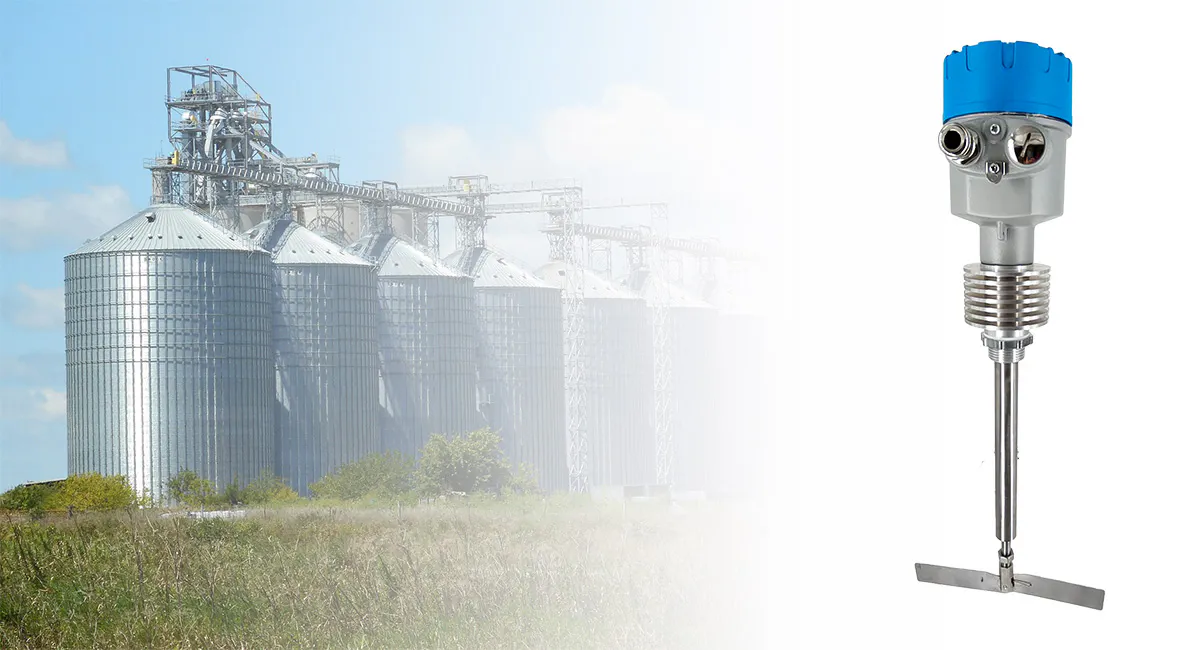
For many powder and bulk solid applications, rotary paddle level switches remain a practical and proven choice when material blockage and density variation are common.
Their suitability comes from how they interact mechanically with the material:
Torque-based detection responds directly to resistance from solids
Adjustable sensitivity allows adaptation to different bulk densities
Overload protection prevents motor damage during compaction or blockage
Simple and robust structure minimizes long-term maintenance
Rather than relying on subtle signal changes, rotary paddle switches make a clear decision based on physical interaction—an advantage in dusty, variable environments.
Detection Reliability vs. Bulk Density Variation
Данные не найдены
The trend shows that torque-based detection remains comparatively stable as bulk density varies, while signal-dependent technologies experience sharper reliability decline.
Understanding the Application Boundaries Builds Trust
Rotary paddle level switches are not the best solution for every application, and recognizing their limits is essential for correct selection.
Well-suited applications include:
Powders and granular bulk solids
Slow to moderate filling rates
Silo, bin, and hopper level detection
Applications where density varies over time
Less suitable applications include:
Highly fluidized solids with minimal resistance
Very high-speed filling with strong material impact
Applications involving extremely abrasive materials without protection
Being clear about these boundaries prevents overapplication and improves system reliability.
Typical Application Scenarios in Bulk Solids Handling
In silo applications handling cement, grain, or plastic pellets, rotary paddle level switches are commonly installed for high-level protection to prevent overfilling and structural stress.
In feed bins and intermediate hoppers, they are frequently used for low-level detection, ensuring material availability while protecting downstream equipment from running empty.
These use cases are not driven by product specifications, but by predictable mechanical interaction between the paddle and the stored material.
Making a Confident Selection Decision
Selecting a level switch for powders and bulk solids is ultimately about risk control—reducing false alarms, avoiding equipment damage, and minimizing maintenance intervention.
For stable point-level detection in bulk solids, rotary paddle level switches with overload protection and adjustable torque are widely adopted in industrial systems where material behavior is uncertain and process conditions vary.