







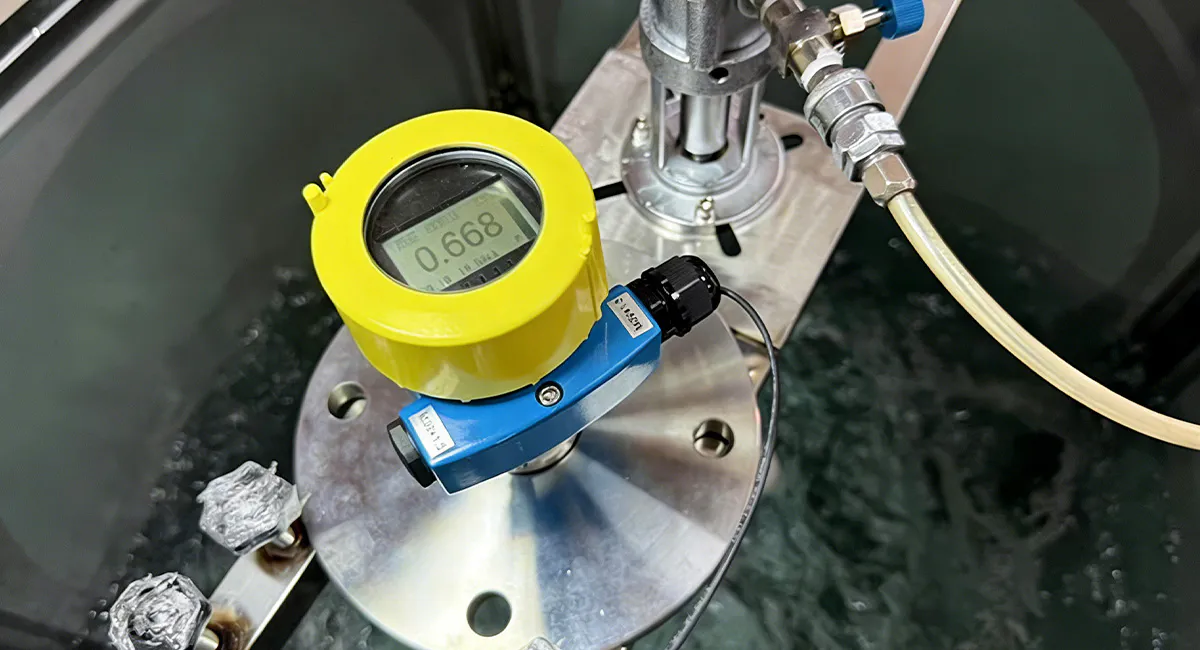
What Is a Water Level Sensor and How to Choose the Right One for Your Application
Introduction: Water Level Measurement Is Not Just About Accuracy
Water level measurement is widely used in water treatment, environmental monitoring, and industrial systems. At first glance, selecting a water level sensor may seem straightforward—many users focus on accuracy as the primary indicator.
However, in real industrial environments, accuracy is often not the most important factor.
In practice, issues such as false alarms, unstable signals, and frequent maintenance have a much greater impact on system reliability than small measurement deviations.
A water level sensor must perform reliably under real conditions—not just in laboratory settings.
Что такое датчик уровня воды?
A water level sensor measures the height of water and converts it into an electrical signal for monitoring or control systems.
In real applications, it is commonly used for:
- Pump control
- Overflow protection
- Process automation
- Environmental monitoring
In several field cases, system failures were not caused by inaccurate measurement—but by unstable signals and incorrect readings that triggered wrong actions.
Types of Water Level Sensors and Their Applications
| Тип | Принцип измерения | Типовые применения |
|---|---|---|
| Ultrasonic Sensor | Sound wave reflection | Open tanks, reservoirs |
| Radar Sensor | Microwave reflection | Harsh or vapor environments |
| Pressure (Submersible) | Hydrostatic pressure | Wells, groundwater monitoring |
| Поплавковый выключатель | Mechanical buoyancy | Pump control |
| Capacitive Sensor | Capacitance variation | Clean or stable liquids |
Each type behaves differently under real-world conditions, especially when environmental interference is present.
Why Accuracy Is Not the First Priority in Real Applications
A common misconception is that higher accuracy automatically means better performance.
In reality, most “accuracy specifications” are measured under ideal laboratory conditions:
- Stable medium
- Flat surface
- Controlled temperature and pressure
- No interference
Actual field conditions are very different.
Water tanks and industrial environments often include:
- Foam and bubbles
- Vapor and condensation
- Turbulence and mixing
- Deposits or buildup on sensors
- Sudden inflow or level fluctuations
These factors do not simply reduce accuracy slightly—they can cause:
- False readings
- Signal loss
- Sudden spikes or drops
- Incorrect alarms
For this reason, experienced engineers focus on three more critical factors instead of accuracy.
The Three Most Important Selection Factors
1. False Alarm Rate
| Scenario | System Impact |
|---|---|
| False high level | Overflow shutdown, pump stop |
| False low level | Pump dry-run damage |
| Signal fluctuation | Unstable process control |
A small accuracy deviation can often be compensated.
But false alarms can directly disrupt operations or damage equipment.
In many systems, repeated false alarms lead operators to ignore warnings—creating serious safety risks when real issues occur.
2. Signal Stability
Stable measurement is essential for reliable control.
| Поведение сигнала | Impact on System |
|---|---|
| Smooth output | Reliable automation control |
| Fluctuating signal | Unstable valves and pump behavior |
| Signal loss | System failure or shutdown |
In control systems such as PID loops, unstable signals can cause continuous adjustments, increasing process instability instead of improving it.
This is why experienced engineers often say:
“A stable measurement is more valuable than a precise but unstable one.”
3. Maintenance-Free Operation
| Фактор | Воздействие |
|---|---|
| Frequent cleaning | Increased labor cost |
| Recalibration needs | System downtime |
| Sensor contamination | Reduced lifespan |
In industrial environments, the best sensor is not the most advanced—it is the one that requires the least intervention over time.
What Determines Stability in Water Level Measurement
Stability depends on whether the measurement principle can handle real-world conditions.
Key Influencing Factors
| Фактор | Practical Effect |
|---|---|
| Measurement path | Fixed vs free-space signal behavior |
| Signal contamination risk | Vapor, foam, or buildup interference |
| Process variability | Sudden or continuous changes |
Practical Engineering Insight
Sensors with a defined measurement path—such as guided radar—tend to be more stable because the signal follows a controlled route.
In contrast, non-contact technologies like ultrasonic or free-space radar rely on signal reflection in open space. In complex tank environments, internal structures, foam, or vapor can generate false echoes.
Another critical factor is signal contamination.
- Ultrasonic sensors may be affected by vapor layers, which change sound propagation
- Foam and bubbles can scatter or absorb signals
- Condensation on sensor surfaces can reduce signal strength
In dynamic processes—such as intermittent filling, strong mixing, or rapid temperature changes—these effects become even more pronounced.
Under these conditions, theoretical accuracy becomes less relevant. The key requirement is whether the sensor can maintain stable and reliable output.
Practical Selection Guide: Matching Sensor to Application
| Application Scenario | Рекомендуемый датчик | Key Reason |
|---|---|---|
| Stable open water tank | Ultrasonic sensor | Экономически эффективный |
| High vapor / condensation | Radar sensor | More reliable signal |
| Foam or turbulent surface | Radar or guided radar | Less affected by interference |
| Deep well / groundwater | Pressure sensor | Direct measurement |
| Simple pump control | Float switch | Reliable and low cost |
In many installations, ultrasonic sensors are initially selected for cost reasons. However, in challenging environments, switching to radar technology often reduces false alarms and improves long-term stability.
Common Mistakes in Water Level Sensor Selection
- Focusing only on accuracy specifications
- Ignoring environmental interference
- Not considering false alarm risks
- Underestimating maintenance requirements
- Selecting sensors without evaluating real conditions
In multiple projects, replacing an unsuitable sensor resulted in higher costs than choosing the correct solution from the beginning.
Why Real-World Experience Matters
Specifications alone cannot predict performance in complex environments.
In one reservoir monitoring project, an ultrasonic sensor was selected due to its simplicity and cost advantage. However, due to condensation and surface instability, the signal became unreliable. After switching to a radar-based solution, the system achieved stable performance with minimal maintenance.
This reinforces a key principle:
the best sensor is not the one with the highest accuracy—but the one that performs reliably in real conditions.
Conclusion: Focus on Reliability, Not Just Specifications
Water level measurement is not just about accuracy—it is about ensuring stable, reliable, and low-maintenance operation in real environments.
The right selection should prioritize:
- Low false alarm rate
- Stable signal output
- Long maintenance intervals
Instrava is a partner focused on providing equipment, solutions, and services for industrial measurement and control instruments used in safety-critical and process control applications. We support customers with customized water level sensor solutions based on real application conditions, helping achieve stable performance, reduced maintenance, and long-term reliability.