
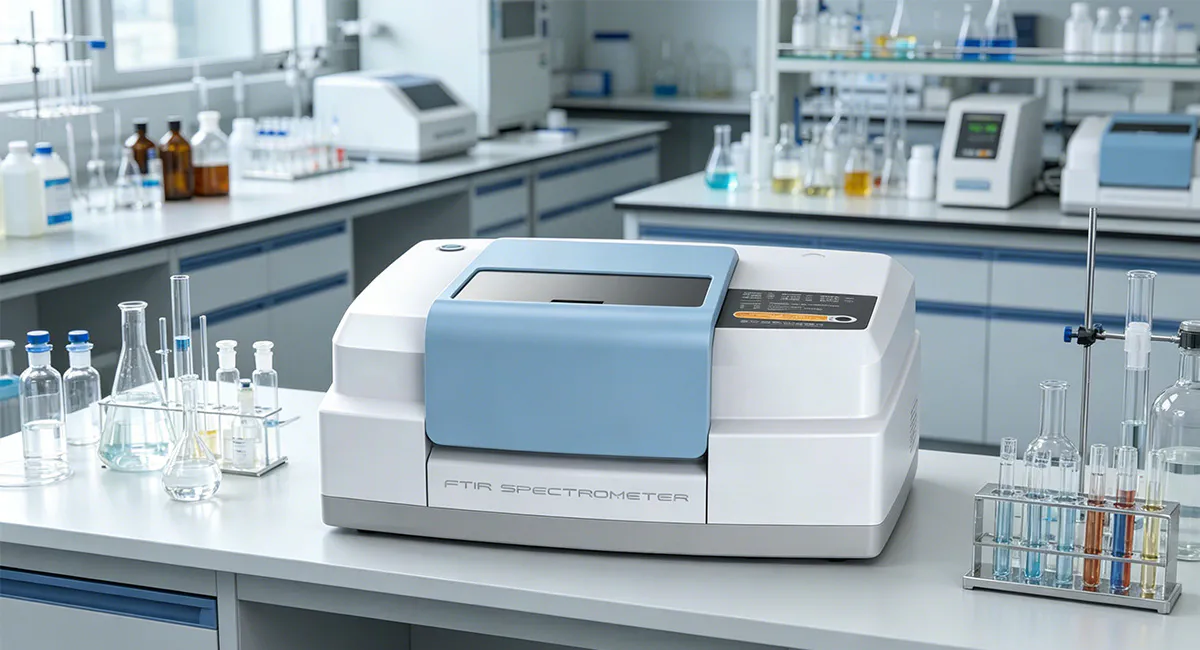
Ensuring Compliance and Accuracy: A Guide to Using FTIR in Pharmaceutical Laboratories
Fourier-Transform Infrared (FTIR) spectroscopy is a critical, non-destructive analytical technique used in pharmaceutical laboratories for Raw Material Identification (RMID), polymorphism analysis, formulation quantification, and both offline and at-line Process Analytical Technology (PAT).
To ensure regulatory compliance and eliminate data integrity risks, pharmaceutical QA/QC laboratories must establish a rigorous framework spanning cGMP compliance, method validation, sample preparation, and instrument maintenance.
1. Compliance with Pharmaceutical Regulations (cGMP & 21 CFR Part 11)
In a pharmaceutical environment, data integrity and regulatory alignment (ChP, USP, EP, and JP) take precedence over all else.
3Q Equipment Qualification (IQ/OQ/PQ)
Installation Qualification (IQ) & Operational Qualification (OQ): Typically performed and certified by the instrument manufacturer upon installation or major repairs.
Performance Qualification (PQ): Laboratories must implement a strict, periodic PQ schedule. Typically, polystyrene film standards are used to verify wavenumber accuracy and resolution, while an infrared-opaque shutter blocks the beam to verify photometric accuracy and baseline flatness.
Computerized System Validation (CSV)
To comply with FDA 21 CFR Part 11 and EudraLex Annex 11:
Audit Trails: The FTIR software’s audit trail must remain permanently activated.
User Access Levels: Clear segregation of duties must be enforced (e.g., separating Method Developers, Operators, and System Administrators).
Traceability: Generic or shared logins are strictly prohibited; every spectral acquisition, processing step, and modification must be traceable to a specific user.
2. Analytical Method Development and Validation
Because FTIR is primarily a comparative or qualitative technique in routine testing, robust method validation is crucial.
Specificity Validation: Methods must prove that the FTIR spectrum can differentiate between structurally similar compounds, target APIs, excipients, and potential degradation products.
Spectral Library Construction: * Internal Libraries: Relying solely on commercial software libraries is highly discouraged in a GMP environment. Laboratories should build custom qualification libraries using verified Reference Standards.
Match Factor Thresholds: The acceptance criteria for Hit Quality Index (HQI) or Match Factors (typically $>0.95$ or $>0.98$) must be statistically justified to prevent false positives while remaining sensitive enough to catch contaminants.
Polymorphism Control: Solid-state FTIR is highly sensitive to crystalline lattices. If an API exhibits polymorphism, the method must define specific diagnostic peaks to avoid false OOS (Out of Specification) results caused by polymorphic transitions during processing.
3. Best Practices for FTIR Sample Preparation and Operation
Because FTIR measures molecular vibrations based on changes in dipole moments, physical sample characteristics drastically impact spectral quality.
Comparison of Core FTIR Sampling Techniques
| Sampling Technique | Typical Pharmaceutical Application | Operational Guidelines & Troubleshooting |
| KBr Pellet Method (Transmission) | Quantitative analysis, solid-state API characterization. | * Moisture Contamination (Critical Failure): Potassium bromide (KBr) is highly hygroscopic. Ambient moisture absorption creates massive $O-H$ bands at $3400\text{ cm}^{-1}$ and $1640\text{ cm}^{-1}$, masking true sample structures. Solution: Grind samples under an infrared lamp and store KBr powder in an oven at $>120^\circ\text{C}$. * Particle Size Optimization: Particles must be smaller than the IR wavelength (a few microns) to prevent scattering (the Christiansen Effect), which causes baseline tilt. |
| Attenuated Total Reflection (ATR) | Rapid raw material identification (RMID), packaging material testing. | * Clamping Pressure: ATR relies on reproducible optical contact between the sample and the crystal (e.g., Diamond or ZnSe). Inadequate pressure leads to weak signals. Solution: Use a torque-limited pressure clamp for consistent contact. * Cross-Contamination: High-throughput testing risks carryover. Solution: Clean the crystal thoroughly with isopropyl alcohol (IPA) or anhydrous ethanol and collect a new background spectrum between every sample. |
Environmental Controls and Artifact Mitigation
Humidity and Temperature: The laboratory must maintain a controlled environment ($20\text{-}25^\circ\text{C}$, Relative Humidity $<50\%$, ideally $<40\%$). High humidity degrades moisture-sensitive optical components (like KBr beamsplitters) and introduces atmospheric water vapor lines ($4000\text{-}3400\text{ cm}^{-1}$ and $1900\text{-}1400\text{ cm}^{-1}$), distorting the sample spectrum.
Background Frequency: Ambient $CO_2$ ($2350\text{ cm}^{-1}$) and moisture levels fluctuate continuously. SOPs should mandate an air background collection every 1 to 2 hours or prior to every new batch evaluation.
4. Routine Maintenance and Troubleshooting
Desiccant Monitoring
FTIR spectrometers feature sealed optical benches protected by internal desiccant packs. A weekly desiccant check must be integrated into the lab logbook. Saturation indicators must be acted upon immediately to prevent irreversible fogging of the expensive beamsplitter.
Energy Throughput Verification
Check the instrument’s raw energy value (Center Burst Intensity) daily. A sudden drop in throughput indicates:
An aging or failing IR source.
Contamination or moisture damage on the optical windows or ATR crystal.
An misaligned or failing HeNe internal reference laser.
Recognizing Common Spectral Artifacts
Baseline Tilt: Usually caused by light scattering from oversized solid particles. While digital “Baseline Correction” algorithms can resolve minor tilts, severe cases require sample re-preparation.
Flat-Bottomed Peaks (Total Absorption): Occurs when a KBr pellet is too thick or the sample concentration is too high, completely absorbing the IR beam. This yields invalid data; the sample must be diluted and re-run.
Summary: Checklist for a Pharmaceutical FTIR SOP
Pre-Analysis: Verify lab humidity is $<50\%$; check software diagnostics and internal desiccant status.
System Suitability: Execute daily PQ protocol using a certified polystyrene standard.
Analysis Workflow: Clean ATR crystal $\rightarrow$ Acquire air background $\rightarrow$ Run sample $\rightarrow$ Inspect spectrum for $H_2O/CO_2$ interference or clipping.
Post-Analysis: Clean the sample interface with a validated solvent; log all actions in the audit-trail-enabled software and the physical equipment logbook.
Why Trust Instrava?
We select manufacturers from a neutral, impartial standpoint, always with your best interests in mind.
Our very existence depends on helping you source the products that are the perfect fit for your needs.
Based in China, we are able to conduct on-site inspections of production environments and product quality firsthand.
We help you avoid intermediaries posing as factories.
We facilitate smoother after-sales support, eliminating time zone issues and the delays often associated with dealing directly with factories.
Our multilingual team ensures effective communication.
For a trading startup, every interaction with a client is a precious opportunity—a sign that you are willing to place your trust in us and give us the chance to prove ourselves.
In the digital age, while information is easily accessible, misconceptions often cloud the trust between people.
Instrava relies entirely on trust; it is our core philosophy and the foundation of our existence in society. It is the fundamental basis for our long-term growth and our commitment to serving the community.
Please place your trust in us.