
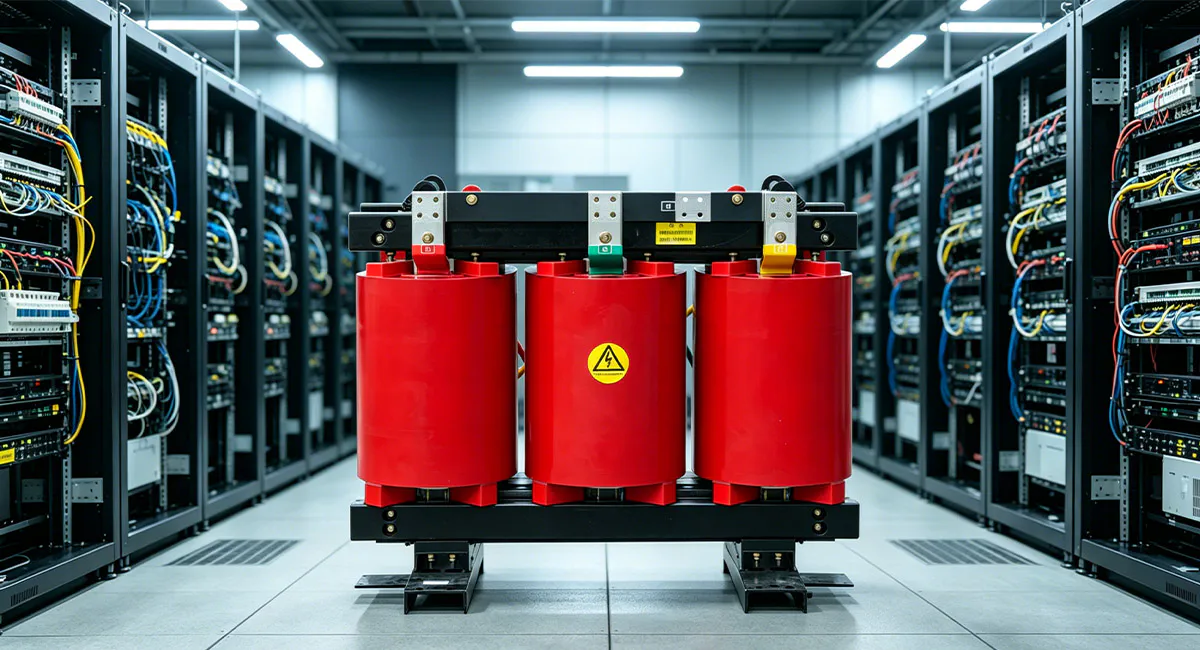
How to Properly Deploy and Utilize Transformers in AI Data Centers
As Artificial Intelligence (AI) data centers shift toward next-generation GPU clusters (such as NVIDIA H100, B200, and ultra-dense AI servers), infrastructure teams face unprecedented power delivery challenges. AI workloads introduce high power densities, extreme dynamic load fluctuations, and severe harmonic distortions. To ensure the stability of the entire computing infrastructure, selecting and deploying the right electrical transformers is paramount.
To successfully address transformer utilization in AI data centers, engineers must focus on five critical pillars: optimized selection, harmonic mitigation, dynamic load management, redundant architecture, and predictive maintenance.
1. High-Density Transformer Selection for AI Workloads
Traditional data center racks typically pull 5 to 10 kW. In stark contrast, modern AI high-density racks demand 40 to 100 kW+ per enclosure. This massive jump requires heavy-duty engineering changes at the transformer level.
Mandatory Use of K-Factor Transformers: The switch-mode power supplies (SMPS) inside thousands of AI servers generate massive amounts of non-linear harmonic distortion. Standard transformers will rapidly overheat under these conditions. Specifying K-13 or K-20 rated transformers is crucial. These units feature specialized designs, such as oversized neutral conductors and continuously transposed premium copper windings, to safely handle the stray losses caused by harmonics.
Premium Insulation and Temperature Control: Dry-type transformers utilizing Class H (180°C) or Class C (220°C) high-temperature insulation materials (such as epoxy resin cast solid-cast or Vacuum Pressure Impregnated [VPI] units) are highly recommended. They provide the necessary thermal margin during massive AI model training runs when sudden full-load spikes occur.
Optimized Impedance Voltage: To counter the sharp voltage sags caused by the instantaneous ramp-up of AI clusters, transformer impedance must be precisely calculated—typically kept within a $6\% \text{ to } 8\%$ range—to maintain excellent transient voltage stability.
2. Harmonic Distortion Mitigation and Neutral Current Balancing
AI data center loads are heavily non-linear, introducing high volumes of 3rd, 9th, and triplen harmonics. These zero-sequence harmonics accumulate in the neutral conductor, often causing the neutral current to exceed the phase current.
D-Yn11 Vector Group Connection: Primary distribution transformers should utilize a Delta-Wye (D-Yn11) connection. The Delta ($\Delta$) primary winding traps 3rd-order harmonics, circulating them within the winding and effectively blocking them from feeding back into the upstream utility grid.
Phase-Shifting Transformer Implementation: For large-scale AI hyperscale facilities, deploying phase-shifting transformers (e.g., configuring two parallel transformers with a 30° phase shift to create a 12-pulse rectification effect) allows characteristic harmonics to cancel each other out at the common busbar.
200% Rated Neutral Conductors: The neutral bus and cables running from the low-voltage side of the transformer to the Power Distribution Units (PDUs) must be upsized to 200% of the phase conductor cross-sectional area to handle the heavy burden of harmonic-induced currents safely.
3. Managing “Cliff-Like” Dynamic Load Fluctuations
AI training workloads are highly cyclical and unpredictable. When an AI training model initializes, the power demand spikes instantly; if the training run crashes or completes, the load drops off a cliff. This severe $di/dt$ (rate of current change) exerts massive mechanical and electrical stress on transformer components.
Dynamic Voltage Regulation & Compensation: Transformers should work alongside On-Load Tap Changers (OLTC) or downstream Static Synchronous Compensators (STATCOM) and Active Power Filters (APF). This setup instantly compensates for power factor drops and sudden voltage fluctuations.
Reinforced Short-Circuit Mechanical Strength: Frequent, violent current swings generate intense electromagnetic forces that can physically deform transformer coils over time. Procurement specifications must mandate enhanced short-circuit ride-through capabilities and high structural rigidity.
4. Redundant Architectures: 2N vs. Distributed Redundancy (DR)
If an AI training sequence loses power halfway through, restarting the process and recovering corrupted training checkpoints can cost organizations millions of dollars.
2N or Distributed Redundancy (DR) Topologies: Power distribution must rely on 2N (Dual-Utility Paths) or DR (Distributed Redundancy) frameworks. Transformers must run in a hot-standby configuration. If one transformer path drops offline, the remaining unit must instantaneously pick up 100% of the critical AI load. This requires excellent short-term overload capacity (e.g., maintaining a 150% overload for 1 to 2 hours).
Physical Isolation and Fire Safety: While dry-type transformers present a minimal fire risk, they should still be housed in dedicated, structurally isolated fire compartments equipped with Very Early Smoke Detection Apparatus (VESDA) and automated gas-suppression systems.
5. Intelligent O&M: Digital Twins and Predictive Maintenance
Maximizing transformer reliability in the AI era requires moving away from reactive maintenance and embracing continuous, data-driven telemetry.
Fiber-Optic Hotspot Temperature Monitoring: High-accuracy temperature sensors (such as PT100 or fiber-optic probes) should be embedded directly into the three-phase windings and the core to track real-time winding hotspots.
Online Partial Discharge (PD) Monitoring: Continuous PD tracking detects early signs of insulation degradation caused by harmonic overheating long before an actual phase-to-phase short circuit occurs.
DCIM Integration and AI Diagnostics: All telemetry—including load factor, Total Harmonic Distortion of Voltage ($THD_u$), and Total Harmonic Distortion of Current ($THD_i$)—should feed directly into the Data Center Infrastructure Management (DCIM) platform. By running these data points through predictive AI algorithms, facility managers receive an automated Health Index, transitioning data center operations from scheduled maintenance to true predictive uptime management.
Why Trust Instrava?
We select manufacturers from a neutral, impartial standpoint, always with your best interests in mind.
Our very existence depends on helping you source the products that are the perfect fit for your needs.
Based in China, we are able to conduct on-site inspections of production environments and product quality firsthand.
We help you avoid intermediaries posing as factories.
We facilitate smoother after-sales support, eliminating time zone issues and the delays often associated with dealing directly with factories.
Our multilingual team ensures effective communication.
For a trading startup, every interaction with a client is a precious opportunity—a sign that you are willing to place your trust in us and give us the chance to prove ourselves.
In the digital age, while information is easily accessible, misconceptions often cloud the trust between people.
Instrava relies entirely on trust; it is our core philosophy and the foundation of our existence in society. It is the fundamental basis for our long-term growth and our commitment to serving the community.
Please place your trust in us.