
Home » Technology » The Definitive Guide to Industrial Ethernet-APL Switches: Revolutionizing Field-Level Process Automation
The Definitive Guide to Industrial Ethernet-APL Switches: Revolutionizing Field-Level Process Automation
1. Introduction: What is an Ethernet-APL Switch?
An Ethernet-APL Switch (Advanced Physical Layer Switch) is a specialized, ruggedized industrial network deployment device engineered to bring native, high-speed Ethernet connectivity directly to field-level instruments located in hazardous, explosive process environments. Historically, field-level instruments (such as flow meters, pressure transmitters, and control valves) were restricted to slow, analog, or proprietary digital networks due to safety limitations in explosive zones. Ethernet-APL changes this entirely by establishing a standard, 2-wire physical layer based on the IEEE 802.3cg (10BASE-T1L) specification.
Acting as the core routing and power-distribution infrastructure within an Industry 4.0 process network, an Ethernet-APL switch combines high-speed data transmission (10 Mbps full-duplex) with Power over Data Lines (PoDL) over a single, shielded twisted-pair cable. By deploying an Ethernet-APL switch, process plants can eliminate traditional protocol gateways and extend enterprise-level industrial Ethernet protocols—such as PROFINET, EtherNet/IP, HART-IP, and Modbus TCP—straight to the instruments inside Zone 0, 1, and 2 hazardous locations, creating a seamless digital thread from the cloud to the field asset.
2. Legacy Technology vs. Ethernet-APL Switches in Harsh Process Environments
Petrochemical refineries, offshore drilling platforms, and chemical processing plants represent some of the most challenging environments in industrial automation. Under Explosive Hazardous Atmospheres & Long-Distance Corrosive Environments, traditional 4-20mA HART and classic fieldbus architectures (such as PROFIBUS PA or Foundation Fieldbus) routinely limit operational efficiency.
Below are the three critical problems encountered by legacy field technologies, alongside the precise engineering mechanisms that modern Ethernet-APL switches use to solve them:
Problem 1: The Severe Bandwidth Bottleneck of Legacy 4-20mA HART Signaling
Traditional 4-20mA analog loops with modulated HART data operate at an extremely slow data rate (typically 1.2 kbps). While sufficient for transmitting a single primary process variable (like temperature or pressure), this bandwidth is entirely inadequate for retrieving advanced diagnostic data, valve signature logs, or multi-variable telemetry. Valuable device optimization data remains trapped inside the field instrument, preventing predictive maintenance modeling.
The Ethernet-APL Switch Solution: Ethernet-APL switches deliver a full-duplex data rate of 10 Mbps—an increase of more than 8,000 times over traditional HART transmission. This massive bandwidth expansion allows instruments to transmit complex data arrays, asset health statuses, and real-time echo curves alongside primary process variables without compromising loop update speeds.
Problem 2: Complex Intrinsic Safety (IS) Engineering and Strict Power Limitations
Implementing legacy intrinsic safety (Ex i) parameters requires meticulous, time-consuming loop calculations for every combination of barrier, cable, and field device to ensure electrical energy cannot trigger an explosion. Furthermore, traditional intrinsically safe barriers severely limit the operating current available to the device, making it impossible to deploy advanced, power-hungry instruments like high-frequency radar sensors or complex analyzer nodes in hazardous zones.
The Ethernet-APL Switch Solution: Modern Ethernet-APL switches adopt the standardized 2-Wire Intrinsic Safety (2-WISE) profile (IEC 60079-47). The 2-WISE standard treats intrinsic safety as a universal plug-and-play configuration, eliminating the need for tedious manual loop calculations. Additionally, it safely delivers up to 92W of power per trunk link, allowing advanced, power-intensive field devices to run reliably in hazardous areas.
Problem 3: Multi-Kilometer Signal Degradation and Fragmented Protocol Gateways
Process plants often span vast geographic areas, requiring cable runs that exceed a kilometer from the control room to the field junction box. Standard Ethernet is physically limited to a 100-meter threshold, forcing plants to use proprietary fieldbuses that require expensive protocol converters and hardware gateways to bridge the data back to an Ethernet-based SCADA or PLC network. These extra layers introduce latency, increase configuration times, and add physical points of failure.
The Ethernet-APL Switch Solution: An Ethernet-APL switch natively supports long-distance industrial networks by dividing communication topologies into two distinct segments: a Trunk line that spans up to 1,000 meters into hazardous areas, and multiple Spur lines extending up to 200 meters to connect individual instruments. Because it transmits standard Ethernet packets directly from the field device, all intermediary translation gateways are eliminated, reducing system architecture costs and removing data latency bottlenecks.
3. International Parameters and Certification Matrix
To operate safely in critical industrial environments, an Ethernet-APL switch must conform to unified international electrical standards and strict explosive-atmosphere certification protocols.
Table 3.1: Baseline Technical Parameters
| Technical Parameter | Standard Engineering Specification |
| Physical Layer Standard | IEEE 802.3cg (10BASE-T1L) Protocol Profile |
| Data Transmission Speed | 10 Mbps, Full-Duplex over Single Twisted Pair |
| Network Topology Options | Trunk-and-Spur Topology or Star Network Configurations |
| Maximum Distance Profile | Trunk Line: Up to 1,000 meters; Spur Lines: Up to 200 meters |
| Intrinsically Safe Concepts | 2-WISE (2-Wire Intrinsic Safety) conforming to IEC 60079-47 |
| Power Distribution Method | Power over Data Lines (PoDL) with specialized power classes |
| Industrial Protocol Support | PROFINET, EtherNet/IP, HART-IP, Modbus TCP, OPC UA |
Table 3.2: Sector-Specific Parameters & Certification Standards
| Industry Vertical | Target Parameter Requirements | Critical Certification Mandates |
| Petrochemical Refineries & Oil & Gas Upstream | Explosive gas gas-group compatibility (Hydrogen/Acetylene protection); Rugged surge protection (≥4kV per IEC 61000-4-5). | ATEX Zone 1 / Zone 2; IECEx Certification; Ex ia/ib/ic explosion protection ratings |
| Chemical Processing & Synthesis Plants | Extended ambient temperature tolerances (-40°C to +70°C); High-grade conformal coating on internal PCBs to resist chemical vapors. | ATEX / IECEx Approval; CE Mark; 2-WISE Compliance Certification |
| Pharmaceutical & Fine Chemical Production | Support for high-density diagnostic profiling and asset tracking; compact layout profiles for space-restricted cabinets. | CE Mark; RoHS Compliance; Functional Safety compliance (SIL 2/3 ready infrastructure) |
4. Instrava Product Showcase: Application Scenario and Compliance Success
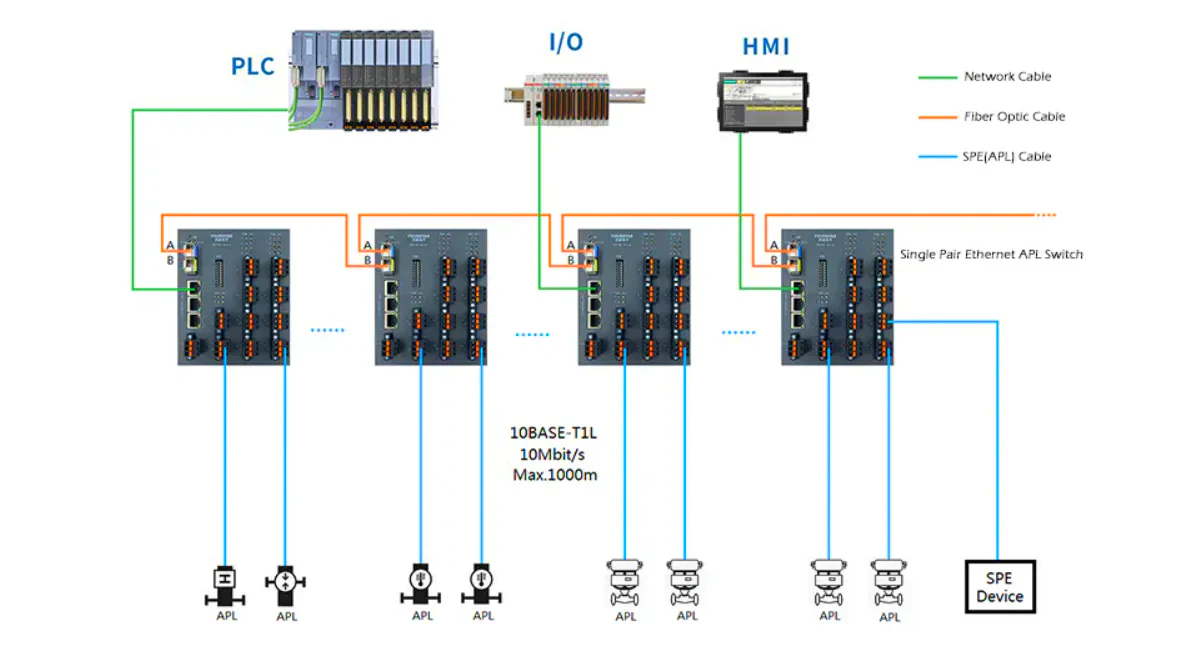
The Instrava Industrial Ethernet-APL Switch for Long-Distance Process Automation Networks is an ideal example of cutting-edge network integration hardware. This ruggedized, high-performance switch functions as a secure gateway between high-level plant automation backbones and intrinsically safe field instruments, bringing high-density digital connectivity to demanding process automation networks.
Real-World Case Study: Transforming Real-Time Diagnostics in a Chemical Plant
The Challenge: A multi-stage chemical processing plant was undertaking an infrastructure modernization project to implement advanced predictive maintenance across its tank farm. The facility relied on legacy 4-20mA HART flow meters and pressure sensors located within an explosive Zone 1 environment. Due to the bandwidth limitations of the analog system, pulling advanced diagnostic data required technicians to physically walk into the hazardous zone with handheld communicators—a practice that created safety risks and delayed maintenance actions. Furthermore, the long distances from the control center to the perimeter tanks (ranging from 650 to 800 meters) made standard Ethernet deployment impossible without adding multiple repeating stations.
The Solution: The plant modernised its network architecture by deploying the Instrava Industrial Ethernet-APL Switch for Long-Distance Process Automation Networks. The Instrava switch was installed inside a field junction box located at the edge of the Zone 1 perimeter. The existing Type-A fieldbus copper wires were repurposed as Ethernet-APL communication links. The main control room link was established via the switch’s long-distance trunk capability, while the field instruments were connected directly to the switch’s intrinsically safe spur ports using the plug-and-play 2-WISE protocol profile.
The Result: The plant successfully established a native 10 Mbps PROFINET over Ethernet-APL network that extended all the way to the core process instruments. Advanced diagnostic variables, device internal temperatures, and valve response curves were streamed continuously to the plant’s central SCADA platform. The 2-WISE intrinsic safety architecture eliminated the need for complex safety loop calculations, allowing the facility to pass its regulatory safety audit with ease. By replacing manual field inspections with real-time, automated diagnostic data tracking, the facility reduced its routine maintenance costs by 32% and eliminated unplanned asset downtime across the tank farm.
5. Installation Protocols and Environmental Thresholds
To ensure long-term physical durability and protect intrinsic safety integrity, the deployment of an Ethernet-APL switch must follow strict industrial installation standards:
Enclosure and Environmental Controls: Mount the Ethernet-APL switch securely onto a standard 35mm DIN rail inside an appropriate industrial cabinet. For indoor control rooms, an IP20 housing is acceptable. However, for field deployment in process environments, the switch must be housed within a rugged, corrosion-resistant enclosure rated to at least IP66 or IP67 to protect against water ingress and ambient airborne particulates.
Cabling Specifications: Use high-quality, shielded single twisted-pair cable classified under the Fieldbus Type A specification (IEC 61158-2). The cable must have an optimal conductor cross-section (typically 18 AWG or 22 AWG) to minimize loop resistance over long runs. Avoid routing APL signal wires parallel to high-voltage, high-current motor leads or variable frequency drive (VFD) output cables to minimize electromagnetic cross-talk.
Shielding and Grounding Management: The shielding of the Ethernet-APL cables must be managed precisely according to intrinsic safety directives. Ground the cable shield at a single, defined reference point—typically at the field switch housing or the primary control cabinet ground bar. Avoid multiple grounding points along a single cable run, as this can introduce ground loop currents that disturb sensitive data signals and undermine explosive-area protection parameters.
6. Preventative Maintenance and Operational Optimization
While solid-state Ethernet-APL switches require no manual adjustments, a structured preventative maintenance program helps ensure long-term network reliability and maximum uptime:
Network Diagnostic Log Audits: Use the switch’s integrated web management interface or an SNMP monitoring tool to regularly review the network health logs. Track key performance parameters, such as packet error rates, signal-to-noise ratios (SNR), and port-specific dropouts, to identify cable degradation or loose connections before they cause an unexpected network failure.
Terminal Torque and Visual Checks: Thermal cycles and constant plant vibrations can cause screw terminals to loosen over time. Technicians should conduct annual visual and physical checks on all power inputs and trunk terminals using insulated tools, verifying that connections remain tightened to the manufacturer’s specified torque settings.
Firmware and Cybersecurity Updates: Process network switches are vital interfaces between the physical plant floor and higher-level networks. Regularly review and apply official firmware releases from the supplier to deploy critical cybersecurity patches, optimize internal network routing performance, and ensure compatibility with newer field device profiles.
What is the maximum permissible distance for an Ethernet-APL network link, and how does wire gauge affect it?
Under the IEEE 802.3cg standard, the maximum distance for an Ethernet-APL Trunk line is 1,000 meters, and the maximum distance for a Spur line is 200 meters when utilizing standard Fieldbus Type A cable (22 AWG). Using a thicker wire gauge (such as 18 AWG) helps minimize DC loop resistance, which ensures stable power delivery over maximum distances. Conversely, using a thinner or unshielded cable increases signal attenuation and limits the practical deployment distance below standard thresholds.
How does the 2-WISE standard simplify intrinsic safety compliance compared to traditional Ex i loop calculations?
The 2-Wire Intrinsic Safety (2-WISE) standard (IEC 60079-47) simplifies compliance by defining universal electrical input and output parameter limits (for voltage, current, and power) for all APL infrastructure components. If both the Ethernet-APL switch port and the connected field device are certified as 2-WISE compliant, they can be connected directly without requiring manual loop calculations for cable capacitance and inductance. This creates a true plug-and-play installation process for explosive environments.
Can an Ethernet-APL switch reuse existing fieldbus cabling previously installed for PROFIBUS PA or Foundation Fieldbus networks?
Yes, an Ethernet-APL switch can reuse existing fieldbus cabling, provided the installed wires meet the Fieldbus Type A specification (shielded single twisted pair, 100-ohm characteristic impedance). Reusing this infrastructure allows process plants to upgrade to 10 Mbps Ethernet-APL networks without the high capital cost of pulling new cables through existing cable trays and conduits.
What is the primary technical difference between an Ethernet-APL Trunk port and an Ethernet-APL Spur port?
The technical difference lies in their power profiles, distance ratings, and hazardous area locations. An APL Trunk port is engineered for long-distance routing (up to 1,000 meters) from the control room to the field, delivering higher current levels under increased power classes to support multiple downstream nodes. An APL Spur port is designed for shorter connections (up to 200 meters) directly to individual field instruments, providing lower-power, intrinsically safe (Ex ia) link outputs that permit hot-swapping of devices in Zone 0 and Zone 1 explosive areas.
What are the diagnostic steps if an Ethernet-APL switch port shows a constant link-down status after connecting a new field sensor?
To resolve a persistent link-down status, follow three diagnostic steps: First, use a digital multimeter to measure the DC voltage across the terminal block to verify that the port is outputting the correct Power over Data Lines (PoDL) voltage. Second, check the wire polarity at both ends of the connection, ensuring the positive and negative lines match the device terminals correctly. Third, review the switch management software to confirm that the specific port has not been disabled by an administrative setting or tripped by an overcurrent protection sequence.
Why is an Ethernet-APL switch preferred over a traditional Ethernet switch with standard RJ45 ports for field-level process automation?
An Ethernet-APL switch is preferred because standard RJ45 Ethernet switches are limited to a 100-meter range, require four or eight conductors, and cannot safely limit electrical energy for explosive environments. An Ethernet-APL switch utilizes a rugged two-wire terminal design that extends up to 1,000 meters, delivers power and data over a single twisted pair, and incorporates intrinsic safety barriers (2-WISE) to protect against ignition risks in hazardous areas.
Why Trust Instrava?
We select manufacturers from a neutral, impartial standpoint, always with your best interests in mind.
Our very existence depends on helping you source the products that are the perfect fit for your needs.
Based in China, we are able to conduct on-site inspections of production environments and product quality firsthand.
We help you avoid intermediaries posing as factories.
We facilitate smoother after-sales support, eliminating time zone issues and the delays often associated with dealing directly with factories.
Our multilingual team ensures effective communication.
For a trading startup, every interaction with a client is a precious opportunity—a sign that you are willing to place your trust in us and give us the chance to prove ourselves.
In the digital age, while information is easily accessible, misconceptions often cloud the trust between people.
Instrava relies entirely on trust; it is our core philosophy and the foundation of our existence in society. It is the fundamental basis for our long-term growth and our commitment to serving the community.
Please place your trust in us.