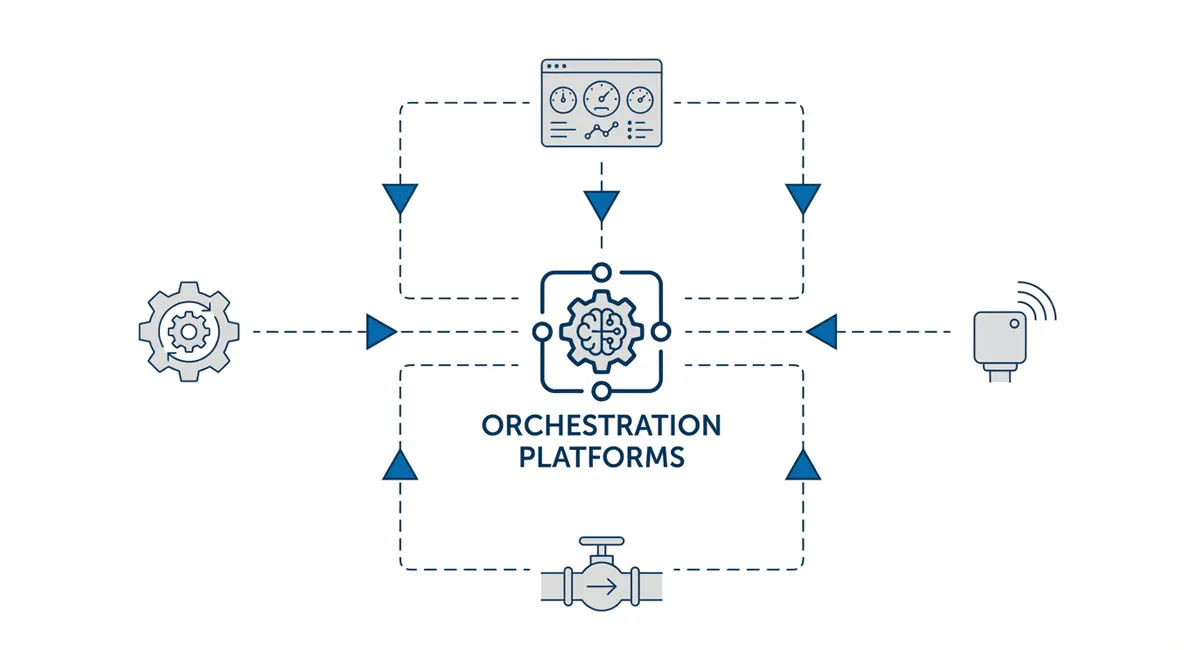
เครื่องมือวัดกำลังเปลี่ยนไปสู่แพลตฟอร์มการประสานงาน: ความหมายสำหรับระบบอุตสาหกรรม
บทนำ เครื่องมือวัดอุตสาหกรรมกำลังเผชิญกับการเปลี่ยนแปลงพื้นฐาน. ตามแบบดั้งเดิม เครื่องมือวัดเช่นเซ็นเซอร์, ตัวส่งสัญญาณ, และตัววิเคราะห์ ทำงานเป็นอุปกรณ์อิสระ...

หน้าแรก » ผลิตภัณฑ์ » เครื่องวัดอัตราการไหล » เครื่องวัดอัตราการไหลแบบแม่เหล็กไฟฟ้า

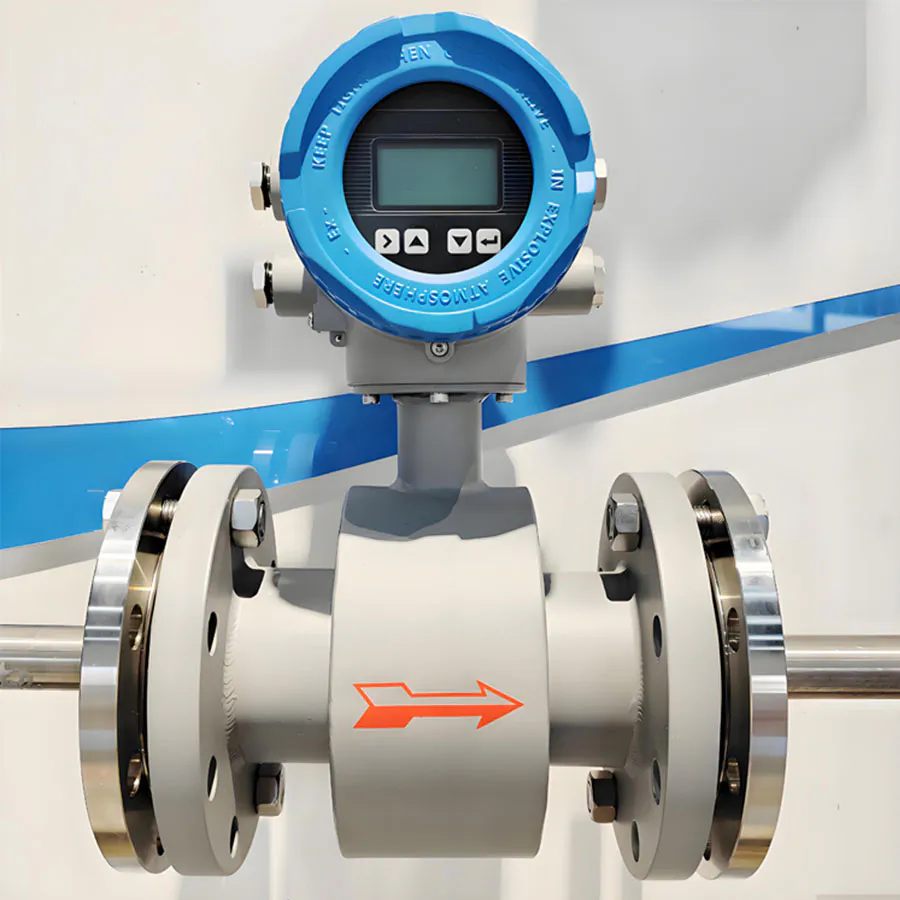
The working principle of an electromagnetic flowmeter is based on Faraday’s law of electromagnetic induction. The measuring tube is made of a non-magnetic alloy and internally lined with an insulating material to prevent signal interference and ensure measurement stability.
Two measuring electrodes are installed diametrically opposite on the inner wall of the flow tube, with the electrode surfaces flush with the lining. When the excitation coils generate a pulsed magnetic field perpendicular to the flow direction, a uniform magnetic flux density is formed across the measuring section.
As a conductive liquid flows through the magnetic field inside the tube, it cuts the magnetic lines of force and generates an induced electromotive force. This induced voltage is proportional to the magnetic flux density, the inner diameter of the pipe, and the average velocity of the fluid. The electrodes detect this voltage signal and transmit it to the converter through shielded cables.
The converter amplifies and processes the signal, converting it into a flow rate value. The electromagnetic flowmeter then outputs standard signals such as pulse output and analog current (4–20 mA), enabling real-time flow display, process monitoring, flow control, and system integration in industrial automation applications.
คำอธิบายเครื่องวัดอัตราการไหล
Electromagnetic Flowmeter-Features
The electromagnetic flowmeter delivers stable electromagnetic flow measurement that is independent of fluid density, viscosity, temperature, pressure, and conductivity, reducing recalibration frequency and long-term operating costs.
With a full-bore design and no moving parts, the electromagnetic flow meter eliminates pressure loss and minimizes maintenance, making it ideal for continuous operation in slurry, wastewater, and corrosive liquid applications.
A wide DN6–DN3000 size range, combined with multiple lining and electrode material options, allows one electromagnetic flowmeter platform to cover diverse processes, reducing spare parts inventory and total cost of ownership.
Advanced low-frequency rectangular wave excitation and full digital signal processing ensure high measurement stability and strong anti-interference performance, even in electrically noisy industrial environments.
The 32-bit embedded processor enables fast signal calculation and a wide measurement range of up to 1500:1, allowing accurate flow monitoring under both low-flow and peak-load conditions without changing instruments.
Integrated diagnostics, empty pipe detection, and conductivity monitoring improve operational safety and reduce unexpected downtime, supporting predictive maintenance strategies.
Multiple industrial communication protocols, including RS485, HART, and optional Profibus, ensure seamless system integration and protect automation investments over the long term.
Explosion-proof options and robust SMT-based electronics provide reliable performance in hazardous and harsh environments, extending service life and maximizing return on investment.


Electromagnetic Flow Meter-Applications
น้ำและน้ำเสีย
Electromagnetic flowmeters are used for raw water intake, distribution pipelines, effluent discharge, and sludge measurement, providing stable electromagnetic flow measurement for municipal and industrial water systems.
Chemical & Pharmaceutical
Electromagnetic flowmeters measure corrosive chemicals, acids, alkalis, and process liquids with high accuracy, supported by multiple lining and electrode options for chemical compatibility.
อาหารและเครื่องดื่ม
Sanitary electromagnetic flow meters are applied to beverages, dairy products, syrups, and process water, supporting hygienic electromagnetic flow measurement and batch consistency.
Pulp & Paper
Electromagnetic flowmeters are suitable for stock preparation, white water circulation, chemical dosing, and wastewater monitoring in fiber-rich process environments.
Power & Cooling Water
Electromagnetic flowmeters monitor cooling water circulation and auxiliary water systems, helping improve system efficiency and operational reliability.
Mining & Slurry
Electromagnetic flowmeters are ideal for abrasive slurry, tailings, and mineral processing fluids, delivering reliable electromagnetic flow measurement in harsh industrial conditions.
Electromagnetic Flowmeters-Measuring Principle
The measuring principle of an electromagnetic flowmeter is based on Faraday’s law of electromagnetic induction. The measuring tube is a non-magnetic alloy spool lined with an insulating material to ensure stable electromagnetic flow measurement and eliminate signal interference.
Two electrodes are mounted diametrically through the pipe wall and fixed on the measuring tube, with the electrode surfaces flush with the inner lining. When the excitation coils are driven by a bidirectional pulsed current, a working magnetic field with a magnetic flux density B is generated in a direction perpendicular to the pipe axis.
As a conductive fluid flows through the measuring tube of the electromagnetic flow meter, it cuts the magnetic field lines and an induced electromotive force E is generated. The induced voltage is directly proportional to the magnetic flux density B, the inner diameter of the measuring tube d, and the average flow velocity v of the fluid.
The electromotive force E, which represents the electromagnetic flow measurement signal, is detected by the electrodes and transmitted to the converter via shielded cables. The converter amplifies and processes the signal, calculates the flow rate, and displays the measurement result. Standard output signals such as pulse output and analog current (4–20 mA) are provided for flow monitoring, control, and process regulation in industrial automation systems.


Flowmeter Electromagnetic-Structure
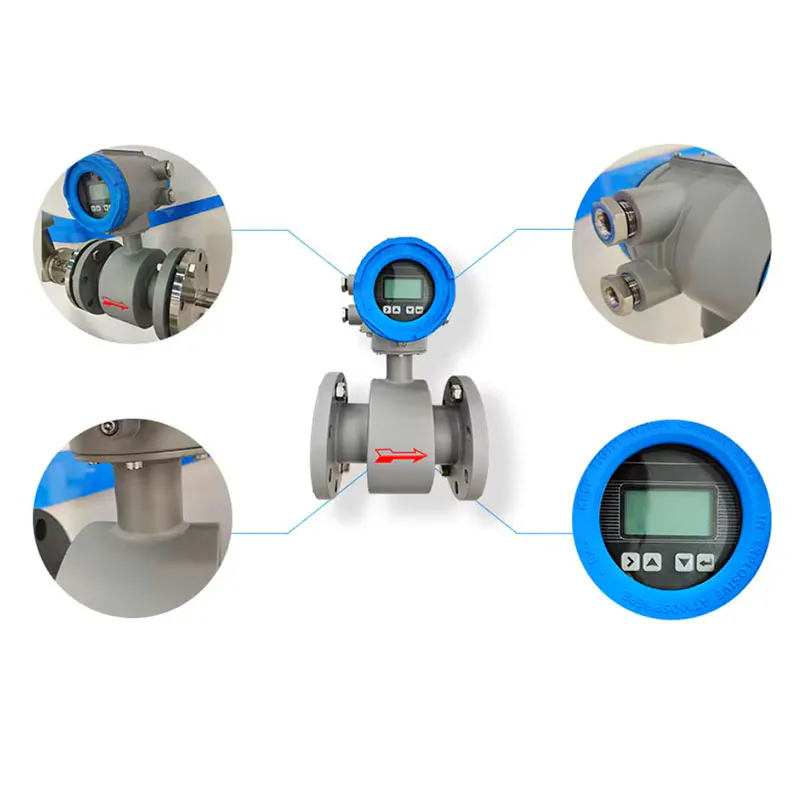
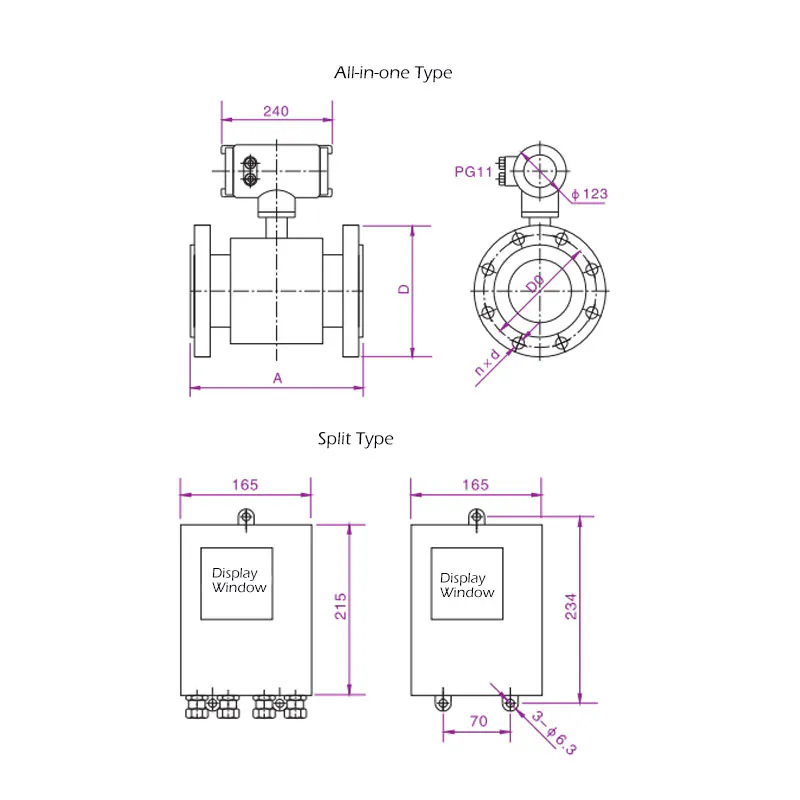
| Selection Item | Integral Electromagnetic Flowmeter | Remote Electromagnetic Flowmeter |
|---|---|---|
| Structure | Sensor and converter integrated into one unit | Sensor and converter installed separately |
| การใช้งานทั่วไป | Standard industrial environments | Harsh or complex installation environments |
| อุณหภูมิแวดล้อม | Suitable for moderate temperatures | Recommended when ambient or radiant temperature exceeds 60°C |
| Pipeline Vibration | Suitable for low-vibration pipelines | Better for strong or continuous vibration conditions |
| Corrosive Environment | Limited resistance if exposed to corrosive gases | Converter can be installed in a safe, non-corrosive area |
| Installation Accessibility | Easy local operation and commissioning | Ideal for high or hard-to-access installation points |
| Maintenance & Operation | Simple wiring, quick installation | Easier maintenance with remote access to the converter |
| Installation Flexibility | Compact, space-saving design | High flexibility for sensor and converter placement |
| Cable Length Requirement | No separation cable required | Sensor–converter distance up to 100 m (to be specified when ordering) |
| Converter Mounting | Integrated on the sensor | Wall-mounted converter as standard |
| Recommended Users | Cost-sensitive projects with standard conditions | Projects prioritizing reliability, safety, and long-term stability |
พารามิเตอร์ของเครื่องวัดอัตราการไหล
| PTFE Lined Pipe(Dn) | 10, 15, 20, 25, 32, 40, 50, 65, 80, 100, 125, 150, 200, 250, 300, 350, 400, 450, 500, 600 |
| Rubber Lined Pipe(Dn) | 40, 50, 65, 80, 100, 125, 150, 200, 300, 350, 400, 500, 600, 800, 1000, 1200, note: special specifications can be customized |
| Measuring Range Ratio | 150:01:00 |
| Repeatability Error | +/-0.1% |
| ความถูกต้อง | Piped: 0.5 class, 1.0 class |
| Measured Medium Temperature | Common rubber lining: -20~+60 ° c |
| High temperature rubber lining: -20~+90 ° c | |
| PTFE lining: -30~+100 ° c | |
| High temperature vinyl lining: -30~+180 ° c | |
| Rated working pressure | Pipeline: DN10~DN65: ≤ 2.5MPa;DN80~DN150: ≤ 1.6MPa; |
| DN200~DN1200: ≤ 1.0MPa | |
| Flow Measuring Range | Flow measuring range corresponding to flow rate range is 0.3~15m/s |
| Measured Fluid Conductivity | 5μs/cm (Most with water as the composition of the medium, its conductivity in the range 200~800 Mu s/cm, optional solenoid flow) |
| ผลลัพธ์ | Current:4~20mADC (isolation), pulse frequency 0~1kHz, OCT photoelectric isolation, external power ≤ 35VDC, breakover, collector Max 25mA |
| Electrode Material | 316L, titanium (Ti), tantalum (Ta), Hastelloy, (h), Platinum (Pt) or other special electrode materials |
อินสตราวา OEM/ODM
Instrava มุ่งเน้นในการนำเสนอโซลูชันอุตสาหกรรมที่เชื่อถือได้ ผ่านผลิตภัณฑ์ที่คัดสรรมาอย่างพิถีพิถัน การปรับแต่งให้เหมาะสมกับการใช้งาน และการปรับแต่งที่ยืดหยุ่น เราเลือกเครื่องมือที่ผ่านการพิสูจน์แล้วจากผู้ผลิตที่เชื่อถือได้ เพื่อให้มั่นใจในคุณภาพที่สม่ำเสมอ ปรับโซลูชันให้เหมาะสมตามสภาพการทำงานจริงเพื่อแก้ไขปัญหาที่เกิดขึ้นจริง และให้การกำหนดค่าที่ปรับแต่งได้เพื่อตอบสนองความต้องการเฉพาะของการใช้งาน.
ด้วยการผสานความเชี่ยวชาญในการคัดเลือกเข้ากับความเข้าใจในการประยุกต์ใช้งาน Instrava ช่วยให้ลูกค้าลดความเสี่ยง เพิ่มประสิทธิภาพ และบรรลุผลลัพธ์ที่เชื่อถือได้ในสภาพแวดล้อมอุตสาหกรรมที่ซับซ้อน.

What types of liquids can an electromagnetic flowmeter measure accurately?
An electromagnetic flowmeter is designed for electromagnetic flow measurement of conductive liquids only. Typical measurable media include water, wastewater, acids, alkalis, slurry, pulp, chemicals, and process liquids.
The minimum conductivity requirement is usually ≥5 μS/cm (some models ≥1 μS/cm with special excitation).
| Liquid Type | Suitability | Notes |
|---|---|---|
| น้ำสะอาด | ยอดเยี่ยม | Most common application |
| Wastewater | ยอดเยี่ยม | Not affected by impurities |
| Slurry | ยอดเยี่ยม | No moving parts, no blockage |
| Oil / Gas | Not suitable | Non-conductive |
| Deionized water | จำกัด | Conductivity must be verified |
This makes the electromagnetic flow meter especially suitable for water treatment, chemical processing, and slurry transport.
How accurate is an electromagnetic flowmeter compared with other flow meters?
standard industrial electromagnetic flowmeter typically offers an accuracy of ±0.5% ของการอ่าน, with high-end models reaching ±0.3%. Accuracy remains stable because electromagnetic flow measurement is independent of fluid density, viscosity, pressure, and temperature.
| Flowmeter Type | Typical Accuracy | Moving Parts |
|---|---|---|
| Electromagnetic flowmeter | ±0.3% – ±0.5% | ไม่ |
| Turbine flowmeter | ±0.5% – ±1.0% | ใช่ |
| Ultrasonic flowmeter | ±0.5% – ±1.0% | ไม่ |
| Orifice plate | ±1.0% – ±2.0% | ไม่ |
For long-term ROI and low maintenance, electromagnetic flow meters are often preferred in continuous industrial processes.
What pipe sizes and flow ranges are supported by electromagnetic flowmeters?
Electromagnetic flowmeters support a very wide nominal diameter range, typically from DN6 to DN3000, making them suitable for both small dosing lines and large pipelines.
| พารามิเตอร์ | ระยะ |
|---|---|
| Nominal diameter | DN6 – DN3000 |
| Flow velocity | 0.1 – 10 m/s |
| Measurement range ratio | Up to 1500:1 |
This wide range allows one electromagnetic flowmeter platform to cover multiple applications, reducing spare parts inventory and system complexity.
How do lining and electrode materials affect electromagnetic flow measurement?
The performance and service life of an electromagnetic flowmeter depend heavily on correct material selection. Different media require different lining and electrode combinations to ensure corrosion resistance and signal stability.
| ระดับกลาง | Lining Material | Electrode Material |
|---|---|---|
| Water / wastewater | Rubber / PTFE | SS316L |
| Acid / alkali | PTFE / PFA | Hastelloy |
| Slurry | Rubber / Ceramic | SS316L / Hastelloy |
| High corrosion | PTFE | Tantalum |
Proper material selection improves measurement reliability and significantly reduces total cost of ownership.
What communication outputs are available for electromagnetic flowmeters?
Modern electromagnetic flowmeters support multiple analog and digital outputs for seamless integration into automation systems.
| Output Type | วัตถุประสงค์ |
|---|---|
| 4–20 มิลลิแอมแปร์ | Process control |
| Pulse | Flow totalization |
| RS485 / Modbus | PLC and SCADA |
| HART | Configuration and diagnostics |
| Profibus | Industrial networks (optional) |
These communication options ensure the electromagnetic flow meter remains compatible with current and future control systems.
What OEM and ODM customization options are available for electromagnetic flowmeters?
As an OEM / ODM manufacturer, we provide deep customization for electromagnetic flowmeters to match specific project requirements and branding needs.
| Customization Item | OEM | ODM |
|---|---|---|
| Logo & nameplate | ใช่ | ใช่ |
| Housing color | ใช่ | ใช่ |
| Diameter & pressure | จำกัด | Fully customizable |
| Lining & electrode | Standard options | Application-specific |
| โปรโตคอลการสื่อสาร | ตัวเลือก | Fully selectable |
| Explosion-proof design | ตัวเลือก | Custom certified |
OEM electromagnetic flowmeter solutions help customers shorten delivery time, while ODM solutions support differentiated products and faster market entry.
สร้างบนความสม่ำเสมอ ไม่ใช่คำกล่าวอ้าง
เราเชี่ยวชาญด้านการวิเคราะห์และตรวจจับในอุตสาหกรรม โดยมีความเข้าใจอย่างชัดเจนเกี่ยวกับสภาพแวดล้อมการทำงานจริงและความต้องการต่างๆ.
ทุกเครื่องมือได้รับการประเมินตามประสิทธิภาพ, ความเสถียร, และความเหมาะสมในการนำไปใช้—ไม่ใช่เพียงแค่ข้อมูลจำเพาะหรือราคา.
เราทำงานร่วมกับผู้ผลิตที่เชื่อถือได้เพื่อให้แน่ใจว่ามีปริมาณการจัดหาที่เสถียร คุณภาพที่สม่ำเสมอ และการจัดส่งที่น่าเชื่อถือ.
คำแนะนำของเราได้รับการสนับสนุนจากความเข้าใจในการใช้งานจริง ช่วยให้ลูกค้าหลีกเลี่ยงปัญหาทั่วไปและบรรลุผลลัพธ์ที่เชื่อถือได้.
Instrava ถูกสร้างขึ้นเพื่อลดความไม่แน่นอน—เพื่อให้ทุกการตัดสินใจของคุณชัดเจน ปลอดภัย และน่าเชื่อถือมากขึ้น.

บทนำ เครื่องมือวัดอุตสาหกรรมกำลังเผชิญกับการเปลี่ยนแปลงพื้นฐาน. ตามแบบดั้งเดิม เครื่องมือวัดเช่นเซ็นเซอร์, ตัวส่งสัญญาณ, และตัววิเคราะห์ ทำงานเป็นอุปกรณ์อิสระ...

เครื่องมือวัดอุตสาหกรรมกำลังเผชิญกับการเปลี่ยนแปลงพื้นฐานครั้งสำคัญ ในอดีต เครื่องมือวัดมักถูกนำไปใช้เป็นอุปกรณ์ฮาร์ดแวร์แบบสแตนด์อโลน—ติดตั้ง ปรับเทียบ และบำรุงรักษาเพื่อ...
การเลือกเครื่องวัดอัตราการไหลไม่ได้ขึ้นอยู่กับค่าความแม่นยำเพียงอย่างเดียว ในอุตสาหกรรม ความท้าทายที่แท้จริงประกอบด้วย: อัตราการไหลที่เปลี่ยนแปลง ความดัน...