





- بواسطة إنسترافا
- 02/25/2026
- 0 تعليق
Thermal vs Vortex vs Differential Pressure: How to Choose the Right Flow Measurement Technology
Selecting a flow meter is rarely about accuracy alone.
In industrial applications, the real challenges include:
Variable flow rates
Pressure loss constraints
Maintenance limitations
Fluid type (gas, steam, liquid)
Installation space
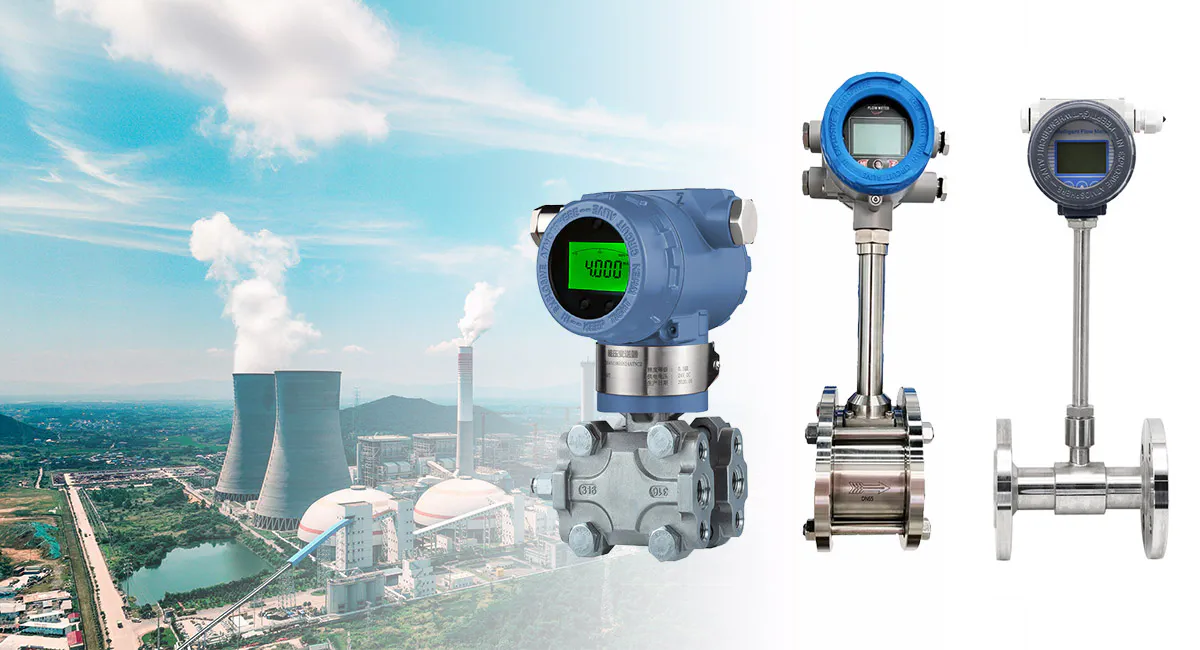
Thermal, vortex, and differential pressure flow meters each solve different engineering problems.
The key is understanding where each technology performs best — and where it reaches its limits.
1. Working Principle Overview
🔹 Thermal Flow Meter
Measures mass flow by detecting heat transfer from a heated sensor to the flowing medium.
Best known for:
Direct mass flow measurement
Low flow sensitivity
Minimal pressure drop
Commonly used in:
Compressed air
Industrial gases
Low-pressure gas systems
🔹 Vortex Flow Meter
Measures flow based on vortex shedding frequency behind a bluff body.
Best known for:
Stable performance in steam applications
Wide flow range
Moderate pressure drop
Commonly used in:
Steam systems
Clean liquids
High-temperature processes
🔹 Differential Pressure (DP) Flow Meter
Measures flow by detecting pressure difference across a restriction element (orifice plate, venturi, etc.).
Best known for:
Mature, standardized technology
High-pressure suitability
Wide industrial adoption
Commonly used in:
Oil & gas
Power plants
High-pressure process lines
مقارنة الأداء
Typical Application Suitability
| Application Type | Thermal | الدوامة | Differential Pressure |
|---|---|---|---|
| Compressed Air | عالية | متوسط | منخفضة |
| Steam | منخفضة | عالية | عالية |
| السوائل النظيفة | منخفضة | عالية | عالية |
| Low Flow Gas | عالية | منخفضة | متوسط |
| High Pressure Lines | متوسط | متوسط | عالية |
Thermal dominates low-flow gas measurement, vortex excels in steam, while DP remains strong in high-pressure and standardized systems.
Accuracy vs Flow Range Stability
Flow Stability Across Wide Turndown
لا توجد بيانات
Thermal flow meters maintain better stability at low and variable flow conditions, while DP performance decreases significantly at high turndown ratios.
4. Pressure Loss Consideration
Pressure drop directly affects energy efficiency.
Thermal → Minimal obstruction
الدوامة → Moderate obstruction
DP → Permanent pressure loss due to restriction element
In compressed air systems, excessive pressure loss increases energy cost over time.
DP meters often introduce the highest lifecycle cost due to this factor.
5. Installation & Maintenance Impact
Thermal
Simple installation
No moving parts
Sensitive to contamination buildup
الدوامة
Requires straight pipe runs
Sensitive to vibration
Suitable for high temperature
Differential Pressure
Requires impulse lines
Prone to clogging
More complex maintenance
In dirty or particulate environments, DP systems may require frequent inspection.
6. When to Choose Each Technology
Choose Thermal Flow Meter When:
✔ Measuring compressed air or clean gases
✔ Low flow sensitivity is required
✔ Pressure loss must be minimized
✔ Direct mass flow is preferred
Choose Vortex Flow Meter When:
✔ Measuring steam
✔ High temperature resistance is required
✔ Moderate pressure loss is acceptable
✔ Liquid flow measurement is needed
Choose Differential Pressure Flow Meter When:
✔ Operating in high-pressure pipelines
✔ Industry standards require orifice/venturi systems
✔ Long-established design specifications must be followed
✔ Capital cost is prioritized over lifecycle efficiency
7. Decision Framework
Instead of asking “Which is better?” ask:
What is the fluid type?
Is mass flow or volumetric flow required?
How critical is pressure loss?
What is the flow variability?
What is acceptable maintenance frequency?
The right technology is defined by process behavior—not brand preference.
Conclusion: Engineering Fit Determines Long-Term Efficiency
Thermal, vortex, and differential pressure flow meters each serve distinct operational roles.
Thermal excels in low-flow gas measurement.
Vortex remains strong in steam and clean liquids.
Differential pressure continues to dominate in standardized high-pressure systems.
The most cost-effective solution over time is the one aligned with process conditions, energy efficiency goals, and maintenance constraints.
Instrava supports industrial users in evaluating these selection boundaries to ensure accurate and stable flow measurement performance.