





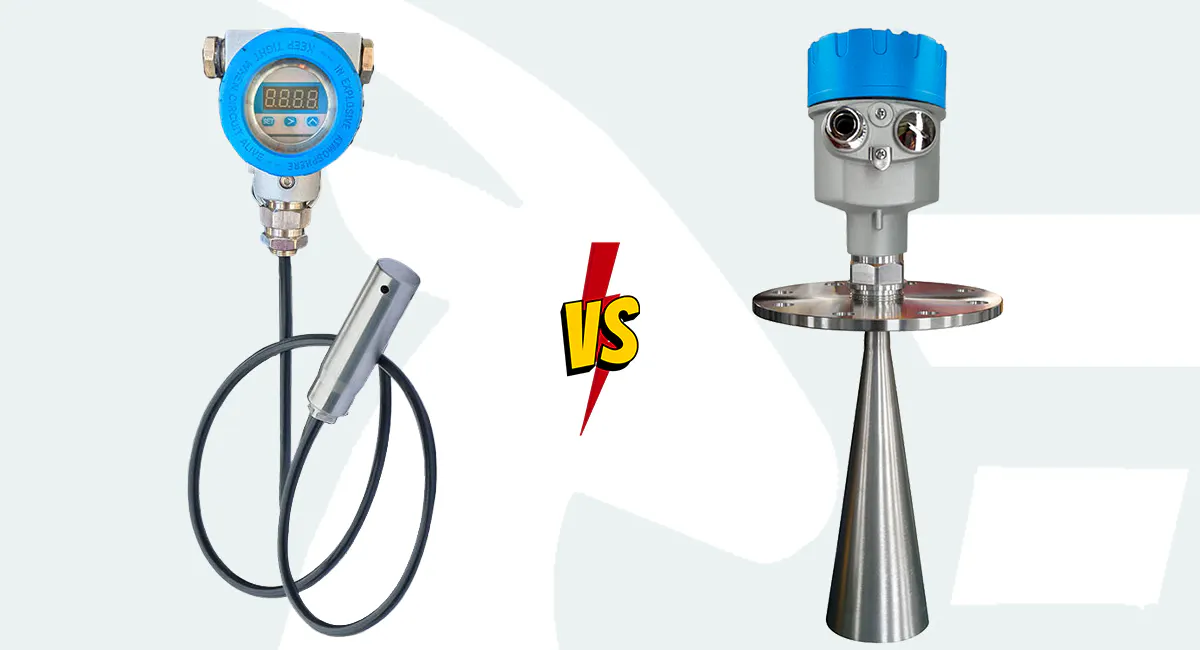
Hydrostatic Level Gauge vs Radar Level Gauge: A Technical Comparison
Introduction
Hydrostatic level gauges and radar level gauges are widely used instruments in industrial level measurement systems. Although both devices are designed to monitor liquid levels in tanks and vessels, they rely on completely different measurement principles.
From an engineering and manufacturer’s perspective, choosing between a hydrostatic level gauge and a radar level gauge requires a clear understanding of their working methods, advantages, and limitations. This article provides an in-depth comparison to help users select the most appropriate level gauge for various industrial applications.
Working Principle
Hydrostatic Level Gauge
A hydrostatic level gauge measures liquid level based on pressure. The instrument senses the hydrostatic pressure generated by the height of the liquid column. The measured pressure is directly proportional to the liquid density and the level height.
This type of level gauge is a contact measurement device and is typically installed at the bottom of the tank or submerged in the medium. It is commonly used for water, fuel, chemical liquids, and other fluids with relatively stable density.
Radar Level Gauge
Radar level gauges use microwave electromagnetic signals to measure the distance from the antenna to the liquid surface. The level is calculated using time-of-flight technology.
Radar is a non-contact measurement method and is almost unaffected by changes in temperature, pressure, vapor, or gas composition inside the tank. This makes radar level gauges ideal for harsh or complex process environments.
Key Differences
| Artículo | Hydrostatic Level Gauge | Radar Level Gauge |
|---|---|---|
| Measurement Method | Contact type | Non-contact type |
| Señal de salida | Pressure-based | Distance-based |
| Influence of Density | Yes | No |
| High Temperature Tolerance | Limited | Excellent |
| High Pressure Suitability | Limited | Excellent |
| Vapor and Foam Resistance | Good | Excellent |
| Installation Position | Bottom mounted | Top mounted |
| Maintenance | Periodic cleaning | Very low |
Advantages Comparison
Hydrostatic Level Gauge Advantages
Simple structure and mature technology
Lower initial cost
Easy installation
Suitable for small and medium tanks
Stable output for clean liquids
Hydrostatic level gauges are often preferred in OEM projects where economical and practical solutions are required.
Radar Level Gauge Advantages
Long measuring range
High accuracy
Excellent reliability
Suitable for high temperature and pressure
Works with corrosive and volatile media
Minimal maintenance
From a manufacturer’s point of view, radar level gauges represent high-end level measurement solutions for critical industrial processes.
Typical Applications
Hydrostatic level gauges are suitable for:
Water tanks
Wastewater reservoirs
Atmospheric pressure vessels
Storage tanks with clean liquids
Radar level gauges are suitable for:
Chemical reactors
Boilers and high-temperature tanks
Pressurized vessels
Tanks with heavy vapor, steam, or agitation
Application Environment Comparison
| Environment Condition | Hydrostatic Level Gauge | Radar Level Gauge |
|---|---|---|
| Clean Liquids | Excellent performance | Excellent performance |
| Corrosive Media | Good with proper material selection | Excellent, non-contact |
| High Temperature Process | Limited suitability | Ideal solution |
| Pressurized Tanks | Limited to low pressure ranges | Fully suitable |
| Tanks with Heavy Vapor | Signal may become unstable | No influence |
| Foam on Liquid Surface | Can cause reading errors | Very stable |
| Liquid Density Change | Directly affects measurement | Not affected |
| Dusty or Dirty Tanks | Requires periodic cleaning | Highly reliable |
| Open Channels or Pits | Very suitable | Suitable but higher cost |
| Long Range Measurement | Accuracy decreases with depth | Excellent for long range |
| Agitated Surfaces | Generally stable | Very stable |
| Hazardous Areas | Suitable with protection | Excellent with Ex design |
Selection Considerations
When selecting a level gauge, users should evaluate:
Process temperature and pressure
Presence of vapor or foam
Liquid density stability
Tank height and range requirement
Required measurement accuracy
From an OEM manufacturer’s perspective, hydrostatic level gauges are ideal for conventional applications, while radar level gauges are strongly recommended for demanding or safety-critical environments.
Installation Requirements Comparison
| Installation Factor | Hydrostatic Level Gauge | Radar Level Gauge |
|---|---|---|
| Mounting Position | Must be installed at tank bottom or submerged in liquid | Installed at tank top |
| Conexión a proceso | Requires threaded or flange pressure connection | Standard flange or thread for antenna |
| Medium Contact | Direct contact with liquid | No contact with medium |
| Cabling Requirement | Signal cable to control system | Signal cable to control system |
| Obstruction Influence | Minimal | Must avoid internal obstacles |
| Influencia de la temperatura | Affects pressure reading accuracy | Almost no influence |
| Pressure Influence | Limited to low pressure | Suitable for high pressure |
| Vapor Influence | Can affect stability | No effect on measurement |
| Maintenance Access | Bottom access needed | Easy top access |
Conclusion
Hydrostatic level gauges and radar level gauges each play important roles in industrial level measurement. The hydrostatic level gauge offers a cost-effective and simple solution for stable process conditions. The radar level gauge provides superior performance and reliability for complex industrial applications.
By understanding these technical differences and consulting with experienced level gauge manufacturers, users can make the best long-term selection for their specific projects.