





- Por Instrava
- 01/10/2026
- 0 Comentario
Types of Magnetic Level Gauge for Industrial Applications | Engineering Guide
Magnetic level gauge technology is often discussed as a single category, but in real industrial practice, magnetic level gauges are available in multiple configurations, each optimized for specific process conditions, installation constraints, and safety requirements.
Understanding the different types of magnetic level gauge is essential for engineers responsible for liquid level indication in oil & gas, LNG/LPG storage, chemical processing, and other demanding environments. Selecting the wrong configuration can lead to reduced accuracy, mechanical stress, or long-term reliability issues.
This article provides a structured overview of the main magnetic level gauge types used in industry and explains how each type supports different application scenarios.
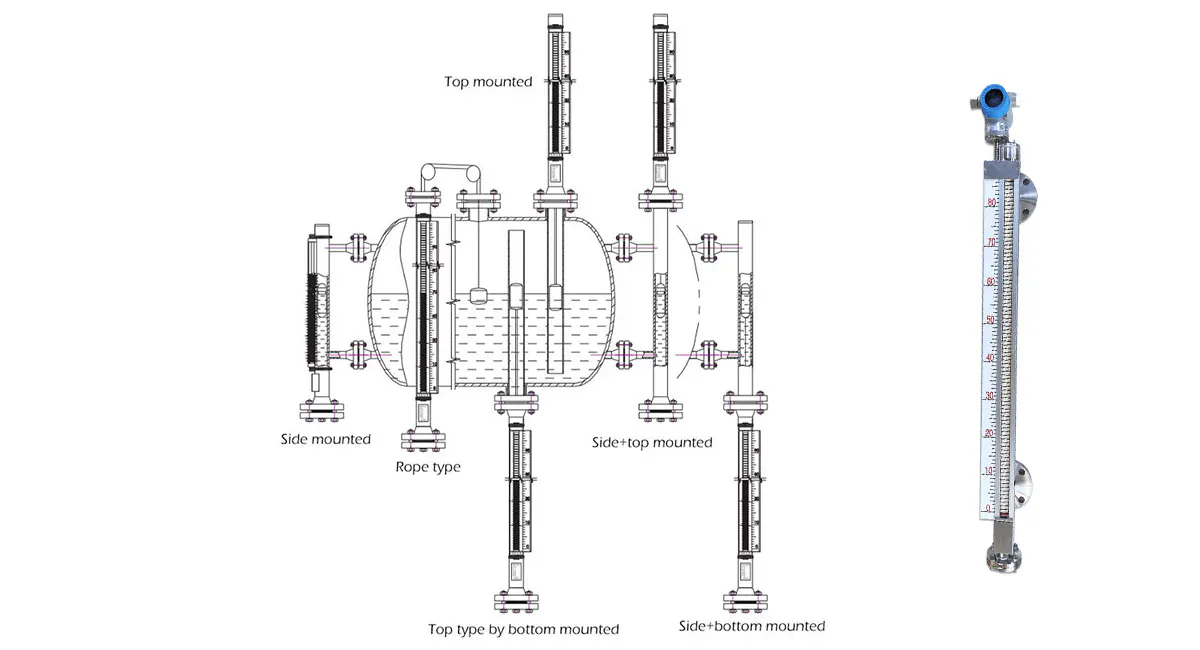
Standard Side-Mounted Magnetic Level Gauge
The most common configuration is the side-mounted magnetic level gauge. It is installed externally on a vessel using upper and lower process connections, allowing the chamber to mirror the liquid level inside the tank.
Typical characteristics
External bypass chamber
Suitable for medium to large vessels
Continuous visual level indication
Easy inspection and maintenance
Common applications
Oil and gas separators
Chemical storage tanks
Utility water systems
This type is widely used because it provides a good balance between mechanical simplicity and measurement stability.
Top-Mounted Magnetic Level Gauge
Top-mounted magnetic level gauges are installed from the top nozzle of a vessel, with the float suspended inside the chamber or guided pipe.
When top-mounted designs are preferred
Limited side nozzles available
High-pressure vertical vessels
Applications with internal obstructions
Because installation access differs from side-mounted designs, careful attention must be paid to float guidance and vertical alignment.
Magnetic Level Gauge with High-Pressure Design
In high-pressure service, magnetic level gauges are engineered with reinforced chambers, pressure-rated flanges, and high-strength materials.
Typical pressure conditions
LNG and LPG storage
Gas-liquid separation vessels
Pressurized hydrocarbon tanks
High-pressure magnetic level gauges are often selected as a mechanical reference in systems where electronic instruments may be exposed to signal instability.
Cryogenic Magnetic Level Gauge
Cryogenic magnetic level gauges are designed specifically for extremely low-temperature applications such as LNG or liquid nitrogen storage.
Key design features
Cryogenic-compatible materials
Special float magnet selection
Thermal isolation between process and indicator
At cryogenic temperatures, magnetic stability and material contraction must be carefully considered to maintain reliable indication.
Magnetic Level Gauge with Remote Signal Output
While magnetic level gauges are inherently mechanical, many industrial installations require remote level signals for control systems or monitoring platforms.
This configuration integrates:
Reed switch chains
Magnetostrictive sensors
Analog or digital signal outputs
In these systems, the magnetic level gauge provides local visual confirmation, while the remote signal supports automation and alarm functions.
Instrava supports measurement architectures where mechanical indication and remote monitoring coexist, ensuring both operational visibility and system integration.
Magnetic Level Gauge for Corrosive or Hazardous Media
For corrosive or toxic fluids, magnetic level gauges are constructed using specialized materials such as stainless steel alloys or lined chambers.
Key considerations
Material compatibility with process media
Seal integrity under temperature cycling
Long-term corrosion resistance
In hazardous environments, magnetic level gauges are often chosen to minimize direct operator exposure to the process fluid.
Comparison of Magnetic Level Gauge Types
| Gauge Type | Typical Application | Key Advantage |
|---|---|---|
| Side-mounted | Storage tanks | Easy installation |
| Top-mounted | Vertical vessels | No side nozzles needed |
| High-pressure | LPG/LNG systems | Mechanical strength |
| Cryogenic | LNG tanks | Low-temperature stability |
| With remote output | Automated plants | Local + remote indication |
| Resistente a la corrosión | Chemical processing | Media compatibility |
Selection Challenges Across Different Types
Although magnetic level gauges are robust, selection errors still occur. Common challenges include:
Incorrect float design for fluid density
Underestimating temperature effects on magnet performance
Choosing inappropriate chamber materials
Overlooking installation orientation constraints
Addressing these factors early in the design phase helps ensure reliable long-term operation.
Why Multiple Magnetic Level Gauge Types Are Still Relevant
Modern industrial plants rarely rely on a single measurement technology. Different magnetic level gauge types allow engineers to adapt the same core principle to a wide range of conditions without sacrificing reliability.
Rather than competing with electronic level instruments, magnetic level gauges often serve as:
Independent visual references
Redundant safety indicators
Stable benchmarks during system upsets
Instrava approaches level measurement with a focus on process conditions, long-term reliability, and engineering collaboration, ensuring that the selected magnetic level gauge type aligns with real operational needs.
Conclusion
Magnetic level gauge technology is not one-size-fits-all. Side-mounted, top-mounted, high-pressure, cryogenic, and signal-integrated designs each address specific industrial challenges.
By understanding the different types of magnetic level gauge and their intended applications, engineers can improve safety, reduce maintenance risk, and ensure consistent level indication across a wide range of industrial processes.