
Accueil » Technologie » Next-Gen Infrastructure for Edge AI: Technical Trends and Applications in Micro Data Center Monitoring
Next-Gen Infrastructure for Edge AI: Technical Trends and Applications in Micro Data Center Monitoring
The explosive growth of Large Language Models (LLMs) and Generative AI has shifted a massive portion of compute requirements toward the frontier: Edge AI and enterprise-level AI Inference nodes. Whether it is real-time computer vision for quality control in smart factories, localized video analytics at telecom edge stations, or on-premise LLM fine-tuning in corporate headquarters, data computation is moving closer to the data source.
This decentralized compute model relies heavily on Micro Data Centers (Micro DCs)—integrated, modular 1-to-4 rack systems that bundle power, cooling, monitoring, and fire suppression into a compact footprint. However, housing high-density GPU servers in a confined space without on-site IT staff presents severe challenges for traditional dynamic environment monitoring systems.
Part 1: Technical Landscape & Evolution of Edge AI Infrastructure
In traditional IT environments, edge racks rarely exceeded a power density of $4\text{kW} \text{ to } 6\text{kW}$. In the Edge AI era, a single high-performance GPU server can draw $1\text{kW} \text{ to } 3\text{kW}$ or more, pushing a 4-rack Micro DC beyond $10\text{kW}$ easily. This rapid densification drives three core technical paradigm shifts:
1. Micro-Climate Micro-Containment vs. Room-Level Cooling
Traditional edge server rooms rely on comfort or standard commercial air conditioning, which leads to mixed airflow and localized hotspots. Because GPU workloads can spike instantly during AI inference, thermal management must evolve into Closed Aisle Containment (CAC). By sealing the rack’s airflow pathway, cold air is directly funneled to the server intakes, and hot exhaust is seamlessly routed back to a dedicated precision cooling unit, preventing thermal runaway.
2. PUE Optimization in Micro Footprints
Power Usage Effectiveness (PUE) remains the gold standard for data center energy efficiency, calculated as:
$$PUE = \frac{P_{\text{Total}}}{P_{\text{IT}}} = \frac{P_{\text{IT}} + P_{\text{Cooling}} + P_{\text{Power\_Loss}} + P_{\text{Other}}}{P_{\text{IT}}}$$
While hyperscale data centers leverage massive scale and liquid cooling to drive PUE below 1.25, achieving low PUE in a micro-scale 1-to-4 rack environment is notoriously difficult due to scaling overheads. Advanced edge monitoring infrastructure must utilize smart variable-frequency cooling and dynamic load-matching to compress the micro-DC PUE down to $\le 1.3$, aligning with green energy regulations.
3. Automated Resilience for Unattended Operations
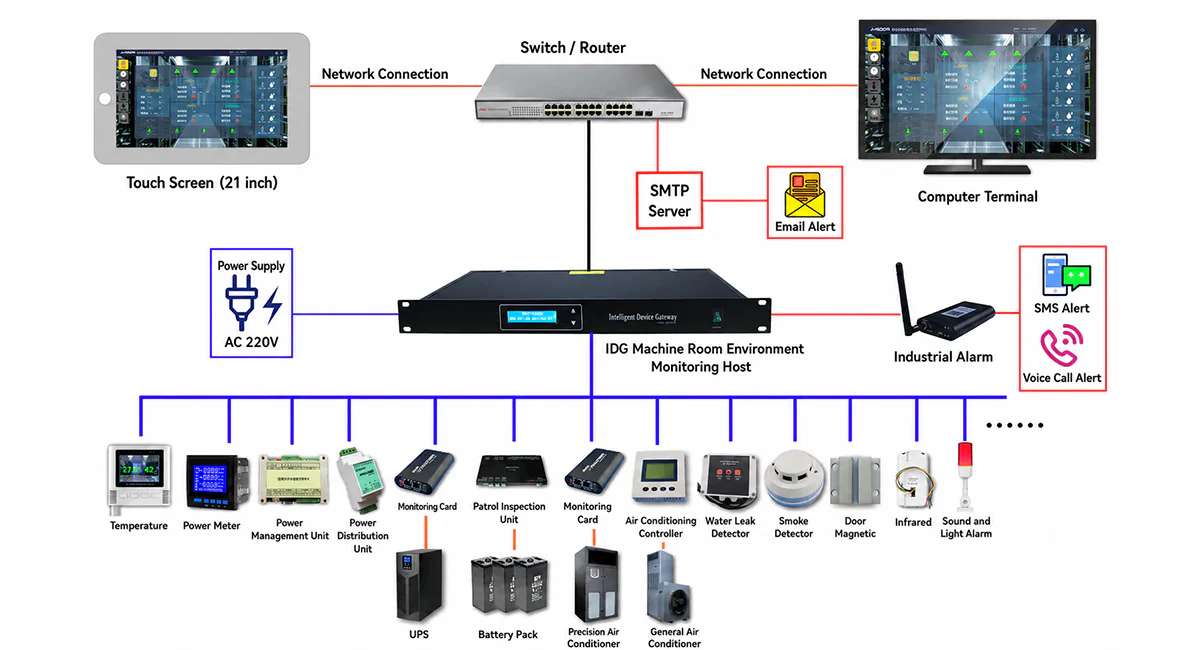
Distributed Edge AI nodes operate without local IT personnel. Consequently, infrastructure monitoring must move beyond simple telemetry collection. It requires a combination of high-density edge gateways, remote Web-based management, and physical-to-digital automation capable of executing autonomous self-healing or emergency defense protocols when cooling or power fluctuations occur.
Part 2: Instrava IDC Smart Monitoring System: Application & Engineering Practices
As a premier provider of curated, field-proven industrial instruments and infrastructure hardware, Instrava addresses these edge constraints with its Système de surveillance des centres de données IDC / AI. This factory-prefabricated, all-in-one micro-DC solution integrates power distribution, UPS, variable-frequency precision cooling, multi-protocol environmental telemetry, and smart fire suppression into a highly resilient package optimized for edge AI workloads.
1. Dynamic Thermal Containment and PUE Compression
To handle the thermal shocks generated by heavy GPU utilization, the Instrava system implements targeted thermal architecture:
Capacity Matching: Supports configurable power options from $2.4\text{kW} \text{ to } 12\text{kW}$ paired with up to $12.5\text{kW}$ of precision cooling capacity, ensuring full coverage for high-density AI nodes.
Closed-Loop Efficiency: The physical containment configuration limits airflow leakage, working in tandem with the smart cooling controller to maintain a highly efficient PUE of $\le 1.3$.
Dual-Stage Emergency Defense: If a cooling unit fails or an unexpected workload spike triggers extreme temperatures, the integrated controller activates an automated top-mounted ventilation override. It also supports optional automated mechanical door-release linkages to introduce ambient air cooling before critical component damage occurs.
2. Multi-Dimensional Telemetry & Industry 4.0 Connectivity
As the centralized nervous system of distributed AI infrastructure, the Instrava monitoring host is built on robust industrial communication frameworks to blend smoothly into existing corporate SCADA or ERP platforms:
Extensive Physical Interface Array: The monitoring gateway is equipped with
5*RS485,2*RS232,12DI(Digital Inputs),4DO(Digital Outputs), and dual Ethernet ports.Environmental Matrix Data: It continuously aggregates metrics from a dense matrix of water leakage detectors, smoke detectors, and precision temperature/humidity sensors to maintain an active digital twin of the micro-climate.
3. Specialized Human-Machine Interfaces (HMI) for Remote Sites
To offset the complete absence of on-site IT technicians at remote telecom branches or factory floors, Instrava optimizes local and remote visual interaction:
Visual Status RGB Lightstrips: The external chassis features dynamic, color-coded RGB light strips mapped directly to the environmental telemetry engine. Local personnel can instantly identify rack health (e.g., normal operation, power overload, or thermal alert) via intuitive color transitions without checking raw data monitors.
Dual-Layer Management Access: A local 10.1-inch Android touchscreen interface simplifies installation and commissioning, while a secure, comprehensive Web interface enables remote centralized engineering teams to perform predictive maintenance globally.
4. Enterprise Asset Protection: Power Resiliency and Physical Access Control
Edge AI inference nodes house highly valuable proprietary AI models and sensitive corporate data. The Instrava platform provides strict physical and electrical security perimeters:
Graceful Workload Migration: The system seamlessly integrates with $3\text{kVA} \text{ to } 15\text{kVA}$ high-reliability UPS modules. During unexpected utility grid failures, the UPS provides 5 to 10 minutes of full-load backup time. Concurrently, the monitoring host broadcasts a critical power alert to the AI servers, giving the OS sufficient time to save computation progress (Checkpoints), migrate running inference containers, or execute a graceful shutdown sequence.
Closed-Loop Access Auditing: Racks are secured by intelligent electronic locks supporting fingerprint authentication, PIN codes, RFID cards, and one-time remote administrative access tokens—with every entry event logged via immutable audit trails.
Non-Destructive Fire Suppression: The micro-enclosure supports optional clean-agent aerosol fire suppression modules designed to extinguish localized electrical fires instantly without depositing residue that could ruin high-cost GPU components.
Technical Specifications Matrix
| Component Cluster | Technical Specification Parameter | Edge AI Infrastructure Value Utility |
| Configurable Power Range | $2.4\text{kW}$ à $12\text{kW}$ Max | Optimally scaled for 1 to 2 high-density AI inference units or multiple edge-compute arrays. |
| Precision Cooling Capacity | $3.5\text{kW}$ / $7\text{kW}$ / $12.5\text{kW}$ | Engineered for front-delivery/rear-return airflow topologies to suppress rapid GPU thermal spikes. |
| Energy Efficiency Index | Target System $\text{PUE} \le 1.3$ | Complies with strict global green energy mandates for decentralized edge computing nodes. |
| Emergency Mitigation | Automated Ventilation / Door-Pop (Opt.) | Mechanical fail-safe against cooling loss and thermal runaway events. |
| Host Connectivity Interfaces | 5*RS485, 2*RS232, 2*RJ45, 12DI, 4DO | Comprehensive industrial protocol mapping to enable seamless enterprise SCADA/IT integration. |
| Fire Suppression Subsystem | Compressed Aerosol Fire Extinguisher (Opt.) | Zero-residue, non-conductive localized fire suppression protecting sensitive silicon logic boards. |
Conclusion
As compute topology downshifts to localized Edge AI, the operational stability of decentralized micro infrastructures directly dictates the uptime of intelligent business applications. The Instrava IDC/AI Data Center Monitoring System condenses complex data center facilities engineering into an optimized, self-contained smart rack solution. By integrating efficient micro-climate containment, high-density industrial telemetry, and autonomous asset defense systems, it provides a highly reliable, turnkey digital foundation for enterprise AI at the edge.
Recommandations de produits connexes

What are the core differences between an AI data center and a traditional data center?
The fundamental differences lie in power density et workload characteristics.
Traditional Data Centers: Primarily driven by CPU servers. Single-rack power density typically ranges from 4kW to 6kW, and changes in business workloads are relatively gradual and predictable.
AI Data Centers: Dominated by high-computing chips such as GPUs and TPUs. Single-rack power density often surges to 10kW – 30kW or even higher. When AI tasks (such as large model training or intensive inference) launch, computing demand spikes within seconds. This causes a “step-like” surge in power consumption and heat generation, demanding an extremely high transient response from both power supply and cooling systems.
Why are cooling technology requirements so stringent for AI data centers?
The primary goal is to prevent expensive chips from performance throttling or burning out due to instantaneous heatwaves.
AI servers release staggering amounts of heat during massive parallel computing tasks. Traditional open-space air conditioning systems can easily lead to localized hot spots. Therefore, AI data centers must adopt Cold/Hot Aisle Containment (CAC/HAC) technology to precisely deliver cold air to the front of the servers. Alternatively, they implement more advanced Liquid Cooling technologies to directly remove heat from the chip cores, ensuring sustained and stable computing output.
What is PUE, and why is it difficult to reduce PUE in micro/edge AI data centers?
PUE (Power Usage Effectiveness) is the gold standard for measuring data center energy efficiency. It is calculated using the following formula:
$$\text{PUE} = \frac{\text{Total Facility Energy}}{\text{IT Equipment Energy}}$$
The closer the PUE value is to 1, the less “overhead energy” is wasted on cooling and power distribution losses.
Large-scale Data Centers: Can leverage economies of scale and massive liquid cooling systems to drive PUE below 1.2.
Micro AI Data Centers (Micro DCs): Typically deployed at the enterprise front-end with only 1 to 4 racks. Due to their compact footprint and limited airflow space, cooling energy accounts for a relatively higher percentage of total power. Modern edge AI infrastructures must rely on the intelligent linkage between variable-frequency precision air conditioners and environment monitoring systems to press the PUE down to an excellent level of ≤ 1.3.
How do AI data centers protect expensive GPUs and training data during sudden power outages?
They rely on a synchronized “graceful shutdown” orchestrated by high-reliability UPS et Environment Monitoring Systems (EMS).
AI server hardware assets are incredibly expensive, and the private models or datasets they process represent core intellectual property. When the external power grid fails unexpectedly, the deployed UPS (Uninterruptible Power Supply) immediately takes over, providing a 5 to 10-minute buffer under full load.
During this window:
The environment monitoring host instantly signals the AI operating system.
The system uses this time to save training progress (Checkpoints) or migrate running inference containers.
The system executes a graceful shutdown sequence to ensure no hardware is damaged and no data is lost.
What is a "Modular Micro AI Data Center (Micro DC)," and what scenarios is it best suited for?
A Modular Micro DC is an all-in-one, plug-and-play facility that essentially “condenses an entire server room into a single rack.”
It highly integrates power distribution, UPS, precision cooling, multi-channel environment monitoring, and fire suppression systems within a few standardized racks, fully pre-fabricated and commissioned at the factory.
Ideal Application Scenarios
Edge AI Computing: Industrial vision quality inspection workshops in smart factories.
Telecom Edges: Real-time video stream AI analytics at edge nodes.
On-Premises Corporate Hubs: Local computing nodes used by enterprise headquarters for private Large Language Model (LLM) fine-tuning and strict data isolation.
What role does the intelligent environment monitoring system play in unmanned edge AI server rooms?
It acts as the “digital nervous center” et le “automated safety guard” for distributed computing nodes.
Because edge AI nodes are typically scattered and lack on-site IT professionals, the monitoring system must feature proactive thermal defense and minimalist edge interaction:
Proactive Defense: In the event of a sudden air conditioning failure, the system makes millisecond-level decisions to automatically activate top-mounted emergency ventilation or trigger the rack doors to pop open, utilizing ambient room air for urgent heat dissipation.
Localized Visualization: Racks are usually equipped with external RGB dynamic color-changing light strips. Local facility inspectors do not need to log into complex backend systems; a single glance at the light strip color (Green for normal, Orange for high load, Red for over-temperature) allows them to determine the health status of the computing node in seconds.
Pourquoi choisir Instrava ?
Construit sur la cohérence, pas sur les revendications
Axé sur les applications industrielles
Nous sommes spécialisés dans l'analyse et la détection industrielles, avec une compréhension claire des environnements d'exploitation et des exigences du monde réel.
Critères stricts de sélection des produits
Chaque instrument est évalué en fonction de ses performances, de sa stabilité et de son adéquation à l'application, et non pas seulement en fonction de ses spécifications ou de son prix.
Approvisionnement fiable et constance de la qualité
Nous travaillons avec des fabricants de confiance pour garantir un approvisionnement stable, une qualité constante et une livraison fiable.
Un soutien pratique et basé sur l'expérience
Nos recommandations sont fondées sur la compréhension des applications, ce qui permet aux clients d'éviter les problèmes courants et d'obtenir des résultats fiables.
Instrava est conçu pour réduire l'incertitude, afin que chaque décision que vous prenez soit plus claire, plus sûre et plus fiable.