How to Choose the Right Liquid Analysis Solution for Industrial Applications
Selecting the right liquid analysis solution is critical for industrial process efficiency, product quality, and regulatory compliance. With multiple parameters...

Home » Products » Liquid Analysis » Portable Dissolved Oxygen Meter

In wastewater treatment, aquaculture, environmental monitoring, and laboratory analysis, accurate dissolved oxygen (DO) measurement directly impacts biological process efficiency, energy optimization, and regulatory compliance.
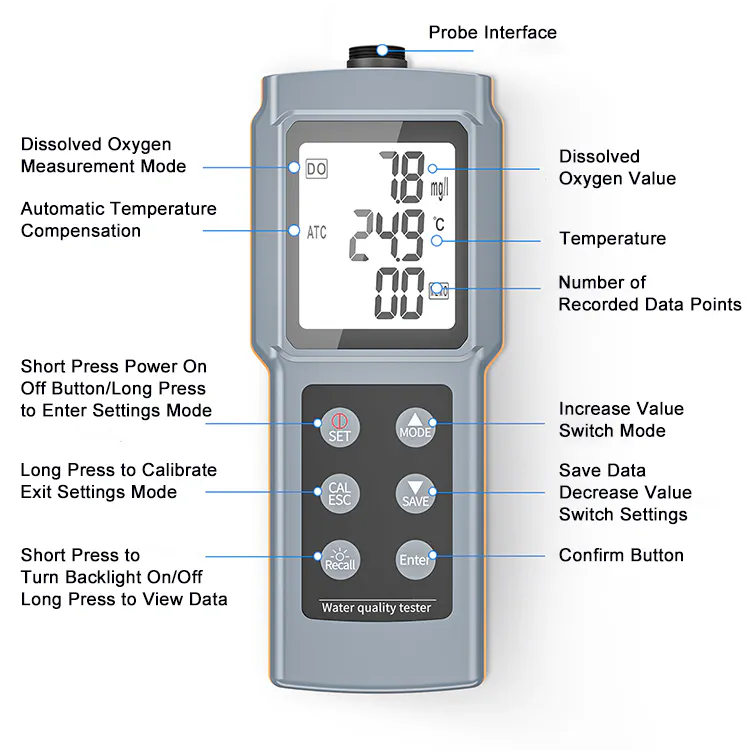
The Instrava Portable Dissolved Oxygen Meter is engineered to provide high-precision DO measurement with both membrane and optical fluorescence probe options, allowing users to select the most suitable technology based on maintenance strategy and operational environment.
With triple compensation (temperature, salinity, altitude), upgraded sealed protection design, and stable ±3% FS accuracy, this instrument ensures reliable performance across varying environmental conditions. Designed for field engineers, plant operators, and laboratory technicians, it balances measurement stability, ease of use, and long-term cost efficiency.
Liquid Analysis Description
Portable Dissolved Oxygen Meter Typical Application Scenarios
Municipal and industrial wastewater treatment plants
Aeration tank and biological process monitoring
Aquaculture and fishery oxygen management
Surface water and environmental field surveys
Laboratory water quality analysis
Remote or outdoor monitoring requiring portable operation
The instrument supports both routine process control and mobile environmental inspections.


Portable Dissolved Oxygen Meter Engineering Advantages
JE8803 (Membrane Method): Traditional electrochemical measurement with reliable performance.
JE8803A (Optical Fluorescence Method):
No membrane cap
No electrolyte filling
No polarization required
Reduced calibration frequency
Resistant to H₂S, heavy metals, oils, acids, and alkalis
Provides flexibility for procurement strategies and operational environments.
Dissolved oxygen is influenced by temperature, salinity, and altitude. This meter integrates:
Automatic Temperature Compensation (ATC)
Salinity Compensation (0–42 ppt)
Altitude Compensation (0–3500 m)
Ensuring stable and accurate readings across variable site conditions.
Upgraded sealed body with triple protection structure
Effectively prevents moisture and water ingress
Large LCD display (41 × 50 mm) with backlight
Compact ergonomic design (70 × 35 × 167 mm)
Optimized for field durability and ease of handling.
100% air saturation calibration
99 data manual storage records
Automatic shutdown after 10 minutes of inactivity
Temperature unit switch (°C / °F)
High-precision probe with 0.1 mg/L resolution
Supports efficient workflow and reduces operational errors.
Powered by 4 × 1.5V AAA batteries
Lightweight handheld structure
Approx. 3.5 m probe cable for flexible measurement
Ideal for on-site deployment and extended field operation.
Liquid Analysis Parameter
| Parameter | Membrane Method | Optical Fluorescence Method |
|---|---|---|
| Measuring Range | 0.0–30.0 mg/L | 0.0–20.0 mg/L |
| Saturation Range | 0–199% | 0–199% |
| Resolution | 0.1 mg/L | 0.1 mg/L |
| Accuracy | ±3% FS | ±3% FS |
| Calibration | 100% air saturation | 100% air saturation |
| Parameter | Specification |
|---|---|
| Temperature Range | 0.0–60.0°C |
| Resolution | 0.1°C |
| Accuracy | ±0.5°C |
| Temperature Unit | °C / °F Switchable |
| Automatic Temperature Compensation | Supported |
| Parameter | Specification |
|---|---|
| Salinity Compensation | 0–42 ppt |
| Altitude Compensation | 0–3500 m |
| Data Storage | 99 manual records |
| Parameter | Specification |
|---|---|
| LCD Size | 41 × 50 mm (Backlit) |
| Probe Cable Length | Approx. 3.5 m |
| Power Supply | 4 × 1.5V AAA batteries |
| Instrument Size | 70 × 35 × 167 mm |
| Automatic Shutdown | 10 minutes inactivity |
Instrava OEM/ODM
Reliable Instruments. Solutions That Fit Your Application.
Instrava is focused on delivering reliable industrial solutions through carefully curated products, application-driven optimization, and flexible customization. We select proven instruments from trusted manufacturers to ensure consistent quality, optimize solutions based on real working conditions to solve practical challenges, and provide tailored configurations to meet specific application needs.
By combining selection expertise with application understanding, Instrava helps customers reduce risk, improve efficiency, and achieve dependable results in complex industrial environments.

What is the difference between membrane and optical (fluorescence) DO models, and how should we choose?
From an engineering standpoint, the membrane model (JE8803) is cost-effective and suitable for routine field testing with standard maintenance schedules.
The optical fluorescence model (JE8803A) is designed for higher stability and lower lifecycle cost. It requires:
No membrane replacement
No electrolyte refilling
No polarization time
Less frequent calibration
For continuous field deployment, aquaculture farms, wastewater plants, or environments containing H₂S, heavy metals, oil, or corrosive media, we recommend the optical version for operational stability and reduced downtime.
How does the meter ensure accuracy under varying environmental conditions?
Dissolved oxygen concentration is directly influenced by temperature, salinity, and altitude. Instrava integrates triple compensation mechanisms:
Automatic Temperature Compensation (ATC)
Salinity Compensation (0–42 ppt)
Altitude Compensation (0–3500 m)
This design ensures reliable DO readings across freshwater, seawater, plateau regions, and industrial process environments.
What is the expected maintenance workload for the probes?
Membrane Model:
Periodic membrane cap replacement
Electrolyte refill
Calibration after maintenance
Optical Model:
No membrane
No electrolyte
No polarization
Resistant to chemical interference
For procurement managers evaluating total cost of ownership (TCO), the optical model significantly reduces maintenance labor and consumables over time.
Can this meter be used for aquaculture and wastewater compliance testing?
Yes. With measurement ranges up to:
0.0–30.0 mg/L (membrane)
0.0–20.0 mg/L (optical)
0–199% saturation
The device supports applications including:
Aquaculture pond oxygen management
Municipal wastewater treatment
Environmental field inspection
Laboratory water analysis
Industrial process monitoring
Its ±3% FS accuracy and 0.1 mg/L resolution meet most field compliance and operational control requirements.
Is the device suitable for field deployment in humid or wet environments?
The upgraded sealed housing features a triple-protection structure to prevent moisture and water ingress. Combined with:
Backlit large LCD (41×50 mm)
3.5 m probe cable
10-minute auto shut-off
Battery-powered portability
It is optimized for on-site and mobile measurement scenarios.
Does the device support data logging for reporting and traceability?
Yes. The meter allows manual storage of up to 99 data records, supporting:
Field inspection documentation
Compliance sampling records
Operational adjustment logs
For engineering teams that require traceability but do not need continuous online logging systems, this provides practical, lightweight data retention functionality.
Built on Consistency, Not Claims
We specialize in industrial analysis and detection, with a clear understanding of real-world operating environments and requirements.
Every instrument is evaluated based on performance, stability, and application suitability—not just specifications or pricing.
We work with trusted manufacturers to ensure stable supply, consistent quality, and dependable delivery.
Our recommendations are grounded in application understanding, helping customers avoid common issues and achieve reliable results.
Instrava is built to reduce uncertainty—so every decision you make is clearer, safer, and more reliable.

Selecting the right liquid analysis solution is critical for industrial process efficiency, product quality, and regulatory compliance. With multiple parameters...
Effective maintenance and calibration are critical for ensuring the accuracy, reliability, and longevity of liquid analysis instruments. In industrial environments,...
In modern industrial processes, monitoring multiple water quality parameters simultaneously is essential for operational efficiency, regulatory compliance, and process optimization....