







- По ссылке Instrava
- 04/13/2026
- 0 Комментарий
Как обновить приборы 4-20 мА, HART и Modbus до архитектуры OPC UA PA-DIM
Traditional industrial instruments were not designed for cloud integration.
They were built for local control systems, not for:
- API-based tuning
- Cloud analytics
- Data traceability
- AI-driven optimization
Yet in 2026, these capabilities are no longer optional.
The challenge is clear:
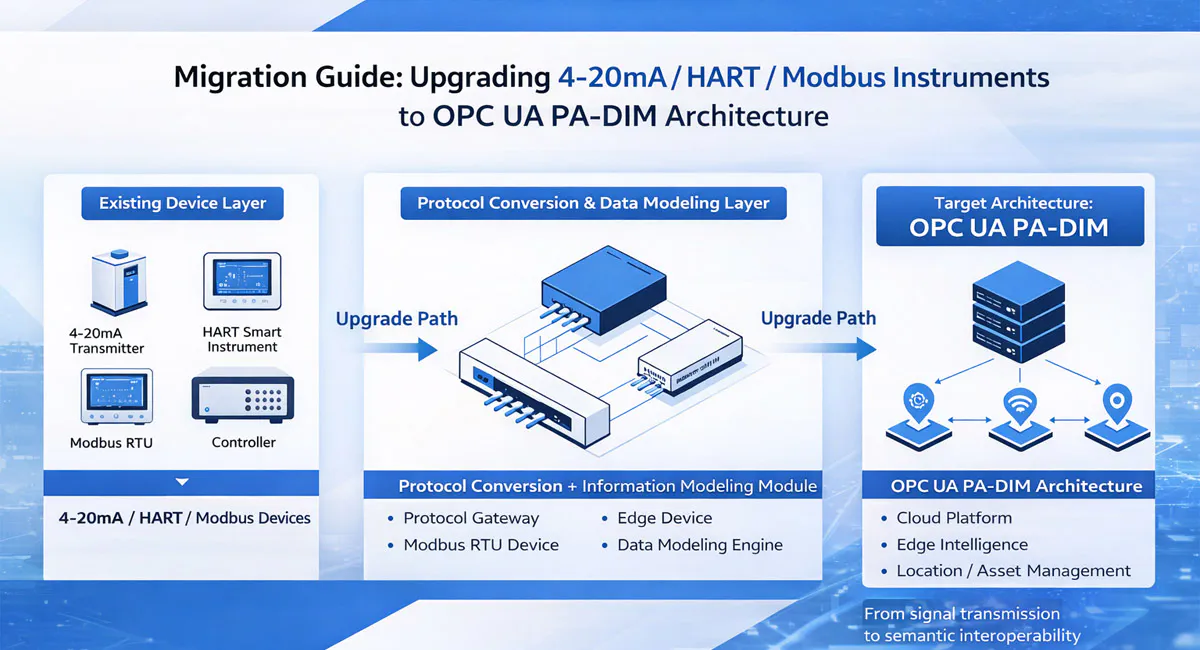
How can existing 4–20mA, HART, and Modbus instruments evolve into OPC UA PA-DIM–compatible systems without full replacement?
The Core Problem: Data Without Meaning
Traditional communication protocols transmit data—but not context.
- 4–20mA → only one analog value
- HART → slow, limited structured data
- Modbus → raw register values
They lack:
- Self-description
- Standardized semantics
- Native interoperability
Communication Capability Comparison
| Protocol | Data Type | Semantic Meaning | Remote Control | Масштабируемость |
|---|---|---|---|---|
| 4-20 мА | Analog | Нет | Нет | Низкий |
| HART | Hybrid | Ограниченный | Частичный | Низкий |
| Modbus RTU | Register-based | Нет | Да | Средний |
| OPC UA + PA-DIM | Object-based | Полный | Да | Высокий |
Traditional protocols provide data transmission—but not semantic interoperability.
Without semantic structure, software must “guess” what each value represents. This makes scalable integration and API-based control extremely difficult.
What Makes OPC UA + PA-DIM Fundamentally Different
Modern instrumentation is not defined by communication speed—but by data intelligence.
OPC UA provides:
- Object-oriented communication
- Built-in security (TLS, certificates)
- Method-based control (not just reading values)
PA-DIM provides:
- Standardized device structure
- Unified parameter naming
- Cross-vendor interoperability
Together, they enable:
- Plug-and-play integration
- API-driven remote tuning
- Consistent data models across systems
Integration Complexity Reduction
Integration complexity grows exponentially in traditional systems but remains manageable with PA-DIM.
Данные не найдены
Standardization eliminates the need for device-specific drivers, enabling scalable system architecture.
The Reality: You Cannot Replace All Existing Instruments
In most industrial plants:
- Thousands of legacy devices are still in operation
- Replacement cost is extremely high
- Downtime risk is unacceptable
Therefore, the practical approach is not replacement—but transformation.
The Key Solution: Edge Gateway Architecture
The bridge between legacy devices and modern systems is the edge gateway.
It acts as:
Protocol translator + semantic engine + security layer
How the Architecture Works
1. Southbound Communication (Field Level)
The gateway connects to legacy instruments via:
- HART
- Modbus RTU (RS485)
- Analog input modules
It reads raw data such as:
- Register values
- Analog signals
- Device parameters
2. Semantic Mapping (Core Layer)
This is the most critical step.
The gateway converts raw data into structured models:
- Register 40001 → pH value
- Status bits → device diagnostics
- Raw signals → engineering units
Then maps them into PA-DIM objects.
Data Transformation Process
| Stage | Data Type |
|---|---|
| Instrument Output | Raw signal / register |
| Gateway Input | Parsed value |
| Semantic Mapping | Structured variable |
| OPC UA Server Output | PA-DIM object |
The gateway transforms raw industrial data into standardized, machine-readable information.
This step enables cloud systems to interact with legacy devices as if they were modern OPC UA instruments.
3. Northbound Communication (Cloud Level)
The gateway exposes:
- OPC UA Server
- MQTT data streams
- REST APIs
Your cloud platform (the “cloud brain”) connects as an OPC UA client.
From its perspective:
- There are no Modbus registers
- No HART commands
- Only standardized PA-DIM objects
Enabling Remote API-Based Tuning
Once semantic mapping is established:
API-based control becomes possible.
Пример:
The process:
- API request sent from cloud
- Gateway translates request
- Maps to Modbus/HART command
- Sends to device
- Confirms execution
This creates a closed control loop between software and hardware.
Enabling “Digital Fingerprints” for Industrial Data
To ensure compliance and traceability, data must be:
- Authentic
- Timestamped
- Tamper-proof
Required Infrastructure
✔ Device Identity
- Unique device ID
- Cryptographic signature
✔ Time Synchronization
- Network-wide clock alignment
✔ Secure Transmission
- Encrypted communication
✔ Immutable Storage
- Blockchain or secure databases
Data Trust Level Comparison
Data trust increases significantly when cryptographic and distributed systems are applied.
Данные не найдены
Digital fingerprints ensure that every measurement is verifiable and audit-ready—critical for environmental and regulatory compliance.
Final Insight: Transformation Without Disruption
You do not need to replace your existing instruments to enter the next generation.
Instead:
- Add intelligence at the edge
- Standardize data through PA-DIM
- Enable API-based interaction
- Secure data with digital identity
Conclusion: From Legacy Signals to Intelligent Systems
Traditional signals like 4–20mA, HART, and Modbus are not obsolete—but incomplete.
With the right architecture:
- Legacy instruments become intelligent nodes
- Raw data becomes structured information
- Local devices become part of cloud systems
Instrava supports this transition by enabling interoperable, secure, and scalable instrumentation architectures—bridging the gap between legacy infrastructure and modern industrial intelligence.