
Brownfield vs Greenfield: Choosing the Right Industrial Digitalization Strategy
Why This Decision Matters
Industrial digitalization is no longer a question of if, but how.
For most operators, the real challenge is not selecting a technology, but choosing the right implementation path:
- Should you upgrade existing systems?
- Or invest in a new, future-ready architecture?
This is where the distinction between Brownfield and Greenfield strategies becomes critical.
Digital transformation is not about choosing technologies — it is about choosing the right path.
What Is a Brownfield Strategy?
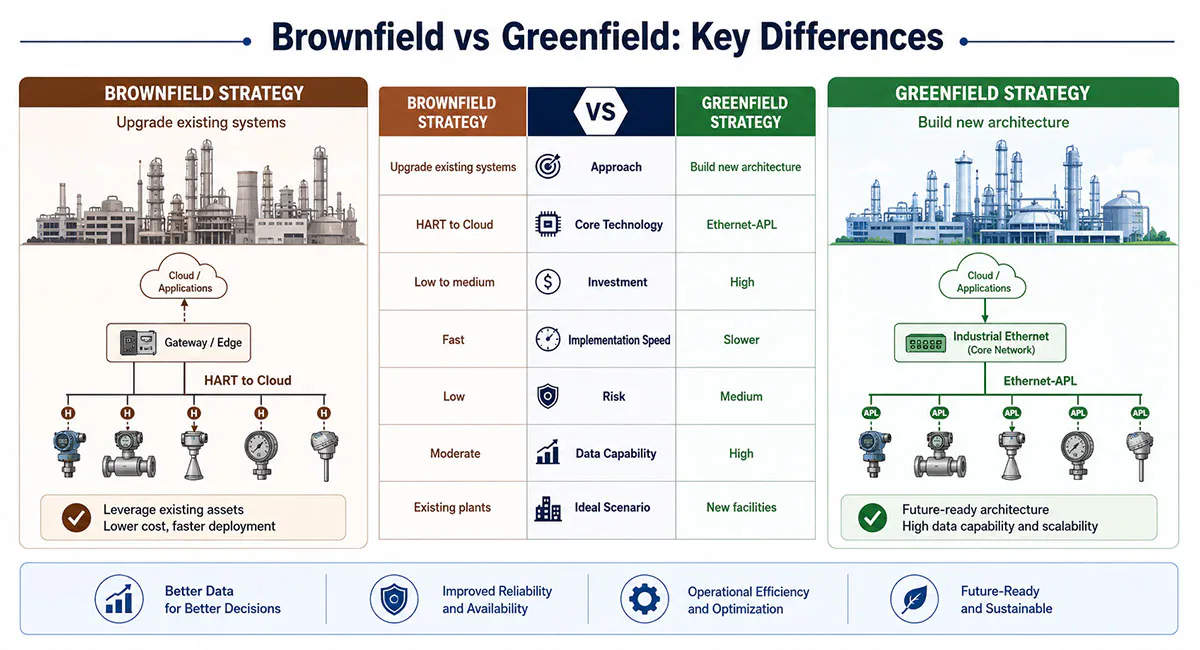
A Brownfield strategy focuses on upgrading existing plants without replacing installed instrumentation or control systems.
Typical characteristics:
- Existing 4–20mA and HART devices
- Legacy PLC/DCS systems
- Mixed communication protocols
Key Approach: HART to Cloud
Brownfield Digitalization is typically enabled through:
- HART data extraction
- Edge gateways and protocol conversion
- Integration with cloud or SCADA systems
Related: HART to Cloud Guide → /hart-to-cloud
Advantages of Brownfield
- Lower investment
- Minimal disruption to operations
- Faster implementation
- Reduced risk
Limitations of Brownfield
- Limited by existing infrastructure
- Partial digitalization
- Integration complexity over time
What Is a Greenfield Strategy?
A Greenfield strategy involves building a new system from the ground up using modern digital architecture.
Typical characteristics:
- New plant or major system redesign
- Full adoption of industrial Ethernet
- Unified data and communication models
Key Technology: Ethernet-APL
Greenfield projects increasingly adopt:
- Ethernet-APL for field-level connectivity
- OPC UA and structured data models
- Fully integrated IT/OT architecture
Learn more: Ethernet-APL Overview → /ethernet-apl
Advantages of Greenfield
- Future-ready architecture
- Full data transparency
- Simplified long-term integration
- Scalable and standardized systems
Limitations of Greenfield
- Higher capital investment
- Longer implementation time
- Greater project complexity
Brownfield vs Greenfield: Key Differences
| Aspect | Brownfield Strategy | Greenfield Strategy |
|---|---|---|
| Approach | Upgrade existing systems | Build new architecture |
| Core Technology | HART to Cloud | Ethernet-APL |
| Investment | Low to medium | High |
| Implementation Speed | Fast | Slower |
| Risk | Low | Medium |
| Data Capability | Moderate | High |
| Ideal Scenario | Existing plants | New facilities |
When Should You Choose Brownfield?
A Brownfield approach is ideal when:
- Existing instrumentation is still reliable
- Budget constraints limit full replacement
- Downtime must be minimized
- Quick results are required
In most industrial facilities, Brownfield is the starting point
When Should You Choose Greenfield?
A Greenfield approach makes sense when:
- Building a new plant
- Performing major system upgrades
- Long-term scalability is a priority
- Full digital integration is required
Greenfield defines the future architecture
The Reality: Hybrid Strategies Dominate
In practice, most industrial operators do not choose one or the other.
Instead, they adopt a hybrid strategy:
- Keep existing instruments (Brownfield)
- Upgrade critical points to Ethernet-APL
- Use edge systems to integrate both
This allows:
- Gradual investment
- Risk control
- Continuous digital evolution
How Instrava Helps You Choose the Right Path
Instrava focuses on helping industrial operators make practical, application-driven decisions.
We support both Brownfield and Greenfield strategies by:
- Assessing existing instrumentation and system readiness
- Identifying where digitalization creates real value
- Designing HART to Cloud upgrade paths
- Supporting integration with Ethernet-APL where appropriate
Rather than pushing a single solution, Instrava helps define a balanced and scalable transition strategy.
From Strategy to Execution
Choosing a strategy is only the first step.
Successful digitalization requires:
- Clear architecture design
- Proper technology selection
- Phased implementation roadmap
Explore:
H2: Conclusion: It’s Not Either-Or
Brownfield and Greenfield are not competing approaches—they are complementary.
- Brownfield unlocks value from what you already have
- Greenfield defines where you want to go
The real challenge is connecting the two.
The future of industrial digitalization is not purely new infrastructure — it is intelligently integrated systems.
Why Choose Instrava
Built on Consistency, Not Claims
Focused on Industrial Applications
We specialize in industrial analysis and detection, with a clear understanding of real-world operating environments and requirements.
Strict Product Selection Criteria
Every instrument is evaluated based on performance, stability, and application suitability—not just specifications or pricing.
Reliable Supply & Quality Consistency
We work with trusted manufacturers to ensure stable supply, consistent quality, and dependable delivery.
Practical, Experience-Based Support
Our recommendations are grounded in application understanding, helping customers avoid common issues and achieve reliable results.
Instrava is built to reduce uncertainty—so every decision you make is clearer, safer, and more reliable.