
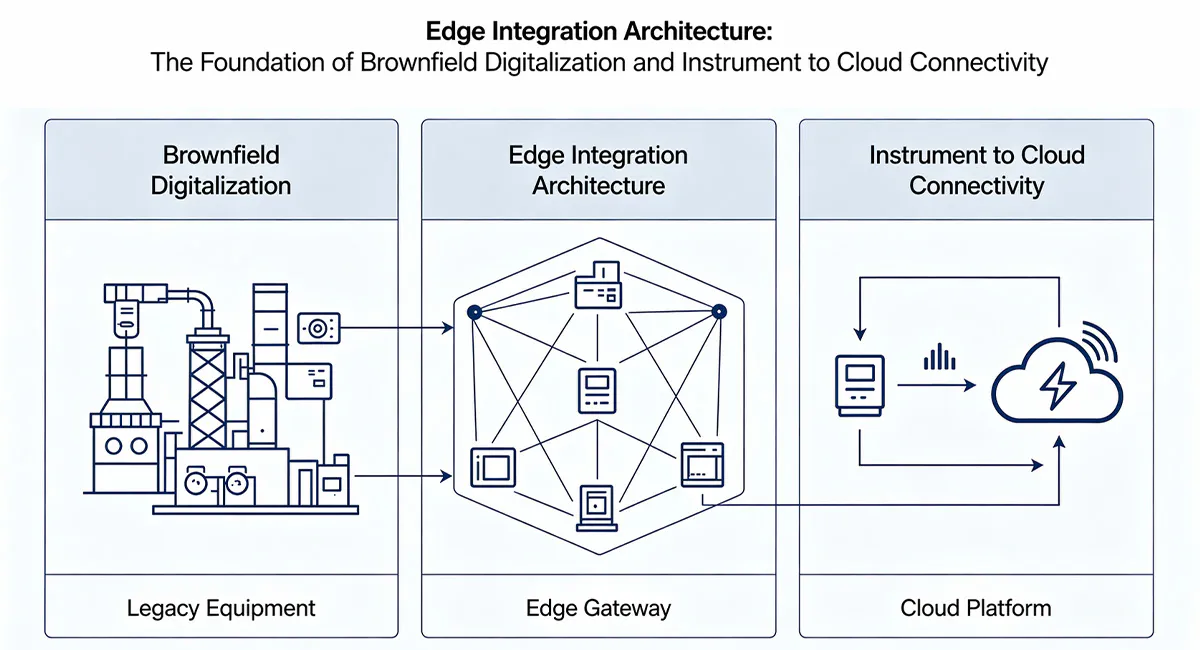
Edge Integration Architecture: The Foundation of Brownfield Digitalization and Instrument to Cloud Connectivity
Introduction: Why Edge Integration Matters in Industrial IoT
Industrial digital transformation is accelerating, but most facilities still rely on legacy instrumentation that lacks native cloud connectivity. This creates a fundamental gap between field-level data (OT) and cloud-based analytics platforms (IT).
Edge Integration Architecture is the key to bridging this gap.
It enables Instrument to Cloud connectivity by transforming legacy signals into structured, secure, and cloud-ready data—without replacing existing assets.
What Is Edge Integration Architecture?
Edge Integration Architecture refers to a layered system design where edge devices (gateways or edge nodes) sit between field instruments and cloud platforms to enable:
- Data acquisition from legacy devices
- Protocol conversion (industrial → cloud protocols)
- Data modeling and contextualization
- Secure and reliable data transmission
Core Objective
👉 Convert fragmented industrial signals into usable digital assets for IIoT platforms.
Why Legacy Systems Require Edge Integration
Most brownfield environments include:
- 4–20mA analog transmitters
- HART-enabled smart instruments
- Modbus RTU devices
- Vendor-specific control systems
Key Limitations
- No Ethernet/IP connectivity
- No support for MQTT or OPC UA
- No structured data format
- Limited cybersecurity
Result
Legacy instruments cannot directly participate in modern Industrial IoT (IIoT) ecosystems.
👉 Edge integration solves this by acting as a translation and intelligence layer.
Edge Integration Architecture: A Three-Layer Model
A robust architecture typically includes:
1. Field Layer (Data Source)
- Sensors and transmitters
- Analog and digital signals (4–20mA, HART, Modbus)
2. Edge Layer (Core Engine)
- Protocol conversion
- Data processing and filtering
- Local buffering (store-and-forward)
- Security enforcement
3. Cloud Layer (IIoT Platform)
- Data ingestion (MQTT / HTTPS / OPC UA)
- Visualization and dashboards
- Analytics and AI
👉 The edge layer is where raw data becomes cloud-ready intelligence.
Key Capabilities of Edge Integration
1. Protocol Conversion
Translate industrial protocols into cloud-native formats:
| Industrial Protocol | Cloud Protocol |
|---|---|
| HART | MQTT |
| Modbus RTU | OPC UA |
| 4–20mA | JSON / API |
2. Data Modeling and Contextualization
Edge systems structure data with:
- Engineering units
- Tag names
- Asset hierarchy
- Status and diagnostics
👉 This eliminates the need for complex cloud-side parsing.
3. Edge Computing
Process data locally to reduce bandwidth and improve responsiveness:
- Filtering noise
- Aggregating values
- Triggering local alerts
4. Store-and-Forward Reliability
Ensure no data loss during connectivity issues:
- Local buffering
- Timestamp synchronization
- Automatic retransmission
5. Industrial Cybersecurity
Secure communication between OT and IT layers:
- TLS encryption
- Device authentication (X.509 certificates)
- Secure firmware updates
From Signals to Cloud: The Data Transformation Journey
Edge integration enables a structured data flow:
| Stage | Description |
|---|---|
| Signal | Raw analog/digital data |
| Edge Processing | Scaling, filtering, decoding |
| Data Modeling | Tagging, structuring |
| Cloud Integration | MQTT / API ingestion |
| Analytics | Insights, dashboards, AI |
👉 This transforms raw signals into actionable intelligence.
Benefits of Edge Integration in Brownfield Digitalization
Operational Benefits
- No need to replace existing instruments
- Minimal disruption to operations
- Faster deployment timelines
Technical Benefits
- Multi-protocol compatibility
- Scalable architecture
- Standardized data models
Business Benefits
- Reduced CAPEX
- Improved asset visibility
- Accelerated digital transformation ROI
Edge Integration vs Native Ethernet (e.g., Ethernet-APL)
| Aspect | Edge Integration | Ethernet-APL |
|---|---|---|
| Target | Legacy systems | New systems |
| Device replacement | Not required | Required |
| Deployment speed | Fast | Long-term |
| Role | Bridge | Native connectivity |
👉 Edge integration is essential for existing infrastructure, while APL is designed for future deployments.
Use Cases for Edge Integration Architecture
Oil & Gas
- Remote pipeline monitoring
- Pressure and flow data acquisition
Chemical Plants
- Reactor and safety system integration
- Predictive maintenance
Water Treatment
- Distributed sensor networks
- Remote monitoring
Manufacturing
- Machine condition monitoring
- Energy optimization
Instrava Edge Integration Approach
Instrava provides a purpose-built architecture for Brownfield Industrial Digitalization:
- Non-intrusive connection to legacy instruments
- Multi-protocol support (4–20mA, HART, Modbus)
- Built-in protocol conversion to MQTT / OPC UA
- Structured data modeling for IIoT platforms
- Secure and scalable edge connectivity
Outcome
Legacy assets become cloud-connected digital resources—without replacement or system redesign.
Conclusion: Edge Integration as the Foundation of Industrial IoT
Edge Integration Architecture is not just a technical layer—it is the foundation of Brownfield Digitalization.
It enables industrial companies to:
- Preserve existing investments
- Unlock hidden data
- Enable Instrument to Cloud connectivity
- Transition to IIoT at their own pace
👉 The future of industrial connectivity is built at the edge.
Why Choose Instrava
Built on Consistency, Not Claims
Focused on Industrial Applications
We specialize in industrial analysis and detection, with a clear understanding of real-world operating environments and requirements.
Strict Product Selection Criteria
Every instrument is evaluated based on performance, stability, and application suitability—not just specifications or pricing.
Reliable Supply & Quality Consistency
We work with trusted manufacturers to ensure stable supply, consistent quality, and dependable delivery.
Practical, Experience-Based Support
Our recommendations are grounded in application understanding, helping customers avoid common issues and achieve reliable results.
Instrava is built to reduce uncertainty—so every decision you make is clearer, safer, and more reliable.