







HART to Cloud & Ethernet-APL: Brownfield Digitalization Explained
ما هي رقمنة الحقول البنية التحتية؟
Brownfield Digitalization is the process of upgrading existing industrial systems without replacing installed instrumentation.
Instead of rebuilding infrastructure, it focuses on:
- Connecting legacy devices
- Extracting usable data
- Enabling gradual digital transformation
This approach is widely used in plants with 4–20mA and HART-based systems.
Learn more: Brownfield vs Greenfield Strategy → /brownfield-vs-greenfield
What is HART to Cloud?
HART to Cloud is a key method in Brownfield Digitalization that enables data extraction from HART-enabled instruments and integration into cloud platforms.
It typically involves:
- HART data acquisition via gateways
- Protocol conversion (OPC UA / MQTT)
- Cloud connectivity for analytics
This allows existing instruments to become part of modern IIoT systems.
Related solution: Edge Gateway Solutions → /edge-gateway
Why is HART to Cloud important in Brownfield Digitalization?
Most industrial plants already have a large installed base of HART devices.
HART to Cloud helps:
- Unlock hidden device data
- Improve operational visibility
- Enable predictive maintenance
- Reduce upgrade costs
It provides a low-risk and scalable path to digital transformation.
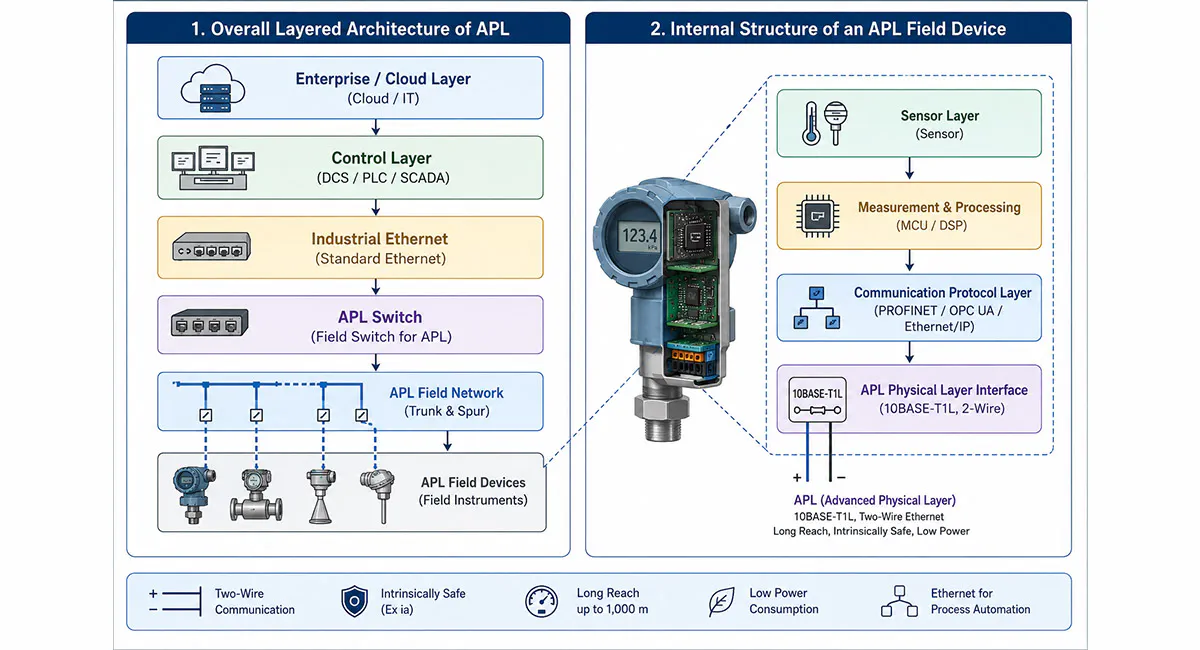
What is Ethernet-APL?
Ethernet-APL (Advanced Physical Layer) is a technology that enables Ethernet communication directly at the field level.
It offers:
- Two-wire communication (power + data)
- Long-distance transmission (up to 1000 meters)
- Intrinsic safety for hazardous areas
- High-speed data (10 Mbps)
Ethernet-APL is a key technology for future-ready industrial networks.
Learn more: Edge Integration Architecture → /edge-integration
What types of instruments support Ethernet-APL?
Only instruments with native Ethernet-APL interfaces can connect directly.
وتشمل الأمثلة على ذلك:
- Pressure transmitters
- مقاييس التدفق
- Level sensors
- Temperature transmitters
Legacy 4–20mA and HART instruments do not support direct APL connectivity.
Can HART instruments be integrated into Ethernet-APL systems?
Not directly, but they can be integrated through edge devices.
Typical approach:
- Use HART gateways or multiplexers
- Convert data into OPC UA or MQTT
- Connect to higher-level systems
This is the foundation of most Brownfield Digitalization projects.
What is the architecture of an Ethernet-APL system?
Ethernet-APL uses a trunk-and-spur topology:
- Trunk: Main communication backbone
- Spur: Connection to individual devices
The system includes:
- APL switches
- Field switches
- Ethernet backbone
- Field instruments
This enables Ethernet connectivity all the way to field devices.
Why can Ethernet-APL transmit more data than HART?
Ethernet-APL removes traditional communication limitations through:
- High bandwidth (10 Mbps vs HART’s low speed)
- Ethernet-based communication
- Support for structured protocols like OPC UA
يتيح ذلك:
- Multi-variable data
- تشخيص الجهاز
- Real-time status information
What is Publish/Subscribe in industrial communication?
Publish/Subscribe is a communication model where:
- Devices publish data continuously
- Systems subscribe to receive data
Unlike traditional polling, this model:
- Enables real-time data flow
- Supports multiple systems simultaneously
- Reduces network load
How do Ethernet-APL instruments send data actively?
Ethernet-APL instruments are network devices with IP-based communication.
They can:
- Send periodic updates
- Trigger event-based messages
- Stream real-time data
Supported by protocols such as:
- OPC UA
- PROFINET
- MQTT (via edge systems)
What is the difference between HART to Cloud and Ethernet-APL?
| أسبكت | HART to Cloud | إيثرنت-APL |
|---|---|---|
| النوع | Upgrade path | New architecture |
| Use case | النباتات الموجودة | New installations |
| التكلفة | أقل | أعلى |
| Speed | Fast deployment | Longer implementation |
HART to Cloud focuses on activating existing assets, while Ethernet-APL enables next-generation infrastructure.
Which is better: HART to Cloud or Ethernet-APL?
There is no one-size-fits-all answer.
- Brownfield projects → HART to Cloud
- Greenfield projects → Ethernet-APL
Most real-world applications use a hybrid approach.
How does Instrava support Brownfield Digitalization?
إنسترافا focuses on practical and scalable upgrade strategies.
We help customers:
- Assess existing instrumentation
- Identify digitalization opportunities
- Design HART to Cloud architectures
- Integrate edge and cloud systems
Our approach enables digital transformation without disrupting operations.
Explore more: Industrial Data Modeling → /data-modeling
Conclusion: From Legacy Signals to Data-Driven Systems
Brownfield Digitalization is not about replacing systems—it is about activating them.
- HART to Cloud unlocks existing data
- Ethernet-APL defines future architecture
Together, they form a complete path toward modern industrial digitalization.