







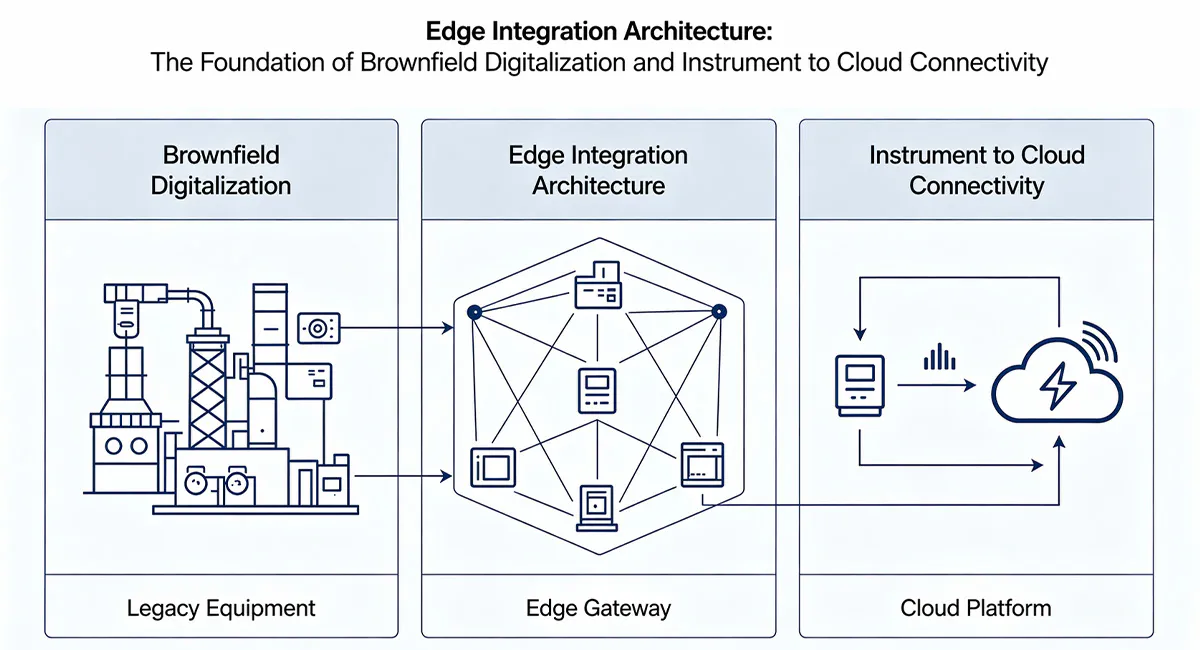
Edge Integration Architecture: The Foundation of Brownfield Digitalization and Instrument to Cloud Connectivity
Introduction: Why Edge Integration Matters in Industrial IoT
Industrial digital transformation is accelerating, but most facilities still rely on legacy instrumentation that lacks native cloud connectivity. This creates a fundamental gap between field-level data (OT) and cloud-based analytics platforms (IT).
Edge Integration Architecture is the key to bridging this gap.
It enables Instrument to Cloud connectivity by transforming legacy signals into structured, secure, and cloud-ready data—without replacing existing assets.
What Is Edge Integration Architecture?
Edge Integration Architecture refers to a layered system design where edge devices (gateways or edge nodes) sit between field instruments and cloud platforms to enable:
- Data acquisition from legacy devices
- Protocol conversion (industrial → cloud protocols)
- Data modeling and contextualization
- Secure and reliable data transmission
Core Objective
👉 Convert fragmented industrial signals into usable digital assets for IIoT platforms.
Why Legacy Systems Require Edge Integration
Most brownfield environments include:
- 4–20mA analog transmitters
- HART-enabled smart instruments
- Modbus RTU devices
- Vendor-specific control systems
Key Limitations
- No Ethernet/IP connectivity
- No support for MQTT or OPC UA
- No structured data format
- Limited cybersecurity
Result
Legacy instruments cannot directly participate in modern Industrial IoT (IIoT) ecosystems.
👉 Edge integration solves this by acting as a translation and intelligence layer.
Edge Integration Architecture: A Three-Layer Model
A robust architecture typically includes:
1. Field Layer (Data Source)
- Sensors and transmitters
- Analog and digital signals (4–20mA, HART, Modbus)
2. Edge Layer (Core Engine)
- Protocol conversion
- Data processing and filtering
- Local buffering (store-and-forward)
- Security enforcement
3. Cloud Layer (IIoT Platform)
- Data ingestion (MQTT / HTTPS / OPC UA)
- Visualization and dashboards
- Analytics and AI
👉 The edge layer is where raw data becomes cloud-ready intelligence.
Key Capabilities of Edge Integration
1. Protocol Conversion
Translate industrial protocols into cloud-native formats:
| Industrial Protocol | Cloud Protocol |
|---|---|
| HART | MQTT |
| Modbus RTU | OPC UA |
| 4–20mA | JSON / API |
2. Data Modeling and Contextualization
Edge systems structure data with:
- Engineering units
- Tag names
- Asset hierarchy
- Status and diagnostics
👉 This eliminates the need for complex cloud-side parsing.
3. Edge Computing
Process data locally to reduce bandwidth and improve responsiveness:
- Filtering noise
- Aggregating values
- Triggering local alerts
4. Store-and-Forward Reliability
Ensure no data loss during connectivity issues:
- Local buffering
- Timestamp synchronization
- Automatic retransmission
5. Industrial Cybersecurity
Secure communication between OT and IT layers:
- TLS encryption
- Device authentication (X.509 certificates)
- Secure firmware updates
From Signals to Cloud: The Data Transformation Journey
Edge integration enables a structured data flow:
| Stage | Description |
|---|---|
| Signal | Raw analog/digital data |
| Edge Processing | Scaling, filtering, decoding |
| Data Modeling | Tagging, structuring |
| Cloud Integration | MQTT / API ingestion |
| Analytics | Insights, dashboards, AI |
👉 This transforms raw signals into actionable intelligence.
Benefits of Edge Integration in Brownfield Digitalization
Operational Benefits
- No need to replace existing instruments
- Minimal disruption to operations
- Faster deployment timelines
Technical Benefits
- Multi-protocol compatibility
- Scalable architecture
- Standardized data models
Business Benefits
- Reduced CAPEX
- Improved asset visibility
- Accelerated digital transformation ROI
Edge Integration vs Native Ethernet (e.g., Ethernet-APL)
| Aspect | Edge Integration | Ethernet-APL |
|---|---|---|
| Target | Legacy systems | New systems |
| Device replacement | Not required | Required |
| Deployment speed | Fast | Long-term |
| Role | Bridge | Native connectivity |
👉 Edge integration is essential for existing infrastructure, while APL is designed for future deployments.
Use Cases for Edge Integration Architecture
Oil & Gas
- Remote pipeline monitoring
- Pressure and flow data acquisition
Chemical Plants
- Reactor and safety system integration
- Predictive maintenance
Water Treatment
- Distributed sensor networks
- Remote monitoring
Manufacturing
- Machine condition monitoring
- Energy optimization
Instrava Edge Integration Approach
Instrava provides a purpose-built architecture for Brownfield Industrial Digitalization:
- Non-intrusive connection to legacy instruments
- Multi-protocol support (4–20mA, HART, Modbus)
- Built-in protocol conversion to MQTT / OPC UA
- Structured data modeling for IIoT platforms
- Secure and scalable edge connectivity
Outcome
Legacy assets become cloud-connected digital resources—without replacement or system redesign.
Conclusion: Edge Integration as the Foundation of Industrial IoT
Edge Integration Architecture is not just a technical layer—it is the foundation of Brownfield Digitalization.
It enables industrial companies to:
- Preserve existing investments
- Unlock hidden data
- Enable Instrument to Cloud connectivity
- Transition to IIoT at their own pace
👉 The future of industrial connectivity is built at the edge.