





- Por Instrava
- 01/22/2026
- 0 Comentario
Cómo elegir entre caudalímetros ultrasónicos portátiles y de pared para aplicaciones industriales
In industrial environments where pipeline shutdown, pipe cutting, or process interruption is not feasible, non-intrusive flow measurement has become an increasingly practical solution. Clamp-on ultrasonic flow meters allow flow measurement without direct contact with the process medium, making them suitable for both temporary diagnostics and long-term monitoring.
However, selecting between a portable ultrasonic flow meter and a wall-mounted ultrasonic flow meter is less about measurement principle and more about operational requirements.
Why Non-Intrusive Ultrasonic Flow Measurement Is Often Preferred
Many flow measurement projects involve existing pipelines where modifications are costly or risky. This is common in water treatment retrofits, energy efficiency audits, HVAC systems, and chemical utility lines. In these cases, ultrasonic clamp-on technology enables measurement without contamination risk, pressure loss, or production downtime.
Both portable and wall-mounted ultrasonic flow meters typically use the transit-time principle and external sensors mounted on the pipe surface. The difference lies in how the measurement is deployed and maintained over time.
Key Engineering Constraints That Influence Selection
Before choosing a configuration, several practical constraints should be evaluated:
Measurement duration: temporary testing or continuous monitoring
Power availability: battery operation versus permanent power supply
Data usage: on-site reading, data logging, or system integration
Installation stability: short-term attachment or fixed mounting
These factors often have a greater impact on suitability than nominal accuracy specifications.
When a Portable Ultrasonic Flow Meter Is the Better Choice
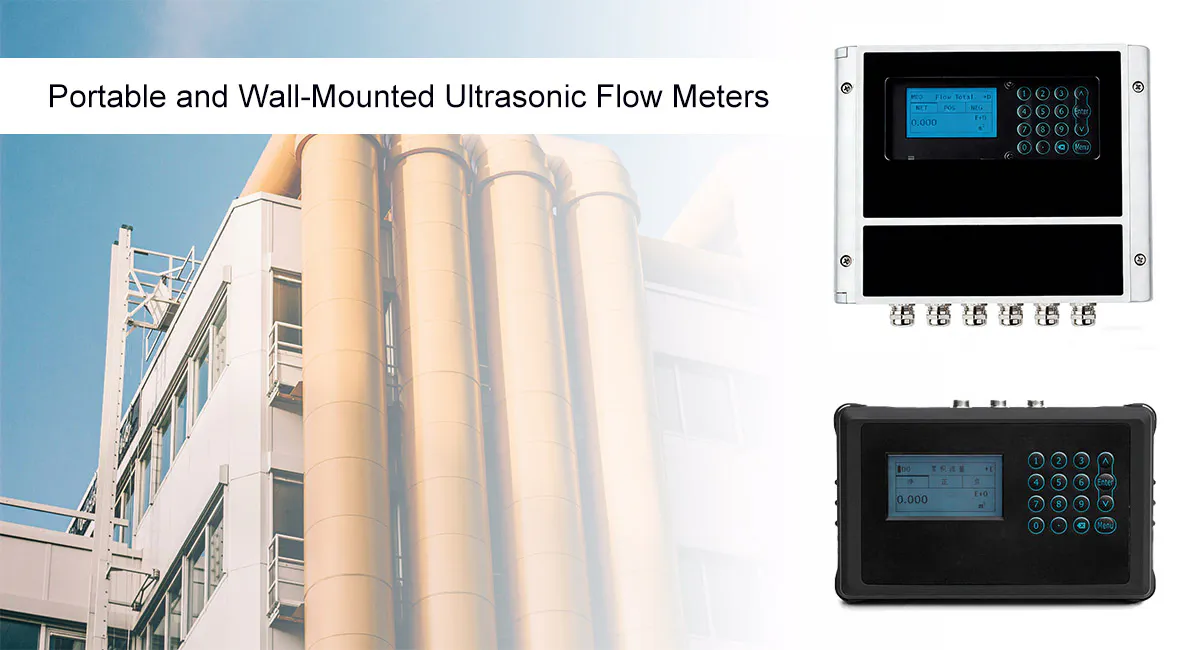
A portable ultrasonic flow meter is typically used for temporary or mobile measurement tasks. It is well suited for commissioning, troubleshooting, and verification of existing flow meters.
If flow measurement is required across multiple locations or for short-term diagnostics, a portable ultrasonic flow meter provides flexibility without permanent installation. This makes it a common choice for maintenance teams, energy audits, and system performance assessments.
When a Wall-Mounted Ultrasonic Flow Meter Is More Appropriate
Wall-mounted ultrasonic flow meters are designed for continuous operation at fixed measurement points. They are commonly applied where flow data needs to be monitored over long periods or integrated into control systems.
For applications requiring continuous monitoring, stable installation, and data transmission to SCADA or DCS platforms, a wall-mounted ultrasonic flow meter offers higher operational consistency and lower long-term maintenance effort.
Common Misconceptions in Ultrasonic Flow Meter Selection
One frequent misunderstanding is that portable ultrasonic flow meters are inherently less accurate than wall-mounted versions. In practice, accuracy is primarily influenced by sensor installation quality, pipe condition, and signal processing rather than enclosure type.
Another common oversight is underestimating the importance of pipe material and surface condition, which directly affect ultrasonic signal transmission and measurement stability.
Aligning Configuration with Measurement Objectives
Mature ultrasonic flow measurement solutions focus on application alignment rather than one-size-fits-all design. Portable and wall-mounted ultrasonic flow meters serve different operational priorities while sharing the same non-intrusive measurement advantages.
Selecting the appropriate configuration ensures reliable data collection, efficient deployment, and optimal use of ultrasonic flow measurement technology in industrial systems.
Ultrasonic Flow Meter – Advanced Selection FAQs
When should a portable ultrasonic flow meter be used instead of a wall-mounted unit?
A portable ultrasonic flow meter is most suitable when flow measurement is required temporarily, across multiple locations, or for diagnostic purposes. It is commonly used for commissioning, maintenance verification, and energy audits where permanent installation is unnecessary.
Is the measurement accuracy of a portable ultrasonic flow meter lower than a wall-mounted one?
Measurement accuracy is not determined by whether the ultrasonic flow meter is portable or wall-mounted. In practice, accuracy depends more on sensor installation quality, pipe material, internal pipe condition, and signal processing capability than on the enclosure type.
What applications require a wall-mounted ultrasonic flow meter rather than a portable solution?
Wall-mounted ultrasonic flow meters are preferred for applications requiring continuous monitoring, long-term data logging, or integration with SCADA and DCS systems. They are typically installed at fixed pipeline sections where stable, unattended operation is a priority.
Can a portable ultrasonic flow meter be used to verify installed flow meters?
Yes. Portable ultrasonic flow meters are widely used for on-site verification and performance comparison of existing flow meters. Their non-intrusive installation allows flow checks without interrupting the process or modifying the pipeline.
How does pipe material affect ultrasonic flow measurement performance?
Pipe material directly affects ultrasonic signal transmission. Metal pipes such as carbon steel and stainless steel generally provide good signal coupling, while plastic or lined pipes may require adjusted sensor spacing and coupling techniques to ensure stable measurement.
Is non-intrusive ultrasonic flow measurement suitable for long-term outdoor installation?
Non-intrusive ultrasonic flow measurement can be suitable for long-term outdoor installation when wall-mounted configurations are used with appropriate environmental protection. Factors such as temperature variation, moisture, and sensor mounting stability must be considered.
What is more important than accuracy specifications when selecting an ultrasonic flow meter?
In many industrial applications, installation stability, measurement duration, data accessibility, and maintenance requirements are more critical than nominal accuracy values. Selecting the correct configuration based on operational needs ensures more reliable flow data.