
Inicio » Productos » Field Devices instruments » Radar Technology in Radar Level Sensors
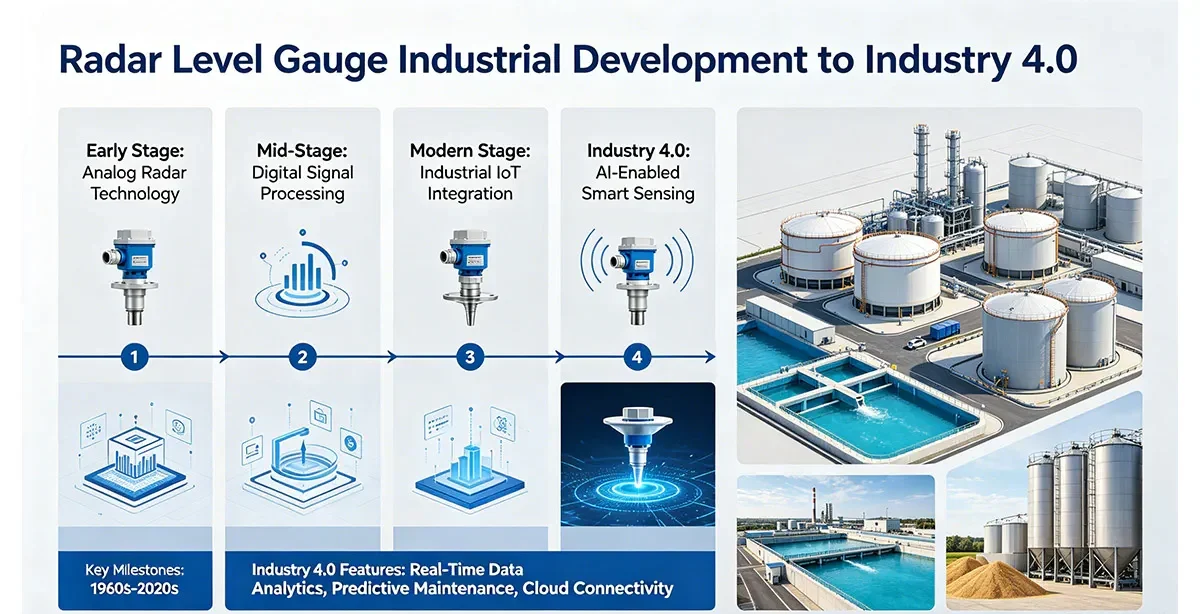
Radar Technology in Radar Level Sensors
Introducción
Radar technology is one of the core sensing technologies driving modern industrial level measurement. Unlike traditional contact-based measurement methods, radar technology uses microwave electromagnetic waves to perform non-contact distance detection, allowing sensores de nivel to operate reliably under high temperature, high pressure, vapor, foam, condensation, and dusty industrial conditions.
The true value of sensores de nivel radar does not come from the instrument itself, but from the continuous evolution of radar microwave technology. Different radar frequencies, antenna structures, signal processing methods, and microwave focusing technologies directly determine the sensor’s measurement capability, anti-interference performance, blind zone size, and environmental adaptability.
As radar technology has evolved from early low-frequency microwave systems to today’s high-frequency 80 GHz and 120 GHz radar architectures, industrial level sensing has entered a new stage of intelligent high-resolution measurement.
1. History and Development of Radar Technology
Radar technology originated from electromagnetic wave research in the late 19th century. During World War II, radar systems were rapidly developed for military detection and navigation applications. Microwave transmission, antenna design, and radio signal processing technologies advanced significantly during this period.
After the war, engineers gradually recognized that radar microwave reflection principles could also be used for industrial distance and level measurement.
Early industrial radar systems introduced in the 1960s and 1970s mainly used relatively low microwave frequencies and large horn antennas. Although these systems provided stable long-distance measurement, they had limited resolution and poor obstacle suppression capability.
The development of semiconductor electronics and microwave integrated circuits in the 1980s and 1990s enabled industrial radar sensors to become more compact and commercially practical. Companies such as Siemens, VEGA, Emerson, y Endress+Hauser played major roles in advancing intelligent radar level sensing technologies.
The industry later evolved from traditional 6 GHz and 26 GHz radar technologies toward modern 80 GHz and emerging 120 GHz high-frequency radar systems. This transition fundamentally improved:
- Beam focusing capability
- Signal resolution
- Obstacle avoidance
- Small tank measurement
- Blind zone reduction
- Weak echo detection
At the same time, higher-frequency radar technologies introduced new engineering challenges related to condensation, antenna contamination, and microwave attenuation.
2. Core Technical Principle of Radar Technology
Radar level sensing technology operates based on microwave electromagnetic wave reflection.
The radar sensor emits high-frequency microwave signals toward the material surface. When the microwave signal reaches the medium surface, part of the signal energy is reflected back to the antenna. The system analyzes the reflected signal characteristics to calculate the distance between the antenna and the target surface.
The basic radar ranging principle is:
d=ct/2
Dónde:
- d = distance
- c = speed of light
- t = microwave signal travel time
The measured distance is then converted into level information according to tank geometry or reference calibration.
Modern radar level sensors mainly utilize:
- Pulse radar technology
- FMCW radar technology
- High-frequency microwave transmission
- Digital signal processing (DSP)
- Intelligent echo analysis algorithms
Among these technologies, microwave frequency has become one of the most important factors determining overall radar performance.
3. Frequency Evolution of Radar Technology
The evolution of radar frequency technology directly changed the performance characteristics of radar level sensors.
Different frequencies produce different microwave beam angles, penetration capabilities, signal focusing performance, and environmental sensitivities.
4. 26 GHz Radar Technology
26 GHz radar technology was widely used for many years in industrial level measurement and remains important in difficult process conditions.
Typical beam angle:
- Approximately 8°–10°
Because the beam angle is relatively wide, 26 GHz radar provides stronger microwave penetration capability.
This technology performs well in environments involving:
- Heavy vapor
- Condensation
- Foam
- Process buildup
- Sticky media
The lower microwave frequency makes the radar less sensitive to antenna surface contamination such as:
- Water droplets
- Condensation crystals
- Material coating
- Antenna fouling
This is because lower-frequency microwaves are less likely to be absorbed or scattered by thin surface films.
Technical Advantages of 26 GHz Radar
Strong Penetration Capability
26 GHz radar can better penetrate:
- Vapor
- Condensation
- Foam layers
making it suitable for difficult process vessels.
Higher Tolerance to Antenna Contamination
The radar signal remains relatively stable even when:
- Water condenses on the antenna
- Sticky media accumulate
- Process crystallization occurs
This improves long-term operational stability.
Technical Limitations of 26 GHz Radar
The relatively large beam angle also introduces limitations.
Because the microwave beam spreads more widely, the radar is more easily affected by:
- Tank walls
- Internal ladders
- Agitators
- Pipes
- Structural supports
This can produce false echoes and unstable readings in narrow or complex vessels.
Additionally:
- Blind zones are generally larger
- Small tank measurement is more difficult
- Obstacle suppression capability is weaker
5. 80 GHz and 120 GHz Radar Technology
Modern radar technology has evolved toward much higher microwave frequencies, especially 80 GHz and the latest 120 GHz radar systems.
Typical beam angle:
- Approximately 1°–4°
Higher-frequency microwaves allow extremely narrow beam focusing.
This significantly improves:
- Target accuracy
- Echo resolution
- Obstacle avoidance
- Small target detection
The narrow microwave beam enables radar sensors to “look” directly at the target surface while avoiding surrounding structures.
Technical Advantages of 80 GHz / 120 GHz Radar
Extremely Narrow Beam Angles
High-frequency radar can easily avoid:
- Agitators
- Internal piping
- Tank supports
- Vessel obstacles
This greatly improves measurement reliability in complex tanks.
Very Small Blind Zones
Higher-frequency radar enables shorter dead zones near the antenna.
This allows:
- More usable tank volume
- Improved small tank applications
- Better top-mounted installation flexibility
Strong Anti-Interference Capability
The focused microwave beam reduces unwanted reflections from surrounding structures.
This improves:
- Signal clarity
- Echo discrimination
- Weak reflection detection
- Dust measurement capability
High-frequency radar performs especially well in powder and bulk solid applications.
6. Technical Challenges of High-Frequency Radar
Although 80 GHz and 120 GHz radar technologies provide major performance advantages, they also introduce new engineering challenges.
High-frequency microwaves are significantly more sensitive to antenna surface conditions.
Sensitivity to Condensation and Water Films
High-frequency microwave signals can be easily:
- Absorbed
- Scattered
- Attenuated
by thin surface layers such as:
- Water droplets
- Condensation films
- Crystallized residue
- Sticky material buildup
This occurs because higher-frequency microwaves interact more strongly with small surface irregularities and moisture layers.
As a result, antenna contamination becomes much more critical in high-frequency radar systems.
Increased Antenna Surface Requirements
Modern 80 GHz and 120 GHz radar systems require:
- Cleaner antenna surfaces
- Better condensation control
- Improved antenna materials
- Optimized sealing structures
to maintain long-term measurement stability.
7. How Radar Frequency Technology Enables Instrument Functions
Radar frequency technology directly determines the capabilities of radar level sensors.
Lower Frequency Radar Enables Stronger Environmental Tolerance
26 GHz radar technology enables:
- Better steam penetration
- Stronger condensation resistance
- Improved foam tolerance
- Better dirty process adaptability
This makes it suitable for harsh process industries.
High-Frequency Radar Enables Precision Measurement
80 GHz and 120 GHz radar technologies enable:
- Ultra-narrow beam focusing
- Small blind zones
- High-resolution echo analysis
- Complex tank obstacle avoidance
This significantly improves intelligent measurement capability.
DSP and Intelligent Algorithms Enable Stable Signal Processing
Modern radar systems combine microwave technology with:
- Digital signal processing
- False echo suppression
- Dynamic gain adjustment
- Intelligent filtering
- Adaptive signal optimization
These technologies greatly improve operational stability under complex industrial conditions.
8. Industry 4.0 Evolution of Radar Technology
In the Industry 4.0 era, radar technology itself has undergone major technological evolution.
The upgrade is no longer limited to communication capability, but involves the entire radar sensing architecture.
Evolution Toward Intelligent Microwave Processing
Modern radar systems now integrate:
- High-speed DSP chips
- FPGA processing architectures
- Real-time echo computation
- AI-assisted signal analysis
This allows radar sensors to dynamically optimize measurement quality.
AI-Based Echo Recognition Technology
Modern radar technologies increasingly use intelligent algorithms capable of:
- Identifying false echoes
- Learning tank reflection characteristics
- Automatically suppressing interference
- Improving unstable surface measurement
AI-assisted radar analysis is becoming especially important for:
- Foam surfaces
- Turbulent liquids
- Powder materials
- Irregular bulk solids
Cloud and IIoT Integration
Modern radar technologies now support:
- Remote diagnostics
- Cloud monitoring
- Computación de borde
- Digital twin systems
- Mantenimiento predictivo
Radar sensors are evolving from standalone instruments into intelligent industrial data nodes.
9. Future Development Trends of Radar Technology
Future radar technologies will continue evolving toward:
- Higher-frequency microwave systems
- AI-driven signal optimization
- Autonomous diagnostics
- Self-calibration technologies
- Inteligencia Edge
- Wireless radar sensing
- Digital twin integration
Future radar systems may dynamically adjust:
- Microwave power
- Signal gain
- Echo filtering
- Frequency response
according to changing process conditions.
AI-assisted radar technologies may eventually allow sensors to autonomously learn tank environments and continuously optimize measurement performance without manual configuration.
Conclusión
The evolution of radar level sensors is fundamentally driven by the evolution of radar microwave technology itself.
Different radar frequencies directly determine:
- Beam angle
- Penetration capability
- Blind zone size
- Obstacle suppression
- Environmental adaptability
- Estabilidad de la señal
26 GHz radar technology remains valuable for harsh process environments involving vapor, condensation, and antenna contamination, while 80 GHz and emerging 120 GHz radar technologies provide superior focusing capability, smaller blind zones, and stronger anti-interference performance.
As Industry 4.0 technologies continue advancing, radar sensing technology is rapidly evolving toward intelligent, AI-assisted, high-frequency sensing architectures capable of delivering highly stable and autonomous industrial level measurement.
Recomendaciones de productos relacionados
What is radar technology in radar level sensors?
Radar level sensors use microwave electromagnetic waves to measure the distance between the sensor antenna and the material surface. The sensor transmits high-frequency radar signals and analyzes the reflected echoes to calculate level information without direct contact with the medium.
What is the difference between 26GHz and 80GHz radar technology?
26GHz radar technology provides stronger penetration through vapor, condensation, and foam, making it suitable for harsh process conditions. However, its wider beam angle makes it more sensitive to internal tank obstacles.
80GHz radar technology offers much narrower beam angles, smaller blind zones, and stronger anti-interference capability, allowing more accurate measurement in narrow tanks and complex vessel structures.
Why are 120GHz radar level sensors becoming important?
120GHz radar technology provides even higher signal resolution and narrower beam focusing than 80GHz systems. This enables highly precise level measurement in small tanks, difficult geometries, and applications requiring extremely accurate echo discrimination.
However, higher-frequency radar systems are also more sensitive to condensation, water films, and antenna contamination.
Why do high-frequency radar sensors have smaller beam angles?
Higher microwave frequencies produce shorter wavelengths, allowing radar antennas to focus microwave energy more tightly. This creates narrower beam angles, which improve obstacle avoidance, reduce false echoes, and enhance measurement accuracy in complex industrial tanks.
What industrial problems can radar technology solve?
Radar technology helps solve many industrial measurement challenges, including:
- Vapor interference
- Foam-covered surfaces
- Dusty environments
- Procesos a alta temperatura
- Recipientes de alta presión
- Tank overflow prevention
- Pump dry-running protection
- Complex silo measurement
Its non-contact measurement capability also reduces maintenance and improves long-term operational reliability.
How is radar technology evolving in the Industry 4.0 era?
Modern radar technologies are evolving from simple measurement systems into intelligent sensing platforms. Industry 4.0 radar systems now integrate:
- AI-assisted echo analysis
- Digital signal processing (DSP)
- Cloud connectivity
- Predictive diagnostics
- Computación de borde
- Control remoto
- Digital twin integration
Future radar technologies are expected to become increasingly autonomous, self-optimizing, and capable of intelligent real-time process adaptation.
Por qué elegir Instrava
Basados en la coherencia, no en las reclamaciones
Aplicaciones industriales
Estamos especializados en el análisis y la detección industriales, con una clara comprensión de los entornos operativos y los requisitos del mundo real.
Estrictos criterios de selección de productos
Cada instrumento se evalúa en función de su rendimiento, estabilidad e idoneidad para la aplicación, no sólo de sus especificaciones o precios.
Suministro fiable y calidad constante
Trabajamos con fabricantes de confianza para garantizar un suministro estable, una calidad constante y una entrega fiable.
Apoyo práctico basado en la experiencia
Nuestras recomendaciones se basan en el conocimiento de la aplicación, lo que ayuda a los clientes a evitar problemas comunes y lograr resultados fiables.
Instrava se ha creado para reducir la incertidumbre, de modo que cada decisión que tome sea más clara, segura y fiable.