How to Choose the Right Liquid Analysis Solution for Industrial Applications
Selecting the right liquid analysis solution is critical for industrial process efficiency, product quality, and regulatory compliance. With multiple parameters...

Liquid Analysis
Home » Products » Liquid Analysis » Benchtop pH Meter


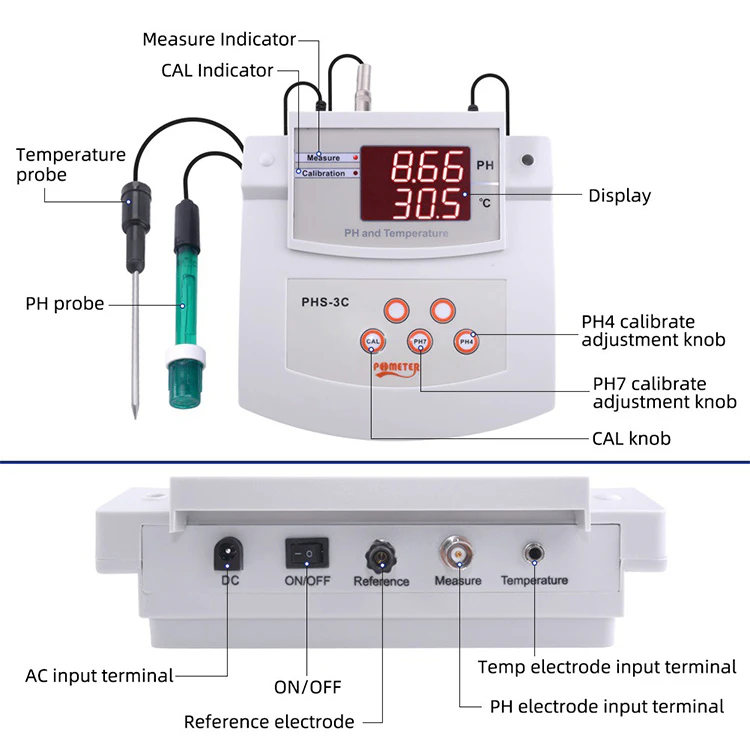
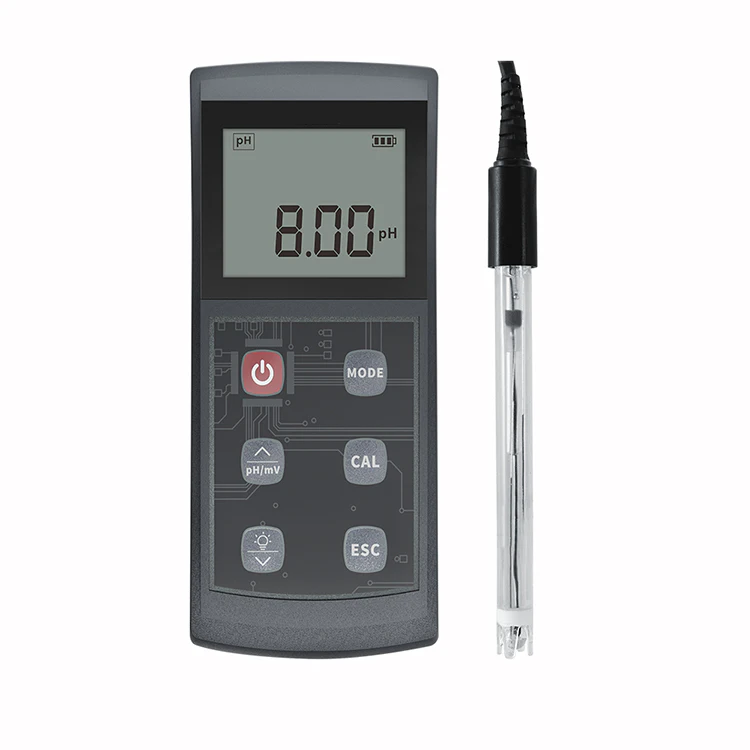
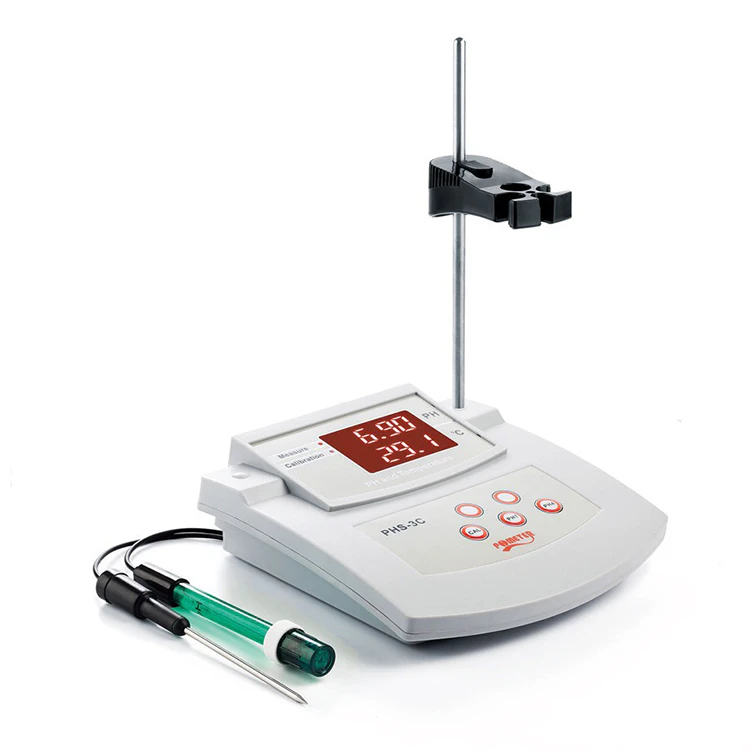
Instrava Benchtop pH Meter is designed for precise and stable pH measurement in laboratory and professional analytical environments.
With ±0.01 pH accuracy, automatic two-point calibration, and integrated temperature compensation, the instrument delivers consistent and repeatable analytical performance across a wide range of water-based solutions.
Featuring a 4-digit LCD display with stability indicator and simultaneous pH/temperature readout, the system ensures accurate interpretation of electrochemical measurement results.
For laboratories, research institutions, environmental monitoring departments, and industrial quality control facilities, Instrava provides dependable bench-scale analytical precision.
Liquid Analysis Description
Benchtop pH Meter Applicable Scenarios
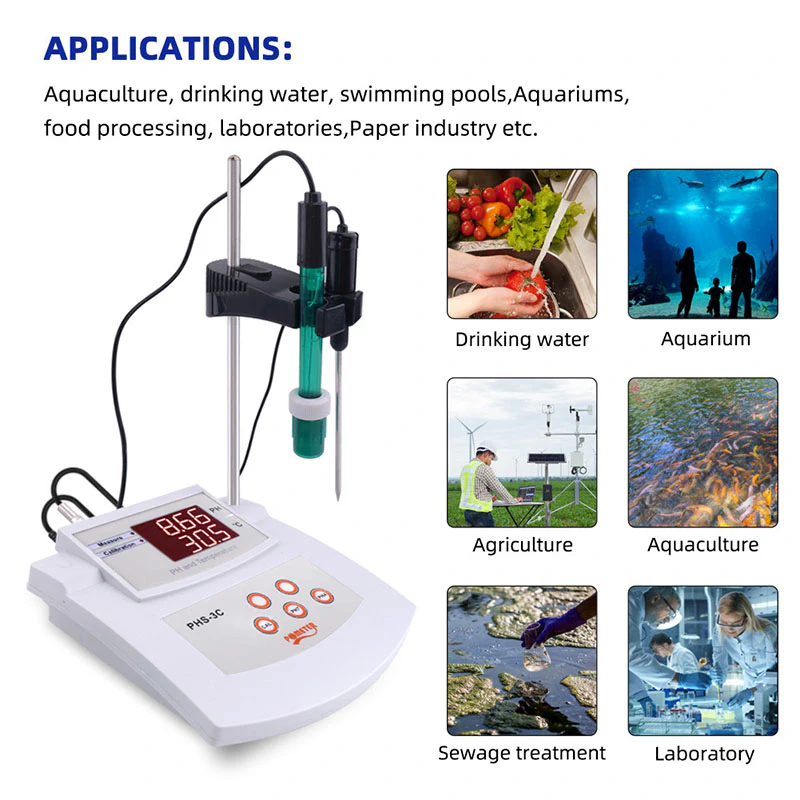
Instrava Benchtop pH Meter is suitable for:
Laboratory chemical analysis
University and research institute experiments
Environmental monitoring laboratories
Medical and pharmaceutical testing
Water treatment quality control
Mechanical and industrial process laboratories
Its stable measurement performance and wide range make it ideal for controlled analytical environments.


Benchtop pH Meter Engineering Advantages
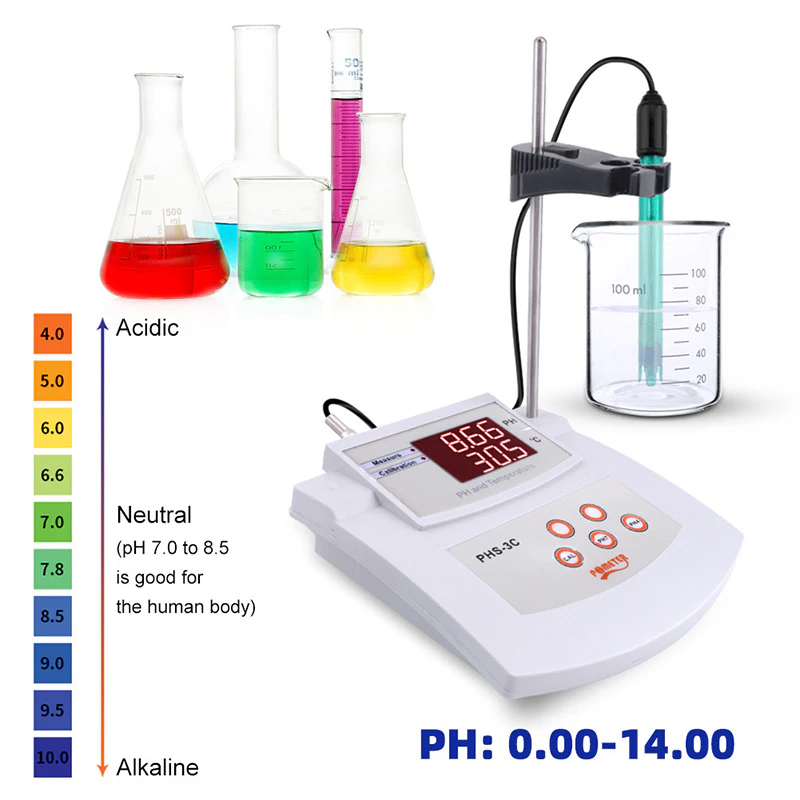
pH measurement range: 0.00 – 14.00 pH
Resolution: 0.01 pH
Accuracy: ±0.01 pH
Ensures laboratory-grade accuracy for routine and advanced analytical testing.
Automatic buffer recognition
Two-point calibration for improved linearity
Optional manual calibration method
Allows flexible calibration strategies for different solution types and measurement requirements.
Temperature range: 0 – 100°C
ATC range: 0 – 50°C
Simultaneous pH and temperature display
All pH readings are automatically temperature compensated to enhance measurement reliability and consistency.
4-digit LCD display
Unique stability indicator
Simultaneous display of pH and temperature
Ensures operators record values only after signal stabilization, reducing reading uncertainty.
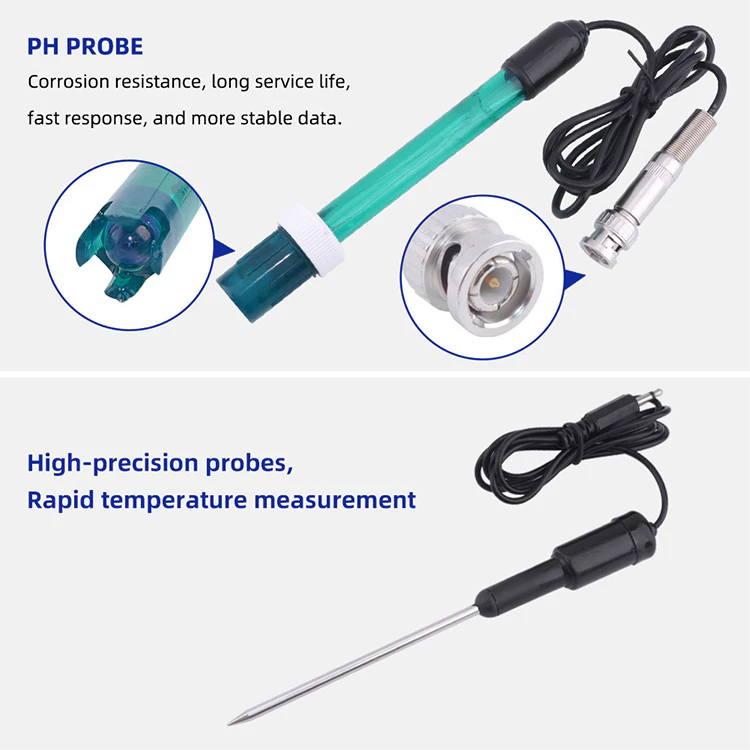
Combination electrode with high sensitivity
Fast response time
Excellent repeatability
Stable internal circuit design
Engineered for consistent laboratory operation and repeatable analytical performance.
Powered by universal AC adapter
Suitable for international voltage standards
Supports laboratory deployment worldwide.
Liquid Analysis Parameter
| Parameter | Specification |
|---|---|
| pH Range | 0.00 – 14.00 pH |
| pH Resolution | 0.01 pH |
| pH Accuracy | ±0.01 pH |
| Temperature Range | 0 – 100°C |
| Temperature Resolution | 0.1°C |
| Temperature Accuracy | ±0.5°C |
| Automatic Temperature Compensation | 0 – 50°C |
| Parameter | Specification |
|---|---|
| Calibration Method | Automatic two-point calibration |
| Calibration Mode | Automatic / Manual |
| Display | 4-digit LCD |
| Stability Indicator | Yes |
| Simultaneous pH & Temp Display | Yes |
| Parameter | Specification |
|---|---|
| Operating Environment | 0 – 50°C |
| Relative Humidity | ≤ 95% RH |
| Dimensions | 240 × 185 × 100 mm |
| Weight | 660 g |
| Power Supply | Universal power adapter |
Instrava Benchtop pH Meter combines measurement precision, automatic temperature compensation, and calibration flexibility to deliver dependable analytical performance in laboratory environments.
Whether used for environmental analysis, academic research, medical testing, or industrial quality verification, the system ensures stable readings and repeatable results.
Instrava — Engineered for Precision and Reliability in Laboratory Measurement.
Instrava OEM/ODM
Reliable Instruments. Solutions That Fit Your Application.
Instrava is focused on delivering reliable industrial solutions through carefully curated products, application-driven optimization, and flexible customization. We select proven instruments from trusted manufacturers to ensure consistent quality, optimize solutions based on real working conditions to solve practical challenges, and provide tailored configurations to meet specific application needs.
By combining selection expertise with application understanding, Instrava helps customers reduce risk, improve efficiency, and achieve dependable results in complex industrial environments.

How should buffer solutions be selected for accurate calibration?
Buffer selection should match the expected sample range.
For neutral water samples, pH 7.00 and pH 4.00 or 10.00 buffers are commonly used. For alkaline or acidic samples, choose calibration points that bracket the expected measurement range.
Fresh, uncontaminated buffer solutions are critical to maintaining ±0.01 pH accuracy.
How does two-point calibration ensure measurement linearity?
Two-point calibration establishes slope and offset of the electrode response curve.
By calibrating at two known pH values, the instrument compensates for electrode sensitivity variations and reference potential deviation.
This improves linearity across the measurement range and ensures analytical reliability.
What factors influence calibration linearity in laboratory conditions?
Calibration linearity can be affected by:
Electrode aging or contamination
Temperature variation between buffers
Improper buffer storage
Incomplete electrode stabilization
Consistent laboratory conditions and proper electrode maintenance are essential for maintaining calibration integrity.
What is the error range associated with Automatic Temperature Compensation (ATC)?
ATC compensates for electrode slope variation caused by temperature changes within the specified 0–50°C compensation range.
However, ATC does not correct chemical equilibrium changes in the sample itself.
Temperature mismatch between calibration buffers and sample solution may introduce additional deviation. For highest accuracy, calibration and measurement should be performed under similar temperature conditions.
How does the stability indicator improve measurement reliability?
The stability indicator monitors signal fluctuation before confirming the final reading.
It ensures the displayed value is recorded only after the electrode potential reaches equilibrium.
This reduces premature readings and enhances repeatability in laboratory analysis.
How frequently should laboratory pH meters be calibrated?
Calibration frequency depends on application sensitivity:
Daily calibration for high-precision laboratory research
Before each measurement session for critical analysis
After electrode replacement or cleaning
Regular calibration ensures traceable and compliant analytical performance.
Built on Consistency, Not Claims
We specialize in industrial analysis and detection, with a clear understanding of real-world operating environments and requirements.
Every instrument is evaluated based on performance, stability, and application suitability—not just specifications or pricing.
We work with trusted manufacturers to ensure stable supply, consistent quality, and dependable delivery.
Our recommendations are grounded in application understanding, helping customers avoid common issues and achieve reliable results.
Instrava is built to reduce uncertainty—so every decision you make is clearer, safer, and more reliable.

Selecting the right liquid analysis solution is critical for industrial process efficiency, product quality, and regulatory compliance. With multiple parameters...
Effective maintenance and calibration are critical for ensuring the accuracy, reliability, and longevity of liquid analysis instruments. In industrial environments,...
In modern industrial processes, monitoring multiple water quality parameters simultaneously is essential for operational efficiency, regulatory compliance, and process optimization....