
How Ethernet-APL Enables Industrial IoT and Smart Instrumentation
Industrial systems are rapidly evolving from isolated control environments into fully connected, data-driven ecosystems. At the center of this transformation...

Home » Products » Transmitters » Guided Wave Radar Level Transmitter


Reliable Contact Level Measurement for Complex Process Conditions
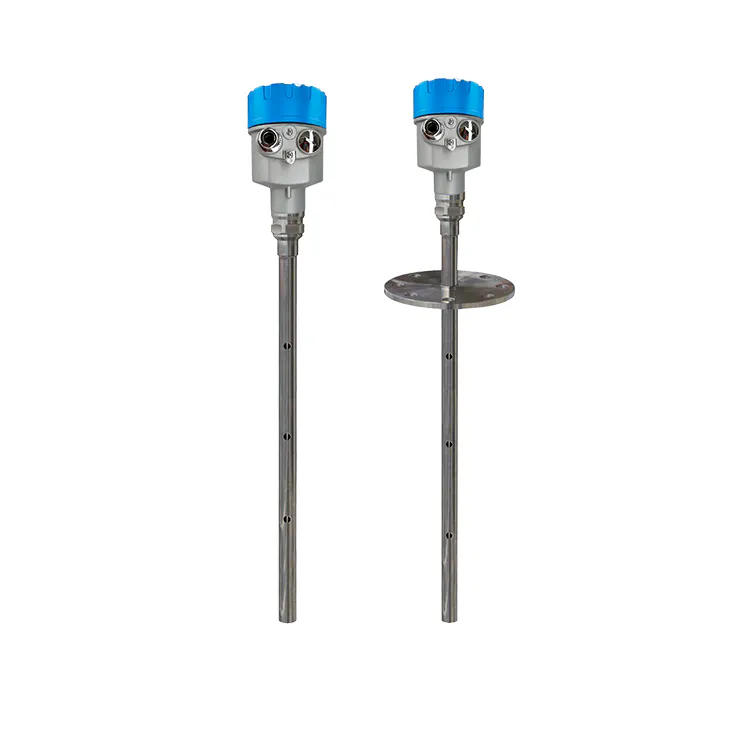
The guided wave radar level transmitter is a contact-type level measurement instrument based on time-domain reflectometry (TDR) technology. It transmits low-energy microwave pulses along a probe (rod or cable). When the signal encounters a change in dielectric constant at the material surface, part of the signal is reflected back to the transmitter and analyzed to determine the level.
Compared with non-contact radar, guided wave radar provides stronger signal coupling, making it especially suitable for applications involving narrow vessels, internal structures, turbulence, foam, or low dielectric media.
Instrava’s guided wave radar solutions are designed for stable, repeatable, and maintenance-friendly level measurement in demanding industrial process environments.
Transmitters & Sensors Description
Guided Wave Radar Level Transmitter Features
Thanks to an advanced microprocessor and proprietary echo processing technology, the guided wave radar level transmitter delivers stable and reliable measurement under a wide range of complex process conditions.
The flexible selection of process connections and probe designs enables the instrument to operate effectively in applications involving high temperature, high pressure, and low dielectric constant media.
Operating in pulsed mode with extremely low transmission power, the guided wave radar level transmitter can be safely installed in metal and non-metal vessels. The measurement process is harmless to personnel and the environment, making it suitable for safety-critical industrial applications.


Guided Wave Radar Level Transmitters Typical Applications
Storage tanks and process vessels
Chemical and petrochemical industries
Power generation and boiler auxiliary systems
Oil, fuel, and condensate level measurement
Applications with foam, agitation, or internal obstructions
Situations where ultrasonic or non-contact radar is unstable
Guided Wave Level Transmitter Working Principle
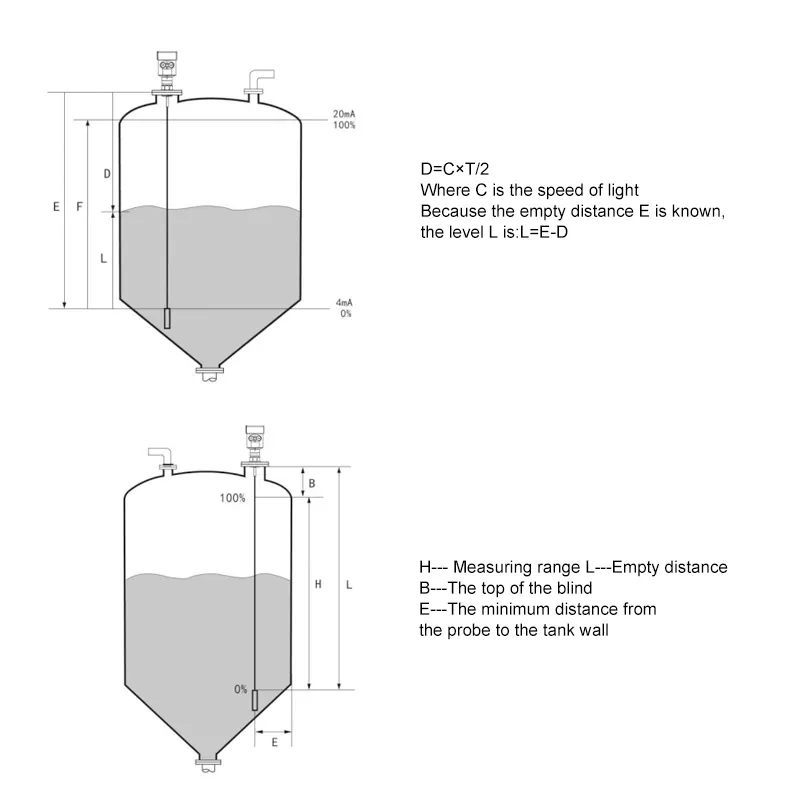
The guided wave radar level transmitter operates by emitting high-frequency microwave pulses that propagate along a detection probe, such as a steel rod or steel cable.
When the microwave pulse reaches the surface of the measured medium, a sudden change in dielectric constant occurs. This discontinuity causes part of the pulse energy to be reflected back toward the transmitter.
The instrument measures the time interval between the transmitted pulse and the received echo. This time difference is directly proportional to the distance between the probe reference point and the material surface. Based on this relationship, the transmitter accurately calculates the level of the medium inside the vessel.Guided Wave Level Transmitter


Guided Wave Radar Type Level Transmitter Structure and Reliability Design
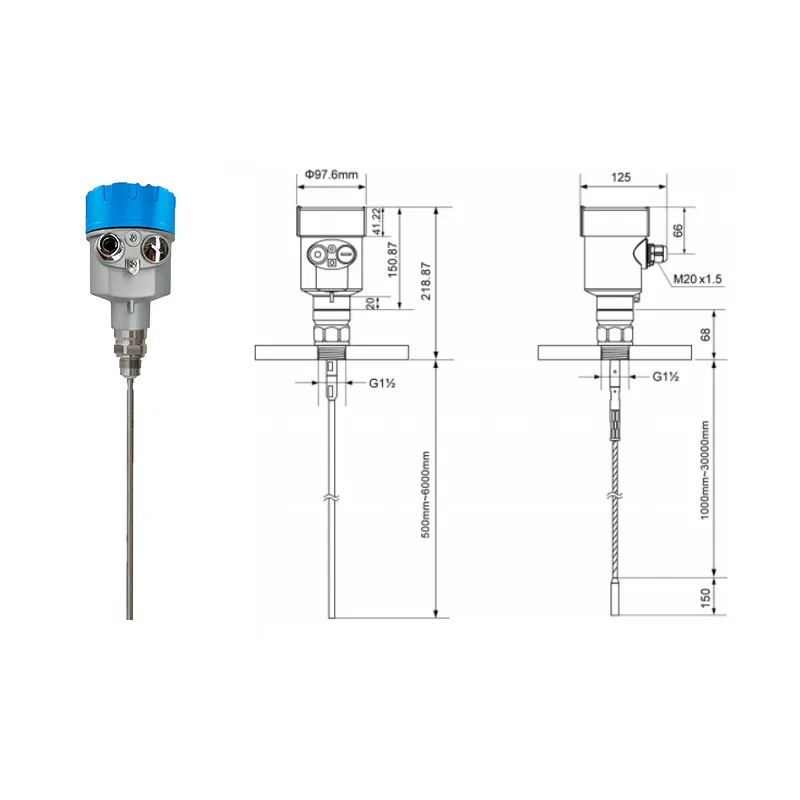
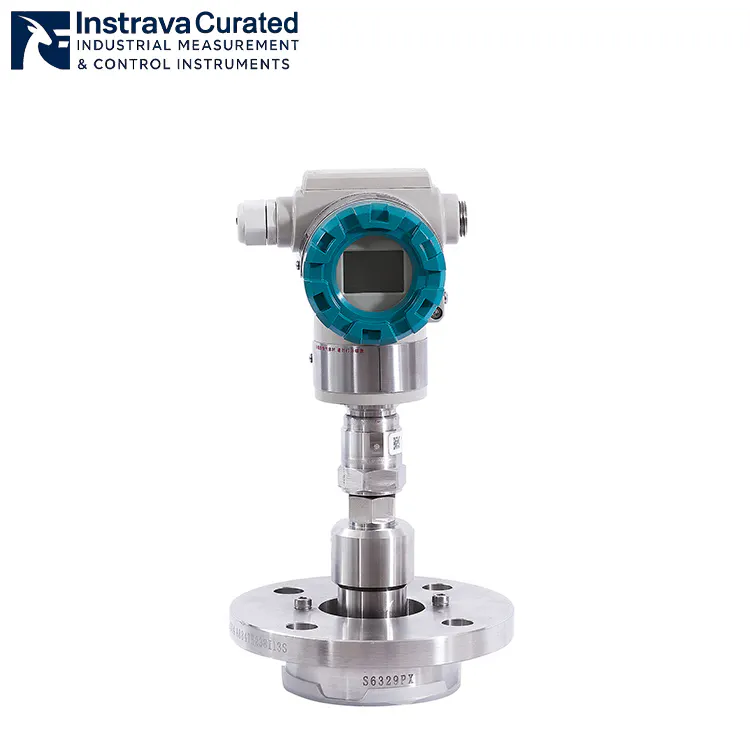
The transmitter consists of a robust electronic head and a mechanically stable probe structure. The probe guides the radar signal directly to the measurement point, minimizing interference from tank walls, nozzles, or internal components.
With no moving parts and a sealed industrial enclosure, the guided wave radar level transmitter offers long service life, low maintenance requirements, and high operational reliability in harsh environments.
Transmitters & Sensors Parameter
| Item | Specification |
|---|---|
| Suitable Measuring Medium | Liquid, solid powder |
| Typical Application | Liquid and solid level measurement under complex process conditions |
| Measuring Range | Up to 30 m |
| Measuring Principle | Guided Wave Radar (TDR) |
| Probe Type | Single cable probe / Single rod probe |
| Operating Frequency | 500 MHz – 1.8 GHz |
| Measurement Accuracy | ±10 mm |
| Process Temperature | -40 ~ 250 °C |
| Process Pressure | -0.1 ~ 4.0 MPa |
| Signal Output | 4–20 mA + HART |
| Power Supply | Two-wire: DC 24 V Four-wire: DC 24 V / AC 220 V |
| Local Display | 4-line LCD, programmable |
| Explosion Protection | Ex ia IIC T6 Ga Ex d IIC T6 Gb |
| Process Connection | Flange (optional) / Thread |
| Housing Material | Aluminum / Plastic |
Instrava OEM/ODM
Instrava is focused on delivering reliable industrial solutions through carefully curated products, application-driven optimization, and flexible customization. We select proven instruments from trusted manufacturers to ensure consistent quality, optimize solutions based on real working conditions to solve practical challenges, and provide tailored configurations to meet specific application needs.
By combining selection expertise with application understanding, Instrava helps customers reduce risk, improve efficiency, and achieve dependable results in complex industrial environments.

Can the guided wave radar level transmitter measure level accurately with heavy foam present?
Yes. The guided wave radar level transmitter uses a probe-guided microwave signal that travels directly along the rod or cable. Unlike non-contact technologies, foam has limited influence on signal propagation, allowing the instrument to detect the true material surface beneath the foam layer.
How does INGWRLT115 perform in low dielectric constant media?
Guided wave radar provides stronger signal coupling compared to non-contact radar. By guiding the microwave energy along the probe, INGWRLT115 ensures reliable signal reflection even in media with low dielectric constants, where ultrasonic or non-contact radar may become unstable.
Is guided wave radar suitable for high-temperature applications?
Yes. INGWRLT115 is designed for process temperatures up to 250 °C. The probe-based measurement principle ensures stable signal transmission under elevated temperatures, making it suitable for demanding thermal process environments.
Can INGWRLT115 operate reliably under high process pressure?
INGWRLT115 supports process pressures up to 4.0 MPa. Its robust probe structure and sealed process connection maintain measurement stability under pressure fluctuations commonly found in chemical and industrial process vessels.
How does guided wave radar handle turbulence and agitation inside the vessel?
Since the radar signal is guided along the probe, turbulence and surface agitation have minimal impact on measurement accuracy. INGWRLT115 maintains a stable echo reference even in vessels with strong mixing or flow disturbance.
Is guided wave radar affected by vapor or process condensation?
Guided wave radar measurement is largely immune to vapor and condensation. The microwave signal is transmitted along the probe rather than through free space, reducing interference from vapor clouds or condensate buildup inside the vessel.
Built on Consistency, Not Claims
We specialize in industrial analysis and detection, with a clear understanding of real-world operating environments and requirements.
Every instrument is evaluated based on performance, stability, and application suitability—not just specifications or pricing.
We work with trusted manufacturers to ensure stable supply, consistent quality, and dependable delivery.
Our recommendations are grounded in application understanding, helping customers avoid common issues and achieve reliable results.
Instrava is built to reduce uncertainty—so every decision you make is clearer, safer, and more reliable.

Industrial systems are rapidly evolving from isolated control environments into fully connected, data-driven ecosystems. At the center of this transformation...
Industrial communication technologies have evolved significantly over the past decades. Traditional fieldbus systems such as PROFIBUS and Modbus have long...
As industrial systems move toward digitalization and intelligent automation, traditional field communication technologies are increasingly unable to meet the demands...