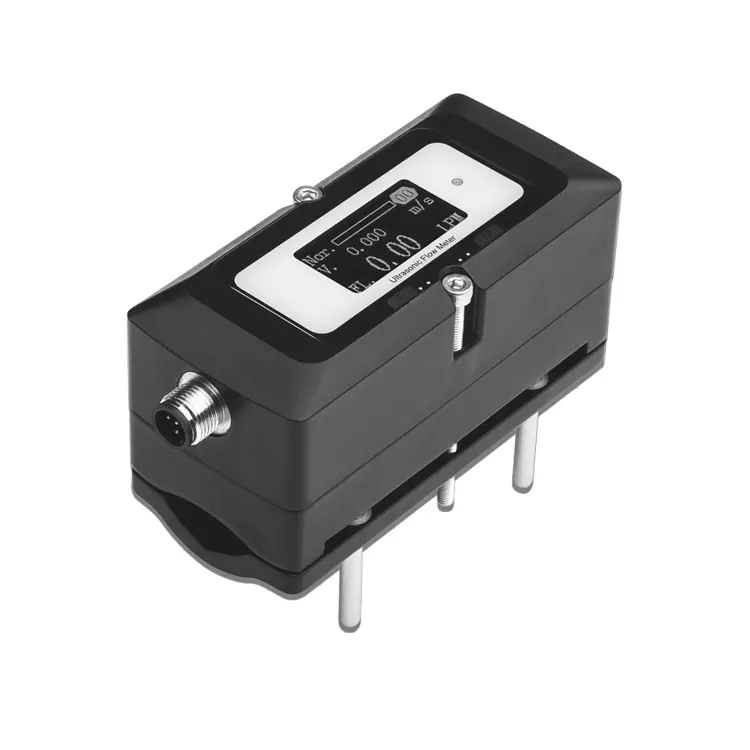

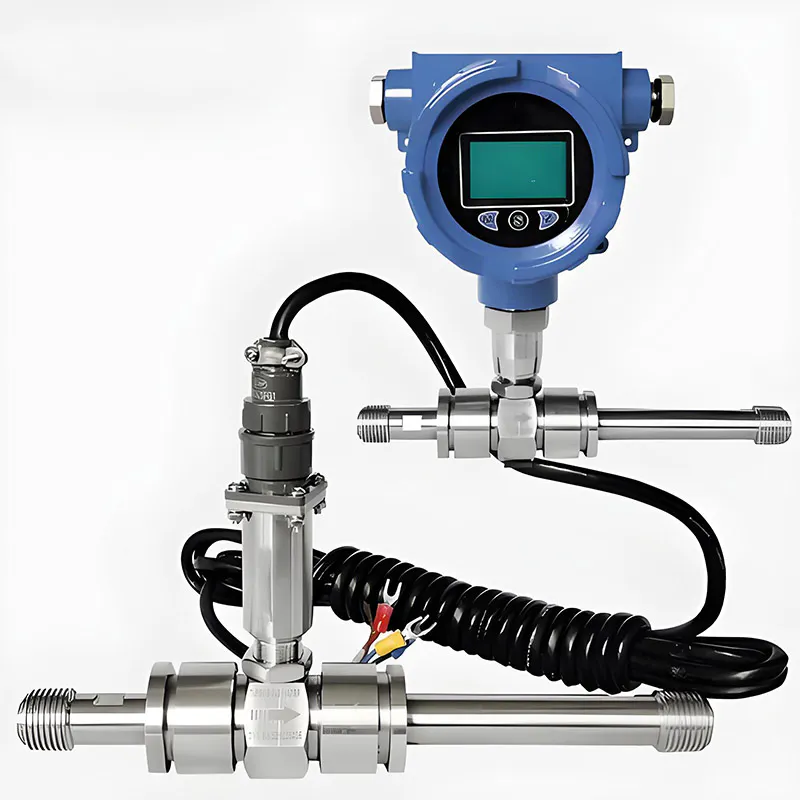
Pulse Output Intelligent Turbine Flowmeter
Solving Stable Flow Measurement for Clean Liquids
The PTF 125 Pulse Output Intelligent Turbine Flowmeter is designed for accurate and repeatable flow measurement of clean liquids in industrial process control applications.
Based on the torque balance principle, the turbine sensor converts fluid kinetic energy directly into rotational motion, producing a high-frequency pulse signal proportional to flow rate.
With a simple mechanical structure, fast dynamic response, and multiple signal output options, PTF 125 is widely used in water, oil, and light hydrocarbon measurement where stability and signal reliability are critical.
Flow Meter Description
Turbine Type Flow Meter-Core Measurement Advantages
-
High measurement accuracy and repeatability
Torque-balanced turbine design ensures linear response within the calibrated flow range. -
Sensitive response to flow changes
Ideal for process monitoring, batching, and totalizing applications. -
Pulse output for control systems
Square-wave pulse signal suitable for PLC, DCS, counters, and data acquisition systems. -
Multiple output options
Pulse, 4–20 mA, RS485, and HART protocols available. -
Rugged industrial construction
Stainless steel body and wear-resistant impeller materials for long service life.
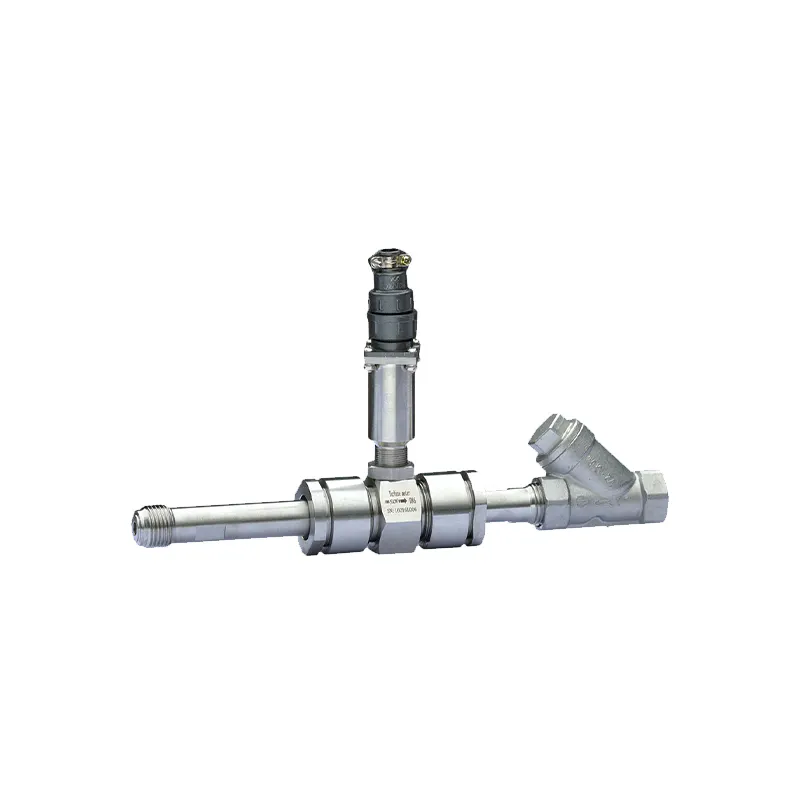
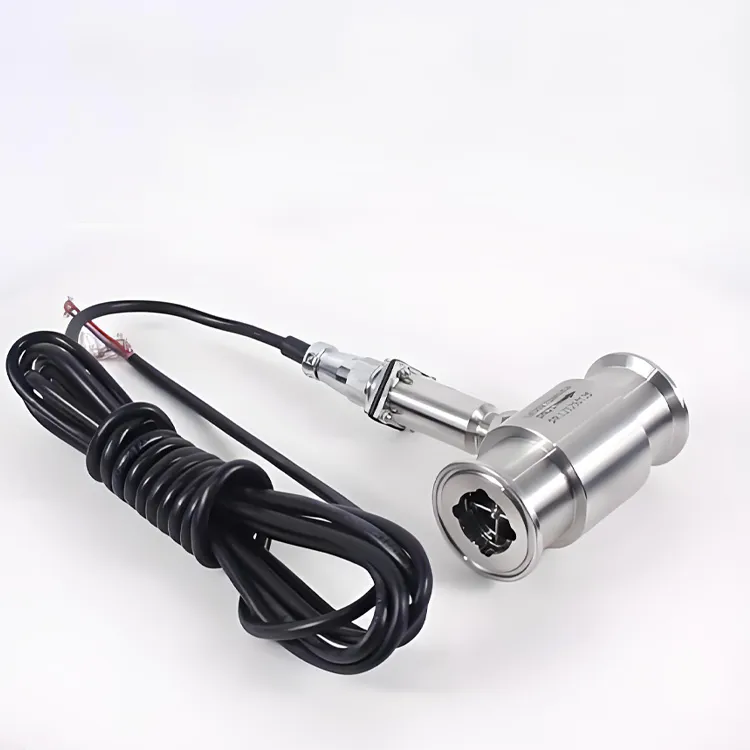
Flowmeter Turbine-Typical Applicable Media
PTF 125 is suitable for clean liquids compatible with stainless steel materials, including:
-
Water and demineralized water
-
Light oils and lubricants
-
Fuel oils and hydrocarbons
-
Other low-impurity industrial liquids
Note:
Free from fibers, particles, or solid impurities
Recommended viscosity ≤ 5 × 10⁻⁶ m²/s
Higher-viscosity liquids require calibration with the actual process fluid
Flow Meter Parameter
| Item | Specification |
|---|---|
| Model | PTF 125 |
| Nominal Diameter | DN6 ~ DN200 |
| Medium | Clean liquids (water, oil, etc.) |
| Viscosity Range | 5 ~ 400 mPa·s |
| Operating Temperature | -20 ~ 120 ℃ |
| Nominal Pressure | PN16 ~ PN63 |
| Flow Range | ≤ 1200 m³/h |
| Accuracy Class | 0.5 / 1.0 / 1.5 |
| Body Material | SS304 / SS321 / SS316L |
| Impeller Material | 2Cr13 / Duplex Stainless Steel |
| Ambient Temperature | -20 ~ 60 ℃ |
| Ambient Humidity | 5 ~ 90% RH |
| Signal Output | Pulse / 4–20 mA / RS485 / HART |
| Power Supply | 24 VDC ±15% |
| Battery Option | 3.6 V Li-battery 10 Ah (no signal output) |
| Explosion Proof | Ex dⅡBT4 |
| Protection Grade | IP65 |
| Electrical Interface | M20 × 1.5 |
| Process Connection | Flange or Thread |
| Installation | Horizontal |
Instrava OEM/ODM
Tailored Sourcing & Customization: Getting You the Exact Product You Need
As your trusted supplier and sourcing partner, we bridge the gap between your custom requirements and China’s vast manufacturing capabilities.
Finding the right product in a massive supply chain can be challenging. That is where we step in.
As a curated industrial supplier, our core value is simple: we stand in your shoes to help you procure the most optimal products. Whether you are an EPC contractor needing specialized technical compliance, an OEM equipment manufacturer looking for custom branding, or an industrial distributor/trader seeking competitive edge, we customize and tailor products to fit your exact procurement needs.
How We Customize to Fit Your Procurement Needs
For EPC Contractors & Engineers: We custom-configure instruments and devices to match your precise datasheets—tailoring process connections, exotic materials, signal protocols, and managing third-party calibration and testing so you get project-ready solutions.
For OEM Equipment Manufacturers: We provide comprehensive OEM/ODM customization, including custom housing, labeling, branding (private labeling), and tailored technical specifications to seamlessly integrate with your machinery.
For Industrial Distributors & Traders: We offer flexible customization in packaging, product ranges, and technical parameters, helping you differentiate your portfolio and win more local bids.
Why Partner with Us for Custom Sourcing?
One-Stop Engineering Alignment: You don’t have to deal with multiple factories. We translate your technical requirements into precise manufacturer blueprints.
Strict Quality & Compliance Safeguard: We oversee the entire customization and production process in China, ensuring the final customized product meets your local standards and certifications.
Our Ultimate Value: We don’t just sell what’s on the shelf. We find, customize, and deliver the most suitable and cost-effective product for your unique application.

How does liquid viscosity affect turbine flow meter accuracy?
Turbine flow meters perform best with low to medium viscosity liquids. As viscosity increases, fluid drag on the impeller rises, which can reduce rotational speed and impact accuracy. For higher-viscosity media, calibration using the actual process fluid is recommended to maintain reliable measurement.
What is the relationship between pulse output and flow rate?
The pulse output frequency is directly proportional to the instantaneous flow rate. Each pulse represents a fixed volumetric increment defined by the meter factor (K-value), making pulse output ideal for batching, totalizing, and PLC-based control systems.
Can the pulse signal be transmitted over long distances?
Yes. Pulse output signals can typically be transmitted up to 300 meters, depending on wiring quality and electromagnetic environment. Proper grounding and shielded cables are recommended to ensure signal integrity in industrial installations.
Why is installation direction important for turbine flow meters?
Turbine flow meters must be installed in the correct flow direction and typically in horizontal pipelines. Incorrect orientation can affect impeller rotation stability, leading to inaccurate pulse output and reduced repeatability.
How do impurities or particles affect turbine flow meters?
Turbine flow meters require clean liquids without fibers or solid particles. Particulates may damage the impeller or interfere with rotation, causing signal fluctuation or long-term wear.
Is pulse output suitable for both flow measurement and totalization?
Yes. Pulse output is widely used for instantaneous flow measurement, total flow accumulation, batching control, and system verification, making it highly compatible with PLC, DCS, and industrial automation systems.
Why Trust Instrava?
We select manufacturers from a neutral, impartial standpoint, always with your best interests in mind.
Our very existence depends on helping you source the products that are the perfect fit for your needs.
Based in China, we are able to conduct on-site inspections of production environments and product quality firsthand.
We help you avoid intermediaries posing as factories.
We facilitate smoother after-sales support, eliminating time zone issues and the delays often associated with dealing directly with factories.
Our multilingual team ensures effective communication.
For a trading startup, every interaction with a client is a precious opportunity—a sign that you are willing to place your trust in us and give us the chance to prove ourselves.
In the digital age, while information is easily accessible, misconceptions often cloud the trust between people.
Instrava relies entirely on trust; it is our core philosophy and the foundation of our existence in society. It is the fundamental basis for our long-term growth and our commitment to serving the community.
Please place your trust in us.