
Home » Products » Field Devices instruments » Pulse Radar (PV) Technology in Radar Level Sensors
Pulse Radar (PV) Technology in Radar Level Sensors
Introduction
Pulse Radar technology, also known as PV (Pulse Velocity) radar technology, is one of the earliest and most widely used microwave sensing technologies in industrial radar level measurement.
Unlike FMCW radar systems that continuously transmit frequency-modulated microwave signals, pulse radar technology works by transmitting short microwave pulses and measuring the signal return time from the target surface.
The true value of pulse radar technology lies in how microwave pulse transmission enables reliable non-contact level measurement under difficult industrial conditions involving:
- High temperature
- High pressure
- Vapor
- Foam
- Dust
- Corrosive media
- Long measuring distances
Modern pulse radar level sensors are industrial applications of microwave transmission technology, antenna engineering, electromagnetic reflection analysis, and digital echo analysis.
Although modern 80 GHz FMCW radar systems are increasingly popular, pulse radar technology remains highly important in many industrial applications because of its strong penetration capability, stable long-distance measurement performance, and higher tolerance to harsh process environments.
1. History and Development of Pulse Radar Technology
Pulse radar technology originated from early microwave radar research in the first half of the 20th century. During World War II, pulse radar systems became critical technologies for aircraft detection, navigation, and military target tracking.
These early radar systems operated by transmitting short bursts of microwave energy and measuring the time required for reflected signals to return from distant objects.
As microwave engineering and electronic technologies advanced, engineers gradually recognized that pulse radar principles could also be applied to industrial distance and level measurement.
In the 1960s and 1970s, industrial automation companies began introducing pulse radar technologies for tank level monitoring applications. Early radar systems mainly used relatively low microwave frequencies with large horn antennas.
Although these early systems had limited resolution and relatively large beam angles, they provided stable non-contact measurement under difficult industrial conditions where traditional contact measurement technologies struggled.
Industrial companies such as Siemens, VEGA, Emerson, and Endress+Hauser played important roles in commercializing pulse radar level sensing technologies.
Modern pulse radar systems continue evolving through improvements in:
- Microwave electronics
- Antenna structures
- Echo processing
- DSP technologies
- Signal filtering
- Intelligent diagnostics
2. Core Technical Principle of Pulse Radar Technology
Pulse radar technology operates by transmitting short microwave pulses toward the target surface and measuring the time required for the reflected signal to return.
The radar sensor calculates the distance based on microwave propagation speed and signal travel time.
The basic ranging principle can be expressed as:
d=ct/2
Where:
- d = target distance
- c = speed of light
- t = microwave pulse travel time
The measured distance is then converted into level information according to tank geometry and installation reference.
Pulse radar systems primarily rely on microwave reflection intensity and propagation timing to determine target position.
3. Basic Operation of Pulse Radar Systems
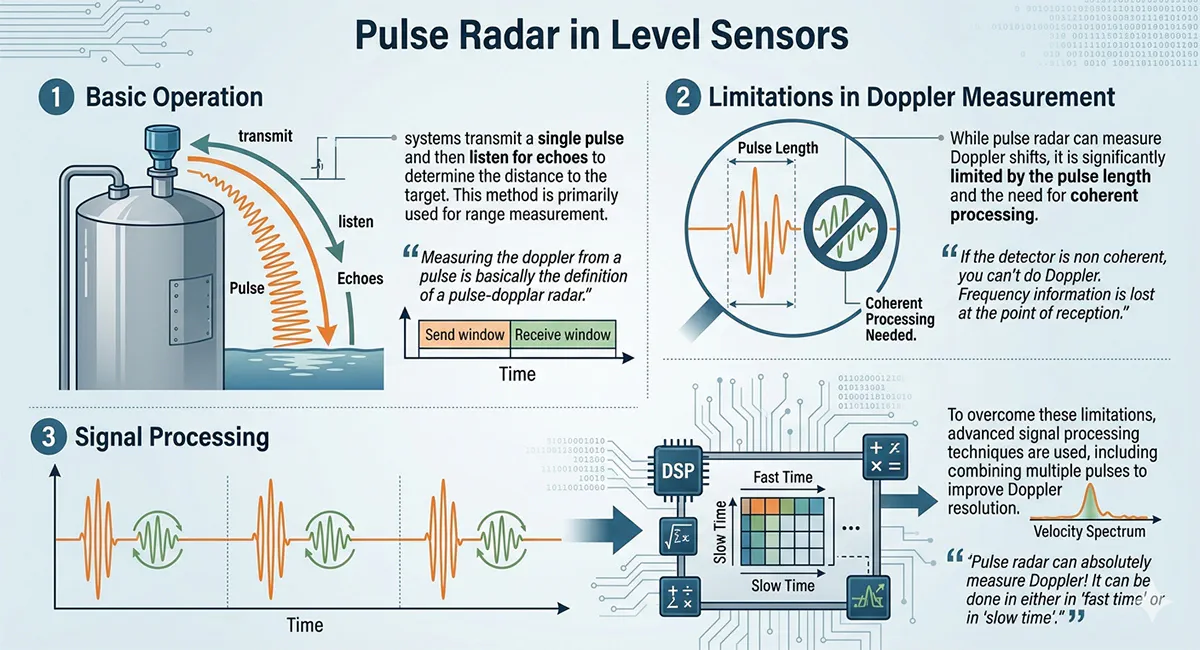
Pulse Radar in Level Sensors
Basic Operation: Pulse radar systems transmit a single pulse and then listen for echoes to determine the distance to the target. This method is primarily used for range measurement.
“Measuring the doppler from a pulse is basically the definition of a pulse-dopplar radar.”
From an industrial radar perspective, pulse transmission allows the radar sensor to separate transmitted and reflected signals clearly in the time domain. This provides stable distance measurement capability in long-range industrial applications.
Pulse radar systems are particularly suitable for:
- Large storage tanks
- High-temperature vessels
- Long measuring distances
- Harsh process environments
- Applications requiring stable penetration capability
Because microwave pulses are separated in time, pulse radar systems generally have simpler microwave architectures compared with advanced FMCW radar systems.
4. Microwave Frequency Evolution in Pulse Radar Technology
The evolution of microwave frequency technology significantly changed the performance characteristics of pulse radar systems.
Traditional pulse radar level sensors commonly utilized:
- 6 GHz radar
- 26 GHz radar
Different frequencies produce different:
- Beam angles
- Penetration capabilities
- Echo sensitivity
- Obstacle rejection performance
5. 6 GHz and 26 GHz Pulse Radar Technology
Lower-frequency pulse radar systems generally provide stronger microwave penetration capability.
Typical advantages include:
- Better vapor penetration
- Stronger foam tolerance
- Improved condensation resistance
- Better tolerance to antenna contamination
Because lower-frequency microwaves are less sensitive to surface moisture and buildup, pulse radar systems often perform reliably in difficult process conditions.
Advantages of Lower-Frequency Pulse Radar
Strong Penetration Capability
Lower-frequency microwave pulses can better penetrate:
- Steam
- Condensation
- Dust
- Foam layers
This makes pulse radar highly suitable for harsh industrial environments.
Higher Tolerance to Process Buildup
Pulse radar systems generally tolerate:
- Antenna contamination
- Sticky material buildup
- Crystallization
- Water films
better than very high-frequency radar systems.
Limitations of Lower-Frequency Pulse Radar
Because lower-frequency radar systems typically generate wider beam angles, they are more easily affected by:
- Tank walls
- Agitators
- Pipes
- Internal supports
- Structural obstacles
This can create false echoes and unstable readings in narrow or complex vessels.
Additionally:
- Blind zones are larger
- Signal resolution is lower
- Weak target discrimination is more limited
6. Doppler Limitations in Pulse Radar Technology
Although pulse radar technology can measure Doppler shifts, practical implementation involves important engineering limitations.
Limitations in Doppler Measurement
While pulse radar can measure Doppler shifts, it is significantly limited by the pulse length and the need for coherent processing.
“If the detector is non coherent, you can’t do Doppler. Frequency information is lost at the point of reception.”
From a radar engineering perspective, Doppler analysis requires precise phase and frequency information from reflected microwave signals.
In non-coherent radar systems, some frequency-related signal information is lost during reception, limiting accurate Doppler measurement capability.
This becomes increasingly important in applications involving:
- Moving surfaces
- Turbulent liquids
- Dynamic process conditions
- High-speed material flow
7. Signal Processing in Pulse Radar Systems
Modern pulse radar systems increasingly rely on advanced digital signal processing technologies to overcome traditional radar limitations.
Signal Processing
To overcome these limitations, advanced signal processing techniques are used, including combining multiple pulses to improve Doppler resolution.
“Pulse radar can absolutely measure Doppler! It can be done in either in ‘fast time’ or in ‘slow time’.”
Modern pulse radar systems increasingly integrate:
- DSP architectures
- FFT analysis
- Echo averaging
- Dynamic filtering
- Adaptive signal gain
- Multi-pulse analysis
These technologies significantly improve:
- Weak echo detection
- Surface tracking
- Dynamic target analysis
- Measurement stability
- False echo suppression
Without advanced digital processing capability, pulse radar systems would struggle to maintain stable operation under complex industrial conditions involving:
- Foam
- Turbulent liquids
- Dust
- Condensation
- Multiple reflections
- Internal vessel interference
As Industry 4.0 technologies continue advancing, intelligent signal processing is becoming increasingly important in determining overall pulse radar performance.
8. How Pulse Radar Technology Enables Instrument Functions
Pulse radar technology directly determines the capabilities of radar level sensors.
Microwave Pulse Transmission Enables Long-Distance Measurement
Pulse radar systems are highly suitable for:
- Tall storage tanks
- Large silos
- Long-distance measurement
- Harsh industrial environments
because microwave pulses maintain stable propagation capability over long distances.
Lower-Frequency Radar Enables Strong Environmental Adaptability
Lower-frequency pulse radar systems provide:
- Better steam penetration
- Improved foam tolerance
- Stronger condensation resistance
- Higher tolerance to dirty environments
This improves operational stability under difficult process conditions.
DSP Technology Enables Intelligent Echo Analysis
Modern pulse radar systems increasingly combine microwave sensing with:
- Echo pattern recognition
- Adaptive filtering
- False echo suppression
- Dynamic signal optimization
These technologies significantly improve measurement reliability.
9. Industry 4.0 Evolution of Pulse Radar Technology
In the Industry 4.0 era, pulse radar technology has evolved beyond simple distance measurement.
Modern radar systems increasingly integrate:
- Intelligent DSP processing
- AI-assisted echo analysis
- Remote diagnostics
- Cloud monitoring
- Predictive maintenance
- Edge computing
- Digital twin integration
Pulse radar sensors are gradually evolving into intelligent industrial sensing nodes capable of autonomous diagnostics and adaptive signal optimization.
AI-Assisted Echo Recognition
Modern pulse radar systems increasingly use AI-based algorithms capable of:
- Learning tank reflection patterns
- Identifying unstable echoes
- Automatically suppressing interference
- Improving difficult surface measurement
This is especially important for:
- Foam-covered liquids
- Turbulent surfaces
- Powder materials
- Irregular bulk solids
10. Future Development Trends of Pulse Radar Technology
Future pulse radar technologies are expected to continue evolving toward:
- Smarter signal analysis
- AI-assisted radar processing
- Adaptive microwave optimization
- Higher digital integration
- Wireless IIoT connectivity
- Autonomous diagnostics
- Self-learning echo analysis
Future pulse radar systems may dynamically optimize:
- Pulse timing
- Signal gain
- Echo filtering
- Interference suppression
according to changing industrial conditions.
Conclusion
Pulse radar technology remains one of the foundational microwave sensing technologies in industrial radar level measurement.
The true value of pulse radar technology lies in how microwave pulse transmission enables:
- Reliable non-contact measurement
- Strong environmental adaptability
- Long-distance sensing
- Stable vapor penetration
- Industrial-grade operational reliability
Although high-frequency FMCW radar systems provide higher resolution and narrower beam angles, pulse radar technology continues to offer major advantages in harsh industrial environments involving steam, condensation, foam, and process buildup.
As Industry 4.0 technologies continue evolving, pulse radar systems are becoming increasingly intelligent through advanced DSP architectures, AI-assisted echo analysis, and autonomous signal optimization technologies.
Related Product Recommendations
What is Pulse Radar (PV) technology in radar level sensors?
Pulse Radar technology transmits short microwave pulses toward the target surface and measures the signal return time to calculate level distance.
How is pulse radar different from FMCW radar?
Pulse radar uses separate microwave pulses and time-domain analysis, while FMCW radar continuously transmits frequency-modulated signals and analyzes frequency differences.
Why is pulse radar suitable for harsh industrial environments?
Lower-frequency pulse radar systems provide strong penetration through vapor, condensation, foam, and dust while maintaining stable long-distance measurement capability.
What are the limitations of pulse radar technology?
Pulse radar systems generally have wider beam angles, larger blind zones, and lower signal resolution compared with modern high-frequency FMCW radar systems.
Can pulse radar measure Doppler shifts?
Yes. Pulse radar can measure Doppler effects, but accurate Doppler analysis requires coherent signal processing and advanced digital analysis techniques.
How will pulse radar technology evolve in the future?
Future pulse radar technologies are expected to integrate AI-assisted signal analysis, intelligent DSP architectures, autonomous diagnostics, cloud monitoring, and adaptive signal optimization technologies.
Why Choose Instrava
Built on Consistency, Not Claims
Focused on Industrial Applications
We specialize in industrial analysis and detection, with a clear understanding of real-world operating environments and requirements.
Strict Product Selection Criteria
Every instrument is evaluated based on performance, stability, and application suitability—not just specifications or pricing.
Reliable Supply & Quality Consistency
We work with trusted manufacturers to ensure stable supply, consistent quality, and dependable delivery.
Practical, Experience-Based Support
Our recommendations are grounded in application understanding, helping customers avoid common issues and achieve reliable results.
Instrava is built to reduce uncertainty—so every decision you make is clearer, safer, and more reliable.