
HART to Cloud & Ethernet-APL: Brownfield Digitalization Explained
What is Brownfield Digitalization?
Brownfield Digitalization is the process of upgrading existing industrial systems without replacing installed instrumentation.
Instead of rebuilding infrastructure, it focuses on:
- Connecting legacy devices
- Extracting usable data
- Enabling gradual digital transformation
This approach is widely used in plants with 4–20mA and HART-based systems.
Learn more: Brownfield vs Greenfield Strategy → /brownfield-vs-greenfield
What is HART to Cloud?
HART to Cloud is a key method in Brownfield Digitalization that enables data extraction from HART-enabled instruments and integration into cloud platforms.
It typically involves:
- HART data acquisition via gateways
- Protocol conversion (OPC UA / MQTT)
- Cloud connectivity for analytics
This allows existing instruments to become part of modern IIoT systems.
Related solution: Edge Gateway Solutions → /edge-gateway
Why is HART to Cloud important in Brownfield Digitalization?
Most industrial plants already have a large installed base of HART devices.
HART to Cloud helps:
- Unlock hidden device data
- Improve operational visibility
- Enable predictive maintenance
- Reduce upgrade costs
It provides a low-risk and scalable path to digital transformation.
What is Ethernet-APL?
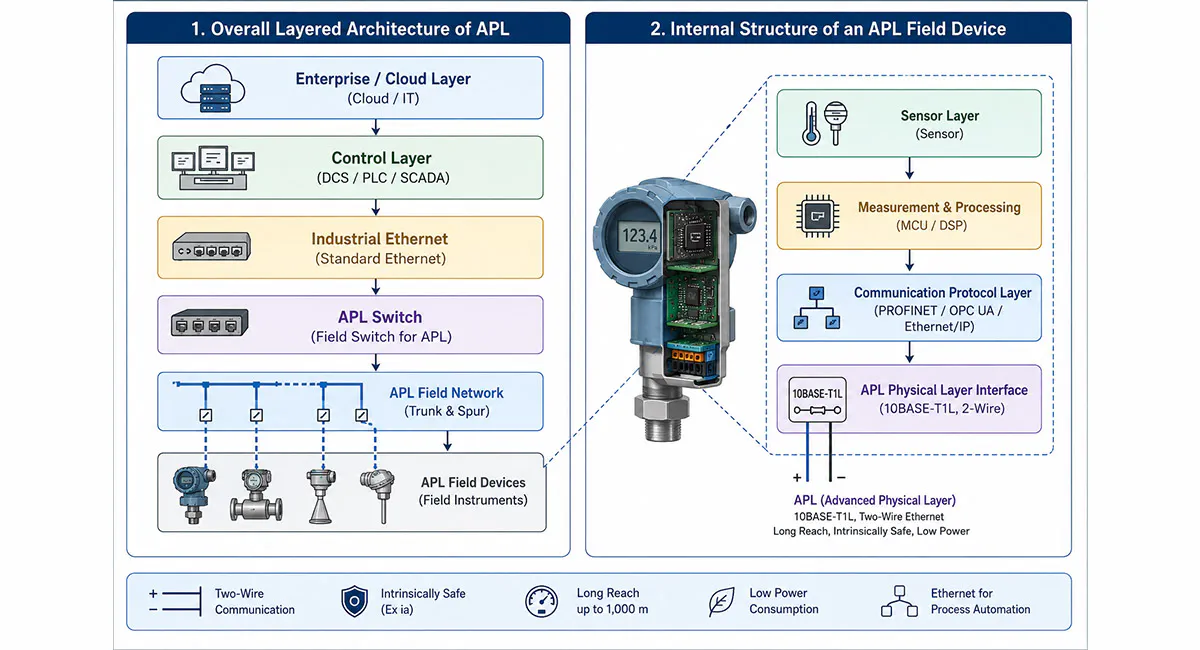
Ethernet-APL (Advanced Physical Layer) is a technology that enables Ethernet communication directly at the field level.
It offers:
- Two-wire communication (power + data)
- Long-distance transmission (up to 1000 meters)
- Intrinsic safety for hazardous areas
- High-speed data (10 Mbps)
Ethernet-APL is a key technology for future-ready industrial networks.
Learn more: Edge Integration Architecture → /edge-integration
What types of instruments support Ethernet-APL?
Only instruments with native Ethernet-APL interfaces can connect directly.
Examples include:
- Pressure transmitters
- Flowmeters
- Level sensors
- Temperature transmitters
Legacy 4–20mA and HART instruments do not support direct APL connectivity.
Can HART instruments be integrated into Ethernet-APL systems?
Not directly, but they can be integrated through edge devices.
Typical approach:
- Use HART gateways or multiplexers
- Convert data into OPC UA or MQTT
- Connect to higher-level systems
This is the foundation of most Brownfield Digitalization projects.
What is the architecture of an Ethernet-APL system?
Ethernet-APL uses a trunk-and-spur topology:
- Trunk: Main communication backbone
- Spur: Connection to individual devices
The system includes:
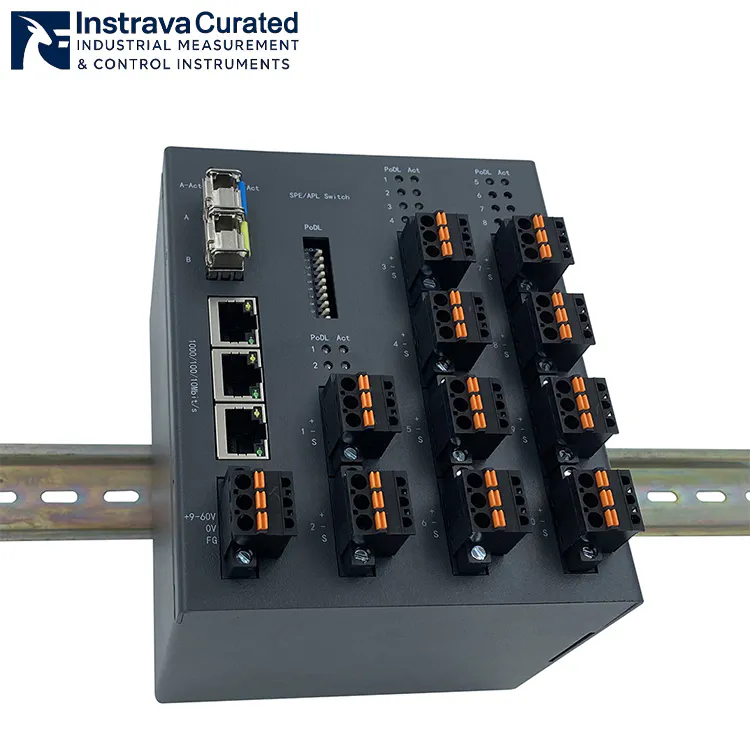
- APL switches
- Field switches
- Ethernet backbone
- Field instruments
This enables Ethernet connectivity all the way to field devices.
Why can Ethernet-APL transmit more data than HART?
Ethernet-APL removes traditional communication limitations through:
- High bandwidth (10 Mbps vs HART’s low speed)
- Ethernet-based communication
- Support for structured protocols like OPC UA
This enables:
- Multi-variable data
- Device diagnostics
- Real-time status information
What is Publish/Subscribe in industrial communication?
Publish/Subscribe is a communication model where:
- Devices publish data continuously
- Systems subscribe to receive data
Unlike traditional polling, this model:
- Enables real-time data flow
- Supports multiple systems simultaneously
- Reduces network load
How do Ethernet-APL instruments send data actively?
Ethernet-APL instruments are network devices with IP-based communication.
They can:
- Send periodic updates
- Trigger event-based messages
- Stream real-time data
Supported by protocols such as:
- OPC UA
- PROFINET
- MQTT (via edge systems)
What is the difference between HART to Cloud and Ethernet-APL?
| Aspect | HART to Cloud | Ethernet-APL |
|---|---|---|
| Type | Upgrade path | New architecture |
| Use case | Existing plants | New installations |
| Cost | Lower | Higher |
| Speed | Fast deployment | Longer implementation |
HART to Cloud focuses on activating existing assets, while Ethernet-APL enables next-generation infrastructure.
Which is better: HART to Cloud or Ethernet-APL?
There is no one-size-fits-all answer.
- Brownfield projects → HART to Cloud
- Greenfield projects → Ethernet-APL
Most real-world applications use a hybrid approach.
How does Instrava support Brownfield Digitalization?
Instrava focuses on practical and scalable upgrade strategies.
We help customers:
- Assess existing instrumentation
- Identify digitalization opportunities
- Design HART to Cloud architectures
- Integrate edge and cloud systems
Our approach enables digital transformation without disrupting operations.
Explore more: Industrial Data Modeling → /data-modeling
Conclusion: From Legacy Signals to Data-Driven Systems
Brownfield Digitalization is not about replacing systems—it is about activating them.
- HART to Cloud unlocks existing data
- Ethernet-APL defines future architecture
Together, they form a complete path toward modern industrial digitalization.
Why Choose Instrava
Built on Consistency, Not Claims
Focused on Industrial Applications
We specialize in industrial analysis and detection, with a clear understanding of real-world operating environments and requirements.
Strict Product Selection Criteria
Every instrument is evaluated based on performance, stability, and application suitability—not just specifications or pricing.
Reliable Supply & Quality Consistency
We work with trusted manufacturers to ensure stable supply, consistent quality, and dependable delivery.
Practical, Experience-Based Support
Our recommendations are grounded in application understanding, helping customers avoid common issues and achieve reliable results.
Instrava is built to reduce uncertainty—so every decision you make is clearer, safer, and more reliable.