What Is a Level Gauge and How to Choose the Right One for Industrial Applications
Introduction: Why Level Measurement Is More Critical Than You Think
In industrial environments, inaccurate level measurement is not just a technical issue—it directly affects safety, efficiency, and operational cost. Whether in water treatment plants, chemical storage tanks, or oil terminals, knowing the exact liquid level is essential for process control and risk prevention.
A level gauge is a device used to measure the level of liquids or solids within a container. However, choosing the right type of level gauge is far more complex than simply selecting a product from a catalog.
In real industrial scenarios, factors such as temperature, pressure, vapor, and installation structure significantly impact measurement performance.
What Is a Level Gauge? (Beyond the Basic Definition)
A level gauge is an instrument designed to monitor the level of liquids or bulk materials inside tanks, vessels, or silos.
But in practice, it is not just a measurement device—it is part of a control system that directly affects:
- Process stability
- Equipment protection (pump dry-run prevention)
- Inventory accuracy
- Safety compliance
In multiple industrial projects, incorrect level measurement has led to overflow incidents, unstable process control, and unexpected downtime—most of which could have been avoided with proper sensor selection.
Types of Level Gauges and Their Applications
Different technologies are designed for different operating conditions. Understanding their strengths and limitations is essential before making a decision.
Common Level Gauge Technologies
| Type | Measurement Principle | Typical Applications |
|---|---|---|
| Radar Level Gauge | Microwave reflection | High-pressure, sealed tanks |
| Ultrasonic Sensor | Sound wave reflection | Open tanks, water treatment |
| Float Level Gauge | Mechanical buoyancy | Simple tanks, low-cost systems |
| Differential Pressure | Pressure difference | Stable liquids in closed tanks |
| Capacitive Sensor | Capacitance variation | Chemical or viscous liquids |
Each technology performs differently depending on environmental and process conditions.
How Ultrasonic Level Sensors Perform in Real Industrial Conditions
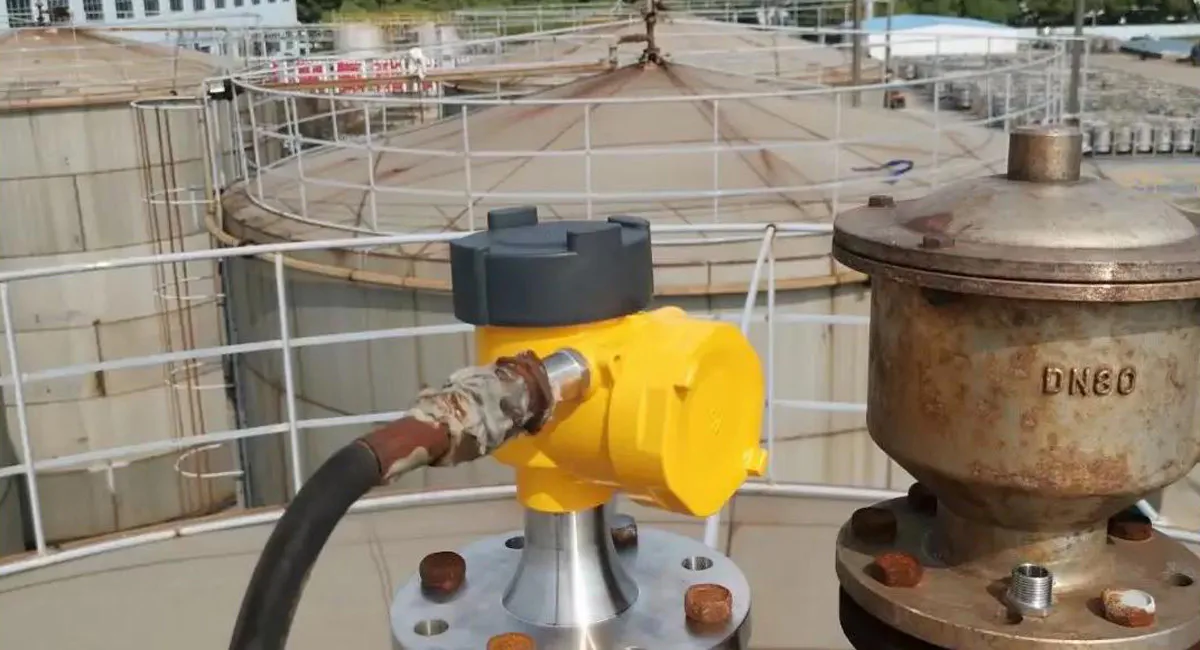
Ultrasonic level sensors are widely used because they are easy to install, non-contact, and not affected by liquid viscosity or density. They are especially common in water treatment and petrochemical applications due to their low maintenance requirements and reliable day-to-day operation.
However, in practical chemical and industrial environments, several issues frequently arise that directly affect measurement accuracy and stability.
Common Ultrasonic Measurement Challenges
| Issue Type | Impact on Measurement |
|---|---|
| Power supply fluctuation | Causes unstable readings or signal loss |
| Blind zone limitation | Reduces effective measurement range |
| Gas bubbles / foam | Causes signal scattering and attenuation |
| Uneven or contaminated surface | Leads to weak or false reflections |
| Installation angle deviation | Signal reflection misses the sensor |
Understanding these real-world limitations is critical when selecting ultrasonic technology.
Practical Engineering Insights from Field Applications
In several chemical plant projects, we observed that power supply instability directly affected ultrasonic sensor performance. When excitation voltage was too high, the blind zone increased, reducing the effective measurement range. When voltage dropped, the returning signal became too weak, causing measurement errors or complete signal loss.
Another common issue is incorrect range selection. Because ultrasonic waves attenuate over distance and have a fixed blind zone, selecting a sensor with an unsuitable range often leads to inaccurate readings or unusable data.
Gas bubbles and vapor are also major sources of measurement error. In environments where bubbles are present—especially in colder regions—ultrasonic signals are scattered and absorbed, leading to false readings. When bubbles accumulate on the sensor surface, the problem becomes more severe, sometimes even damaging the probe over time.
Surface conditions also play a key role. If the liquid surface is turbulent or contains impurities, reflected signals may not return directly to the sensor, resulting in unstable or lost measurements.
Installation is another critical factor. Ultrasonic sensors must be mounted vertically, and the blind zone must always be considered. In most industrial applications, the blind zone typically ranges from 30 to 50 cm. If the sensor is installed too close to the liquid surface or at an angle, measurement failure is highly likely.
In space-constrained applications, small blind-zone ultrasonic sensors can be used, but they typically have a limited measurement range (often below 0.6 meters), which restricts their applicability.
How to Choose the Right Level Gauge
Selecting a level gauge is not about choosing the most advanced technology—it is about choosing the most suitable one for your specific working conditions.
Key Selection Factors
| Factor | Why It Matters |
|---|---|
| Liquid Type | Corrosive, viscous, or clean liquids behave differently |
| Temperature & Pressure | Limits applicable technologies |
| Tank Type | Open vs sealed tanks require different sensors |
| Surface Conditions | Foam, vapor, or turbulence affects signals |
| Installation Constraints | Space and mounting angle impact performance |
Ignoring these factors often leads to unstable performance or system failure.
Practical Comparison: When to Choose Each Technology
Real-world selection depends more on conditions than specifications.
| Scenario | Recommended Solution | Reason |
|---|---|---|
| High-pressure sealed tank | Radar level gauge | Unaffected by pressure and vapor |
| Open water tank | Ultrasonic sensor | Cost-effective and easy installation |
| Foam or vapor environment | Radar level gauge | More stable signal performance |
| Simple on/off detection | Float level switch | Reliable and low cost |
In wastewater and open tank applications, ultrasonic sensors are often preferred for cost reasons. However, in environments with condensation, vapor, or unstable surfaces, radar level gauges consistently provide more reliable results.
Step-by-Step Selection Model (Engineering Approach)
A structured approach reduces risk and improves long-term reliability.
| Step | Action | Outcome |
|---|---|---|
| 1 | Define process conditions | Clear requirement baseline |
| 2 | Identify measurement range | Eliminate unsuitable sensors |
| 3 | Evaluate environmental factors | Avoid failure risks |
| 4 | Compare technologies | Balance cost vs performance |
| 5 | Validate with real scenarios | Ensure long-term stability |
This method is widely used in industrial projects to ensure correct selection from the beginning.
Common Mistakes in Level Gauge Selection
Many selection failures come from overlooking real-world conditions.
Typical Mistakes
- Using ultrasonic sensors in high-condensation or vapor environments
- Ignoring blind zone limitations during installation
- Selecting incorrect measurement range
- Not accounting for bubbles or foam in liquid
- Installing sensors at incorrect angles
In multiple projects, replacing an unsuitable level sensor resulted in higher costs than the original system, emphasizing the importance of proper initial selection.
Why Experience Matters in Level Measurement
Technical specifications alone are not enough—real-world experience determines success.
In one chemical storage project, an ultrasonic sensor was initially selected due to its lower cost and ease of installation. However, due to vapor and surface instability, measurement results were inconsistent. After switching to a radar level gauge, the system achieved stable and accurate readings with minimal maintenance.
This demonstrates a critical principle:
the best solution is not the simplest or cheapest—but the one that fits the application conditions.
Conclusion: Choosing the Right Level Gauge Is About Fit, Not Complexity
There is no universal solution for level measurement. Each application requires a balance between performance, cost, and environmental compatibility.
The right level gauge depends on:
- Process conditions
- Environmental challenges
- Installation constraints
- Long-term reliability
Instrava is a partner focused on providing equipment, solutions, and services for industrial measurement and control instruments used in safety-critical and process control applications. We support customers with customized level measurement solutions, combining engineering experience, reliable product quality, and flexible OEM/ODM capabilities to ensure optimal performance in real-world applications.