Radar vs Ultrasonic Level Sensor: Which One Is Better for Your Application?
Introduction: The Wrong Choice Doesn’t Reduce Accuracy—It Breaks the System
When selecting a level sensor, many users compare specifications like accuracy and range. However, in real industrial and environmental applications, the biggest problem is not measurement deviation—it is unreliable readings.
Fluctuating signals, false alarms, and signal loss are far more critical than small accuracy differences.
This is especially true when choosing between radar and ultrasonic level sensors—two of the most widely used technologies for water and liquid level measurement.
Understanding how they perform under real conditions is the key to making the right decision.
Quick Answer: Radar vs Ultrasonic (Direct Comparison)
| Criteria | Radar Level Sensor | Ultrasonic Level Sensor |
|---|---|---|
| Measurement Principle | Microwave reflection | Sound wave reflection |
| Accuracy | High (±2–5 mm typical) | Medium (±5–10 mm typical) |
| Stability | Very high | Moderate |
| Sensitivity to Vapor | Low | High |
| Sensitivity to Foam | Low | High |
| Maintenance | Low | Moderate |
| Cost | Higher | Lower |
Radar sensors provide more stable and reliable measurements in complex environments, while ultrasonic sensors are more cost-effective in simple conditions.
How the Two Technologies Work
Radar Level Sensor
Radar sensors emit microwave signals that reflect off the liquid surface and return to the sensor.
Because electromagnetic waves are not significantly affected by temperature, pressure, or vapor, radar sensors maintain stable performance even in harsh environments.
Ultrasonic Level Sensor
Ultrasonic sensors emit sound waves and measure the time it takes for the echo to return.
However, sound propagation is highly dependent on environmental conditions such as temperature, humidity, and vapor. This makes ultrasonic sensors more sensitive to interference.
Why Radar Is More Reliable in Real-World Conditions
In controlled environments, both technologies can perform well.
But in real applications, conditions are rarely ideal.
Factors such as foam, condensation, turbulence, and vapor do not just reduce accuracy—they can cause signal instability or complete measurement failure.
Radar sensors are less affected by these factors, making them the preferred choice in demanding environments.
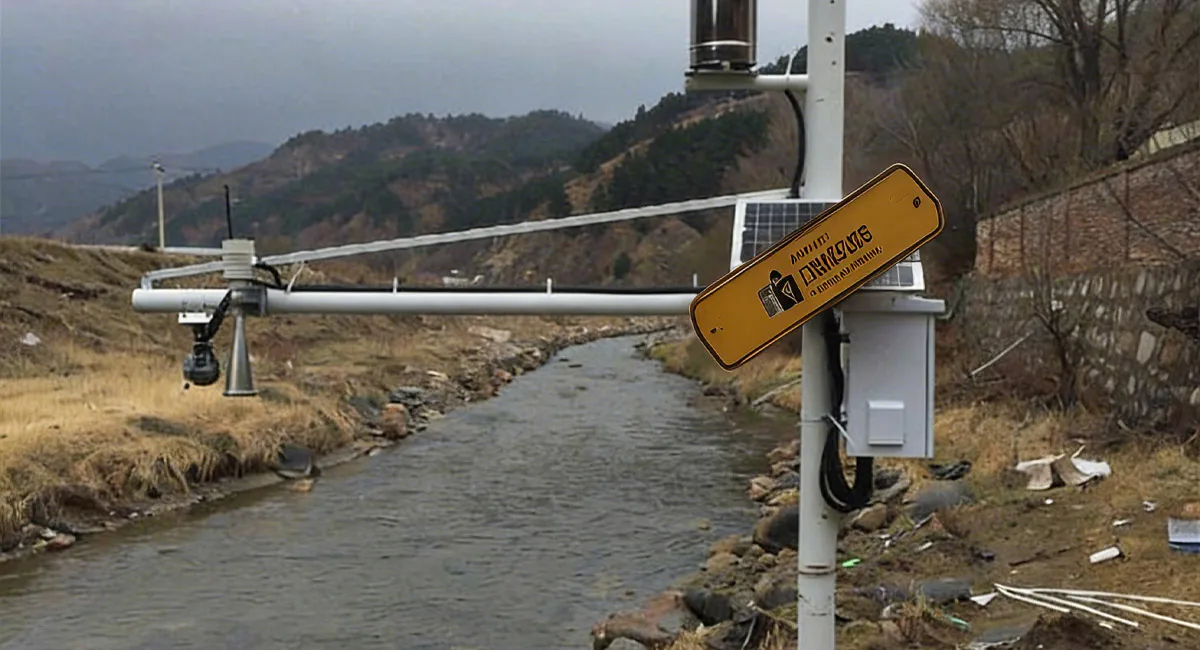
Practical Engineering Case: Radar Level Monitoring in River Systems
In river water level monitoring projects, radar sensors are widely used due to their stability and adaptability to outdoor conditions.
Key Implementation Considerations
| Factor | Practical Approach |
|---|---|
| Equipment selection | High-precision, long-life radar with strong anti-interference capability |
| Installation location | Wide cross-section, stable flow area |
| Mounting method | Fixed (bridge/bracket) or floating (buoy-based) |
| Data transmission | Wired or wireless real-time data transfer |
| Data processing | Integration with monitoring and prediction systems |
Radar sensors are particularly suitable for river environments because they provide consistent measurements despite changing weather, water flow, and environmental conditions.
For example, fixed installations on bridges allow stable long-term monitoring, while floating installations adapt to large water level variations.
Why Ultrasonic Sensors Fail in Challenging Conditions
Ultrasonic sensors are widely used due to their low cost and ease of installation. However, their performance can degrade significantly under certain conditions.
Common Failure Scenarios
| Condition | Impact on Ultrasonic Sensor |
|---|---|
| Vapor / condensation | Signal attenuation or loss |
| Foam or bubbles | Scattered reflections |
| Temperature fluctuation | Changes in sound velocity |
| Turbulent surface | Weak or unstable echo signals |
| Installation deviation | Signal reflection errors |
In wastewater and open tank applications, ultrasonic sensors can perform well when conditions are stable.
However, in environments with heavy vapor or surface instability, signal fluctuations and false readings are common.
Selection Logic: Which One Should You Choose?
Choosing between radar and ultrasonic sensors is not about which is “better”—it is about which is more suitable for your application.
Scenario-Based Selection
| Application Scenario | Recommended Sensor | Reason |
|---|---|---|
| Open tank, stable conditions | Ultrasonic | Cost-effective solution |
| River / environmental monitoring | Radar | High stability in outdoor conditions |
| Vapor or condensation present | Radar | Unaffected by air conditions |
| Foam or turbulence | Radar | Reliable signal reflection |
| Budget-sensitive project | Ultrasonic | Lower initial cost |
The Real Selection Principle: Stability Over Accuracy
A common mistake is prioritizing accuracy over reliability.
In real applications, accuracy differences are usually small and manageable.
But instability can cause:
- False alarms
- System shutdowns
- Equipment damage
- Process inefficiency
This leads to a key engineering principle:
A stable measurement system is more valuable than a highly accurate but unreliable one.
Cost vs Performance: Short-Term vs Long-Term Thinking
| Factor | Ultrasonic Sensor | Radar Sensor |
|---|---|---|
| Initial Cost | Lower | Higher |
| Maintenance Cost | Higher over time | Lower |
| Reliability | Moderate | High |
| Total Cost of Ownership | Often higher | Often lower |
While ultrasonic sensors may seem more economical initially, radar sensors often provide better long-term value due to reduced maintenance and higher reliability.
Conclusion: Choose Based on Conditions, Not Specifications
Both radar and ultrasonic level sensors have their place in industrial and environmental applications.
- Ultrasonic sensors are ideal for simple, stable environments
- Radar sensors are better suited for complex, dynamic, or harsh conditions
The best choice depends on:
- Environmental conditions
- Required stability
- Maintenance expectations
- Long-term operational cost
Instrava is a partner focused on providing equipment, solutions, and services for industrial measurement and control instruments used in safety-critical and process control applications. We support customers with customized level measurement solutions, combining real-world engineering experience with reliable product performance to ensure stable and accurate monitoring in any environment.