Débitmètre

Débitmètre à turbine intelligent à sortie d'impulsion

Solving Stable Flow Measurement for Clean Liquids

The PTF 125 Pulse Output Intelligent Turbine Flowmeter is designed for accurate and repeatable flow measurement of clean liquids in industrial process control applications.
Based on the torque balance principle, the turbine sensor converts fluid kinetic energy directly into rotational motion, producing a high-frequency pulse signal proportional to flow rate.

With a simple mechanical structure, fast dynamic response, and multiple signal output options, PTF 125 is widely used in water, oil, and light hydrocarbon measurement where stability and signal reliability are critical.

  Description du débitmètre  

Turbine Type Flow Meter-Core Measurement Advantages

  • High measurement accuracy and repeatability
    Torque-balanced turbine design ensures linear response within the calibrated flow range.

  • Sensitive response to flow changes
    Ideal for process monitoring, batching, and totalizing applications.

  • Pulse output for control systems
    Square-wave pulse signal suitable for PLC, DCS, counters, and data acquisition systems.

  • Multiple output options
    Pulse, 4–20 mA, RS485, and HART protocols available.

  • Rugged industrial construction
    Stainless steel body and wear-resistant impeller materials for long service life.

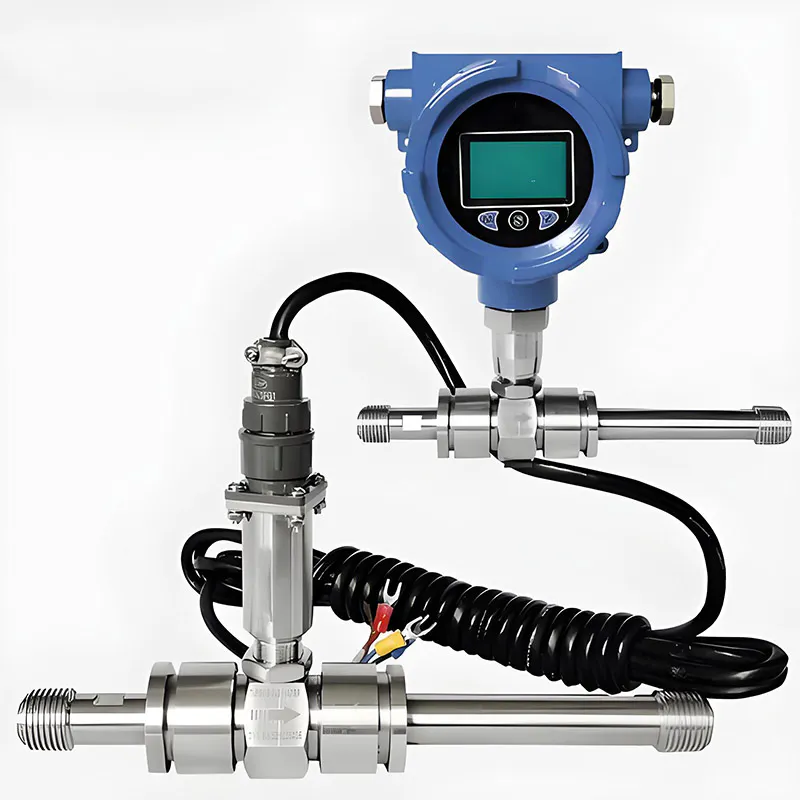
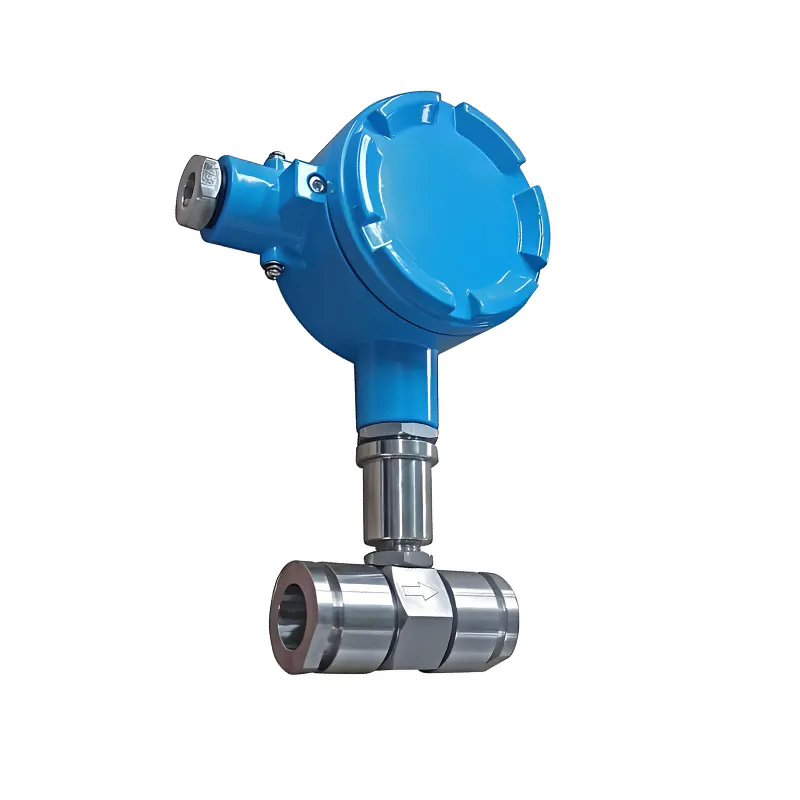
Turbine flow meter with inline stainless steel body and pulse sensor for liquid flow measurement
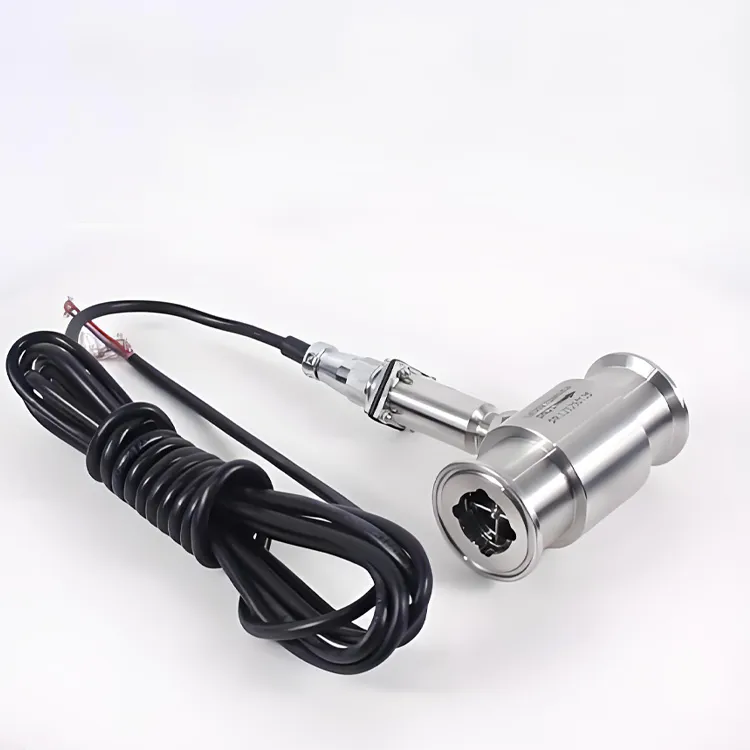
Compact turbine flow sensor with cable for industrial liquid flow measurement

Flowmeter Turbine-Typical Applicable Media

PTF 125 is suitable for clean liquids compatible with stainless steel materials, including:

  • Water and demineralized water

  • Light oils and lubricants

  • Fuel oils and hydrocarbons

  • Other low-impurity industrial liquids

Note:

  • Free from fibers, particles, or solid impurities

  • Recommended viscosity ≤ 5 × 10⁻⁶ m²/s

  • Higher-viscosity liquids require calibration with the actual process fluid

Turbine Flowmeter-Working Principle

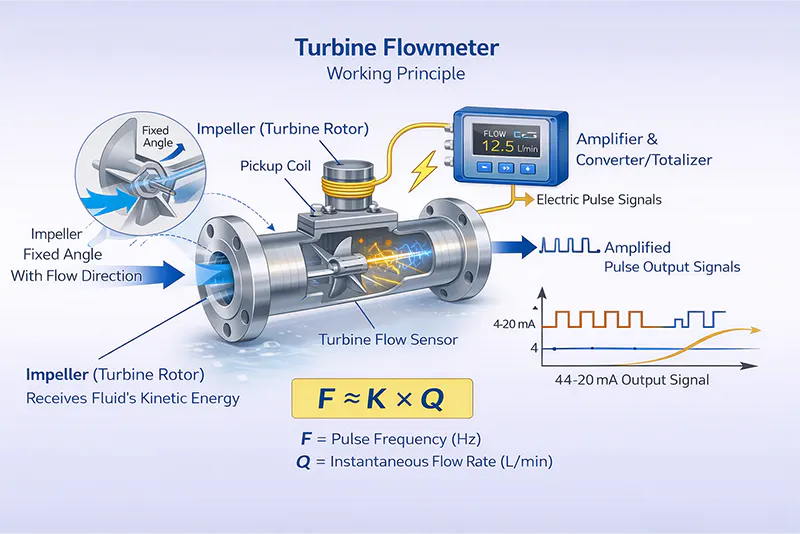
When the measured liquid flows through the turbine flow sensor, the impeller blades—mounted at a fixed angle to the flow direction—receive kinetic energy from the fluid.

As the impeller rotates, it reaches a stable speed once fluid driving torque, friction torque, and resistance torque are balanced. Under defined conditions, the rotational speed of the impeller is directly proportional to the average flow velocity inside the pipe.

Each rotation of the impeller periodically changes the magnetic field at the detection coil, generating an electrical pulse signal. After amplification and signal processing, the system outputs:

  • Pulse signal

  • 4–20 mA analog signal

  • Instantaneous flow rate

  • Totalized flow

Within the calibrated flow range, the relationship between pulse frequency and flow rate is:

Within the calibrated flow range, the pulse frequency is directly proportional to the instantaneous flow rate:

Q = 3600 × F / K

Where:

  • Q — Instantaneous flow rate (m³/h)
  • F — Pulse frequency (Hz)
  • K — Instrument coefficient (pulses/m³), determined during calibration
Turbine flow meter working principle diagram showing rotor, pulse signal, and 4–20 mA output
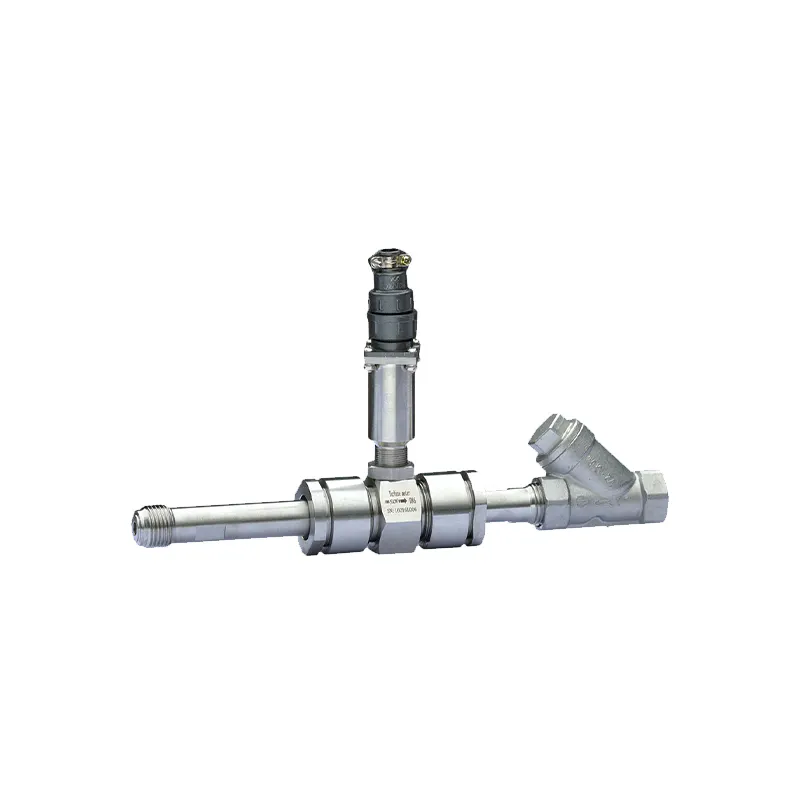
turbine flowmeter with stainless steel body for industrial liquid measurement

Pulse Output Intelligent Turbine Flowmeter Design

The intelligent pulse output module enables direct signal transmission to control and monitoring systems:

  • Power Supply Options: +12 VDC or +24 VDC

  • Signal Type: Square-wave pulse

  • Transmission Distance: ≤ 300 m

  • Output Amplitude:

    • ~10 V at +12 V supply

    • ~20 V at +24 V supply

Raccordement électrique

  • Red wire: Power supply positive

  • White wire: Sortie d'impulsion

  • Black wire: Ground

The amplifier is directly mounted to the turbine sensor via M16 × 1.0 threaded connection, ensuring compact installation and reliable signal integrity.

  Paramètres du débitmètre  

ObjetSpécifications
ModèlePTF 125
Diamètre nominalDN6 ~ DN200
MoyenClean liquids (water, oil, etc.)
Viscosity Range5 ~ 400 mPa·s
Température de fonctionnement-20 ~ 120 ℃
Pression nominalePN16 ~ PN63
Plage de débit≤ 1200 m³/h
Classe de précision0.5 / 1.0 / 1.5
Body MaterialSS304 / SS321 / SS316L
Impeller Material2Cr13 / Duplex Stainless Steel
Température ambiante-20 ~ 60 ℃
Ambient Humidity5 ~ 90% RH
Sortie du signalPulse / 4–20 mA / RS485 / HART
Alimentation électrique24 VDC ±15%
Battery Option3.6 V Li-battery 10 Ah (no signal output)
AntidéflagrantEx dⅡBT4
Protection GradeIP65
Interface électriqueM20 × 1.5
Connexion au processusFlange or Thread
InstallationHorizontal

  Instrava OEM/ODM

Pourquoi choisir Instrava ?

From Specification Matching to Long-Term Field Support

At Instrava, customization is not limited to parameter selection — it is about ensuring measurement reliability throughout the entire lifecycle of the application.

Customized to Process Reality

Instrava works closely with customers to tailor turbine flow meter configurations based on actual operating conditions, including:

  • Medium viscosity range and flow stability

  • Required pulse output level, frequency range, and signal interface

  • Nominal diameter, pressure rating, and material compatibility

  • Explosion-proof and environmental protection requirements

Each customized configuration is validated to ensure accurate pulse output and stable performance under real process conditions.

Engineering-Level Service & On-Site Support

Beyond product delivery, Instrava provides:

  • Application consulting and meter selection guidance

  • Installation orientation and signal wiring recommendations

  • Support for calibration, commissioning, and signal integration

  • Long-term technical support for maintenance and performance optimization

Instrava positions itself not only as a supplier, but as a trusted long-term partner supporting customers and OEMs across China in safety-critical and process control applications.

symbolisant la confiance et le début d'un partenariat à long terme

  Recommandations de produits connexes  

Turbine flow meters perform best with low to medium viscosity liquids. As viscosity increases, fluid drag on the impeller rises, which can reduce rotational speed and impact accuracy. For higher-viscosity media, calibration using the actual process fluid is recommended to maintain reliable measurement.

The pulse output frequency is directly proportional to the instantaneous flow rate. Each pulse represents a fixed volumetric increment defined by the meter factor (K-value), making pulse output ideal for batching, totalizing, and PLC-based control systems.

Yes. Pulse output signals can typically be transmitted up to 300 meters, depending on wiring quality and electromagnetic environment. Proper grounding and shielded cables are recommended to ensure signal integrity in industrial installations.

Turbine flow meters must be installed in the correct flow direction and typically in horizontal pipelines. Incorrect orientation can affect impeller rotation stability, leading to inaccurate pulse output and reduced repeatability.

Turbine flow meters require clean liquids without fibers or solid particles. Particulates may damage the impeller or interfere with rotation, causing signal fluctuation or long-term wear.

Yes. Pulse output is widely used for instantaneous flow measurement, total flow accumulation, batching control, and system verification, making it highly compatible with PLC, DCS, and industrial automation systems.

Pourquoi choisir Instrava ?

En choisissant Instrava, vous bénéficiez d'un partenaire ayant une connaissance approfondie des applications industrielles et l'expertise nécessaire pour relever les défis opérationnels d'aujourd'hui.
Notre rôle va au-delà des produits - nous soutenons votre réussite grâce à des solutions fiables et à un engagement à long terme.

L'innovation par l'ingénierie

L'innovation chez Instrava est guidée par les exigences industrielles réelles. Nous affinons continuellement nos technologies pour répondre aux défis opérationnels en constante évolution, en garantissant des performances pratiques et fiables dans des environnements exigeants.

Personnalisation en fonction de l'application

Nous offrons une personnalisation au niveau de l'ingénierie pour répondre aux conditions spécifiques du processus. De la plage de mesure et des matériaux aux signaux de sortie et aux options d'installation, nos solutions sont configurées pour s'adapter aux applications réelles.

Une qualité et une fiabilité éprouvées

La qualité et la fiabilité sont fondamentales pour chaque produit Instrava. Fabriqués sous un contrôle de qualité strict et testés de manière approfondie, nos instruments offrent des performances précises, stables et à long terme.

Une capacité mondiale avec un soutien local

Instrava associe une expertise technique mondiale à un support local réactif, garantissant à nos partenaires une technologie alignée au niveau international et un service régional opportun.

Un portefeuille de produits complet

Notre large gamme d'instruments de mesure et de contrôle nous permet de répondre à un grand nombre de besoins industriels, en fournissant des solutions intégrées à partir d'une source unique et fiable.

Soutien technique axé sur les partenaires

Nous travaillons en étroite collaboration avec nos partenaires, de la consultation technique à l'assistance après-vente. Notre objectif est de fournir des solutions qui créent une valeur durable et soutiennent le succès opérationnel à long terme.


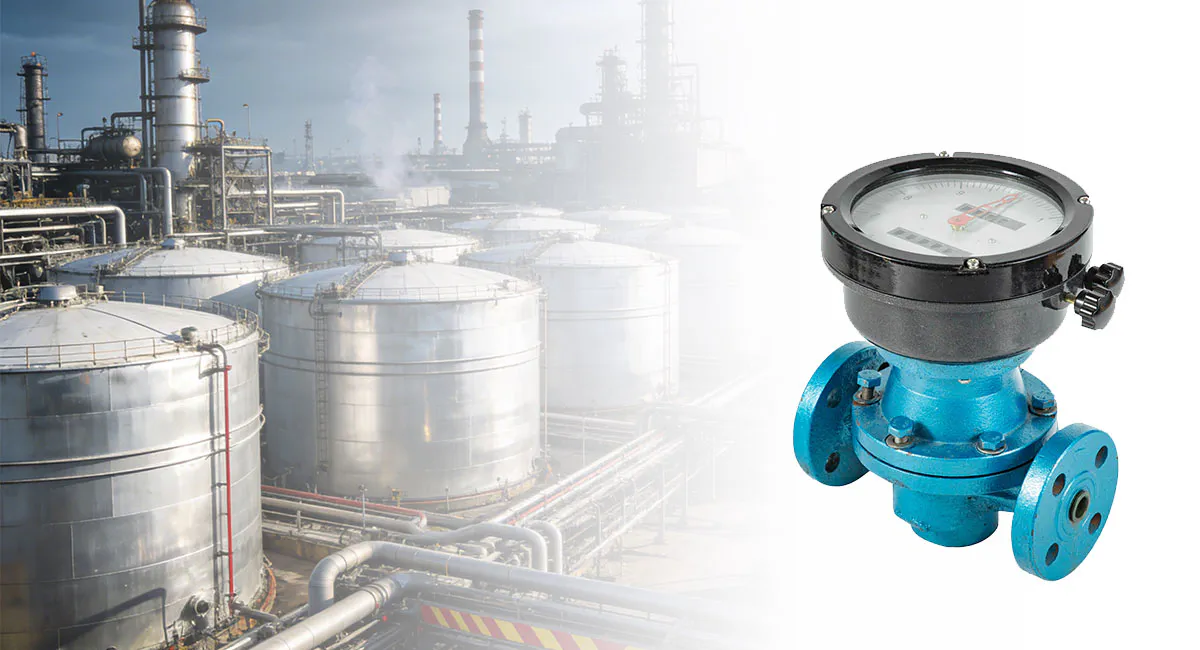
Débitmètre à engrenage ovale : Pourquoi il domine toujours la mesure des débits de haute viscosité dans l'automatisation moderne

  • Par Instrava
  • 28 janvier 2026

La persistance tranquille des débitmètres à engrenage ovale À une époque où les capteurs intelligents, les jumeaux numériques et les instruments pilotés par l'IA dominent...

  • 2Min Lire

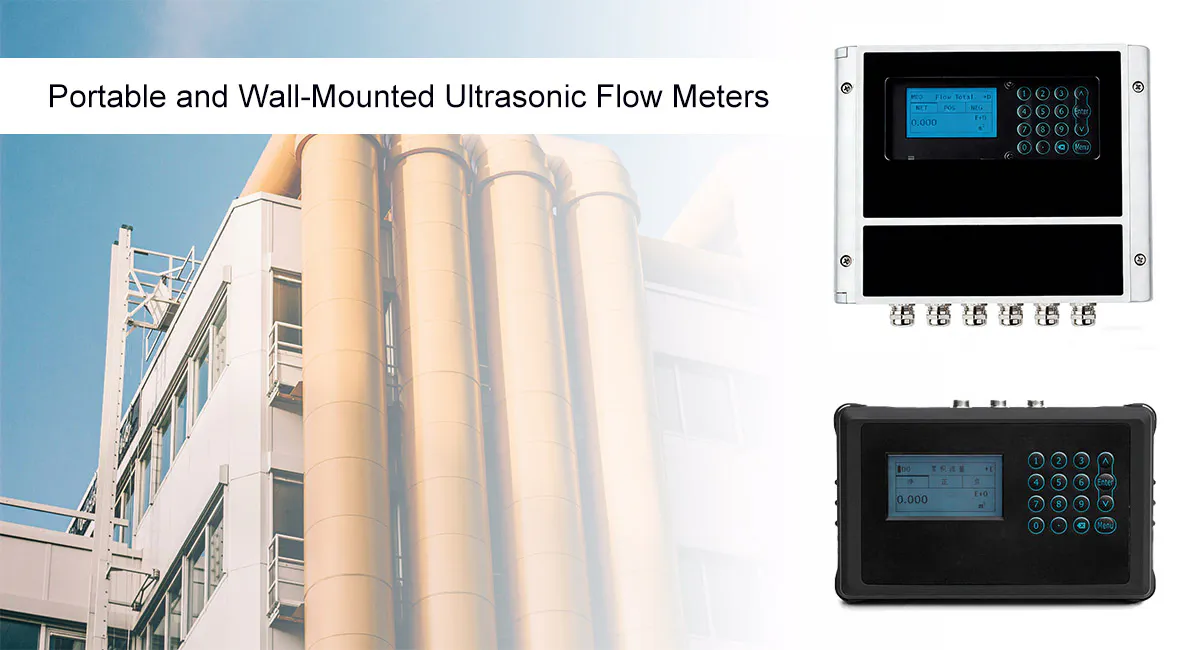
Débitmètres portables à ultrasons - Mesure précise du débit industriel

  • Par Instrava
  • 22 janvier 2026

Débitmètres portables à ultrasons - Mesure précise du débit industriel | Instrava Débitmètres portables à ultrasons Vue d'ensemble Débitmètres portables à ultrasons...

  • 40 minutes de lecture

Comment choisir entre un débitmètre à ultrasons portable et un débitmètre à ultrasons mural pour les applications industrielles ?

  • Par Instrava
  • 22 janvier 2026

Dans les environnements industriels où il n'est pas possible d'arrêter un pipeline, de couper une conduite ou d'interrompre un processus, la mesure non intrusive du débit est devenue...

  • Lecture minimale
Accueil
Produits
Whatsapp