







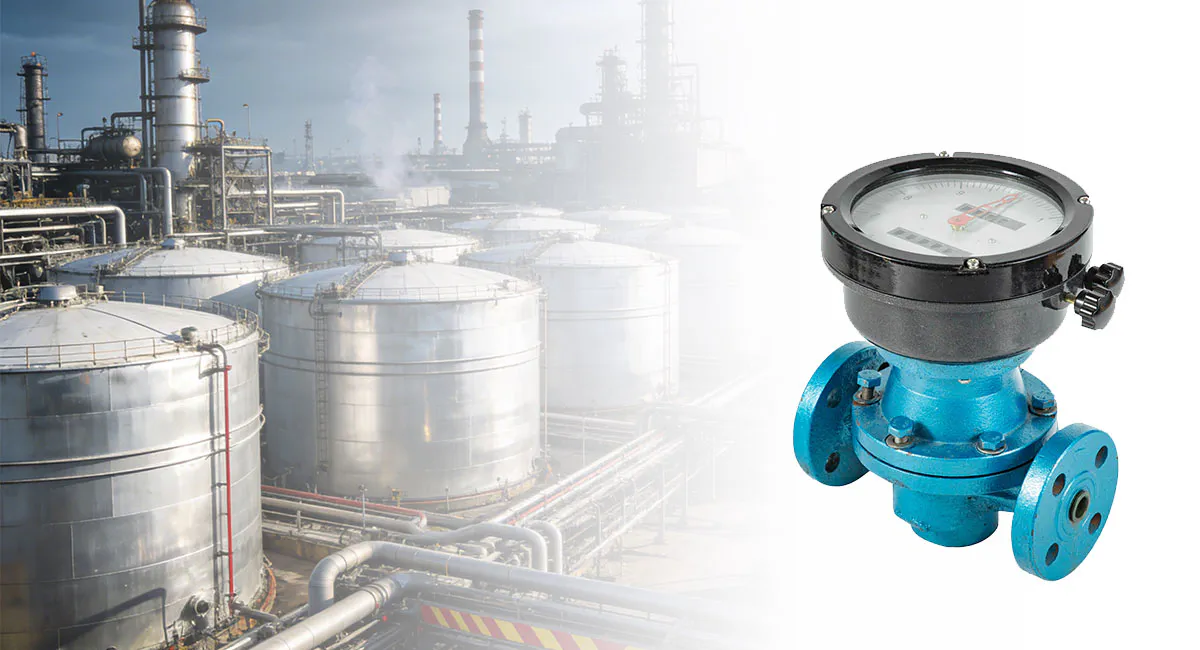
Oval Gear Flow Meter: Why It Still Dominates High-Viscosity Flow Measurement in Modern Automation
The Quiet Persistence of Oval Gear Flow Meters
In an era where smart sensors, digital twins, and AI-driven instrumentation dominate industry conversations, oval gear flow meter technology continues to hold its ground—especially in applications involving viscous, lubricating, or difficult fluids.
This persistence is not accidental. Oval gear flow meters solve a class of measurement problems that newer technologies often struggle to address consistently. Rather than competing on innovation hype, they compete on process certainty.
Why Viscosity Still Breaks “Advanced” Flow Technologies
Modern flow measurement solutions perform exceptionally well under ideal conditions. However, viscosity remains one of the most disruptive variables in industrial flow measurement.
As fluid viscosity increases:
Flow profiles become unpredictable
Reynolds numbers fall outside ideal ranges
Turbulence-based assumptions collapse
Signal linearity deteriorates
Oval gear flow meter designs bypass these limitations entirely by relying on direct volumetric displacement, making them inherently immune to many viscosity-driven uncertainties.
Oval Gear Flow Meter as a Volumetric Truth Source
Unlike inferred flow technologies, an oval gear flow meter does not estimate flow based on velocity, pressure loss, or signal interpretation. Instead, it physically segments the fluid into known volumes.
Each rotation of the oval gears represents a fixed, repeatable quantity of fluid. This makes the meter function as a volumetric truth source within the system.
For modern automation architectures, this characteristic is increasingly valuable:
It simplifies control logic
Reduces reliance on compensation algorithms
Enhances data confidence for batch and custody-related processes
Stability Over Speed: A Modern Engineering Trade-Off
Many contemporary systems prioritize response speed and high-frequency sampling. However, in viscous media applications, stability matters more than speed.
Oval gear flow meters provide:
Smooth pulse output
Minimal signal noise
Predictable dynamic behavior
This stability reduces controller overreaction and improves long-term system behavior, particularly in dosing, blending, and injection systems.
Digital Output Does Not Mean Digital Reliability
Digital communication protocols are often mistaken for better measurement. In reality, digital reliability depends entirely on the quality of the underlying signal.
Oval gear flow meters generate inherently stable mechanical signals that translate exceptionally well into:
Pulse outputs
Frequency-based transmitters
Integrated digital counters
This makes them highly compatible with modern PLC and DCS environments without requiring heavy signal filtering.
Where Oval Gear Flow Meters Quietly Outperform Alternatives
Oval gear flow meter technology remains the preferred choice in industries where other flow meters introduce uncertainty:
High-viscosity oils and fuels
Resins, polymers, and adhesives
Chemical additives and dosing systems
Hydraulic oil monitoring
Food-grade syrups and concentrates
In these applications, repeatability and confidence often outweigh theoretical accuracy advantages offered by more complex sensors.
Customization Is No Longer Optional
Modern industrial systems demand flexibility. Today’s oval gear flow meter is rarely a one-size-fits-all device.
Customization trends include:
Specialized materials for corrosion or wear resistance
Custom gear clearances for specific viscosity ranges
Explosion-proof or hygienic certifications
Tailored signal outputs for OEM integration
This adaptability is a major reason oval gear flow meters continue to be integrated into new system designs rather than phased out.
Oval Gear Flow Meter in Automated Dosing and Batching
Automation success depends on predictable behavior, not just precise numbers.
In batching systems, oval gear flow meters:
Deliver consistent pulse-to-volume relationships
Maintain accuracy across wide viscosity changes
Enable reliable batch cut-off control
As batch accuracy directly impacts yield and waste, the mechanical certainty of oval gear flow meter technology remains highly valued.
Maintenance Predictability as a Design Advantage
From a lifecycle perspective, oval gear flow meters offer another overlooked benefit: maintenance transparency.
Wear progression is gradual and measurable. When performance changes occur, they tend to be predictable rather than sudden. This allows maintenance teams to:
Plan interventions
Avoid unexpected downtime
Extend operational lifespan
In contrast, electronic-heavy sensors often fail abruptly, offering less warning before system disruption.
The Role of Oval Gear Flow Meter in OEM Systems
OEM manufacturers increasingly seek measurement technologies that:
Integrate easily
Require minimal field calibration
Maintain consistent performance across global installations
Oval gear flow meters meet these requirements well, which is why they remain common in packaged skids, fueling systems, lubrication units, and chemical injection modules.
Why Oval Gear Flow Meter Technology Aligns With Industry 4.0 Realities
Industry 4.0 emphasizes data reliability over data volume. Clean, interpretable data feeds analytics far more effectively than noisy, complex signals.
Oval gear flow meter outputs provide:
Clear volumetric correlation
Low signal ambiguity
High trust in long-term trend analysis
This makes them surprisingly compatible with modern digital transformation goals.
Not Old Technology—Focused Technology
Labeling oval gear flow meters as “traditional” misses the point. They are not legacy solutions waiting to be replaced; they are focused tools optimized for specific challenges.
Where viscosity, lubrication, and flow stability dominate the problem space, oval gear flow meter designs remain unmatched.
Conclusion: Why Engineers Still Choose Oval Gear Flow Meters
Engineering decisions are rarely about novelty. They are about reliability, predictability, and total system performance.
Oval gear flow meters continue to deliver:
Volumetric certainty
Signal stability
Customization flexibility
Long-term reliability
In modern automated systems, those attributes remain as relevant as ever.