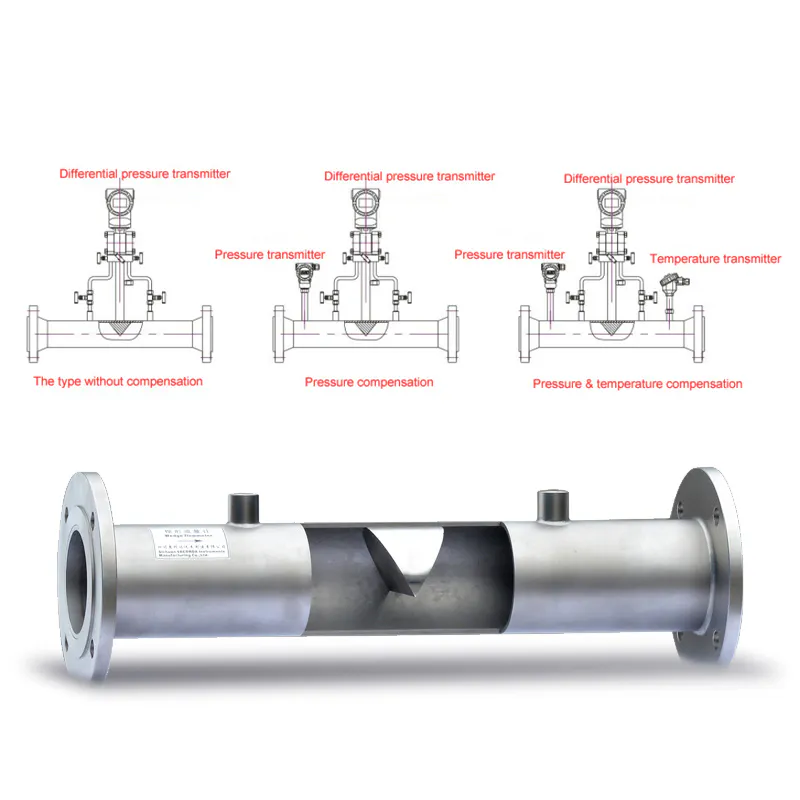
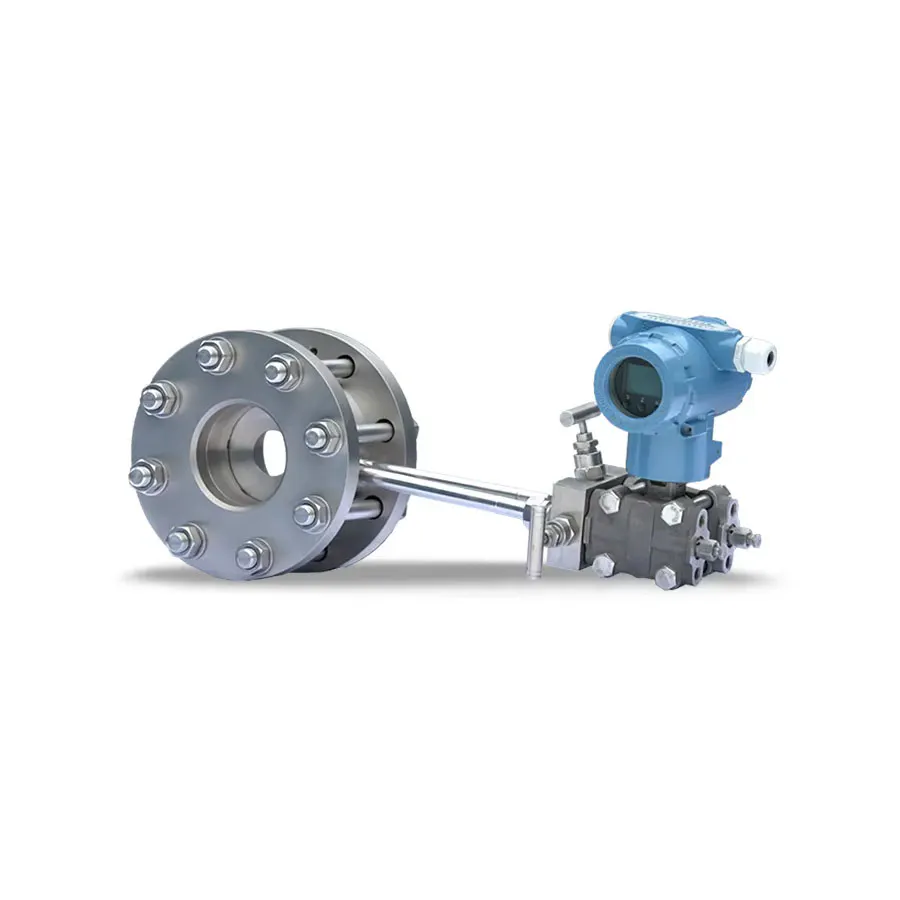
The wedge flow meter operates on the same differential pressure measurement principle as traditional orifice plates and Venturi flow meters, based on the Bernoulli equation and the law of conservation of mass.When fluid flows through a throttling element, a differential pressure is generated,which is proportional to the square of the flow rate.
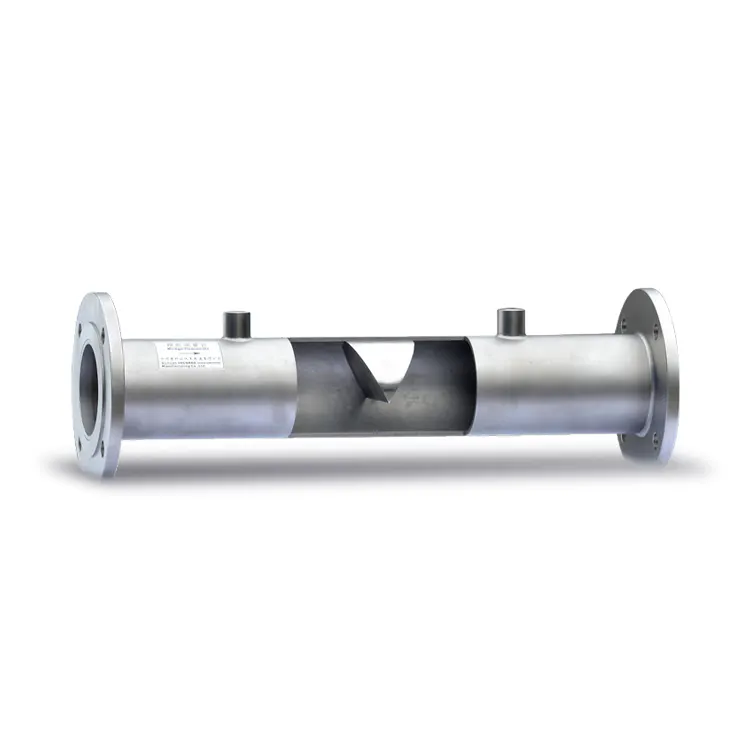
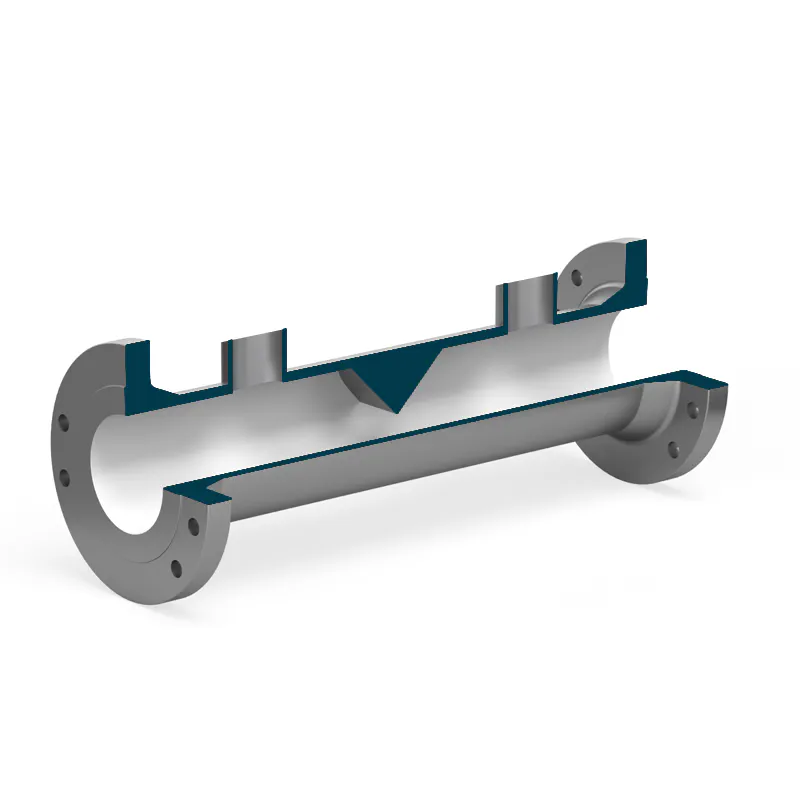
The sensing element of the wedge flow meter is a V-shaped wedge throttling element.Its rounded downstream edge and special geometry effectively reduce upstream vortex formation,prevent particle accumulation, and avoid blockage when measuring high-viscosity, dirty, slurry, or particle-laden media.
As the fluid passes through the wedge, a stable differential pressure is produced.The square root of the differential pressure is directly proportional to volumetric flow rate or mass flow rate.The measuring range is determined by the ratio of the wedge height H to the pipe inner diameter D (H/D ratio).
Flow Calculation Formula
Volume flow rate:
qv =
C · ε · m · (πD2 / 4) · √(2ΔP / ρ) / √(1 − m2)
Parameter Definitions
- qv – Volume flow rate (m³/s)
- C – Flow coefficient
- ΔP – Differential pressure (Pa)
- ε – Expansion factor
- D – Inner diameter of pipe (m)
- ρ – Fluid density (kg/m³)
- m – Throttle area ratio
Throttle Area Calculation
m = S1 / (πD2 / 4)
Arch flow area (S1):
S1 = 1/2 · r · l − x · (r − h)
x = 2√[h(2r − h)]
l = 0.01745 · r · α
Thanks to its stable differential pressure signal and anti-clogging structure,the wedge flow meter maintains long-term measurement stability of up to
±0.1% F.S/year, making it an ideal solution for the most challenging industrial flow measurement applications.