Wedge Flow Meter

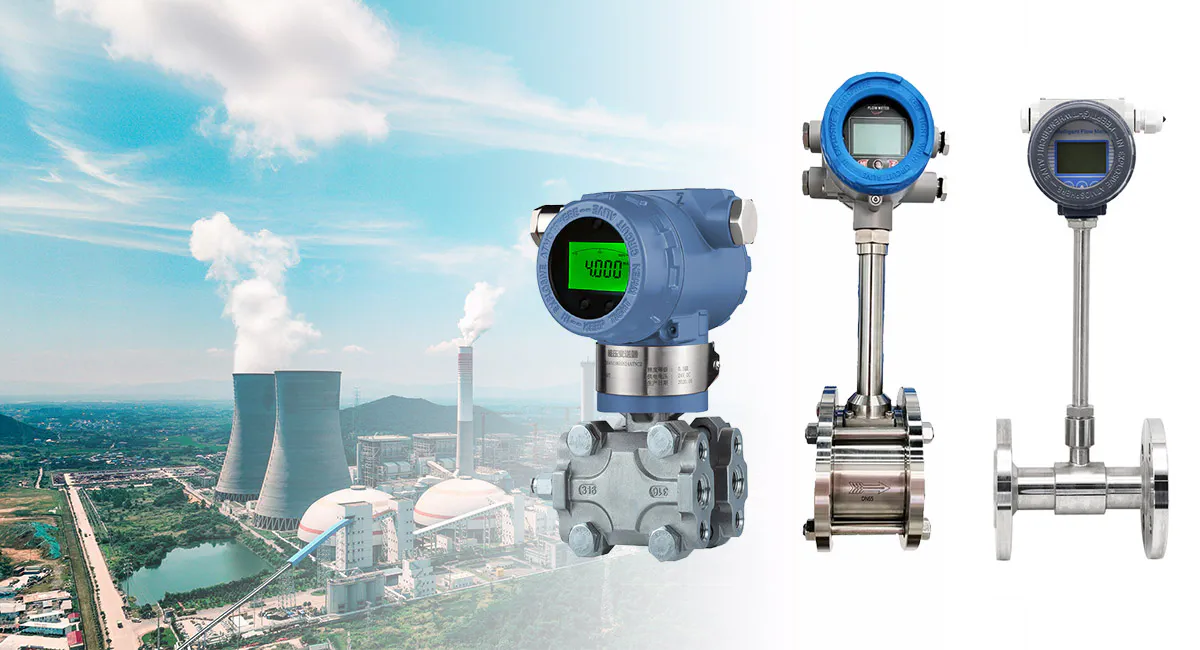
The wedge flow meter is a differential pressure flow measurement instrument designed for accurate and stable flow measurement under harsh industrial conditions. It integrates a wedge-type flow sensor with a differential pressure transmitter to provide reliable performance for complex process applications.

It is especially suitable for measuring city gas and natural gas with large flow fluctuations, where flow rates may vary significantly over time. It also effectively solves flow measurement challenges for high-viscosity media such as pitch, asphalt, residual oil, and paraffinic oil.

With its simple structure, strong resistance to clogging, and stable differential pressure signal, the wedge flow meter performs reliably in corrosive, dirty, and slurry applications, including saturated or crystallizing acidic, alkaline, and saline liquids.

The wedge flow meter is ideal for extreme conditions, supporting Reynolds numbers as low as 500 and fluid viscosities up to 500 mPa·s, offering a low-maintenance and cost-effective solution for industrial flow measurement.

Flow Meter Description  

Optimized Product Features 1 – Wedge Flow Meter

  • High accuracy and excellent stability
    Measuring accuracy up to ±0.5% F.S, with long-term stability of ±0.1% F.S/year, ensuring reliable and repeatable flow measurement.

  • Simple and robust structure with long service life
    The wedge-shaped flow sensor features a proven differential pressure design. After strict testing and calibration, the service life can reach up to 10 years, enabling up to 5 years of maintenance-free operation.

  • Wide measuring range
    Standard turndown ratio of 1:25, expandable to 1:33, and up to 1:100 with differential pressure adjustment, suitable for applications with large flow variations.

  • Wide application range for complex media
    Suitable for single-phase fluids as well as two-phase media (gas–liquid, gas–solid, liquid–solid). Operates with Reynolds numbers as low as 300 and up to 1×10⁷.

  • Anti-adhesion and non-clogging design
    The special wedge structure and smooth measuring pipe prevent adhesion, deposition, and clogging by silt, powder, suspended solids, and fibers, ensuring long-term measurement accuracy.

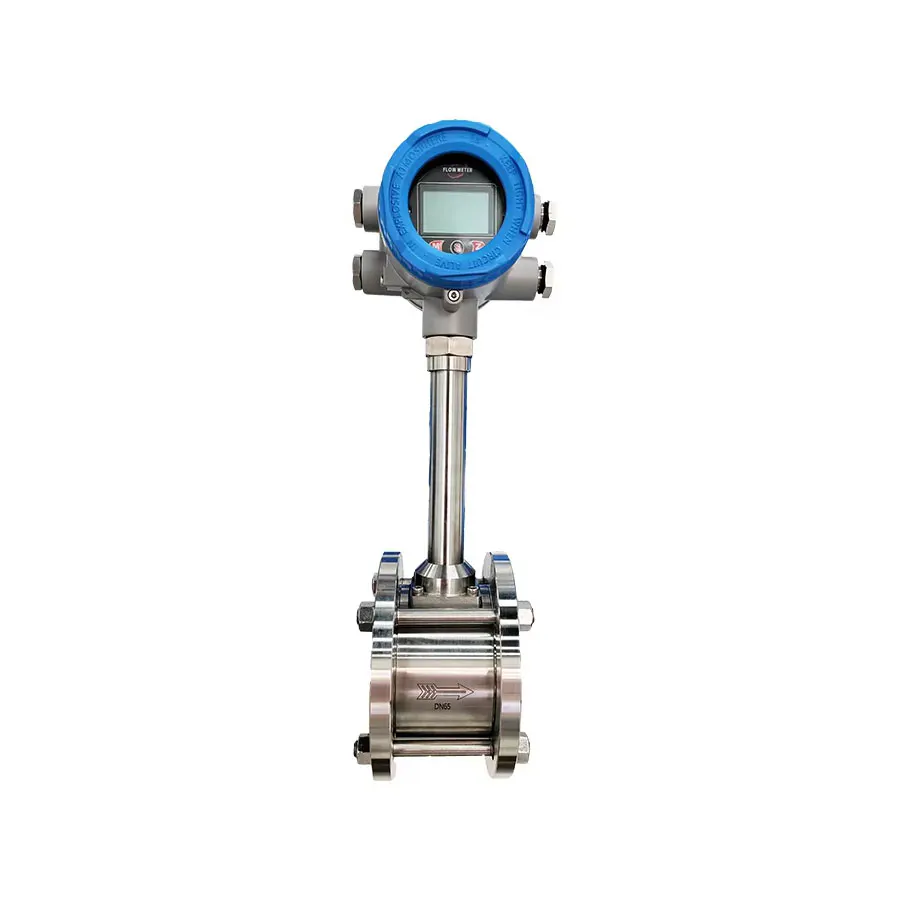
V-Cone flow meter manufacturer differential pressure flow meter
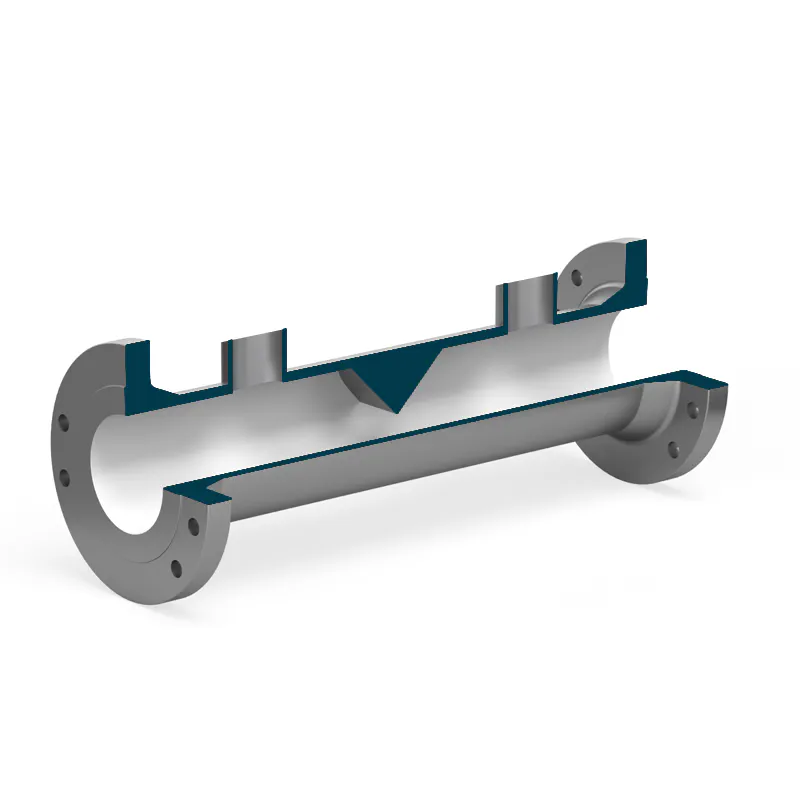
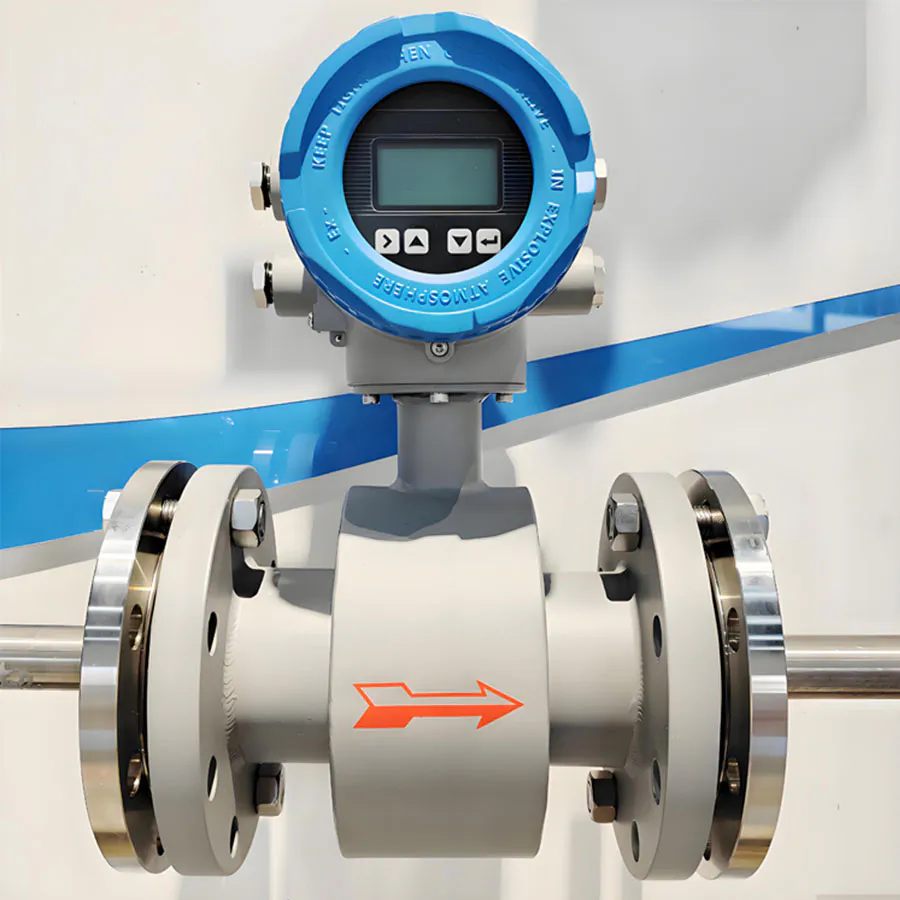
V-Cone flow meter internal structure manufacturer

Optimized Product Features 2 – Wedge Flowmeter

  • Integrated installation design
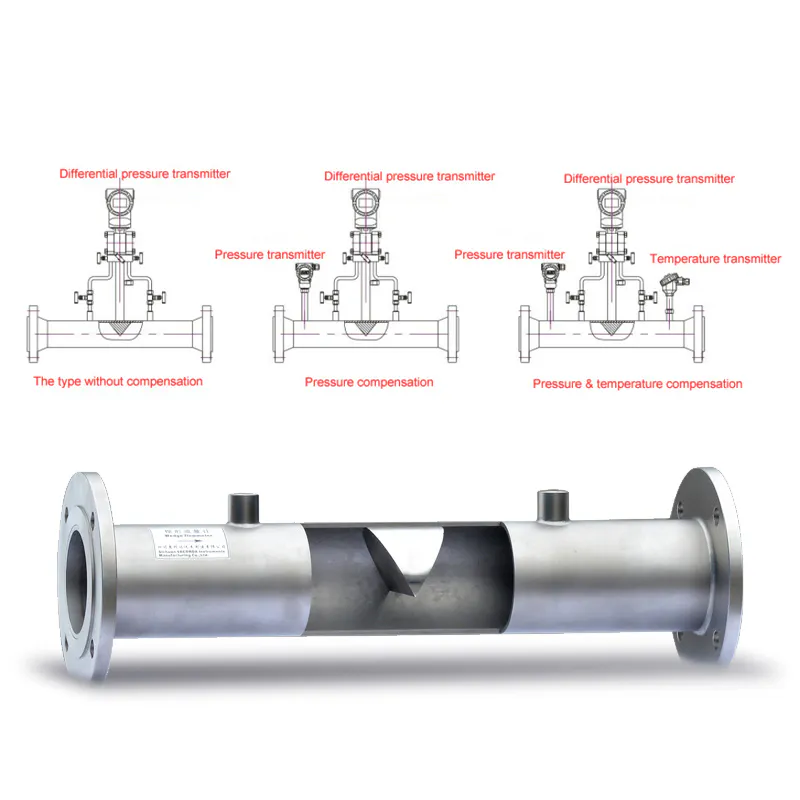
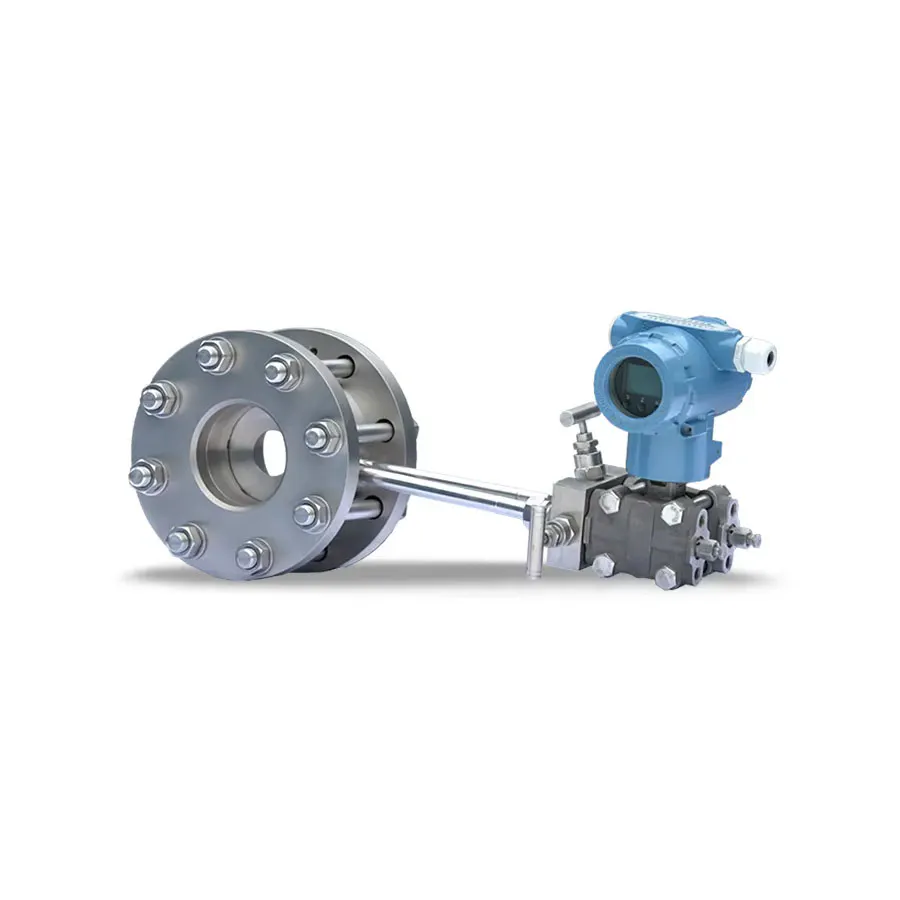
    Integrates the wedge sensor, three-valve manifold, and differential pressure transmitter into a single unit, eliminating impulse lines and fittings, simplifying installation, and improving measurement accuracy.

  • Intelligent and configurable
    Supports HART and other communication protocols for parameter configuration. Enables automatic adjustment of differential pressure based on medium changes and supports multi-parameter measurement, including differential pressure, volumetric flow, mass flow, pressure, and temperature, with full temperature compensation.

  • Low straight pipe length requirement
    Requires minimal upstream and downstream straight pipe lengths, effectively reducing installation uncertainty and improving measurement reliability.

  • Low permanent pressure loss
    Optimized flow structure minimizes pressure loss, helping reduce energy consumption and operating costs.

Working Principle of Wedge Flow Meter

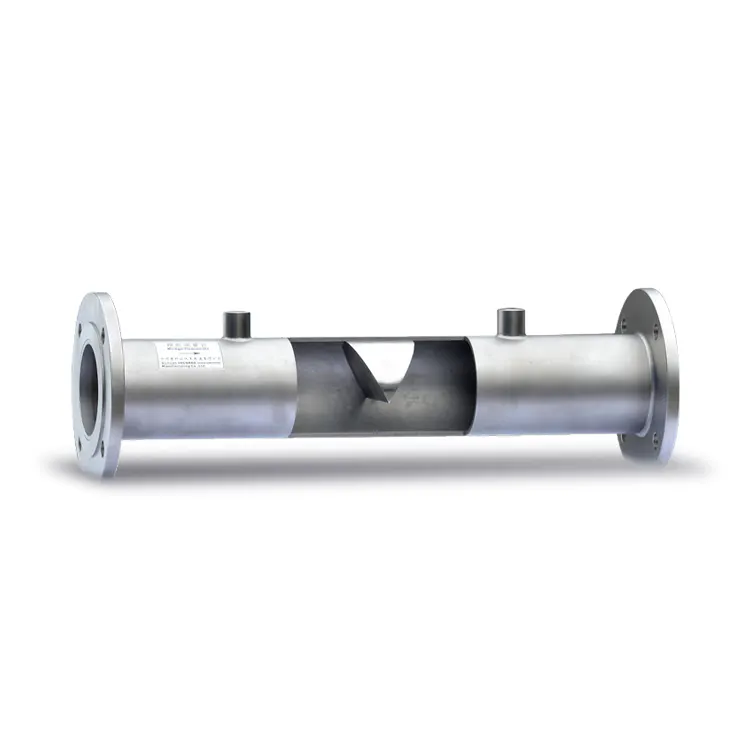
The wedge flow meter operates on the same differential pressure measurement principle as traditional orifice plates and Venturi flow meters, based on the Bernoulli equation and the law of conservation of mass.When fluid flows through a throttling element, a differential pressure is generated,which is proportional to the square of the flow rate.

The sensing element of the wedge flow meter is a V-shaped wedge throttling element.Its rounded downstream edge and special geometry effectively reduce upstream vortex formation,prevent particle accumulation, and avoid blockage when measuring high-viscosity, dirty, slurry, or particle-laden media.

As the fluid passes through the wedge, a stable differential pressure is produced.The square root of the differential pressure is directly proportional to volumetric flow rate or mass flow rate.The measuring range is determined by the ratio of the wedge height H to the pipe inner diameter D (H/D ratio).

Flow Calculation Formula

Volume flow rate:

qv =
C · ε · m · (πD2 / 4) · √(2ΔP / ρ) / √(1 − m2)

Parameter Definitions

  • qv – Volume flow rate (m³/s)
  • C – Flow coefficient
  • ΔP – Differential pressure (Pa)
  • ε – Expansion factor
  • D – Inner diameter of pipe (m)
  • ρ – Fluid density (kg/m³)
  • m – Throttle area ratio

Throttle Area Calculation

m = S1 / (πD2 / 4)

Arch flow area (S1):

S1 = 1/2 · r · l − x · (r − h)

x = 2√[h(2r − h)]

l = 0.01745 · r · α

Thanks to its stable differential pressure signal and anti-clogging structure,the wedge flow meter maintains long-term measurement stability of up to
±0.1% F.S/year, making it an ideal solution for the most challenging industrial flow measurement applications.

V-Cone flow meter working principle manufacturer
V-Cone flow meter installation and compensation options manufacturer

Wedge Type Flow Meter Product Applications

Wedge flow meters are widely used in:

  • City gas and natural gas distribution systems

  • Oil, asphalt, pitch, and residual oil pipelines

  • Chemical and petrochemical processing plants

  • Slurry, sludge, and wastewater treatment systems

  • Steam and condensate measurement

  • Corrosive acid, alkali, and saline fluid measurement

Flow Meter Parameter  

Model: WF 122

ParameterSpecification
Accuracy Class0.5 (0.2 / 0.3 / 0.4 available on request)
Long-term Stability±0.2% F.S / year
Repeatability±0.2%
Applicable MediaLiquids, gases, and steam
Minimum Flow Velocity0.01 m/s
Measuring Range (Turndown Ratio)Standard: 1:25; Maximum: 1:33
Permanent Pressure LossApprox. 1/5 of measuring differential pressure (about 1/3 of an orifice plate)
Reynolds Number Range≥500 to ≤1 × 10⁷
Medium Viscosity≥500 mPa·s
Working Pressure Range–0.1 to 42 MPa
Working Temperature Range–160 °C to 450 °C (up to 700 °C max)
Pipe SizeDN10 to DN1200 (up to DN2500 on request)
Wedge Ratio (h/D)0.2 / 0.3 / 0.4 / 0.5
DP Transmitter Power Supply24 V DC
DP Transmitter Output4–20 mA DC (HART)

Instrava OEM/ODM

Reliable Instruments. Solutions That Fit Your Application.

Instrava is focused on delivering reliable industrial solutions through carefully curated products, application-driven optimization, and flexible customization. We select proven instruments from trusted manufacturers to ensure consistent quality, optimize solutions based on real working conditions to solve practical challenges, and provide tailored configurations to meet specific application needs.

By combining selection expertise with application understanding, Instrava helps customers reduce risk, improve efficiency, and achieve dependable results in complex industrial environments.

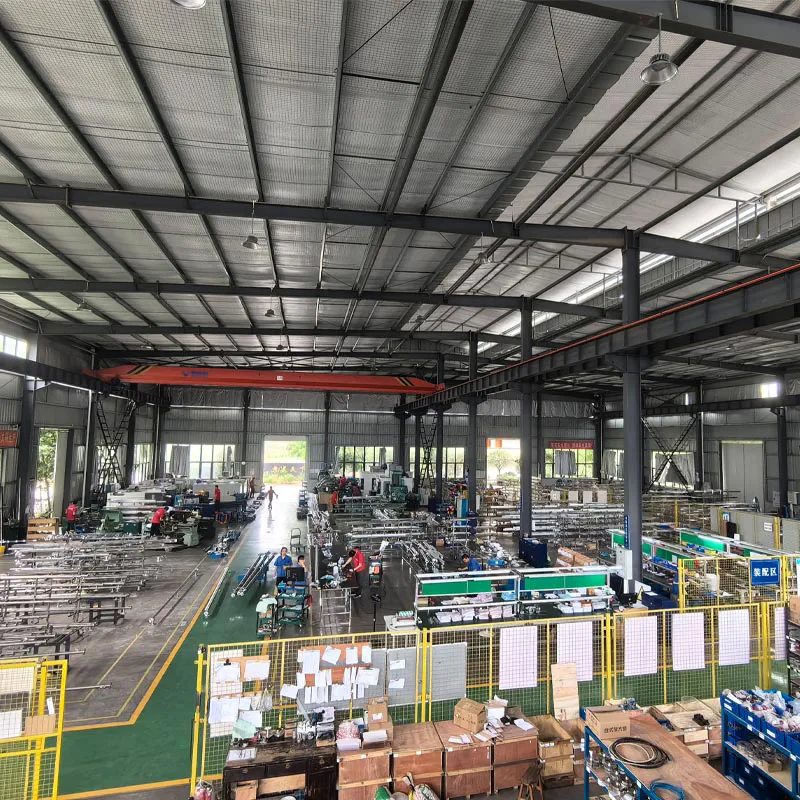
Industrial instrument manufacturer production workshop showing large-scale manufacturing of level gauges and process instruments

Related Product Recommendations  

Wedge flow meters are specifically designed for applications with wide flow variations. With a standard turndown ratio of 1:25 (expandable to 1:33 or higher), they maintain stable differential pressure signals even when flow rates change significantly, making them ideal for city gas, natural gas, and batch processes.

Yes. The wedge flow meter performs reliably with fluid viscosities exceeding 500 mPa·s and supports Reynolds numbers as low as 500. Its wedge-shaped throttling element minimizes flow separation and signal distortion, allowing accurate measurement of high-viscosity, shear-sensitive, and non-Newtonian fluids.

Absolutely. The non-clogging wedge structure prevents the accumulation of solids, fibers, and sediments. This makes wedge flow meters especially suitable for slurry, wastewater, pulp, sludge, and crystallizing chemical media where traditional orifice plates may fail.

A wedge flow meter typically generates only about one-third of the permanent pressure loss of an orifice plate under similar operating conditions. This significantly reduces energy consumption while maintaining accurate differential pressure measurement.

Wedge flow meters require shorter upstream and downstream straight pipe lengths compared to traditional differential pressure flow meters. This makes them well suited for retrofit projects and installations with limited piping space.

Thanks to its robust structure and absence of moving parts, the wedge flow meter requires minimal maintenance. In most applications, it can operate up to 5 years without recalibration, providing long-term stability of ±0.2% F.S/year and reducing total cost of ownership.

Why Choose Instrava

Built on Consistency, Not Claims

Focused on Industrial Applications

We specialize in industrial analysis and detection, with a clear understanding of real-world operating environments and requirements.

Strict Product Selection Criteria

Every instrument is evaluated based on performance, stability, and application suitability—not just specifications or pricing.

Reliable Supply & Quality Consistency

We work with trusted manufacturers to ensure stable supply, consistent quality, and dependable delivery.

Practical, Experience-Based Support

Our recommendations are grounded in application understanding, helping customers avoid common issues and achieve reliable results.

Instrava is built to reduce uncertainty—so every decision you make is clearer, safer, and more reliable.

Industrial measurement scene showing a worker using a precision measuring instrument to measure and mark material on a workbench, demonstrating the practical application of measuring instruments in manufacturing and processing.

Instrumentation is Shifting Toward Orchestration Platforms: What It Means for Industrial Systems

  • By Instrava
  • Apr 3, 2026

Introduction Industrial instrumentation is undergoing a fundamental transformation. Traditionally, instruments such as sensors, transmitters, and analyzers operated as independent devices...

  • 2Min Read

What is “Instrument-as-a-Service” in Industrial Automation?

  • By Instrava
  • Apr 3, 2026

Industrial instrumentation is undergoing a fundamental transformation. Traditionally, instruments were typically deployed as standalone hardware devices—installed, calibrated, and maintained to...

  • 1Min Read

Thermal vs Vortex vs Differential Pressure: How to Choose the Right Flow Measurement Technology

  • By Instrava
  • Feb 25, 2026

Selecting a flow meter is rarely about accuracy alone. In industrial applications, the real challenges include: Variable flow rates Pressure...

  • 1Min Read
Home
Products
Whatsapp
Contact