







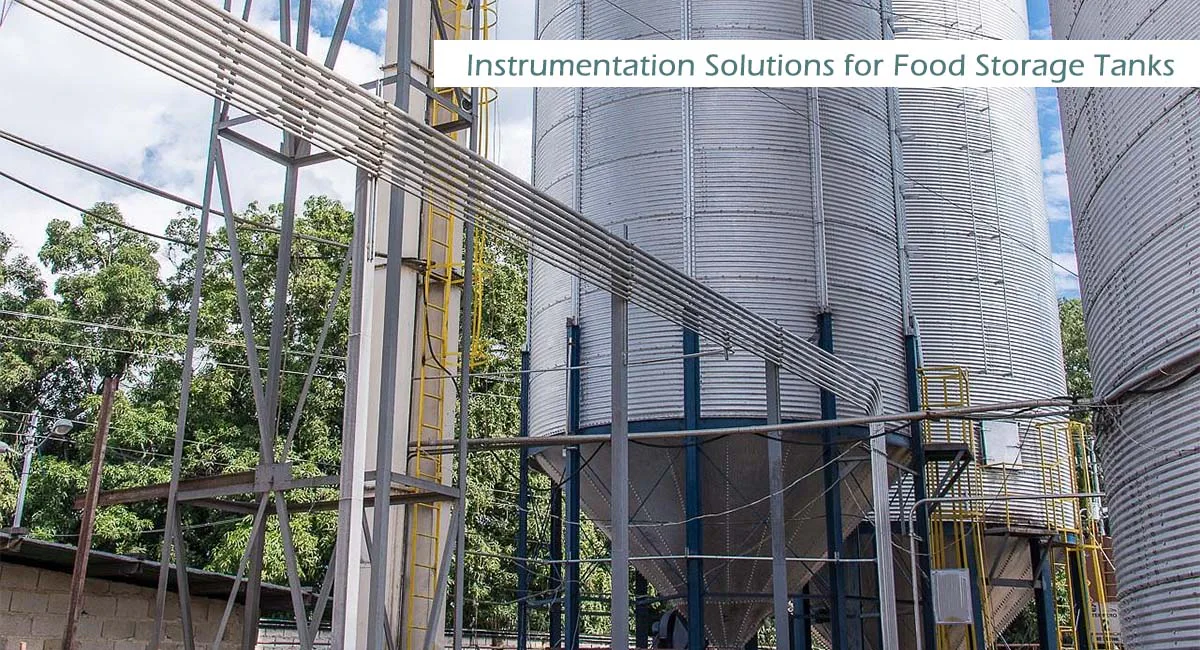
โซลูชันการวัดสำหรับถังเก็บอาหาร
In the food processing industry, the performance, safety, and hygiene of storage tanks are critical to maintaining product quality and operational efficiency. Selecting the right instrumentation ensures accurate monitoring, precise control, and smooth operation. Our company offers comprehensive instrumentation solutions for food storage tanks, designed to deliver reliable performance while meeting strict hygienic standards.
1. Level Measurement Solutions
Accurate liquid level monitoring is essential for tank management and overfill protection. Our recommended solutions include:
- Hygienic Radar Level Meters – Non-contact 80GHz radar sensors ideal for foam, vapor, or turbulent surfaces. Tri-clamp connections and FDA-compliant 316L stainless steel ensure food safety.
- เซ็นเซอร์วัดระดับด้วยคลื่นอัลตราโซนิก – Cost-effective option for clear liquids, with adjustable blind zones and compact design.
- Vibrating Fork Level Switches – Point-level switches for high and low level alarms, providing reliable safety protection.
Benefits: Precise level monitoring, easy installation, and fully compatible with CIP/SIP cleaning processes.
2. Temperature Monitoring Solutions
Maintaining correct temperature is vital for product quality, fermentation, and cleaning processes. We offer:
- RTD Temperature Transmitters (Pt100/Pt1000) – High-accuracy sensors with hygienic Tri-clamp connections.
- Integrated or Remote Transmitters – Flexible probe lengths for different tank sizes and installation types.
Benefits: Real-time temperature control, precise process monitoring, and compliance with food-grade hygiene standards.
3. Pressure Monitoring Solutions
Monitoring tank pressure ensures safety and prevents damage in sealed or fermentation tanks. Recommended instruments include:
- Flush Diaphragm Pressure Transmitters – Hygienic design compatible with food liquids and CIP/SIP cleaning.
- Gauge and Vacuum Pressure Sensors – Ideal for maintaining optimal conditions in storage and processing tanks.
Benefits: Protects tanks from overpressure, provides accurate process monitoring, and maintains product safety.
4. Flow Measurement and Process Analytics
For fully integrated food processing, flow measurement and analytical monitoring are essential:
- เครื่องวัดอัตราการไหลแบบแม่เหล็กไฟฟ้า – Hygienic flow measurement for conductive liquids such as milk, juice, and syrup.
- pH, Conductivity, and Dissolved Oxygen Analyzers – Key for fermentation monitoring and liquid food quality control.
Benefits: Optimizes material usage, improves process control, and ensures consistent product quality.
5. Automation and System Integration
Instrumentation works best when integrated into a control system:
- PLC and SCADA Solutions – Enable real-time monitoring, alarms, and automated control.
- Batch Control and Data Logging – Supports traceability and compliance with food industry regulations.
Benefits: Simplifies operations, enhances safety, and enables data-driven decision-making.
Why Choose Our Solutions?
- Hygienic Design: All instruments are made with สแตนเลสสตีล 316L and FDA-compliant materials.
- Customizable Configurations: Solutions tailored to your tank size, product type, and process requirements.
- Reliable and Accurate: High stability, fast response, and minimal maintenance.
- Seamless Integration: Supports automation, remote monitoring, and traceability.
Hopper Bottom Silo Instrumentation: Complete Guide for Level, Temperature & Flow Monitoring
Hopper bottom silos are widely used in industries such as agriculture, feed processing, and bulk material storage. Designed with a conical bottom, these silos ensure smooth discharge of granular materials like grain, seeds, and pellets.
However, due to the nature of dry bulk solids, accurate monitoring can be challenging. Dust, uneven material surfaces, and flow blockages all impact measurement reliability.
Why Instrumentation Is Critical for Hopper Bottom Silos
Without proper monitoring, silo operations may face:
- Overfilling and material loss
- Empty silo conditions disrupting production
- Material bridging or blockage
- Spoilage due to temperature rise
Installing the right sensors helps operators achieve:
- Real-time inventory visibility
- Safer and more efficient unloading
- Reduced maintenance and downtime
1. Level Measurement for Bulk Materials
Point Level Detection (Essential)
Point level sensors are the most critical instruments for silo safety.
Recommended options:
- Vibrating Fork Level Switch
- สวิตช์ระดับใบพัดหมุน
Typical installation:
- High-level alarm at the top
- Low-level alarm near the discharge outlet
ประโยชน์หลัก:
- Reliable in dusty environments
- Resistant to material buildup
- Low maintenance and long service life
👉 Best for: grain silos, feed silos, and powder/granular storage
Continuous Level Measurement (For Inventory Control)
For larger silos or automated systems, continuous level measurement is recommended.
Common technologies:
- Radar Level Sensor (best choice for dusty conditions)
- เซ็นเซอร์วัดระดับด้วยคลื่นอัลตราโซนิก
- เซ็นเซอร์วัดระดับความจุไฟฟ้า
Important considerations:
- Dust may affect ultrasonic performance
- Uneven material surfaces can impact accuracy
- Proper mounting position is critical for radar sensors
👉 Best for: bulk inventory tracking and smart silo systems
2. Temperature Monitoring in Grain Silos
Temperature monitoring is essential for preventing spoilage, especially in grain storage.
Recommended solution:
- RTD Temperature Sensor (Pt100)
Key features:
- Multi-point temperature detection
- Suitable for deep silo installation
- Dustproof and moisture-resistant
ทำไมมันถึงสำคัญ:
- Detects hot spots early
- Prevents mold and self-heating
- Supports SCADA alarm systems
👉 Best for: grain storage, feed storage, and long-term bulk storage
3. Pressure Monitoring (When Needed)
Most hopper silos do not require pressure measurement unless they are sealed or connected to pneumatic systems.
Use cases:
- Pneumatic conveying systems
- Dust collection systems
- Sealed storage silos
Recommended devices:
- Pressure Transmitter
- Vacuum Pressure Switch
👉 Purpose: protect silo structure and ensure stable air pressure
4. Flow & Discharge Monitoring
For silos equipped with conveyors or discharge systems, flow monitoring improves operational efficiency.
Available solutions:
- Flow sensors
- Radar or ultrasonic level tracking
Benefits:
- Optimize discharge timing
- Improve process automation
- Reduce material handling inefficiencies
5. Anti-Blocking & Safety Enhancements
To maintain smooth material flow, consider adding:
- Silo vibrators or air cannons → prevent bridging
- High/low level alarms → avoid overflow or empty runs
- Temperature alarms → protect product quality
These additions significantly reduce downtime and manual intervention.
Recommended Instrumentation Setup
For most hopper bottom silos, the following configuration is ideal:
Basic Setup (Essential):
- High-level switch
- Low-level switch
- Temperature monitoring system
Advanced Setup (Recommended):
- Radar level sensor
- SCADA system integration
- Optional flow monitoring
How to Choose the Right Silo Instrumentation
Follow this simple selection strategy:
Step 1 – Safety First
Install point level switches and temperature sensors
Step 2 – Improve Visibility
Add continuous level measurement
Step 3 – Automate Operations
Integrate flow monitoring and SCADA systems
Step 4 – Ensure Durability
Choose dustproof, wear-resistant, and low-maintenance devices
สรุป
A complete instrumentation suite for food storage tanks enhances operational efficiency, improves product safety, and simplifies maintenance. Our solutions deliver level, temperature, pressure, flow, and analytical monitoring in a hygienic, customizable, and reliable package.
Contact us today to receive a tailored recommendation for the ideal instrumentation solution for your food storage tanks.