
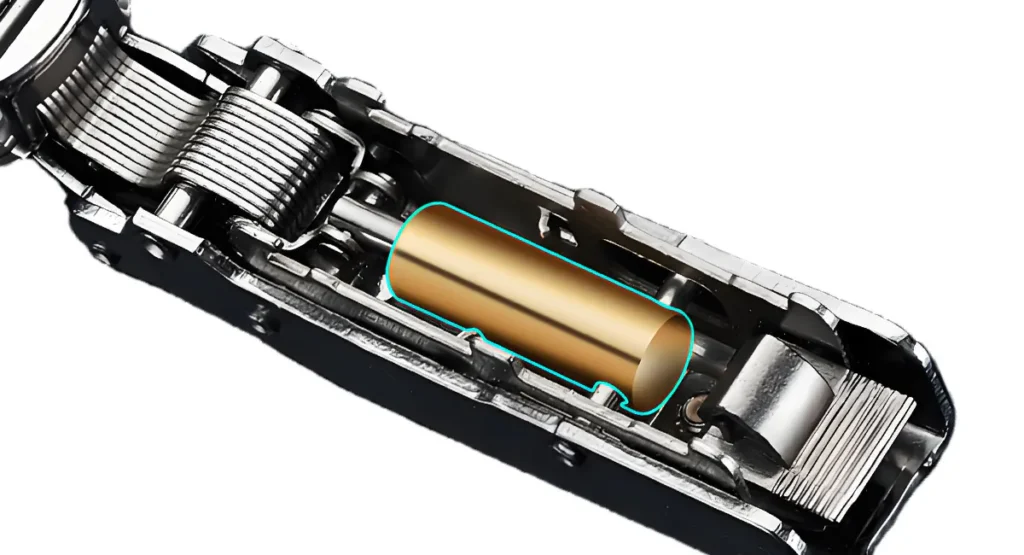
- Integrated Built-in Hydraulic Damping System (Mainstream Integrated Cylinder)
- Core Components
- Operational Mechanism & Workflow
- Key Physical Characteristics
- Hydraulic Damping System-Hinge Force Stages: 1-Stage, 2-Stage, and 3-Stage Hinges
- 1-Stage Force Hinge: The Basic “Simple Opening & Closing” Entry-Level Model
- 2-Stage Force Hinge: The Practical Upgraded Model
- 3-Stage Force Hinge: Premium High-End Engineering
إن Hydraulic Damping System of a hinge is primarily responsible for achieving the self-closing (Soft-Closing) effect, delivering “silent deceleration, impact prevention, and anti-pinch safety.”
Core Principle: It utilizes the viscous resistance generated as hydraulic oil flows through micro-apertures in the piston within a sealed chamber to dissipate the closing kinetic energy of the door panel into thermal energy, thereby achieving soft deceleration and damping during the final closing phase.
Integrated Built-in Hydraulic Damping System (Mainstream Integrated Cylinder)
This represents the most mainstream and refined engineering structure in modern European-style concealed cabinet hinges. The entire damping mechanism is encapsulated inside a miniature cylinder embedded within the hinge arm or hinge cup.
Core Components
-
Hydraulic Cylinder: A sealed container filled with high-stability silicone oil or damping fluid. Serving as the physical housing of the damping system, it is mostly made of brass, aluminum alloy, or stainless steel.
-
Damping Hydraulic Rod: Driven by the rotation of the door panel, its piston surface is engineered with precision micro-apertures (damping orifices).
-
Reset Spring: Provides the initial driving force for door closure, pushing the door panel until the damper is engaged.
-
4-Bar Linkage Mechanism: Connects the door panel to the damper, converting rotational motion into linear piston movement.
Operational Mechanism & Workflow
-
Free-Closing Stage: When the door opening angle exceeds approximately 60°, the reset spring dominates the motion. The damper remains disengaged, allowing the door to close normally with natural acceleration.
-
Damping Trigger Stage: As the door closes to around 60°, the linkage mechanism pushes the piston rod to compress the hydraulic cylinder, forcing the piston against the fluid.
-
Energy Dissipation Stage: The hydraulic oil is forced at high speed through the micro-apertures on the piston. Fluid viscosity creates substantial flow resistance (throttling effect), forcibly reducing the piston’s speed.
-
Energy Conversion Completion: The remaining kinetic energy of the door panel is converted into thermal energy via fluid friction and dissipated, allowing the door to softly rest against the cabinet frame at a constant low speed without impact.
Key Physical Characteristics
-
Speed Dependency: The faster the door closes, the greater the pressure differential created as fluid passes through the micro-apertures, resulting in a stronger damping force that automatically suppresses hard impact.
-
One-Way / Two-Way Control: Standard dampers only buffer during the closing phase. Premium two-way damping systems utilize a check valve structure to restrict fluid flow during opening as well, preventing the door from snapping open too quickly.
-
Temperature Adaptability: High-grade products use specially formulated damping oils to ensure stable viscosity in environments ranging from -10°C to 60°C, preventing freezing at low temperatures or failure at high temperatures.
Hydraulic Damping System-Hinge Force Stages: 1-Stage, 2-Stage, and 3-Stage Hinges
The operational path of the damping system produces distinct mechanical force profiles in cabinet hinges, categorized as 1-Stage, 2-Stage, and 3-Stage Force. This classification serves as a defining metric for hardware quality and engineering grade.
1-Stage Force Hinge: The Basic “Simple Opening & Closing” Entry-Level Model
As the original form of modern hinges, the core characteristic of a 1-Stage hinge is unsegmented force control. It provides only basic opening and closing functions, serving as the entry-level option in residential hardware.
-
Operating Principle: Utilizing a single-sided torsion spring structure, opening the door relies entirely on external physical pushing. Driven by inertia, the door panel swings open “all at once” to its maximum angle and often bounces several times before stabilizing. It lacks a dampening mechanism during closing, relying entirely on manual force control; excessive closing speed causes hard, violent collisions.
-
Core Characteristics:
-
Limited Damping: Damping occurs only weakly around an opening angle of ~45° (or is completely absent in basic models). Small-angle closing offers zero resistance, posing pinch risks and generating noise.
-
Poor Structural Stability: Oscillation forces during door movement transfer directly to the mounting plate screws. Prolonged use leads to screw stripping, loosening, and reduced furniture service life.
-
Unrefined User Experience: Doors swing open abruptly and slam shut loudly, lacking smooth tactile feedback and silent operation.
-
-
سيناريوهات التطبيق: Temporary furniture or infrequently used storage rooms. Unsuited for children’s rooms, kitchens, or safety-critical applications.
2-Stage Force Hinge: The Practical Upgraded Model
A 2-Stage hinge is an optimized evolution of the 1-Stage hinge. By incorporating a damping structure, it achieves segmented force control, balancing practical performance with cost-efficiency, making it the mainstream choice for standard residential applications.
-
Operating Principle: The opening and closing cycle is divided into two distinct mechanical phases, achieving targeted force management via hydraulic dampers or internal springs:
-
Phase 1 ($>45^\circ$, or $60^\circ$ on select models): The door panel can hover freely at various opening angles, allowing easy access to contents without needing to hold the door open manually.
-
Phase 2 ($<45^\circ$): The damping mechanism engages, automatically decelerating the door panel into a soft, smooth closure to prevent frame collisions and noise.
-
-
Core Characteristics:
-
Upgraded Soft-Closing: Eliminates the impact issues of 1-Stage hinges, closing softly and quietly to protect door finishes and cabinet structures.
-
Flexible Operation: Mid-angle stay features fit daily routines—such as opening upper kitchen cabinets without holding the door.
-
Noticeable Limitations: Small-angle operations ($0^\circ–30^\circ$) lack precision buffering and may snap shut quickly under spring tension, presenting a finger-pinch hazard for children and making them less suited for luxury furniture.
-
-
سيناريوهات التطبيق: Standard kitchen cabinets, living room storage units, and bedroom wardrobes. Ideal for lightweight doors with moderate usage frequency—a balanced compromise between performance and budget.
3-Stage Force Hinge: Premium High-End Engineering
3-Stage hinges represent the pinnacle of hinge technology. Building upon 2-Stage functionality, they introduce small-angle advanced damping to achieve full-angle precision force control. Regarded as a breakthrough innovation in residential hardware, they are a primary driver in high-end consumer upgrades.
-
Operating Principle: The opening and closing cycle is engineered into three precise mechanical zones, achieving full-cycle buffering via integrated dampers and dual-spring systems (patented by leading manufacturers):
-
Zone 1 ($90^\circ+$): Zero-resistance open zone. The cabinet door stays effortlessly fully open for large item removal without resistance or binding.
-
Zone 2 ($30^\circ–90^\circ$, or $65^\circ–90^\circ$ depending on model): Free-stop hover zone. Constant tension holds the door stable at any angle for composed handling.
-
Zone 3 ($<30^\circ$, down to $7^\circ$ on top-tier models): Small-angle buffering zone. The damper engages early, guiding the door shut at a uniform, gentle speed to completely eliminate pinch hazards.
-
-
Core Characteristics:
-
Comprehensive Safety: Full-angle buffering—especially at minimal closing angles—is exceptionally friendly for children and the elderly, making it the preferred specification for family homes.
-
Ultimate Tactile Experience: The entire cycle operates smoothly and quietly without wobble or noise, elevating overall furniture quality for high-end custom cabinetry.
-
Superior Durability: Uniform force distribution mitigates impact forces on mounting screws and cabinet structures. Top-grade models pass 100,000-cycle durability tests for long-term reliability.
-
-
سيناريوهات التطبيق: Children’s rooms, master wardrobes, premium kitchen cabinetry, and high-frequency usage zones. Specifically recommended for heavy door panels or custom whole-house furniture where maximum safety, quality, and silent operation are paramount.