

جدول المحتويات
- I. Introduction
- 1.1. What are WPC wall panels?
- 1.2. Classifications
- II. Raw Materials
- 2.1. Thermoplastic Resin Matrix (Polymer Resins: 30%–50%)
- 2.2. Plant Fibers (30%–60%)
- 2.3. Inorganic Fillers (10%–30%)
- 2.4. Functional Additives (5%–10%)
- III. Manufacturing Processes
- 3.1. Raw Material Pre-treatment and Compounding / Granulation
- 3.2. Core Forming & Extrusion Processes
- 3.3. Surface Finishing Processes
- 3.4. Post-Processing & Profile Shaping
- Ⅳ. Classification and Characteristics
- Ⅴ. Instrava’s Strategic Procurement & Supply Chain Solutions
- 5.1. Factory Auditing & Raw Material Traceability
- 5.2. Custom OEM/ODM Capabilities & Pattern Curation
- 5.3. Freight & Container Loading Optimization
I. Introduction
1.1. What are WPC wall panels?
يتم تصنيع ألواح الجدران المصنوعة من مركب الخشب والبلاستيك (WPC) عن طريق خلط ألياف نباتية — مثل دقيق الخشب أو مسحوق الخيزران — مع راتنجات بلاستيكية حرارية (PE، PP، PVC) ومواد مضافة (بما في ذلك عوامل الربط، ومثبطات اللهب، ومثبتات الأشعة فوق البنفسجية). ويتم تشكيلها باستخدام عمليات مثل البثق عالي الحرارة، والتصفيح، والقولبة بالضغط، أو القولبة بالحقن.
1.2. Classifications
WPC wall panels are categorized into two types based on application: indoor و outdoor. Distinctions are primarily based on the base resin, UV resistance requirements, and weatherability.
-
Indoor panels: Predominantly utilize PVC or bamboo-charcoal WPC materials. They feature surface lamination finishes (such as wood grain, solid colors, marble patterns, and 3D embossing) to suit various interior design styles.
-
Outdoor panels: Primarily utilize PE or PP, offering properties such as weather resistance, UV resistance, fade resistance, and low maintenance. They are suitable for exterior cladding, landscape walls, terraces, and fencing.
II. Raw Materials
WPC wall panels are primarily composed of thermoplastic resins, natural plant fibers, inorganic fillers, and functional chemical additives, processed through high-temperature extrusion and compounding.
2.1. Thermoplastic Resin Matrix (Polymer Resins: 30%–50%)
The resin acts as the binding matrix that encapsulates the plant fibers, providing flowability, toughness, and water resistance.
-
PVC (Polyvinyl Chloride): The primary base material for indoor WPC wall panels (such as bamboo-wood fiber integrated wall panels and indoor acoustic slats). It offers excellent fire retardancy (typically achieving Class B1 rating) and is easily finished with surface thermal lamination.
-
PE (Polyethylene) / PP (Polypropylene): The primary base materials for outdoor WPC wall panels (such as exterior siding and landscape wall cladding). Good low-temperature toughness; resistant to freeze-thaw cycles and weathering.
2.2. Plant Fibers (30%–60%)
Impart texture, hardness, and flexural modulus similar to natural wood.
-
Wood Flour: Typically derived from fast-growing wood sawdust or processing offcuts (60–100 mesh).
-
Bamboo Powder: Bamboo fibers offer excellent toughness and high tensile strength; commonly used in premium indoor “bamboo-wood composite wall panels.”
-
Other Crop Fibers: Rice husk powder, straw powder, etc. (often used for low-cost or eco-friendly recycled boards).
2.3. Inorganic Fillers (10%–30%)
-
Calcium Carbonate ($\text{CaCO}_3$): Increases board hardness and density while reducing production costs; also improves dimensional stability and fire resistance.
2.4. Functional Additives (5%–10%)
Although present in small quantities, they determine the board’s actual service life and processability.
-
Coupling Agents / Compatibilizers: Such as silanes or maleic anhydride-grafted polymers; used to enhance interfacial bonding between polar wood flour and non-polar resin.
-
UV Stabilizers and Light Stabilizers (UVA/HALS): Essential for outdoor boards; prevent polymer chain scission, fading, and chalking caused by UV exposure.
-
Lubricants and Foaming Agents: Control the flow and density of the extruded melt (e.g., for rigid foamed WPC indoor boards).
-
Flame Retardants: Improve indoor fire safety ratings (e.g., phosphorus-based or aluminum-magnesium-based flame retardants).
III. Manufacturing Processes
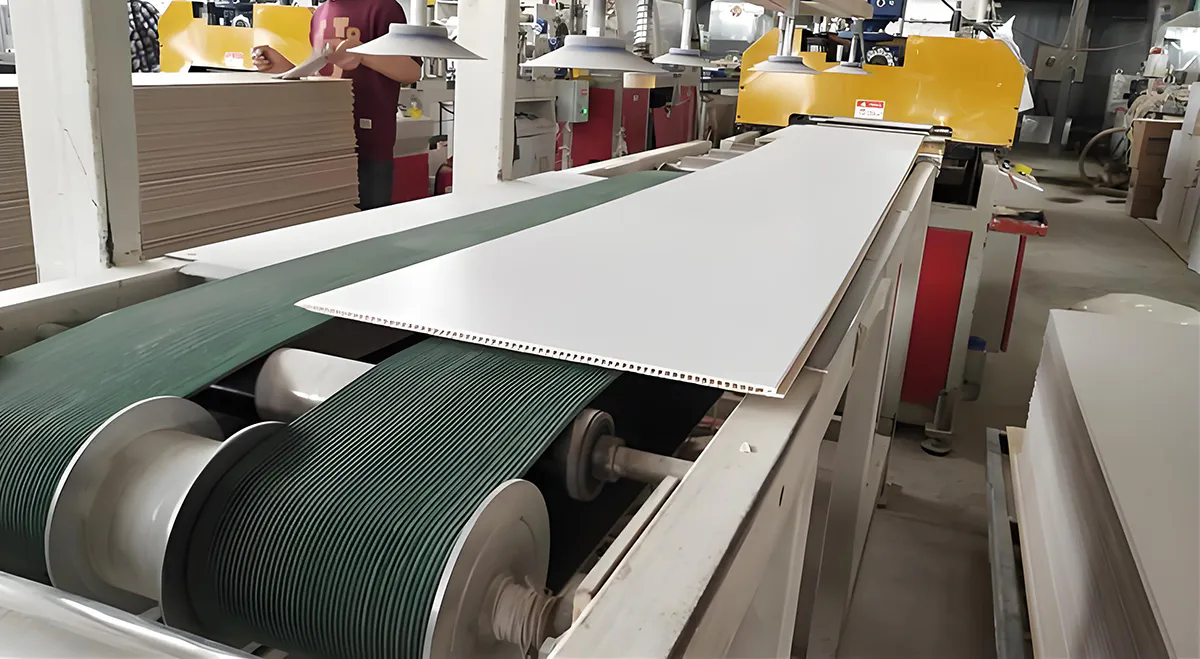
The core manufacturing processes for WPC (Wood-Plastic Composite) wall panels include extrusion, co-extrusion/encapsulation, hot pressing, and compression/injection molding. Extrusion is the dominant method, while subsequent advancements—such as co-extrusion and encapsulation—have introduced enhanced capabilities that directly determine the panels’ durability and aesthetic quality.
3.1. Raw Material Pre-treatment and Compounding / Granulation
WPC performance depends largely on the degree of integration (interfacial compatibility) between the wood flour and the plastic resin.
-
Drying of Wood/Bamboo Flour: Plant fibers are highly hygroscopic; if the moisture content exceeds 2%–3%, issues such as bubbling and brittleness can occur during extrusion. High-temperature drying (100–120°C) is required to reduce moisture levels.
-
High-Speed Mixing: Resin (PVC/PE/PP), dried wood flour, calcium powder, coupling agents, lubricants, and stabilizers are placed in a high-speed mixer. Friction-generated heat raises the temperature to 110–130°C, allowing the coupling agent to effectively “bridge” the resin and wood flour molecular chains.
-
Granulation / Pelletizing Process:
-
One-Step Method (Direct Extrusion): The mixture is fed directly into a twin-screw extruder for shaping, offering cost savings.
-
Two-Step Method (Pelletizing First): The mixture is first extruded and granulated to form uniform WPC pellets, followed by a secondary extrusion process. Panels produced via the two-step method exhibit greater uniformity in density and structural integrity.
-
3.2. Core Forming & Extrusion Processes
Depending on product application (indoor/outdoor) and performance requirements, forming and extrusion are categorized into three mainstream processes:
3.2.1. Single Extrusion (Standard Extrusion)
-
Process: WPC melt is extruded directly through a specific die header using a single conical twin-screw extruder.
-
Characteristics: The material composition is uniform throughout (inner and outer layers are identical); offers high production efficiency and lower costs. Primarily used for first-generation outdoor boards and standard indoor substrate boards.
3.2.2. Co-extrusion Process
-
Process: A main extruder (supplying the WPC core material) and a secondary extruder (supplying a modified surface resin, such as ASA or high-density PE) operate in tandem to achieve 360° full-encapsulation extrusion within the die.
-
Characteristics: The surface layer contains no wood flour; it is UV-resistant, scratch-resistant, water-impermeable, and colorfast. This is the core manufacturing technology for second-generation outdoor WPC wall panels.
3.2.3. Rigid Micro-foaming Extrusion (Celuka / Free Foaming)
-
Process: A foaming agent is added during the extrusion of PVC-WPC indoor wall panels; controlled skinning or free-foaming techniques are employed to create a microporous internal structure.
-
Characteristics: Significantly reduces board weight while enhancing toughness, sound insulation, and thermal insulation properties. Primarily used for indoor bamboo-wood fiber integrated large panels and louver panels.
3.3. Surface Finishing Processes
The surface of the extruded substrate is typically smooth or has a “plastic” appearance; specialized surface finishing processes (such as PUR hot-film laminating, 3D online embossing, brushing/sanding, or digital printing with UV coating) are applied to achieve diverse visual and tactile effects like wood grain, stone patterns, or fabric textures.
| Process (English) | Operating Principle | Application & Visual Features |
| Hot Pur Film Laminating | Thermal lamination of decorative PVC films onto WPC substrates using PUR hot-melt adhesives. | Dominant for Indoor Panels. Replicates wood grain, marble, leather, fabric, and soft-touch textures. |
| 3D Online Embossing | Engraving deep textures directly onto warm, unsolidified extruded profiles using heavy-duty embossing rollers. | Dominant for Outdoor Cladding. Creates realistic 3D deep wood grain that resists wearing down. |
| Brushing / Sanding | Mechanically abrading the profile surface with high-speed wire wheels or sanding belts. | Removes synthetic plastic sheen to deliver a matte, brushed timber texture. |
| Digital Printing & UV Coating | High-definition digital pattern printing followed by multiple passes of UV-cured protective topcoat. | Used for premium indoor accent walls (e.g., continuous book-matched marble or custom art). |
| Heat Transfer Printing | Transferring film patterns under high heat/pressure onto WPC surfaces, finished with a clear coat. | Low cost; used for simple wood grains or decorative trims. |
3.4. Post-Processing & Profile Shaping
-
Vacuum Calibration & Cooling: The high-temperature extruded sheet passes through a vacuum calibration unit and a water cooling tank to ensure dimensional tolerances and flatness.
-
Grooving & Tongue-and-Groove Milling: A tenoner is used to precisely mill interlocking joints (tongue-and-groove profiles) onto both sides of the wall panel, enabling concealed installation and seamless joining.
-
Automated Flying Cut-off: A dust-free flying saw performs automated, in-line cutting to project-specific lengths (e.g., 2.8m, 2.9m, or 5.8m for container-compatible sizing).
Ⅳ. Classification and Characteristics
WPC (Wood-Plastic Composite) wall panels can be classified in various ways—based on application scenarios, production processes, physical structures, visual forms, and surface treatments—with each category exhibiting distinct performance characteristics:
| Categorization Dimension | Sub-category | Core Material / Process Characteristics | Key Features & Performance | التطبيقات النموذجية |
| بيئة التطبيق | Indoor WPC Wall Panels | PVC resin base + wood/bamboo powder + calcium carbonate powder | Moisture-proof, mold-resistant, high fire retardancy (Class B1), ultra-low formaldehyde emissions, rich surface decoration. | Feature walls, interior ceilings, hotel & commercial wall cladding |
| Outdoor WPC Wall Panels | PE/PP resin base + wood flour / plant fiber | Superior UV resistance, high weatherability, freeze-thaw resistant, high structural strength, non-cracking. | Exterior building cladding, landscape walls, outdoor corridors | |
| Manufacturing Process | 1st Gen Mono-Extrusion Panels | Single-extruder profile; homogeneous inner and outer core material | Highly cost-effective with uniform texture; however, scratch resistance and color fading performance under prolonged outdoor exposure are moderate. | Budget-conscious projects, interior base wallboards, general landscaping |
| 2nd Gen Co-Extrusion Panels | 360° fully encapsulated with ASA or modified resin shell | Ultra-Weatherable: Superior UV resistance, scratch resistance, stain/oil repellency, zero color fading, chemical/acid-alkali resistance. | High-end building facades, coastal high-salt-spray environments, premium exterior cladding | |
| Physical Structure | Hollow Profile Panels | Internal grid or multi-chamber hollow structure | Lightweight, raw-material efficient, easy to handle and install, excellent thermal and acoustic insulation. | Most indoor wall installations, non-structural exterior cladding (industry preference) |
| Solid Profile Panels | Dense, solid cross-section with no internal voids | High density, heavy weight, maximum impact resistance, non-warping under heavy loads. | Exterior facades in high-wind-load areas, high-impact public wall zones | |
| Appearance & Profile Design | 3D Fluted / Slat Panels | Surface features continuous concave/convex grooves or wave-like ridges | High visual depth and architectural shadow effect; visually expands space and conceals vertical panel joints effectively. | TV backdrop walls, room dividers/screens, commercial storefront accents |
| Appearance & Profile Design | Integrated Flat Panels | Large format profiles (typically 400–1220mm wide) | Minimal joint lines, ultra-fast installation efficiency; ideal for seamless, large-scale replacement of traditional wallpaper, paint, or wood veneers. | Large-area interior walls, office buildings, hospital wall lining |
| Interlocking Exterior Cladding | Precision tongue and groove (T&G) edge profiles | Concealed screw/fastener installation; provides outstanding rainwater shedding and wind pressure resistance. | Outdoor dry-hung cladding, prefabricated timber houses, villa exteriors | |
| Surface Finishing | Hot Film Laminating | Thermal lamination of decorative PVC film using PUR hot-melt adhesives | Accurately replicates high-definition wood grain, marble, leather, textile, and soft-touch tactile surfaces. | Industry standard for indoor WPC panels |
| 3D Online Embossing | Heavy-duty metallic embossing rollers apply deep patterns at high temperatures | Highly authentic 3D wood texture; deep grain resists wear and does not smooth out under long-term outdoor exposure. | Industry standard for outdoor WPC cladding | |
| Brushing / Sanding | High-speed wire wheels abrade the synthetic plastic sheen | Eliminates plastic sheen, delivering a matte, brushed timber finish with a natural antique wood texture. | Outdoor slatted panels, American-style timber cladding |
Ⅴ. Instrava’s Strategic Procurement & Supply Chain Solutions
Navigating the global sourcing of WPC wall panels requires more than just choosing a profile—it demands rigorous quality control, supplier verification, and logistical optimization. As a specialized industrial procurement service provider, **Instrava** bridges international clients with premier Chinese manufacturing infrastructure through turnkey sourcing strategies:
5.1. Factory Auditing & Raw Material Traceability
To eliminate issues such as product brittleness or premature fading, Instrava conducts strict on-site audits across our vetted manufacturing network. We verify:
-
Virgin Polymer vs. Recycled Resin Ratios: Ensuring high structural integrity, optimal flexibility, and odor-free interior-grade PVC panels.
-
Moisture Content Compliance: Verifying that plant fiber drying procedures stay strictly below 2% prior to compounding to prevent post-installation warping and internal micro-foaming defects.
5.2. Custom OEM/ODM Capabilities & Pattern Curation
-
Vast Surface Catalog: Access to 300+ hot-melt PUR laminated surface films, including authentic wood grains, stone/marble textures, soft-touch metallic finishes, and acoustic felt backing.
-
Tooling & Profile Customization: Rapid prototyping and custom die header development for proprietary tongue-and-groove or fluted/slatted profile designs.
5.3. Freight & Container Loading Optimization
Shipping hollow or fluted WPC panels involves high volumetric space utilization. Instrava provides customized loading strategies to minimize landed costs:
-
Maximized Cubic Capacity (CBM): Customized nested packaging and reinforced iron-frame palletization to maximize 40HQ container space while preventing corner deformation and edge crushed during sea freight.
-
Container Loading Plans: Pre-shipment weight-to-volume ratio calculations and payload engineering to prevent axle overloading, port surcharges, and container demurrage.