
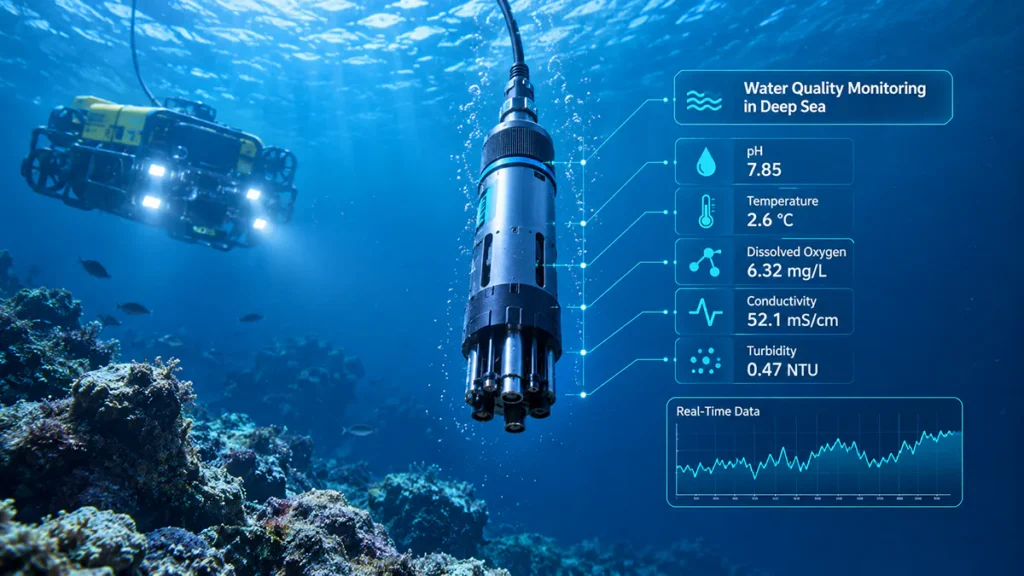
Comment les capteurs de qualité de l'eau peuvent-ils surmonter les limites de profondeur lorsqu'ils effectuent des mesures à plus de 200 mètres ?
Recherche de prestataires de services
Table des matières
Aucun titre disponible.
We approach this by breaking down the problem and identifying specific solutions for each aspect.
Challenge 1: Sensor Equipment Limitations
At a depth of 200 meters—equivalent to 20 bar of pressure—standard sensors cannot withstand the load and are therefore unsuitable for such depths.
Challenge 2: Signal Transmission Issues
Signal transmission issues during long-term operation.
Challenge 3: Power Supply Requirements
Power supply requirements for long-term underwater operation.
Solutions Provided by Our Factory Engineers
Addressing Challenge 1: High-Pressure Digital pH Sensors
We utilize high-pressure, fermentation-grade digital pH sensors 1. These sensors feature a core component—a high-temperature-resistant glass sensing membrane—housed within a specialized glass body, equipped with a ceramic or PEEK liquid junction, and filled with a gel or solid reference electrolyte. Such electrodes are engineered to endure both high-temperature sterilization and high pressure; the selection of materials is the primary factor determining their operational lifespan and measurement stability.
Glass Sensing Membrane: Composed of a high-temperature-resistant glass formulation, this membrane is approximately 0.3 mm thick. It undergoes specialized treatment to maintain a stable hydration layer throughout repeated sterilization cycles, serving as the primary sensing element for pH measurement.
Electrode Body: Typically constructed from specialized glass or 316L stainless steel. Stainless steel versions offer superior resistance to mechanical impact and meet hygienic design standards.
Liquid Junction/Diaphragm: Commonly made from ceramic, PEEK, or PTFE, these materials provide resistance to contamination and chemical corrosion. Ceramic diaphragms are the most widely used type in fermentation-grade electrodes.
Reference Electrolyte: Consists of a pre-pressurized polymer gel or solid electrolyte. This design eliminates the need for replenishment, resists pressure-induced clogging, and is well-suited for high-temperature, high-pressure environments.
Addressing Challenges 2 and 3: Custom Deep-Sea Anti-Torsion Cables
We employ custom-engineered, anti-torsion deep-sea cables, with dedicated, separate channels designed for power and signal transmission. These specialized composite cables are purpose-built for high-pressure, corrosive deep-sea environments. Their primary feature is the ability to resist twisting during repeated deployment, retrieval, or towing, while simultaneously facilitating power delivery, signal transmission, and providing robust resistance to pressure and corrosion.
Signal transmission cables designed for long-term use in marine environments are resistant to torsion—though they do come at a higher price.