
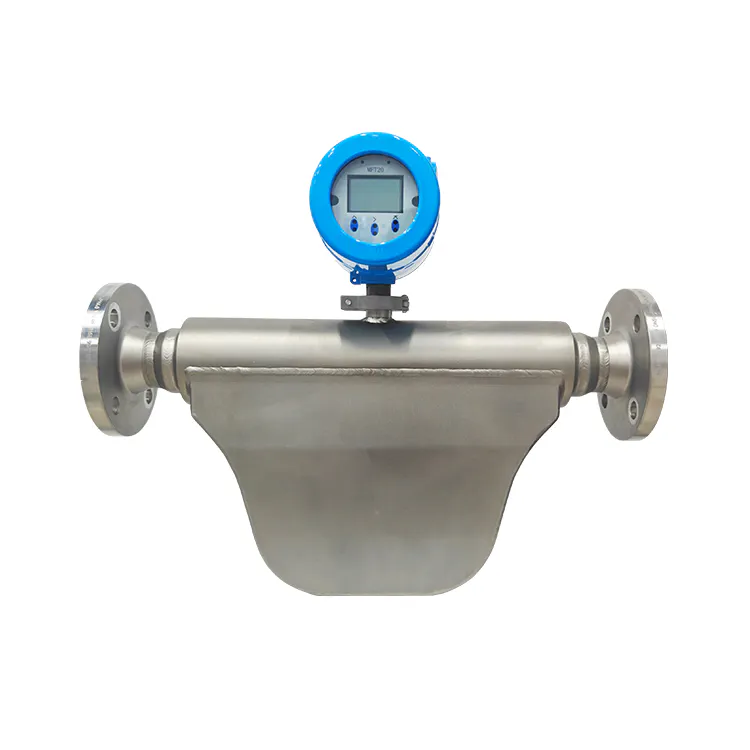
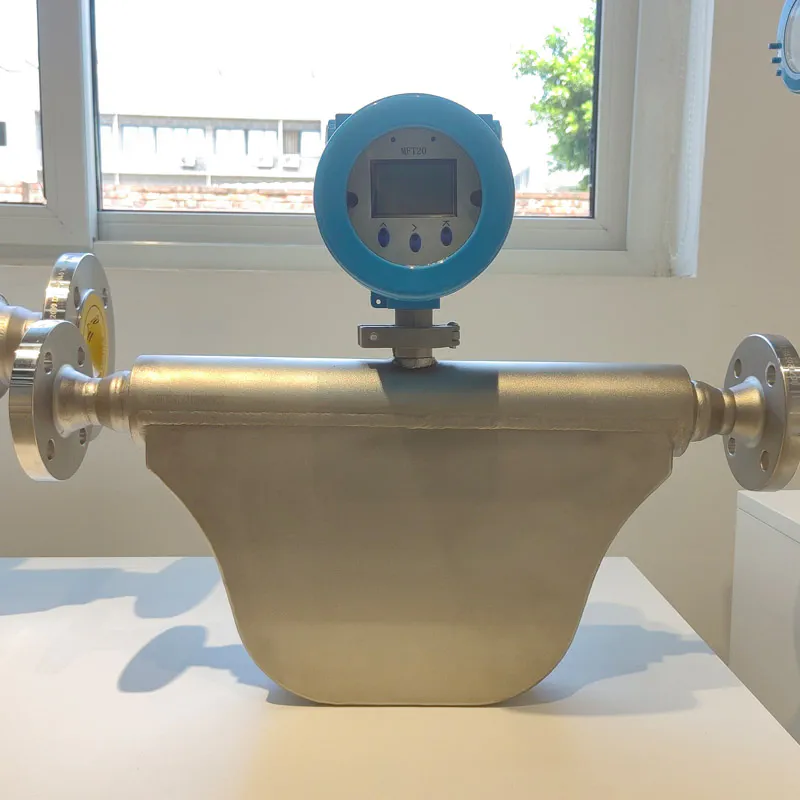
Coriolis Mass Flow Meter
High-Precision Coriolis Mass Flow Measurement
The Coriolis Mass Flow Meters patented and developed by our company represent a leading solution for high-precision flow measurement across demanding industrial applications.
These meters provide direct and simultaneous measurement of mass flow, volume flow, density, and temperature for liquids and slurries—without requiring additional instruments, manual calculations, or compensation algorithms.
Thanks to their advanced sensor design, the meters deliver exceptional accuracy with minimal pressure drop, making them suitable for both process control and critical measurement tasks.
Designed for reliable operation in harsh industrial environments, the meters feature:
-
No moving parts, ensuring long-term stability and minimal maintenance
-
No special mounting or flow conditioning requirements
-
Stainless steel wetted parts as standard
-
A wide range of process connections to accommodate various installation needs
These characteristics make the Coriolis Mass Flow Meter an ideal choice for applications requiring measurement certainty, process reliability, and operational efficiency.
Flow Meter Description
Mass Flow Meter Features
Measuring Mass Directly, Eliminating Process Uncertainty
Unlike differential pressure or volumetric flow meters, Coriolis mass flow meters measure mass flow directly, not inferred from velocity or volume.
-
True mass flow measurement – unaffected by temperature, pressure, or density changes
-
High accuracy and repeatability – ideal for custody transfer and critical dosing
-
Multi-variable output – mass flow, density, and temperature from a single instrument
-
No flow profile requirements – minimal straight pipe length
For engineers, a Coriolis meter is not just a flow sensor, but a process integrity instrument.
Coriolis Effect-Based Mass Flow Detection- Working Principle
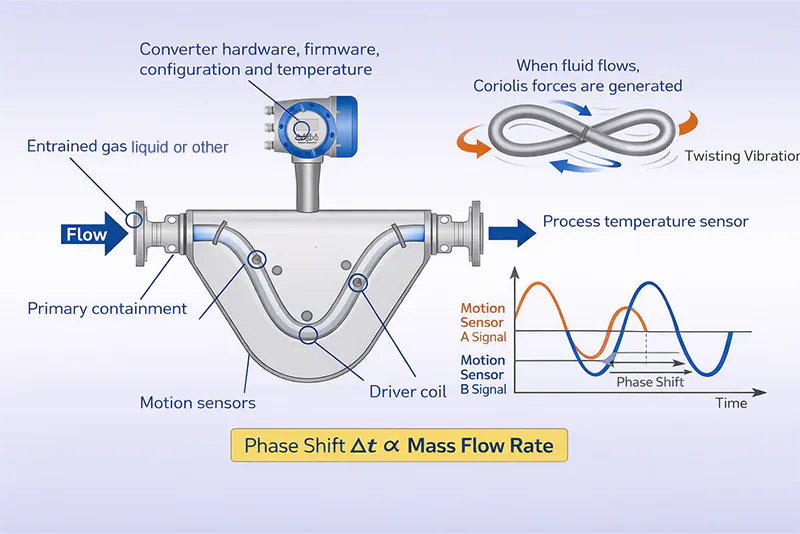
The Coriolis Mass Flow Meter consists of a pair of precisely formed bent measuring tubes, which are driven to vibrate at their natural resonant frequency.
When fluid flows through the vibrating tubes, Coriolis forces are generated as a result of the interaction between tube vibration and fluid movement. These forces cause a torsional deformation of the tubes, producing a measurable phase shift between the inlet and outlet sections.
Key operating principles include:
-
The measuring tubes are excited into stable vibration
-
Fluid flowing through the tubes generates Coriolis force
-
The Coriolis force causes symmetric tube deflection about the centerline
-
Displacement sensors mounted on both sides of the tubes detect this deformation
-
The resulting electrical signals are processed to calculate mass flow directly
In addition, the vibration frequency of the tubes is used to determine fluid density, while integrated temperature sensors provide accurate process temperature measurement.
This measurement method enables direct, real-time mass flow measurement, independent of fluid properties such as viscosity, pressure, or temperature.
Flow Meter Parameter
| Category | Parameter | Specification |
|---|---|---|
| Model | Product Model | CMF125 |
| Flow Measurement | Mass flow accuracy | ±[0.2% + (Zero stability / Flow rate × 100%)] |
| Mass flow repeatability | ±½ × [0.2% + (Zero stability / Flow rate × 100%)] | |
| Density Measurement | Density range | 0.2 g/cm³ ~ 3.5 g/cm³ |
| Density accuracy | ±0.002 g/cm³ | |
| Temperature Measurement | Process temperature range | -60℃ ~ +200℃ |
| Extended temperature options | -60℃ ~ +300℃ / -200℃ ~ +100℃ | |
| Temperature accuracy | ±1℃ | |
| Output Signals | Analog output | 4–20 mA |
| Frequency / pulse output | 0–10 kHz | |
| Communication | Digital communication | RS485 / Modbus or HART |
| Relay Output | Relay contact rating | 24 V / 0.1 A, Normally Open |
| Fluid Conditions | Fluid temperature | -40℃ ~ +200℃ |
| Extended fluid temperature | -40℃ ~ +300℃ / -200℃ ~ +100℃ | |
| Environmental Conditions | Ambient temperature | 0℃ ~ +40℃ (Optional: -40℃ ~ +40℃) |
| Relative humidity | ≤90% RH, non-condensing | |
| Atmospheric pressure | 86 kPa ~ 106 kPa | |
| Electrical | Power supply | 24 V DC (±10%) |
| Power consumption | < 15 W | |
| Safety Certification | Intrinsic safety | Ex ib IIB T4 Gb |
| Flameproof protection | Ex d ib II C T6 Gb |
Instrava OEM/ODM
Tailored Sourcing & Customization: Getting You the Exact Product You Need
As your trusted supplier and sourcing partner, we bridge the gap between your custom requirements and China’s vast manufacturing capabilities.
Finding the right product in a massive supply chain can be challenging. That is where we step in.
As a curated industrial supplier, our core value is simple: we stand in your shoes to help you procure the most optimal products. Whether you are an EPC contractor needing specialized technical compliance, an OEM equipment manufacturer looking for custom branding, or an industrial distributor/trader seeking competitive edge, we customize and tailor products to fit your exact procurement needs.
How We Customize to Fit Your Procurement Needs
For EPC Contractors & Engineers: We custom-configure instruments and devices to match your precise datasheets—tailoring process connections, exotic materials, signal protocols, and managing third-party calibration and testing so you get project-ready solutions.
For OEM Equipment Manufacturers: We provide comprehensive OEM/ODM customization, including custom housing, labeling, branding (private labeling), and tailored technical specifications to seamlessly integrate with your machinery.
For Industrial Distributors & Traders: We offer flexible customization in packaging, product ranges, and technical parameters, helping you differentiate your portfolio and win more local bids.
Why Partner with Us for Custom Sourcing?
One-Stop Engineering Alignment: You don’t have to deal with multiple factories. We translate your technical requirements into precise manufacturer blueprints.
Strict Quality & Compliance Safeguard: We oversee the entire customization and production process in China, ensuring the final customized product meets your local standards and certifications.
Our Ultimate Value: We don’t just sell what’s on the shelf. We find, customize, and deliver the most suitable and cost-effective product for your unique application.

Can Coriolis mass flow meters operate reliably at high temperatures?
Yes. Coriolis mass flow meters are well suited for high-temperature applications, with operating ranges extending up to several hundred degrees Celsius depending on configuration. Because mass flow measurement is based on tube vibration rather than fluid properties, accuracy remains stable even under thermal variation.
How does a Coriolis flow meter perform under high pressure conditions?
Coriolis flow meters are designed with robust tube structures and high-strength materials, enabling operation at pressures up to tens of MPa. Measurement accuracy is unaffected by pressure changes, making them ideal for high-pressure chemical, oil, and energy systems.
Is Coriolis technology suitable for high-viscosity fluids?
Yes. High-viscosity fluids do not impact measurement accuracy because Coriolis meters measure direct mass flow, not velocity. This makes them especially effective for oils, polymers, resins, syrups, and other viscous or non-Newtonian fluids.
Can Coriolis mass flow meters handle multiphase or slurry media?
Coriolis meters perform well with liquids containing suspended solids or slurries, as long as the flow remains reasonably homogeneous. The measurement principle is independent of flow profile, making it more stable than differential pressure or turbine meters in complex media.
How do Coriolis meters maintain accuracy under changing process conditions?
Because Coriolis flow meters directly measure mass flow and density, they are inherently immune to variations in temperature, pressure, and fluid properties. This eliminates the need for compensation calculations and ensures consistent long-term measurement stability.
Are Coriolis flow meters suitable for safety-critical or continuous processes?
Yes. With no moving parts, minimal maintenance requirements, and excellent repeatability, Coriolis mass flow meters are widely used in safety-critical and continuous industrial processes where measurement reliability and uptime are essential.
Why Trust Instrava?
We select manufacturers from a neutral, impartial standpoint, always with your best interests in mind.
Our very existence depends on helping you source the products that are the perfect fit for your needs.
Based in China, we are able to conduct on-site inspections of production environments and product quality firsthand.
We help you avoid intermediaries posing as factories.
We facilitate smoother after-sales support, eliminating time zone issues and the delays often associated with dealing directly with factories.
Our multilingual team ensures effective communication.
For a trading startup, every interaction with a client is a precious opportunity—a sign that you are willing to place your trust in us and give us the chance to prove ourselves.
In the digital age, while information is easily accessible, misconceptions often cloud the trust between people.
Instrava relies entirely on trust; it is our core philosophy and the foundation of our existence in society. It is the fundamental basis for our long-term growth and our commitment to serving the community.
Please place your trust in us.