Home » Technology » 2026 Power Transformer Revolution: How Solid-State Transformers (SST) Are Reshaping the AI Computing Power Grid
2026 Power Transformer Revolution: How Solid-State Transformers (SST) Are Reshaping the AI Computing Power Grid
What is a Solid-State Transformer (SST) and how does it differ from a traditional transformer?
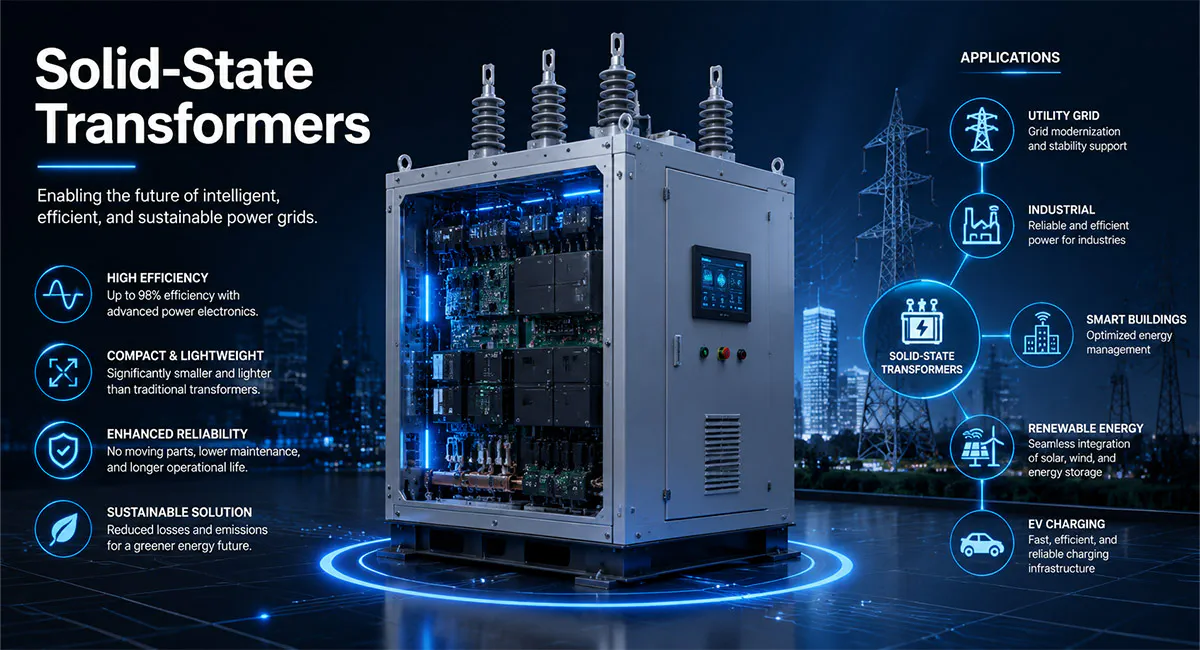
A Solid-State Transformer (SST), also known as a power electronics transformer, replaces the traditional “iron core and copper wire” passive electromagnetic design with advanced semiconductor chips (such as Silicon Carbide/SiC and Gallium Nitride/GaN). While traditional transformers rely on a fixed line frequency (50Hz/60Hz), SSTs actively modulate and manage electricity at high frequencies (tens to hundreds of kHz), transitioning the equipment from a passive physical component into an intelligent digital asset.
Why are SSTs suddenly becoming critical for AI data centers in 2026?
Next-generation AI data centers operate under extreme power densities, frequently utilizing 800V DC high-voltage direct current architectures. Traditional transformers only operate on AC, forcing systems into a high-loss, multi-stage conversion chain (AC-DC-AC-DC). An SST natively supports bidirectional AC/DC conversion, allowing it to directly transform 13.8kV–35kV medium-voltage AC grid power straight into 800V DC, eliminating redundant power conversion steps and cutting down component counts.
What are the physical footprint and weight advantages of deploying an SST?
Thanks to high-frequency switching topologies, the physical size of the internal magnetic elements is drastically reduced. An SST occupies only 1/5 to 1/10 of the volume of a traditional line-frequency transformer. Furthermore, it can reduce total structural weight by up to 40 times, freeing up highly valuable real estate in urban or space-constrained hyperscale computing facilities.
What kind of efficiency payouts can operators expect from an SST?
Modern tier-1 solid-state transformers deliver an exceptional standalone conversion efficiency of 98.5%. By bypassing multi-tier conversion steps, the end-to-end power chain efficiency of the data center is boosted to over 93%. For a 100 MW hyperscale facility, this extra 1% to 2% efficiency gain saves millions of dollars in electricity overhead annually while lowering the facility’s Power Usage Effectiveness (PUE) metrics.
If an SST costs 4 to 10 times more than a legacy transformer, how is the ROI justified?
While the initial capital expenditure (CAPEX) is significantly higher due to the premium cost of wide-bandgap SiC power semiconductors, the Total Cost of Ownership (TCO) is highly competitive. The premium is rapidly amortized through immense lifecycle utility bill savings, downscaled cooling/thermal management costs, and the optimization of physical whitespace, allowing for more revenue-generating AI racks on the same server floor.
Can SSTs be integrated with renewable energy microgrids and energy storage?
Yes, exceptionally well. SSTs are frequently described as “intelligent energy routers.” Unlike traditional transformers, they feature millisecond-level dynamic response times, active harmonic filtering, and reactive power compensation. They inherently support bidirectional power flow, making them the ideal nexus point for seamlessly integrating volatile, distributed energy sources like solar PV, wind farms, and battery energy storage systems (BESS).
Why Trust Instrava?
We select manufacturers from a neutral, impartial standpoint, always with your best interests in mind.
Our very existence depends on helping you source the products that are the perfect fit for your needs.
Based in China, we are able to conduct on-site inspections of production environments and product quality firsthand.
We help you avoid intermediaries posing as factories.
We facilitate smoother after-sales support, eliminating time zone issues and the delays often associated with dealing directly with factories.
Our multilingual team ensures effective communication.
For a trading startup, every interaction with a client is a precious opportunity—a sign that you are willing to place your trust in us and give us the chance to prove ourselves.
In the digital age, while information is easily accessible, misconceptions often cloud the trust between people.
Instrava relies entirely on trust; it is our core philosophy and the foundation of our existence in society. It is the fundamental basis for our long-term growth and our commitment to serving the community.
Please place your trust in us.