
การปฏิวัติเครื่องแปลงกำลังในปี 2026: วิธีที่เครื่องแปลงกำลังแบบโซลิดสเตต (SST) กำลังเปลี่ยนแปลงระบบโครงข่ายไฟฟ้าสำหรับการประมวลผล AI
ผู้ให้บริการด้านการจัดหา
สารบัญ
- 1. What Is a Solid-State Transformer? The Underlying “Silicon-Over-Iron” Tech Innovation
- 2. Solving AI Data Center Bottlenecks: Unlocking the 800V DC Architecture
- 3. Ultimate Energy Efficiency: The “Million-Dollar” Financial Ledger
- 4. Primary Application Verticals for Solid-State Transformers
- 5. Commercial Tipping Point: Cost Evolution and 2026 Global Deliveries
In 2026, China’s power transformer technology is undergoing a profound structural leap from the traditional paradigm of “high voltage and large capacity” toward three core vectors: solid-state architecture, intelligent control, and ultimate energy efficiency.
Driven by the exponential surge in AI computing power, the power consumption per chip has skyrocketed. Consequently, hyperscale data centers now demand unprecedented power density and conversion efficiency from their electrical infrastructure. In this tight-supply macroeconomic super-cycle, the Solid-State Transformer (SST)—also widely designated as the power electronics transformer—is leveraging its disruptive underlying logic to cross the chasm from technical validation into a massive global commercialization phase.
1. What Is a Solid-State Transformer? The Underlying “Silicon-Over-Iron” Tech Innovation
Traditional power transformers have anchored global grids for over a century, relying completely on the passive electromagnetic induction of heavy iron cores and copper wire windings.
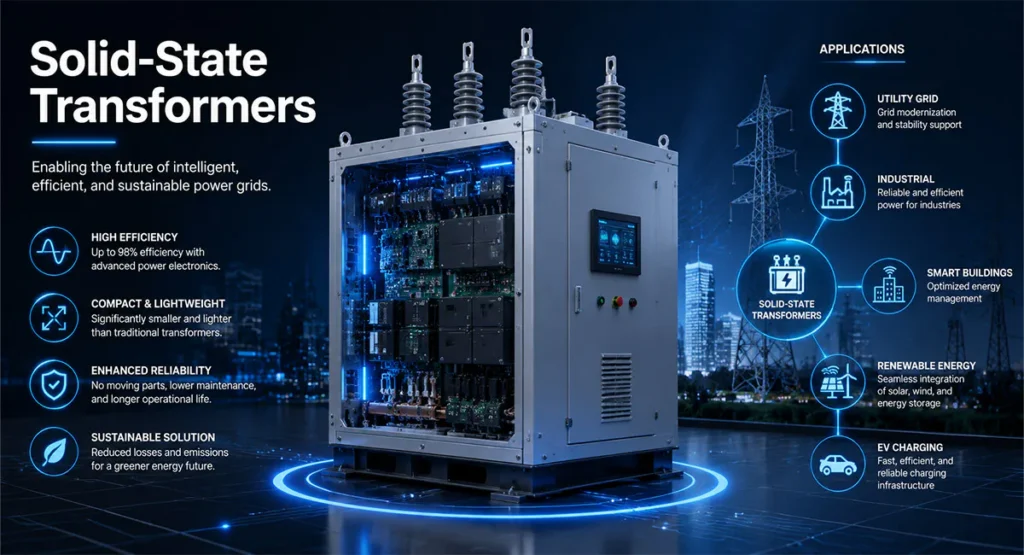
Conversely, the foundational architecture of an SST replaces legacy physical windings with high-performance semiconductor chips. By utilizing third-generation wide-bandgap semiconductors such as Silicon Carbide (SiC) and Gallium Nitride (GaN) paired with high-frequency circuits, an SST elevates standard line frequencies (50Hz/60Hz) up to tens or hundreds of kilohertz (kHz). This transition enables active, digitized power management.
Technical Comparison: Legacy Transformers vs. Solid-State Transformers (SST)
| Evaluation Metric | Legacy Line-Frequency Transformer | Solid-State Transformer (SST) | Core Value & Technological Dividend |
| Operating Mechanism | Passive electromagnetic induction (Iron Core + Copper Wire) | Active power electronics management (Semiconductor Chips + High-Frequency Topology) | Upgrades infrastructure from a rigid physical component to an intelligent digital asset. |
| ความถี่ในการทำงาน | Fixed at 50Hz or 60Hz | Scales from several kHz to hundreds of kHz | High-frequency switching triggers a precipitous drop in the physical footprint of magnetic elements. |
| Physical Footprint | Massive, heavy, requiring significant structural reinforcement and land area. | Volume reduced to 1/5 or 1/10 of legacy baselines; weight reduced up to 40x. | Frees up critical real estate, making it perfectly suited for space-constrained urban data centers. |
| Functional Versatility | Single-function; strictly bound to alternating current (AC) networks. | Supports bidirectional AC/DC power flow, active voltage regulation, filtering, and rapid fault isolation. | Functions as a hybrid “power transformer + intelligent energy router.” |
2. Solving AI Data Center Bottlenecks: Unlocking the 800V DC Architecture
AI data centers serve as the primary catalyst for the 2026 SST boom because the technology directly resolves the inherent efficiency bottlenecks of legacy multi-stage power distribution.
In the advanced 800V DC high-voltage direct current architecture championed by cutting-edge AI chipsets, traditional line-frequency transformers face basic structural limitations because they operate strictly within AC circuits. This incompatibility forces data centers to execute redundant, high-loss conversions.
The Legacy Power Path (High-Loss Multi-Stage Conversion)
Medium-voltage AC power (13.8kV–35kV) from the utility grid must endure an inefficient transformation chain:
Medium Voltage AC ──> Line-Frequency Transformer ──> 480V AC ──> AC UPS (Rectification + Inversion) ──> Power Distribution Unit (PDU) ──> 415V AC ──> Rack-Level Power Supply Unit (PSU) AC/DC ──> 54V DC ──> Board-Level DC-DC Regulator ──> AI Chip
Every individual AC/DC or DC/DC conversion step inevitably generates waste heat due to internal resistance and switching losses, degrading the end-to-end efficiency coefficient.
The SST-Driven 800V DC Path (Streamlined Two-Stage Conversion)
With solid-state transformers, the entire distribution architecture is consolidated into a highly efficient two-stage topology:
Medium Voltage AC (13.8kV–35kV) ──> Solid-State Transformer (SST) ──> 800V DC ──> DC Distribution Rack ──> Computing Tray Motherboard ──> Board-Level DC-DC Step-Down ──> AI Chip
By deploying a three-stage internal topology consisting of medium-voltage rectification, isolation-stage high-frequency transformation, and low-voltage inversion, the SST directly bridges the gap between the medium-voltage AC grid and the 800V DC power bus.
3. Ultimate Energy Efficiency: The “Million-Dollar” Financial Ledger
In hyperscale computing, fractional efficiency gains yield massive financial returns. Traditional AC UPS distribution networks yield an end-to-end efficiency of roughly 95%, while advanced centralized topologies operate at around 97.5%.
The SST Efficiency Standard: Solid-state transformer configurations deliver a standalone conversion efficiency of 98.5%, pushing the entire end-to-end distribution system efficiency beyond 93%.
For a typical 100 MW (Megawatt) hyperscale AI data center operating continuously under full computational load, a 1% improvement in power distribution efficiency translates directly to millions of dollars saved annually in utility expenditures while dramatically lowering the facility’s Power Usage Effectiveness (PUE) metrics.
4. Primary Application Verticals for Solid-State Transformers
Beyond serving as the energy core for AI infrastructure, the active digital regulation capabilities of SSTs offer critical advantages across diverse industrial sectors:
-
AI Data Centers (High-Growth Strategic Priority): Maximizes power delivery to ultra-dense, high-wattage computing racks, reduces real estate requirements, and eliminates multi-tier conversion steps for direct-to-rack high-voltage DC distribution.
-
Smart Grids & Distributed Renewable Energy: SSTs respond to load fluctuations within milliseconds, actively suppressing harmonics and compensating for reactive power. Operating as intelligent energy routers, they smoothly manage bidirectional power flows from distributed solar PV arrays, wind farms, and battery energy storage systems (BESS).
-
Transportation & Specialized Heavy Industry: Provides lightweight, resilient power solutions for high-speed rail locomotives, marine propulsion systems, offshore wind platforms, and ultra-fast electric vehicle (EV) charging stations where physical space and weight limitations are critical.
5. Commercial Tipping Point: Cost Evolution and 2026 Global Deliveries
Despite these clear operational advantages, widespread SST adoption has historically faced one primary hurdle: initial capital expenditure. Due to the intensive use of premium Silicon Carbide (SiC) power semiconductors, the upfront procurement cost of an SST is approximately 4 to 10 times higher than that of a traditional line-frequency unit.
However, when evaluated across the operational lifecycle of a high-density, energy-intensive infrastructure asset like a data center, the dramatic reduction in electricity losses and saved spatial footprint rapidly amortizes the initial premium. This structural shift makes the ค่าใช้จ่ายรวมในการเป็นเจ้าของ (TCO) highly competitive.
China’s highly integrated power electronics manufacturing ecosystem is moving the global industry down the cost curve. Leading domestic electrical manufacturers, such as XD Group และ Sifang Automation, have successfully deployed utility-scale SST demonstration projects.
Furthermore, in June 2026, Chinese manufacturers secured the world’s first major batch of overseas commercial export orders for solid-state transformers. This milestone establishes that solid-state transformer technology has successfully transitioned from localized pilot programs into full-scale international commercial industrialization.