
สารบัญ
Interior wall paneling has evolved into a vital architectural component for modern spaces, offering an ideal balance of material science, structural performance, and visual elegance. A wide variety of wall panels is available for interior application, broadly categorized by substrate and engineering profile:
-
Bamboo-wood fiber panels (WPC)
-
Carbon-crystal composite panels
-
Impact-resistant HPL compact laminates
-
Stone-plastic composite (SPC) panels
-
All-aluminum honeycomb panels
-
Solid wood and wood-veneered panels
-
Oriented strand board (OSB)
-
Fair-faced concrete cladding
-
Calcium silicate / fiber-cement boards
-
PVC decorative sheets
These materials differ significantly in water resistance, fire performance, structural durability, and surface aesthetics. Selection depends on specific spatial requirements, budget parameters, and intended visual outcomes. Below, we examine two versatile and cost-effective wall panel solutions suitable for residential and commercial interiors.
I. Bamboo-Wood Fiber Panels (WPC Wall Panels)
1. Material & Technical Composition
Bamboo-wood fiber panels are composite wall boards manufactured through high-temperature, high-pressure extrusion. Their core formulation integrates natural plant fibers with polymer resins and mineral matrices:
| Raw Material Category | Specific Material Description | Percentage by Weight |
| Plant Fibers | Premium bamboo powder, wood flour, or agricultural crop straw fibers | $30\%\text{–}50\%$ |
| Polymer Resin | Polyvinyl chloride (PVC) virgin resin or high-quality recycled resin | $30\%\text{–}40\%$ |
| Inorganic Fillers | Fine, lightweight calcium carbonate ($\text{CaCO}_3$) powder | $15\%\text{–}25\%$ |
| Functional Chemical Additives | Coupling agents, thermal stabilizers, lubricants, flame retardants, and anti-aging agents | $3\%\text{–}5\%$ |
2. Key Performance Features
-
Exceptional cost-effectiveness and rapid “dry-method” installation (applicable directly over rough substrate walls).
-
$100\%$ moisture-proof and mold-resistant performance.
-
Flame-retardant properties (B1 / Class B compliance).
-
Low maintenance and ease of cleaning.
-
Extensive surface pattern library spanning hundreds of decor options.
3. Visual & Aesthetic Applications
Organic Wood Grains
For spaces requiring warmth and natural comfort, designs featuring bold, organic wood grains offer a compelling solution. Each wood-grain pattern provides subtle, intentional variations mimicking real timber. Under ambient lighting, the natural texture yields a gentle visual response that evokes warmth, tranquility, and connection to nature.
In traditional philosophy and holistic wellness, natural wood elements symbolize vitality and continuous growth. The tactile and visual presence of wood textures creates a relaxed environment that supports emotional balance and spatial comfort.
Stone & Marble Textures
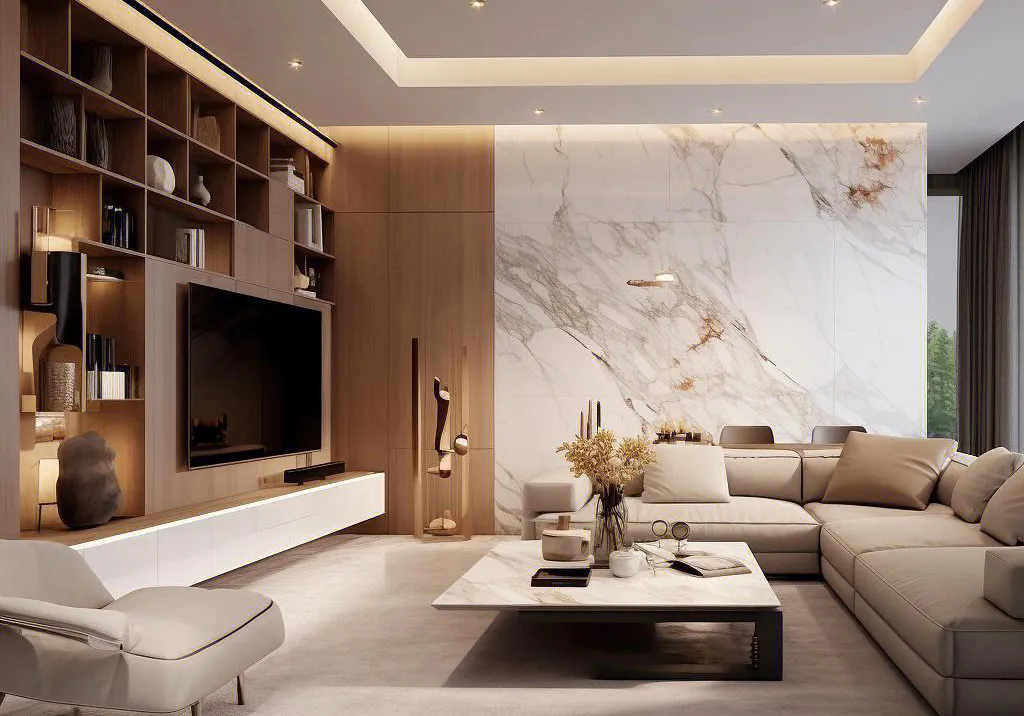
For understated luxury, panels with white oak or marble-inspired patterns provide refined sophistication. Every stone pattern is unique, offering depth, grounded stability, and visual interest without the monotony of plain surfaces:
-
Translucent Crystalline Motifs: Reminiscent of snow-capped alpine landscapes, making spaces feel bright, open, and artistic.
-
Veined & Injected Details: Featuring ink-like splashes, mineral inclusions, or metallic veins that deliver a striking visual impact.
II. Carbon Crystal Panels
1. Material & Layered Structure
Carbon crystal panels represent an advanced evolution of traditional Wood-Plastic Composite (WPC) and Stone-Plastic Composite (SPC) technologies, upgraded through material modification and high-density extrusion.
Core Substrate Composition
| Raw Material Category | Specific Material Description | Percentage by Weight | Core Function & Performance Contribution |
| Carbon Reinforcement | Carbon fiber powder และ nano bamboo charcoal powder | $5\%\text{–}15\%$ | Rigidity & Toughness: Carbon fibers provide high flexural strength and toughness, allowing $2.8\text{–}3\text{ m}$ floor-to-ceiling panels to resist warping or bulging. Bamboo charcoal helps absorb harmful gases. |
| Polymer Matrix | Polyvinyl chloride (PVC) virgin resin (or high-grade modified PVC) | $35\%\text{–}45\%$ | Binding & Waterproofing: Serves as a continuous binder encapsulating all powders, delivering $100\%$ water and mold resistance, weatherability, and structural resilience. |
| Inorganic Filler | Fine, lightweight calcium carbonate ($\text{CaCO}_3$) powder | $35\%\text{–}45\%$ | Hardness & Dimensional Stability: Imparts exceptional hardness, impact resistance, and a fire-retardant base while minimizing thermal expansion and contraction. |
| Functional Additives | Thermal stabilizers, coupling agents, lubricants, flame retardants (ATH/MDH), and anti-aging agents | $3\%\text{–}8\%$ | Performance Optimization: Enhances compatibility between inorganic powders and polymer resins, raising fire resistance (typically achieving Class B1 / EN 13501 Class B). |
Layered Panel Construction
-
Clear UV Topcoat: Anti-scratch, anti-fingerprint, and UV-resistant protection.
-
Decorative Surface Film: High-definition PET or PVC film (stone, wood, micro-cement, or metallic).
-
PUR Adhesive Layer: High-strength, zero-formaldehyde polyolefin/polyurethane hot-melt bonding.
-
Carbon Crystal Core Matrix: High-density core ($0.9\text{–}1.2\text{ g/cm}^3$) providing structural integrity.
-
Backing Balance Layer: Moisture-barrier film ensuring dimensional equilibrium and stress balance.
2. Key Performance Features
-
Superior structural density and high impact resistance.
-
Extra-large format availability (up to $1.22\text{ m} \times 3.0\text{ m}$ for seamless floor-to-ceiling coverage).
-
Refined surface finishes, including soft-touch matte, tactile textures, and high-gloss奢石 effects.
-
Advanced processing capability allowing $90^\circ$ V-groove CNC milling for seamless cold-folded corner wrapping.
3. Visual & Style Possibilities
Industrial Urban Aesthetics
Carbon crystal panels easily capture a modern industrial vibe through metallic films, dark wood grains, or cementitious stone textures. Rather than relying on raw structural elements or stark monochrome palettes, this style achieves balance through the harmonious interplay of crisp metallic accents, deep timber tones, and tactile mineral surfaces.
Quiet Luxury & Minimalist Interiors
To execute a “quiet luxury” or refined minimalist aesthetic:
-
Color Palette: Large surface areas utilize low-saturation, low-chroma shades (such as off-white, warm taupe, or light gray) based on Munsell color principles to minimize visual fatigue.
-
Accent Profiles: Slender aluminum alloy metallic strips provide subtle, elegant division lines.
-
Corner Precision: Back-milled V-grooves allow panels to fold continuously around structural corners, eliminating bulky corner trims for a seamless, minimalist finish.
III. Conclusion
Interior wall decoration is ultimately a reflection of functional requirements and personal lifestyle. Whether utilizing the accessible versatility of bamboo-wood fiber panels or the structural sophistication of carbon crystal boards, modern composite wall panels provide the material foundations necessary to craft comfortable, durable, and inspiring architectural spaces.