
Three-dimensional micro-adjustment of cabinet hinges is used to align the position and gap of cabinet doors and panels in space.
When using cabinet doors, issues such as misalignment, incomplete closing, or uneven gaps can be resolved by adjusting the hinges yourself.
Modern cabinet hinges generally feature 3D adjustment functionality. Without specialized tools, using only a Phillips screwdriver or a hex key, micro-adjustments in three directions can restore smooth and flush door operation. The key lies in following the step-by-step principle of “adjusting side-to-side gaps first, then height vertically, and finally depth flatness,” with fine-tuning measured in millimeters.
Detailed Analysis: Illustrated 3D Hinge Adjustment Steps and Corresponding Issues
Before adjusting, identify the issue to be resolved and proceed accordingly. Adjust one dimension at a time and repeatedly test by opening and closing the door.
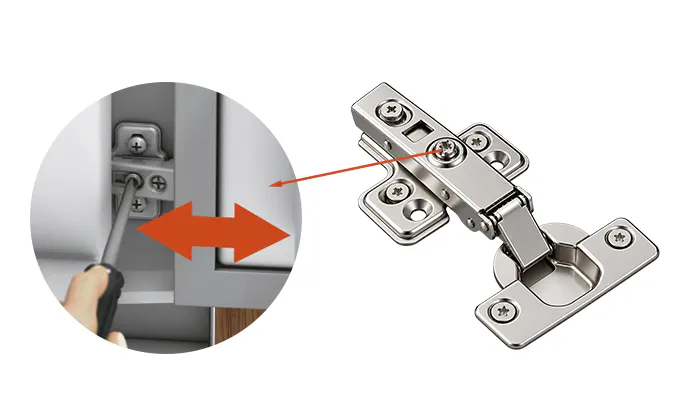
[Left and Right Adjustment – Solving Gap Problems]
This adjustment mainly solves the problem of uneven, excessively wide, or excessively narrow gaps between the cabinet door and the cabinet body.
The objects to be adjusted are: the lateral adjustment screws (usually Phillips screws) on the side or middle of the hinge arm.
Adjustment Direction: Turning clockwise moves the cabinet door towards the hinge, narrowing the gap; turning counter-clockwise moves the cabinet door away from the hinge, widening the gap (the direction may be reversed for some brands; it is recommended to make a slight adjustment of half a turn first).
Handling Special Gaps: If the door gap is wider at the top and narrower at the bottom, or vice versa, both the upper and lower hinges need to be adjusted. For example, if the gap is wider at the top and narrower at the bottom, tighten the left and right adjustment screws of the upper hinge (clockwise) appropriately, while loosening the left and right adjustment screws of the lower hinge (counter-clockwise) appropriately, causing the door to tilt inwards to balance the gap.
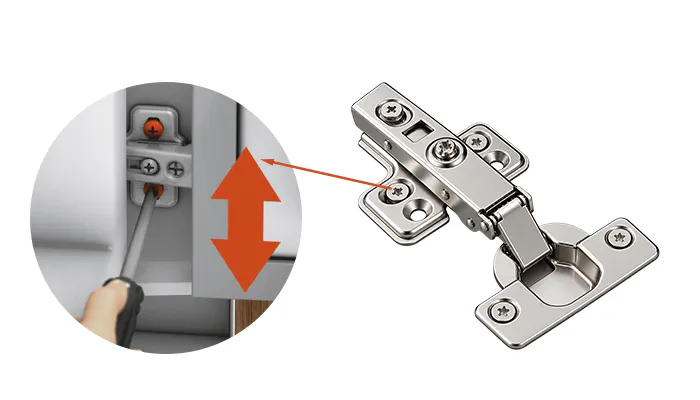
[Up-Down Adjustment – Solving Alignment and Sagging]
This adjustment is used to correct issues such as overall cabinet door sagging, misalignment with adjacent door panels or the top panel of the cabinet, and bottom friction against the ground or door frame.
The target is the hinge base fixing screws fixed to the side panel of the cabinet; their mounting holes are usually elongated.
Operating Instructions: Slightly loosen (do not completely unscrew) the two fixing screws on the base with a screwdriver. At this point, the entire door can move up and down. Support the door with your hand and adjust it to the desired height, ensuring alignment with the surrounding area. Once the position is confirmed, retighten the two fixing screws.
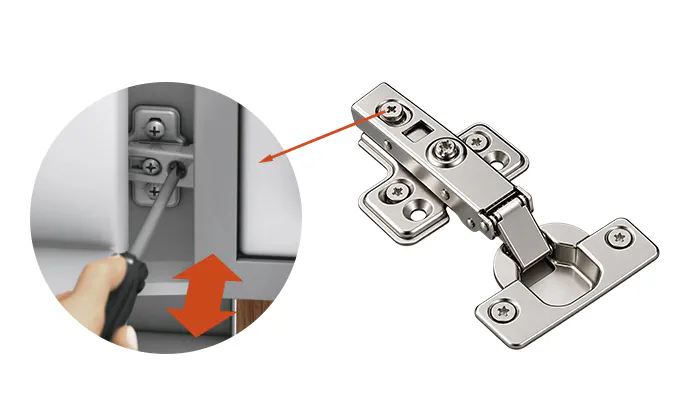
[Front-Back Adjustment – Solving Flatness Issues]
This adjustment is used to solve problems such as unevenness (protrusion or depression) between the door panel and the cabinet surface, incomplete closing, or wobbling when opening and closing.
The object of operation is: the depth adjustment screw (commonly an Allen screw) located at the end of the hinge (closest to the inside of the cabinet).
Operating Instructions: Tightening this screw controls the movement of the door panel inward (closer to the cabinet) or outward (away from the cabinet). Through fine-tuning, the door panel surface is brought to the same plane as the adjacent cabinet or door panel, achieving a flat and snug fit.