
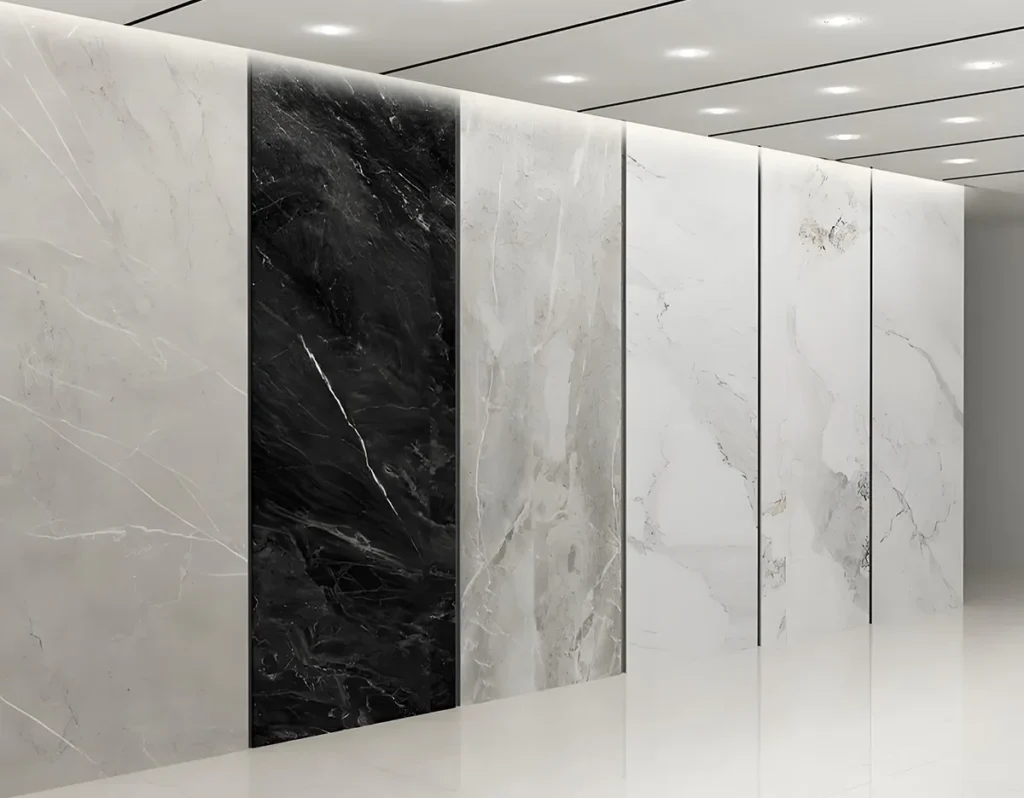
I. Material Composition & Industry Reality
The Truth About “Graphene” Marketing Claims
-
Cost Prohibitions: Industrial-grade, high-purity graphene and graphene nanoplatelets (GNPs) carry extremely high raw-material costs per kilogram.
-
Commercial Viability: Incorporating significant ratios of genuine graphene into a high-volume wall cladding formula would cause production costs to skyrocket, rendering the final product commercially unviable for global building markets.
II. Key Advantages & Performance Characteristics
-
High Environmental Safety Standards: Manufactured from bamboo-wood fibers, carbon powder, and PVC resin compressed under high temperatures, carbon crystal panels feature ultra-low formaldehyde emissions (achieving E0 and ENF ratings). This enables immediate occupancy post-installation, making them an ideal choice for residential developments and healthcare facilities.
-
Fire & Flame Retardancy: Formulated with inorganic mineral fillers, the core substrate is self-extinguishing and emits no toxic fumes upon thermal degradation—achieving Class B1 (or Class A depending on core density) fire safety ratings suitable for public architecture, hospitals, schools, and commercial complexes.
-
Waterproof & Moisture Resistance: The high-density, closed-cell polymer structure exhibits near-zero water absorption, ensuring the panels will not warp, delaminate, or develop mold even under prolonged high humidity or direct water contact. This makes them a reliable solution for basements, kitchens, and tropical climates.
-
Rapid Prefabricated Installation: Featuring engineered interlocking snap-lock systems, these panels can be mounted directly onto raw masonry or stud walls, eliminating plastering, mudding, and sanding. A standard installation crew can cover dozens of square meters daily, reducing total project timelines by over $50\%$ compared to traditional wet construction methods.
-
Impact & Scratch Resistance: The engineered surface layer resists high-impact impacts, surface abrasion, and daily wear. The material is colorfast, dimensionally stable for over a decade, and easily maintained with standard damp-cloth cleaning.
Inquiries regarding carbon crystal wall panel pricing are welcome
Ⅲ. Differences Between Carbon Crystal Panels and Traditional Bamboo WPC Panels
While Carbon Crystal Wall Panels y Traditional Bamboo WPC Wall Panels both belong to the family of polymer composite interior wall cladding, carbon crystal panels represent an upgraded, next-generation iteration. They feature an enhanced extrusion formula and processing technique designed specifically for large-format, high-density applications.
The core differences between the two products lie in four key areas: raw material composition, physical performance, dimensional specifications, and installation capabilities.
| Comparison Dimension | Carbon Crystal Panels (Next-Gen) | Standard Bamboo WPC Panels |
| Substrate Composition & Color |
Charcoal Black / Dark Gray PVC resin + Bamboo charcoal / Micro-carbon powder + Calcium carbonate ($\text{CaCO}_3$) |
Cream Yellow / Light Tan PVC resin + Bamboo / Wood flour + Calcium carbonate ($\text{CaCO}_3$) |
| Density & Flexural Toughness |
Ultra-High Density ($0.9–1.2\text{ g/cm}^3$) Exceptional structural rigidity, high toughness, and superior impact resistance |
Medium Density ($0.7–0.8\text{ g/cm}^3$) Softer internal core; prone to brittleness if excessive calcium carbonate is added |
| Standard Dimensions |
Large-Format Sheets Width: $1220\text{ mm}$; Length: Custom $2800–3000\text{ mm}$ (Floor-to-Ceiling) |
Narrow/Medium Profiles Standard widths: $300\text{ mm}$, $400\text{ mm}$, o $600\text{ mm}$ |
| $90^\circ$ V-Groove Corner Bending |
Supports direct $90^\circ$ cold-folding after rear V-grooving Enables seamless wrapping around inside/outside corners and structural columns |
Cannot be bent directly (prone to cracking) Corners require separate aluminum alloy or PVC corner trim profiles |
| Surface Flatness & Warp Resistance |
Superior Flatness High dimensional stability with minimal thermal expansion/contraction; resists bowing in large formats |
Wide Boards Prone to Slight Bowing Wide profiles (e.g., $1220\text{ mm}$) can experience minor bowing under significant ambient temperature shifts |
| Surface Finish & Aesthetics |
PET Crystal Film / High-Definition PUR Encapsulation Specializes in high-gloss book-matched marble, brushed metallics, and tactile soft-touch finishes |
Standard PVC Thermal Laminate Film Specializes in conventional wood grains, stone textures, and fabric weaves |