
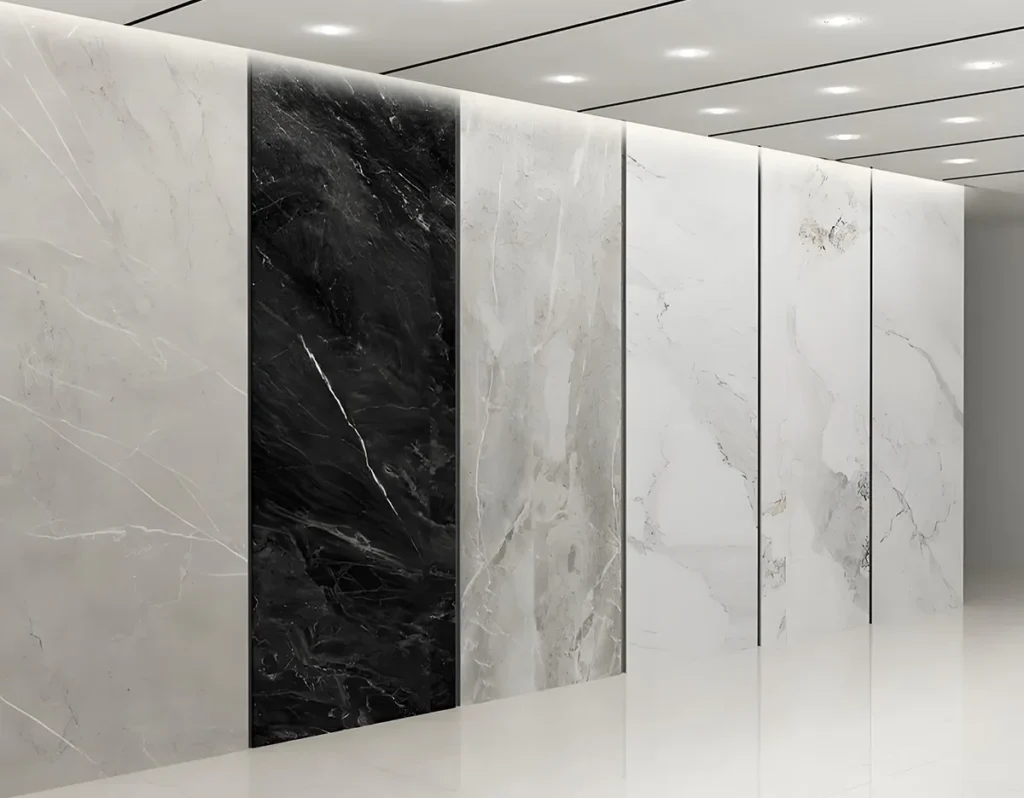
I. Material Composition & Industry Reality
The Truth About “Graphene” Marketing Claims
-
Cost Prohibitions: Industrial-grade, high-purity graphene and graphene nanoplatelets (GNPs) carry extremely high raw-material costs per kilogram.
-
Commercial Viability: Incorporating significant ratios of genuine graphene into a high-volume wall cladding formula would cause production costs to skyrocket, rendering the final product commercially unviable for global building markets.
II. Key Advantages & Performance Characteristics
-
High Environmental Safety Standards: Manufactured from bamboo-wood fibers, carbon powder, and PVC resin compressed under high temperatures, carbon crystal panels feature ultra-low formaldehyde emissions (achieving E0 and ENF ratings). This enables immediate occupancy post-installation, making them an ideal choice for residential developments and healthcare facilities.
-
Fire & Flame Retardancy: Formulated with inorganic mineral fillers, the core substrate is self-extinguishing and emits no toxic fumes upon thermal degradation—achieving Class B1 (or Class A depending on core density) fire safety ratings suitable for public architecture, hospitals, schools, and commercial complexes.
-
Waterproof & Moisture Resistance: The high-density, closed-cell polymer structure exhibits near-zero water absorption, ensuring the panels will not warp, delaminate, or develop mold even under prolonged high humidity or direct water contact. This makes them a reliable solution for basements, kitchens, and tropical climates.
-
Rapid Prefabricated Installation: Featuring engineered interlocking snap-lock systems, these panels can be mounted directly onto raw masonry or stud walls, eliminating plastering, mudding, and sanding. A standard installation crew can cover dozens of square meters daily, reducing total project timelines by over $50\%$ compared to traditional wet construction methods.
-
Impact & Scratch Resistance: The engineered surface layer resists high-impact impacts, surface abrasion, and daily wear. The material is colorfast, dimensionally stable for over a decade, and easily maintained with standard damp-cloth cleaning.
Inquiries regarding carbon crystal wall panel pricing are welcome
Ⅲ. Differences Between Carbon Crystal Panels and Traditional Bamboo WPC Panels
While Carbon Crystal Wall Panels and Traditional Bamboo WPC Wall Panels both belong to the family of polymer composite interior wall cladding, carbon crystal panels represent an upgraded, next-generation iteration. They feature an enhanced extrusion formula and processing technique designed specifically for large-format, high-density applications.
The core differences between the two products lie in four key areas: raw material composition, physical performance, dimensional specifications, and installation capabilities.
| Comparison Dimension | Carbon Crystal Panels (Next-Gen) | Standard Bamboo WPC Panels |
| Substrate Composition & Color |
Charcoal Black / Dark Gray PVC resin + Bamboo charcoal / Micro-carbon powder + Calcium carbonate ($\text{CaCO}_3$) |
Cream Yellow / Light Tan PVC resin + Bamboo / Wood flour + Calcium carbonate ($\text{CaCO}_3$) |
| Density & Flexural Toughness |
Ultra-High Density ($0.9–1.2\text{ g/cm}^3$) Exceptional structural rigidity, high toughness, and superior impact resistance |
Medium Density ($0.7–0.8\text{ g/cm}^3$) Softer internal core; prone to brittleness if excessive calcium carbonate is added |
| Standard Dimensions |
Large-Format Sheets Width: $1220\text{ mm}$; Length: Custom $2800–3000\text{ mm}$ (Floor-to-Ceiling) |
Narrow/Medium Profiles Standard widths: $300\text{ mm}$, $400\text{ mm}$, or $600\text{ mm}$ |
| $90^\circ$ V-Groove Corner Bending |
Supports direct $90^\circ$ cold-folding after rear V-grooving Enables seamless wrapping around inside/outside corners and structural columns |
Cannot be bent directly (prone to cracking) Corners require separate aluminum alloy or PVC corner trim profiles |
| Surface Flatness & Warp Resistance |
Superior Flatness High dimensional stability with minimal thermal expansion/contraction; resists bowing in large formats |
Wide Boards Prone to Slight Bowing Wide profiles (e.g., $1220\text{ mm}$) can experience minor bowing under significant ambient temperature shifts |
| Surface Finish & Aesthetics |
PET Crystal Film / High-Definition PUR Encapsulation Specializes in high-gloss book-matched marble, brushed metallics, and tactile soft-touch finishes |
Standard PVC Thermal Laminate Film Specializes in conventional wood grains, stone textures, and fabric weaves |